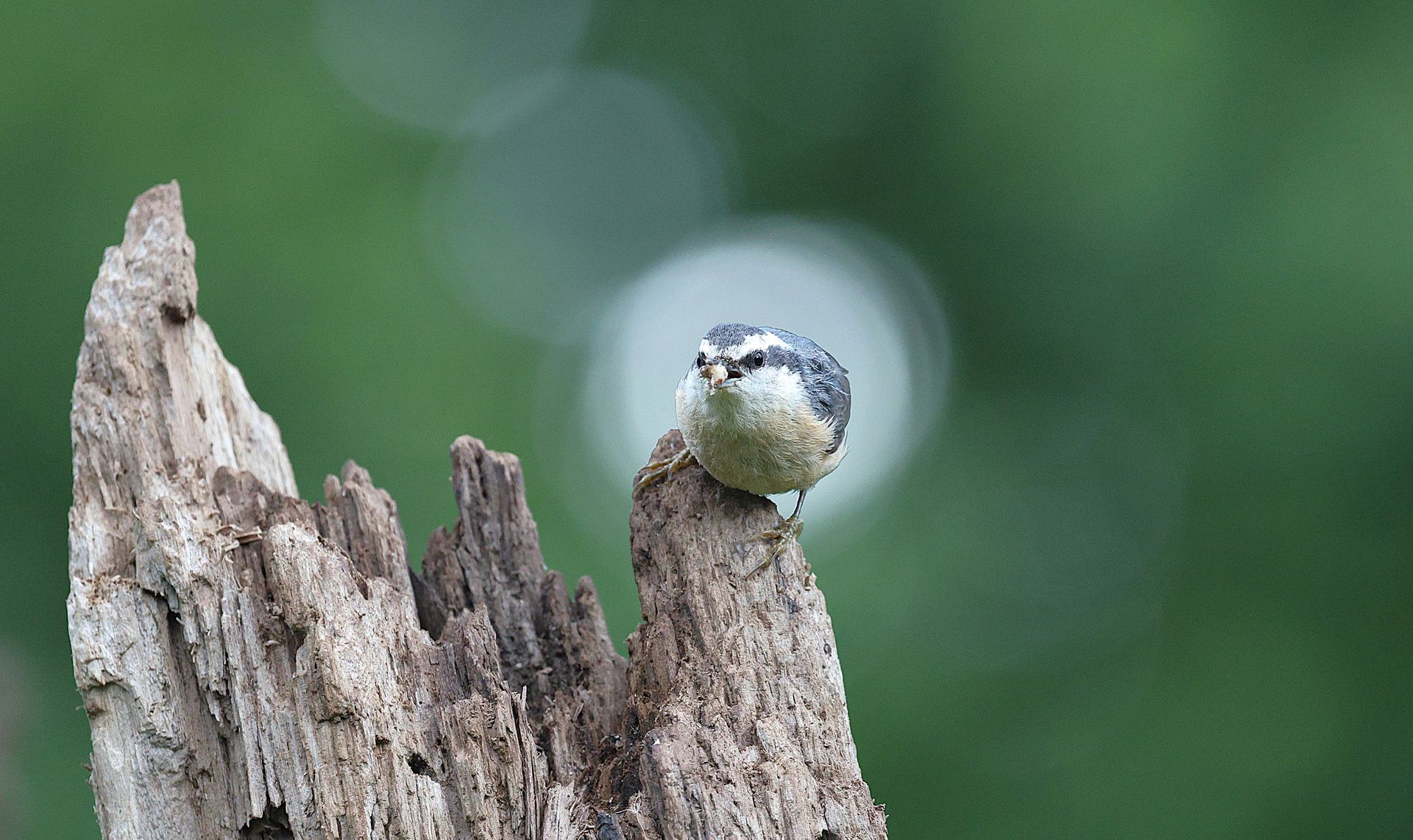
The Red Breasted Nuthatch is a fascinating bird species that can be found in North America. They are known for their distinctive red face and white cheeks.
These birds are primarily found in coniferous forests, where they can be seen flitting between trees in search of insects and seeds.
The Red Breasted Nuthatch is a medium-sized bird, measuring around 13-15 centimeters in length.
Physical Characteristics
Red-breasted nuthatches are small birds, measuring about 11.5 cm long and weighing around 10 grams.
They have compact bodies and short tails and necks, which allow them to move easily through dense vegetation.
Their bills are long and tapered, perfect for extracting insects and seeds from tree bark.
Red-breasted nuthatches have sturdy toes and claws that enable them to climb down trees headfirst or hang upside down from branches.
The male and female red-breasted nuthatches look alike, but the female has a bluish black cap and paler underparts.
Juveniles are similar to adults, but their head markings and underparts are duller in color.
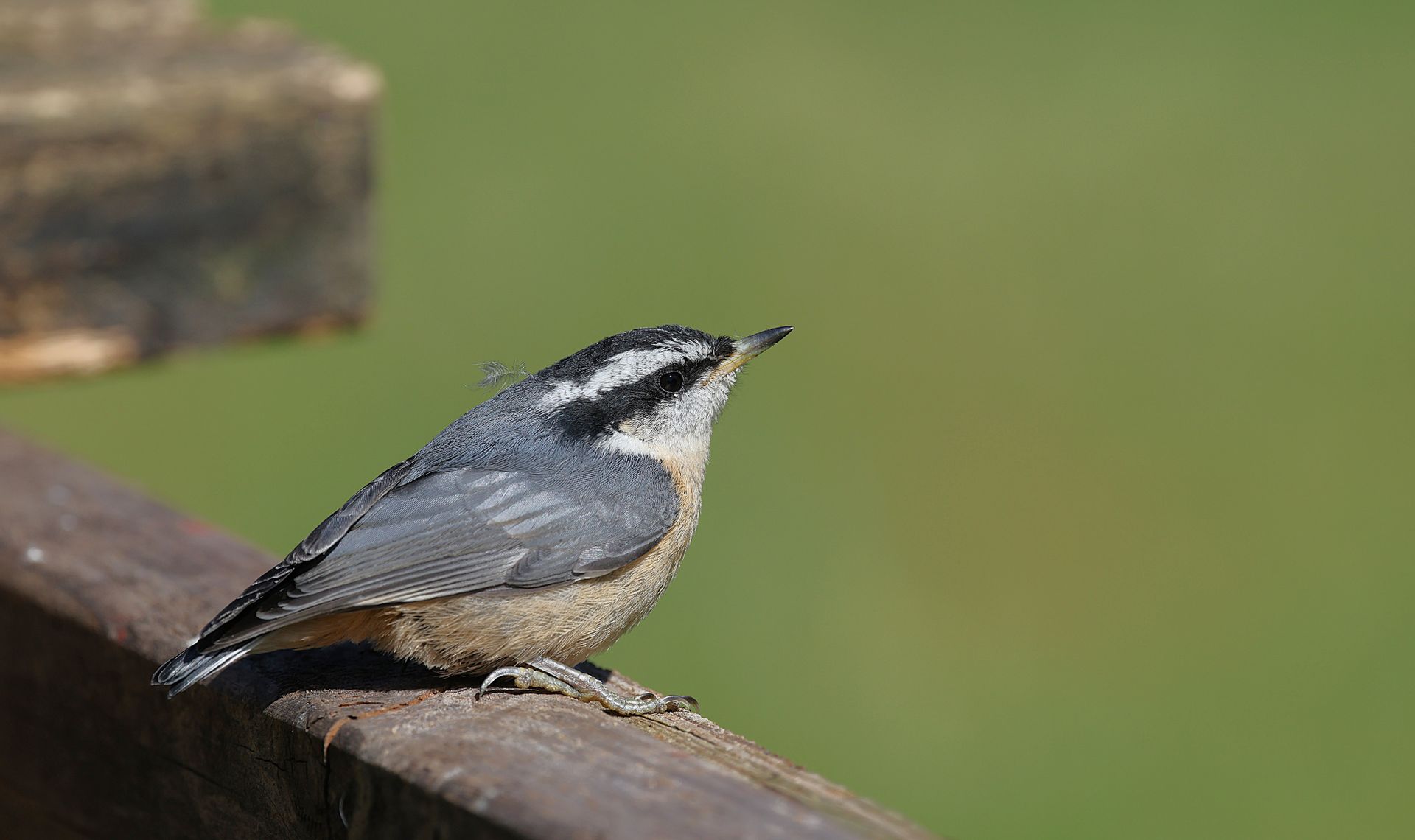
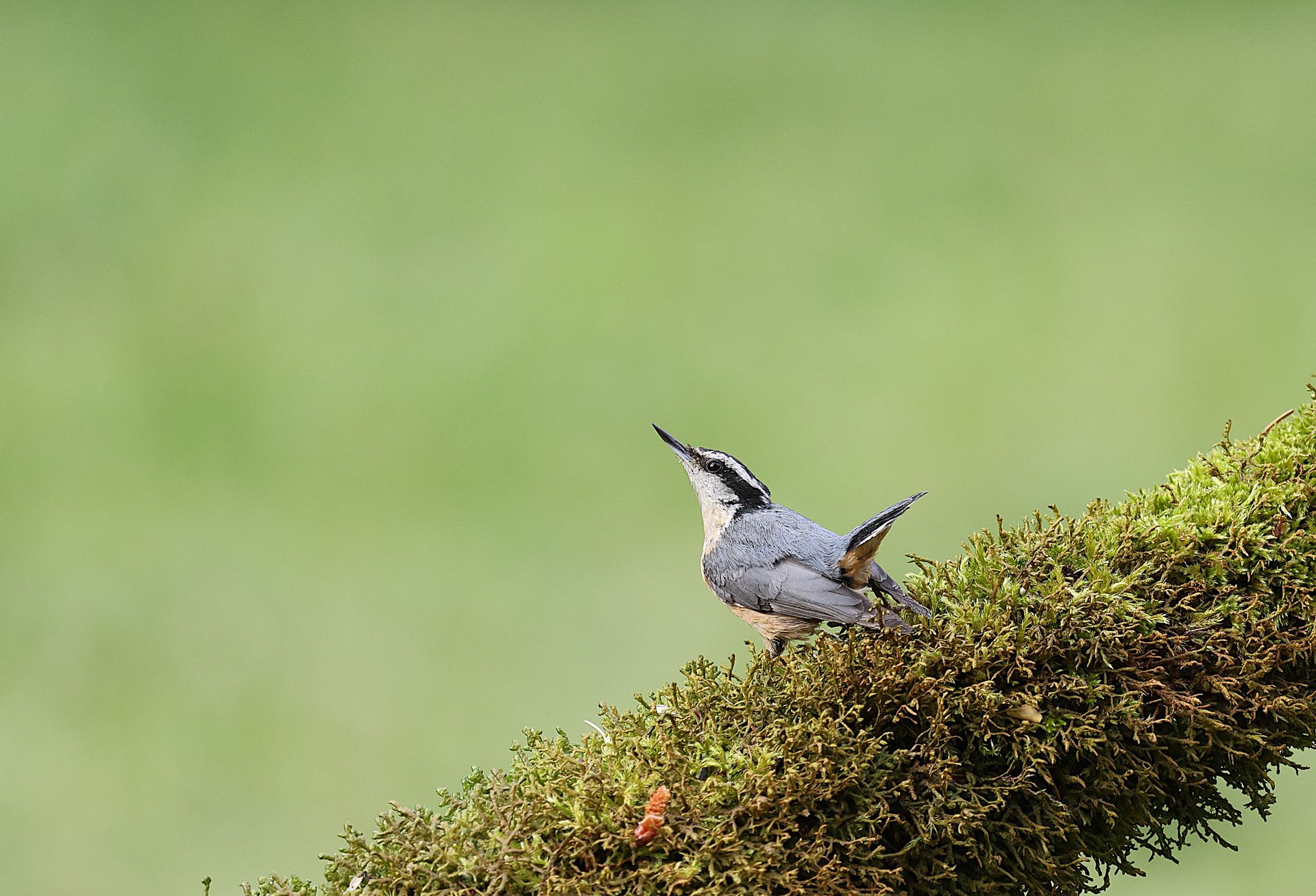
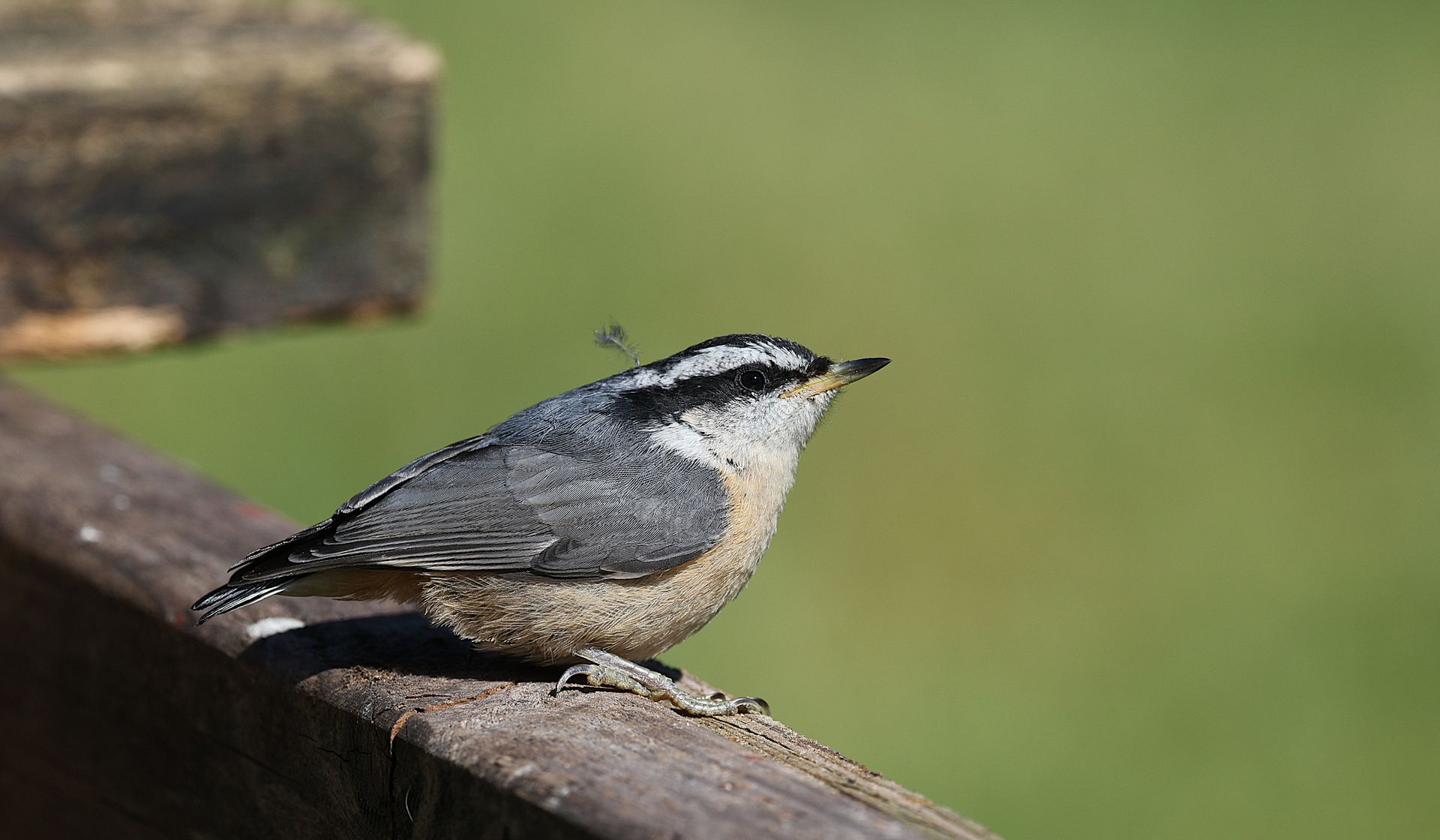
Red-breasted nuthatches have distinctive markings, including a broad black stripe over their eye and a white stripe above it.
Their heads also feature a black cap, while their backs are a bluish gray color and their undersides are rusty colored.
They have white on their chins, cheeks, and sides of their neck, and their tails have white bands and dark tips on the outer feathers.
Their wings are long and pointed, with ten primary feathers.
Behavior and Communication
Red-breasted nuthatches use a combination of physical displays and vocalizations to communicate. They make a distinctive nasal "yank-yank" call that sounds like a small tin horn, which is the most common call you'll hear from these birds.
Male and female red-breasted nuthatches have a range of calls, but the nasal "yank-yank" call is the one you're most likely to recognize.
Red-breasted nuthatches are incredibly agile, and they're able to climb down tree trunks headfirst in search of food. This unique ability allows them to find tasty treats that other birds might miss.
Here are some key behaviors associated with red-breasted nuthatches:
- arboreal
- scansorial
- flies
- diurnal
- motile
- migratory
- territorial
During the breeding season, red-breasted nuthatches are fiercely territorial, and pairs will often defend their food territories together. In the winter, they may join large flocks of mixed species, but they'll still be on the lookout for potential threats.
What's Their Behavior?
Red-breasted nuthatches are quite unique in their ability to climb down tree trunks headfirst, allowing them to find food that other birds miss.
They're also extremely territorial during the breeding season, with pairs remaining together throughout the winter to defend their food territories if resources are plentiful.
Male red-breasted nuthatches have a distinct threat display, which is similar to their courtship displays. They drop their wings, hold their tail upright, and raise the feathers on the crest of their head to deter others.
In the winter, these birds may join large flocks of mixed species, but if food is scarce in the north, they'll migrate southward for the season, a phenomenon known as an irruption.
Here are some key behaviors exhibited by red-breasted nuthatches:
- Arboreal: They spend most of their time in trees.
- Scansorial: They're expert climbers and can climb down tree trunks headfirst.
- Flying: They're capable of flight, but it's not their primary mode of transportation.
- Diurnal: They're active during the day.
- Motile: They're able to move around and change their location.
- Migratory: They may migrate southward if food is scarce in the north.
- Territorial: They're extremely protective of their food territories, especially during the breeding season.
What Is Their Communication Method?
Red-breasted nuthatches use a variety of methods to communicate with each other.
They rely on physical displays to convey information, as well as vocalizations, which are a crucial part of their communication.
Their most common call is a nasal "yank-yank" sound, reminiscent of a small tin horn.
Both males and females have a range of calls, but the "yank-yank" call is the most frequently heard.
These softer calls are less common, but still an important part of their communication.
Habitat and Distribution
The red-breasted nuthatch is primarily a full-time resident of northern and subalpine conifer forests. They're well adapted to these environments, but their migratory habits are quite fascinating.
They regularly migrate irruptively, meaning the number of birds migrating and their wintering locations can vary greatly from year to year. This unpredictability makes it exciting for bird enthusiasts to track their movements.
In the eastern United States, their range is expanding southwards, which is a notable change in their distribution over time. This expansion is likely due to various environmental factors, such as changes in food availability or habitat quality.
Red-breasted nuthatches are rare winter visitors to Nuevo León, Baja California Norte, and south along the Pacific slope as far as Sinaloa in northern Mexico.
Diet and Predation
Red-breasted nuthatches have a variety of predators that feed on them. Sharp-shinned hawks, Cooper's hawks, and merlins are just a few examples of birds that prey on adult red-breasted nuthatches.
To defend themselves, red-breasted nuthatches use pine pitch to surround the entrance to their nest. This natural protection helps keep predators at bay.
Red-breasted nuthatches also join other small birds in mobbing potential predators, such as hawks and jays, to deter them from their nest.
What Do They Eat?
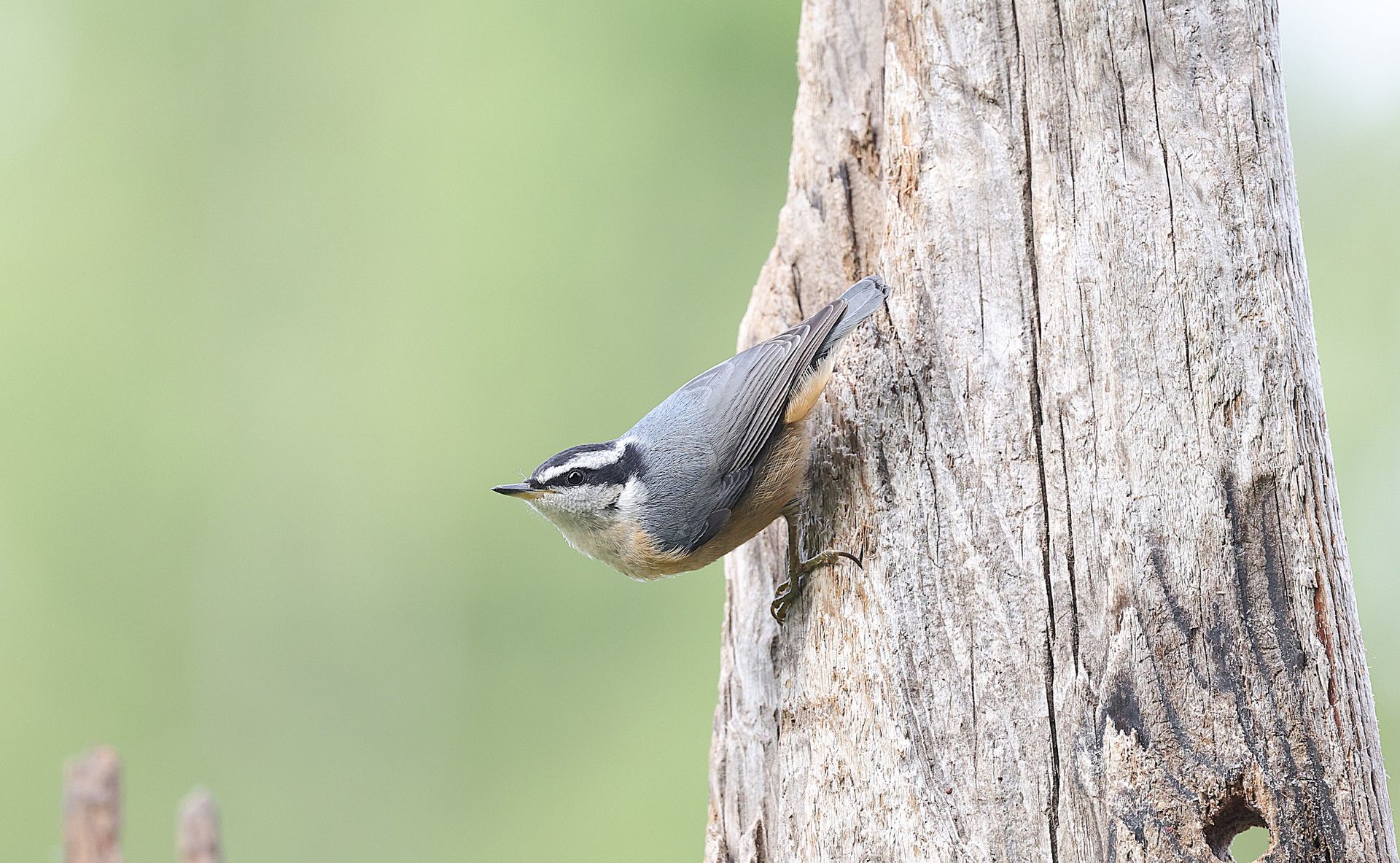
Red-breasted nuthatches primarily eat conifer seeds and insects, with a shift in diet between seasons. During the breeding season, they focus on arthropods like beetles, wasps, caterpillars, crane flies, moths, and insect eggs.
They break food apart by wedging it into bark crevices and breaking smaller pieces off, or by prying seeds open with their strong beaks.
Nuthatches are bark-gleaning birds, spending most of their time on tree trunks searching for food. They also search for food on branches, stumps, and the ground.
They store food during the fall and winter, hiding it under bark, in holes in tree trunks, and sometimes on the ground.
What Eats Them and How They Avoid Predation
Red-breasted nuthatches have a number of predators that feed on them, including sharp-shinned hawks, Cooper's hawks, merlins, northern pygmy-owls, spotted owls, red squirrels, and weasels.
They are also preyed upon by other bird species, such as Steller's jays, housewrens, and gray-necked chipmunks.
Weasels and mice are known to feed on their eggs and nestlings.
To defend their nest, red-breasted nuthatches surround the entrance with pine pitch.
They also join other small birds in mobbing potential predators, such as hawks and jays.
When a nest is threatened, the female may jump out of her nest cavity and perform an anti-predator display.
She spreads her wings and sways slowly back and forth to distract the predator from the nest.
Conservation and Status
The red-breasted nuthatch is rated as a species of Least Concern by the International Union for Conservation of Nature due to its large global range and increasing population. It's protected by the Migratory Bird Treaty Act of 1918 in the Americas.
Nuthatches depend on habitat with dead trees and a variety of tree species, which is often threatened by logging that removes dead trees or leaves only a few species of trees. This hurts nuthatch populations, as seen in declining local populations in some areas.
Despite the challenges, red-breasted nuthatch populations are increasing overall. The species' reliance on coniferous forests and its habit of caching seeds in tree crevices for later use also suggests a certain level of adaptability.
Conservation Status & Threats
The red-breasted nuthatch is listed as a species of Least Concern by the International Union for Conservation of Nature, thanks to its large global range and increasing population.
This conservation status is a result of its widespread distribution and growing numbers, but it's essential to note that local populations are declining in some areas.
The Migratory Bird Treaty Act of 1918 protects red-breasted nuthatches in the Americas, providing an added layer of protection for these birds.
Habitat loss and fragmentation are significant threats to red-breasted nuthatch populations, particularly when logging removes dead trees or leaves only a few species of trees.
Here's a summary of the red-breasted nuthatch's conservation status and threats:
- IUCN Red List: Least Concern
- US Migratory Bird Act: Protected
- US Federal List: No special status
- CITES: No special status
- State of Michigan List: No special status
Conservation Actions
The Red-breasted Nuthatch is an irruptive species, meaning its population numbers fluctuate greatly from year to year due to variations in conifer seed crops in Canada.
In years with abundant cones and seeds, fewer nuthatches need to migrate south, but in years with scarce food, they'll travel until they find a reliable source. This leads to significant variations in population numbers, making them a challenging species to track.
If you're lucky enough to have a bird feeder, you've probably noticed that nuthatches love seeds, and they'll often cache them in tree crevices for later use. This behavior is especially notable in years with poor seed crops.
Red-breasted Nuthatches are known to dig their own nest holes if the wood is soft enough, but they'll also take over existing cavities if available. Males may even start multiple holes in hopes of attracting a mate.
Nuthatches often coat the rim of their nest hole with pitch to deter predators, sometimes using a piece of bark as a makeshift trowel. This clever behavior is just one of the many fascinating adaptations of these remarkable birds.
For more insights, see: Red Heeler Behavior Problems
Life Cycle and Longevity
The red-breasted nuthatch's lifespan is quite impressive, with the oldest known individual living for at least 7 years and 6 months.
In the wild, these birds can live up to 7.5 years, although their average lifespan is around 90 months. This is a remarkable feat, considering the challenges they face in their natural habitat.
The lifespan of a red-breasted nuthatch is around 6 years, according to one source. This suggests that they have a relatively long lifespan compared to some other bird species.
Here's a summary of their lifespan in the wild:
- Range lifespan: 7.5 years (high)
- Average lifespan: 90 months
How Long Do They Live?
Red-breasted nuthatches can live a relatively long life, especially in the wild. The oldest known individual lived for at least 7 years and 6 months.
Their lifespan varies depending on their status. In the wild, their range lifespan is estimated to be around 7.5 years, which is quite impressive. This is based on data from the USGS Patuxent Wildlife Research Center.
On average, a wild red-breasted nuthatch can live for about 90 months, according to the Bird Banding Laboratory.
Breeding
Red-breasted nuthatches are monogamous birds, with the male performing a peculiar courtship display to win over the female. This display involves lifting his head and tail, turning his back to her, drooping his wings, and swaying from side to side.
The pair works together to excavate their own cavity nest, which can be as high as 37 meters above ground. Excavation takes anywhere from one to eight weeks, with both sexes contributing to the process.
The nest is typically lined with grass, moss, shredded bark, and rootlets, and the pair smears sap around the entrance hole to deter predators. Nest building is a collaborative effort, with the female playing a more significant role.
Red-breasted nuthatches lay between 2 and 8 eggs, usually 5-6, which are white or creamy with reddish-brown speckles. The eggs measure 0.6-0.7 inches long by 0.4-0.5 inches wide.
The female incubates the eggs for 12-13 days, while the young are altricial and stay in the nest for 2-3 weeks. During this time, the female broods the young, and both parents feed them.
Here's a breakdown of the breeding process:
- Monogamous pairs
- Cavity nest excavation (1-8 weeks)
- Nest lining (grass, moss, shredded bark, rootlets)
- Egg laying (2-8 eggs, usually 5-6)
- Incubation (12-13 days)
- Young stay in nest for 2-3 weeks
Taxonomy and Classification
The red-breasted nuthatch is assigned to the genus Sitta, a name derived from the Ancient Greek word for the Eurasian nuthatch.
This genus includes the red-breasted nuthatch and other nuthatch species, all of which share similar characteristics and habits.
The specific epithet canadensis is Neo-Latin for "belonging to Canada", reflecting the bird's origins in North America.
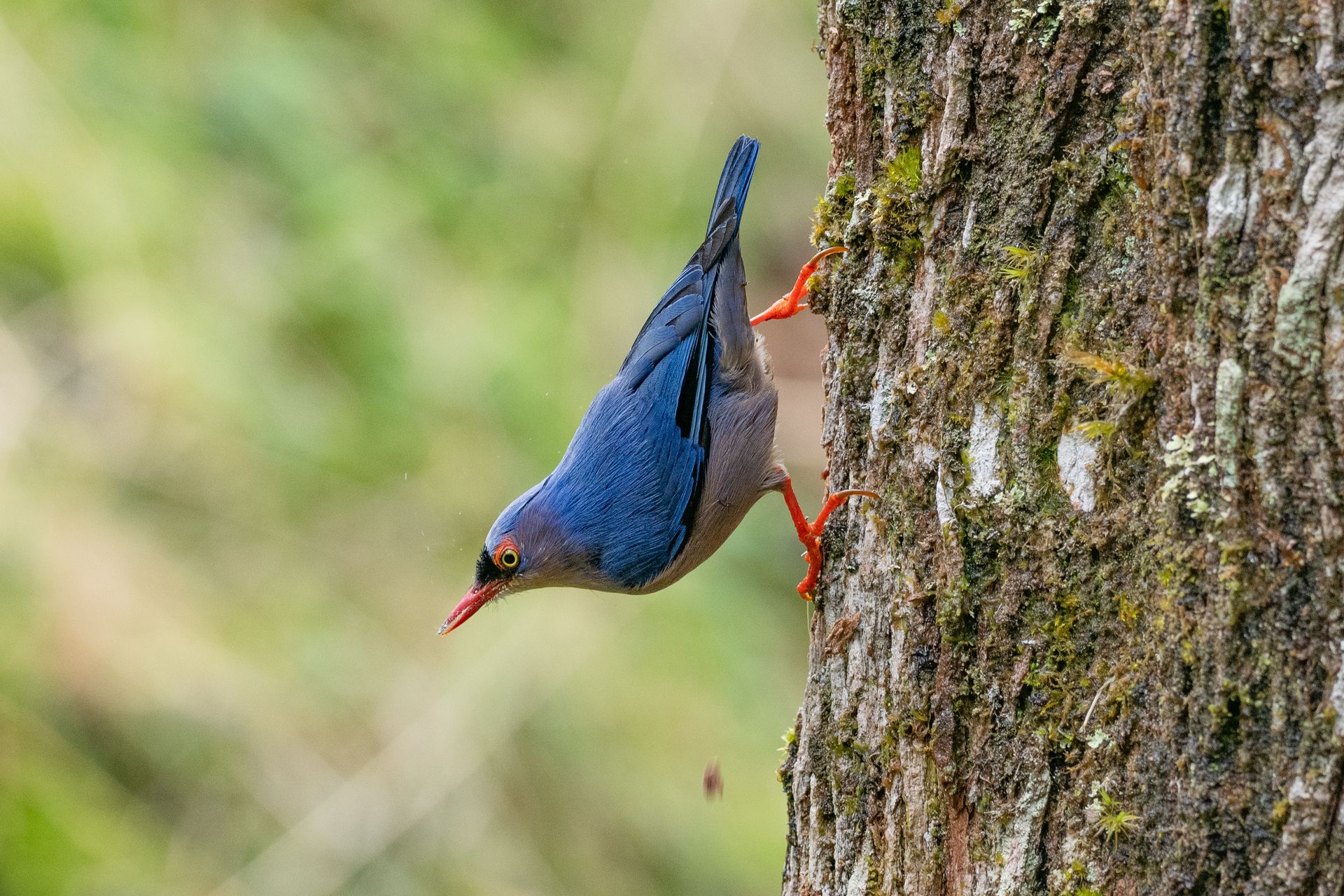
In the past, the red-breasted nuthatch was thought to be part of a single species with four other nuthatch species.
These five species make up a well-defined species group known as the "Sitta canadensis group", and are sometimes considered to be a superspecies.
The red-breasted nuthatch is part of a clade that includes the Corsican nuthatch and the Chinese nuthatch, and is closely related to the Algerian nuthatch and Krüper's nuthatch.
The red-breasted nuthatch is monotypic across its extensive range, meaning it does not have any close relatives within its range.
Photos and Videos
The Red-breasted Nuthatch is a frequent visitor at seed and suet feeders, so having a camera nearby can be a great way to capture its behavior.
This bird is quite compact with a short tail, making it easy to spot in the trees.
You might notice its distinctive blue-gray feathers on top, sharply marked with black and white on its face.
A stout, no-necked bird with a long, sharply pointed bill is what you'll see when looking closely.
Typically, these birds make short flights between trees, so be prepared to snap a photo quickly.
One way to get a great shot is to watch for the bird moving up, down, and around tree trunks and branches, pulling out insects from bark or seeds from cones.
If you're lucky, you might even catch a glimpse of its zigzag pattern as it heads downward.
Seasonal Abundance
The red-breasted nuthatch is a bird that's active year-round, but its abundance varies with the seasons. Numbers indicate likelihood of finding this species in suitable habitat at a given time of year, not actual numbers encountered.
In the spring, red-breasted nuthatches are more likely to be found in coniferous forests, where they're busy searching for insects and seeds to feed their young. They're a common sight in these areas during this time.
Their abundance peaks in the summer months, as they take advantage of the lush foliage and abundant food sources. This is the best time to spot them in their natural habitat.
In the fall, red-breasted nuthatches begin to migrate to areas with more abundant food sources, such as oak and beech trees. They're still relatively common in these areas, but their numbers are decreasing.
In the winter, red-breasted nuthatches are less abundant, but can still be found in areas with coniferous trees and abundant seed sources. They're more likely to be seen in these areas during this time.
Featured Images: pexels.com