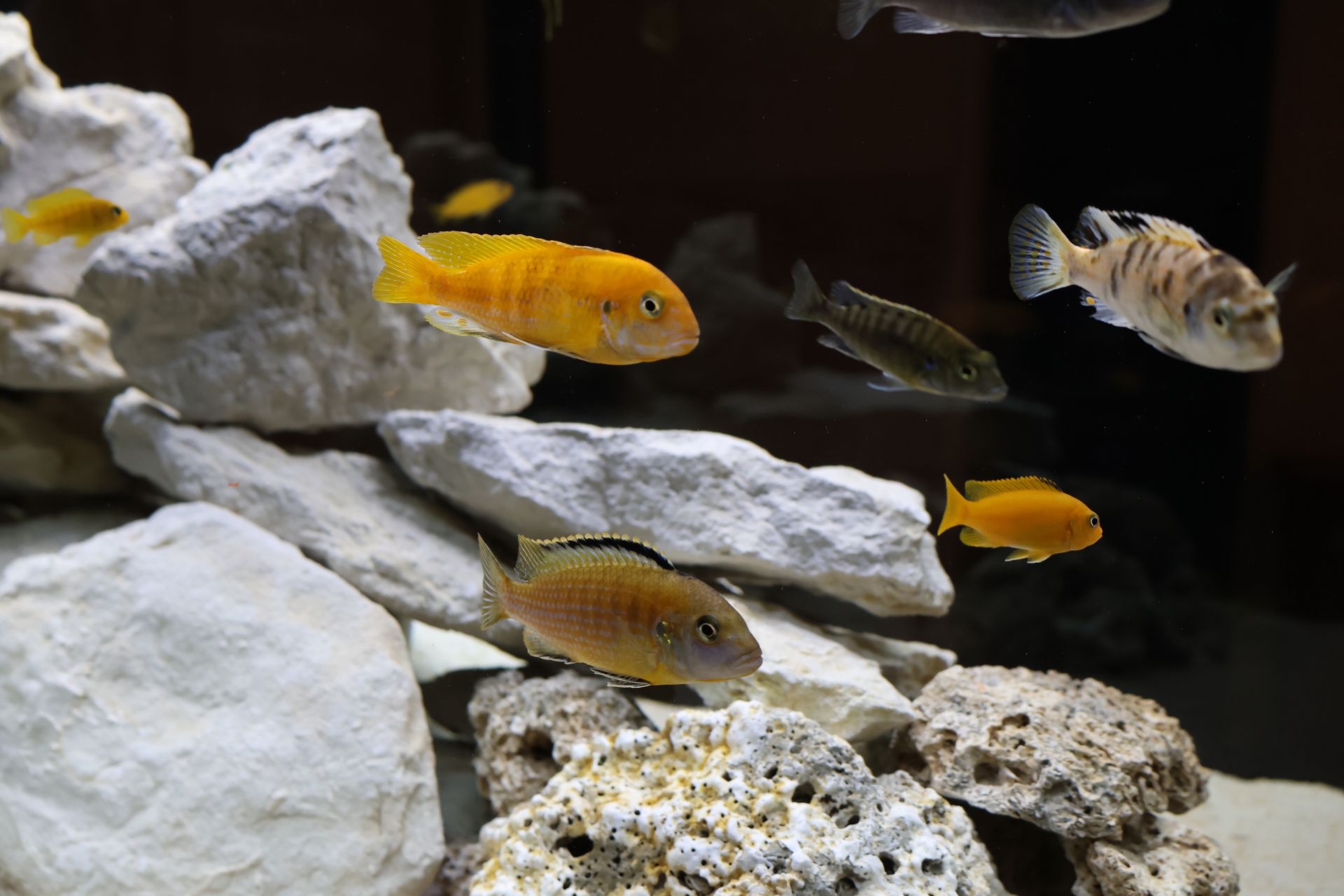
Pseudotropheus fish are a popular choice for aquarium enthusiasts, and for good reason. They're relatively small, reaching a maximum length of about 3-4 inches.
These fish are native to the rocky shores and sandy areas of Lake Malawi in Africa. They're part of the cichlid family and are known for their vibrant colors and intricate patterns.
In the wild, Pseudotropheus fish are found in areas with plenty of hiding places, such as rocks and weeds. This is because they're naturally wary of predators and need a safe place to hide.
Pseudotropheus fish are omnivores, which means they eat both plants and animals. In the wild, they feed on small insects, crustaceans, and plankton.
Classification
Classification of Pseudotropheus is a complex and evolving field. Pseudotropheus is a large cichlid genus with 25 recognized species.
Some species, such as Pseudotropheus ater and Pseudotropheus cyaneus, were described as early as 1988. Others, like Pseudotropheus demasoni, were described later, in 1994.
Several species have been moved to different genera, including Tropheops and Maylandia. This reclassification is an ongoing process.
Here is a list of some of the recognized species in the Pseudotropheus genus:
- Pseudotropheus ater
- Pseudotropheus benetos
- Pseudotropheus brevis
- Pseudotropheus crabro
- Pseudotropheus cyaneorhabdos
- Pseudotropheus cyaneus
- Pseudotropheus demasoni
- Pseudotropheus elegans
- Pseudotropheus elongatus
- Pseudotropheus flavus
- Pseudotropheus fuscoides
- Pseudotropheus fuscus
- Pseudotropheus galanos
- Pseudotropheus interruptus
- Pseudotropheus joanjohnsonae
- Pseudotropheus johannii
- Pseudotropheus likomae
- Pseudotropheus longior
- Pseudotropheus minutus
- Pseudotropheus perileucos
- Pseudotropheus perspicax
- Pseudotropheus purpuratus
- Pseudotropheus saulosi
- Pseudotropheus socolofi
- Pseudotropheus tursiops
- Pseudotropheus williamsi
Some of these species, such as Pseudotropheus interruptus and Pseudotropheus joanjohnsonae, were described as early as the 1970s.
Introduction
Pseudotropheus is a large and diverse genus of cichlids found in Lake Malawi, a lake in eastern Africa that's shared by three countries: Malawi, Mozambique, and Tanzania.
Lake Malawi is home to a vast array of cichlid species, with many different ecological niches available for them to inhabit.
The Pseudotropheus species belong to the Mbuna group, which is characterized by smaller size and striking colors in both males and females.
In the wild, most Pseudotropheus species feed on algae, and it's recommended to provide similar food types in aquariums.
Pseudotropheus cichlids need a rocky setup in the aquarium to feel at home, with plenty of hiding places among the rocks to relieve stress.
Lake Malawi is a relatively young lake, formed around 40,000 years ago, and its unique environment has given rise to the diverse fauna we see today.
The cichlids in Lake Malawi are divided into two groups: Haplochromine cichlids and Mbuna cichlids, with Pseudotropheus species falling into the Mbuna category.
Biology and Care
The Pseudotropheus genus is known for its unique lifestyle, living mostly in rocky areas of Lake Malawi. These cichlids are algal grazers in the wild, which means they spend their days munching on algae that grows on the rocks.
In their natural habitat, Pseudotropheus reproduce via maternal mouthbrooding, where the female fish incubates her eggs in her mouth without eating for 2-4 weeks. This behavior is a fascinating example of the adaptability of these fish.
To keep Pseudotropheus in an aquarium, it's essential to provide a large tank with ample rock coverage for hiding and providing havens from aggression. A high population of fish is also recommended to distribute the aggression.
Biology
Mbuna cichlids, like those in the Pseudotropheus genus, are rock dwellers that mostly live in rocky areas. They're algal grazers in the wild, which means they feed on algae growing on rocks.
Most Pseudotropheus species reproduce via maternal mouthbrooding, where the female fish incubates her eggs in her mouth without eating for 2-4 weeks. This is a unique and fascinating way that these fish care for their young.
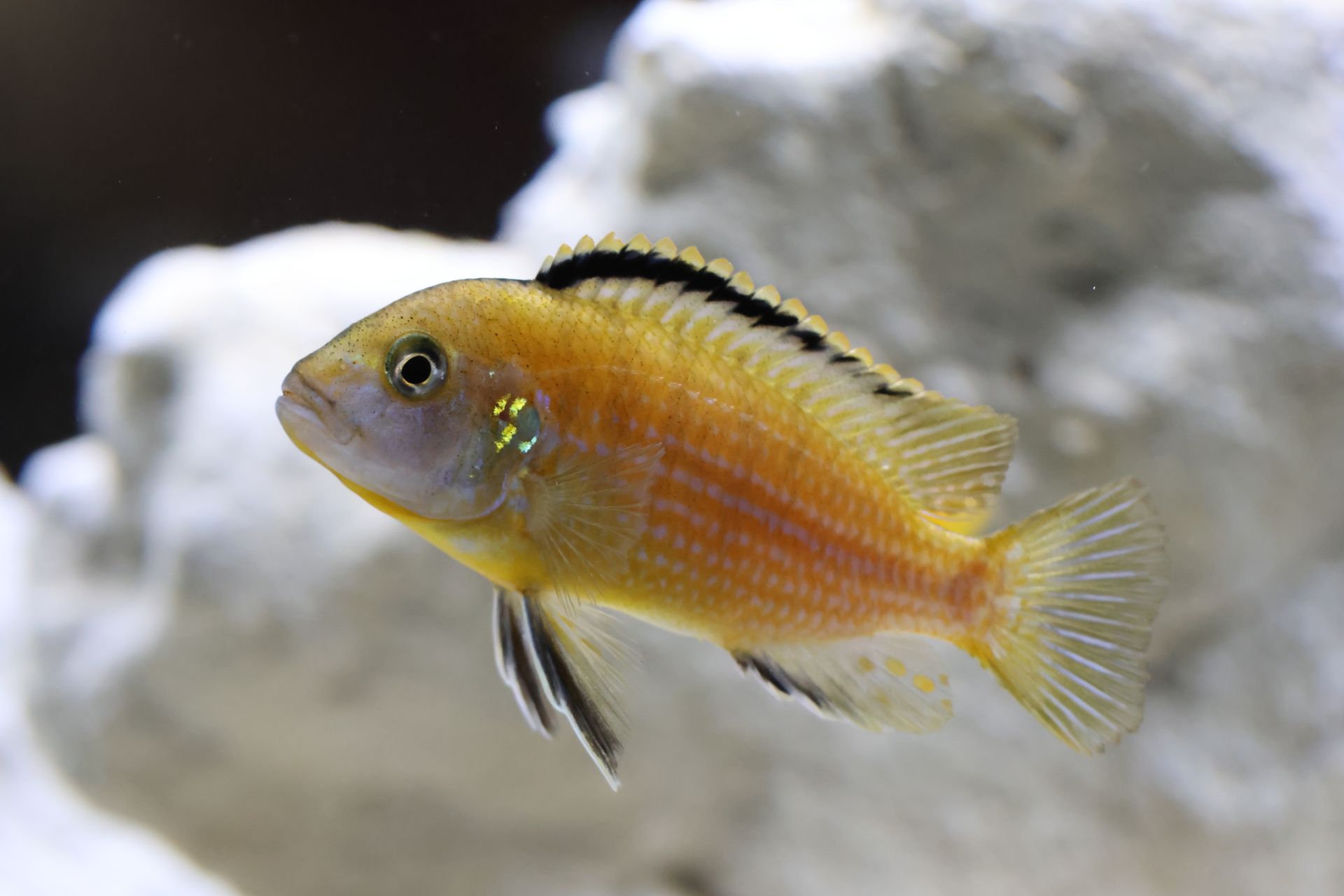
Males of the Pseudotropheus genus often have egg spots on their anal fins, which attract spawn-ready females. The males will then attempt to retrieve the imitation eggs while the male emits sperm into her biting mouth, thus fertilizing the eggs.
The female and male generally move in an intensive circular motion while they spawn. This behavior is a key part of the reproductive process for these fish.
Here's a list of some of the most popular Pseudotropheus species:
- Pseudotropheus Aggressive Blue
- Pseudotropheus Aggressive Gray Head
- Pseudotropheus Aggressive Yellow Head
- Pseudotropheus Acei
- Pseudotropheus Aurora
- Pseudotropheus Black Dorsal
- Pseudotropheus Callainos
- Pseudotropheus Crabro
- Pseudotropheus Daktari
- Pseudotropheus Demasoni
It's worth noting that most, possibly all species of Pseudotropheus will breed together if given the right environment. This makes them a great choice for aquarists who want to create a diverse and thriving community tank.
Size
When it comes to the size of our subject, it's worth noting that males can grow up to about 10 centimetres.
Males reach this size, which is a pretty impressive length for such a small creature.
Females, on the other hand, remain slightly smaller than their male counterparts.
This slight size difference between the sexes is something to keep in mind when caring for your subject.
Physical Characteristics
Pseudotropheus are quite striking when it comes to their color and markings.
Females and young animals are a beautiful orange-yellow hue, with subtle dark longitudinal bands on their bodies. The first rays of the pelvic fins and the outer rim of the anal fin are a lovely white.
Males, on the other hand, are a deep blue-black color. They have two bright blue cross bands on their forehead, one between and one above their eyes. The latter extends as a longitudinal band across the body to the base of the caudal fin.
A second longitudinal band starts behind the gill cover, above the pectoral fins. A row of light blue spots at the base of the dorsal fin also forms a longitudinal band. The first rays of the pelvic fins and the outer edge of the dorsal and anal fins have a white to light blue border.
Broaden your view: Electric Blue Jack Dempsey Cichlid Care
Featured Images: pexels.com