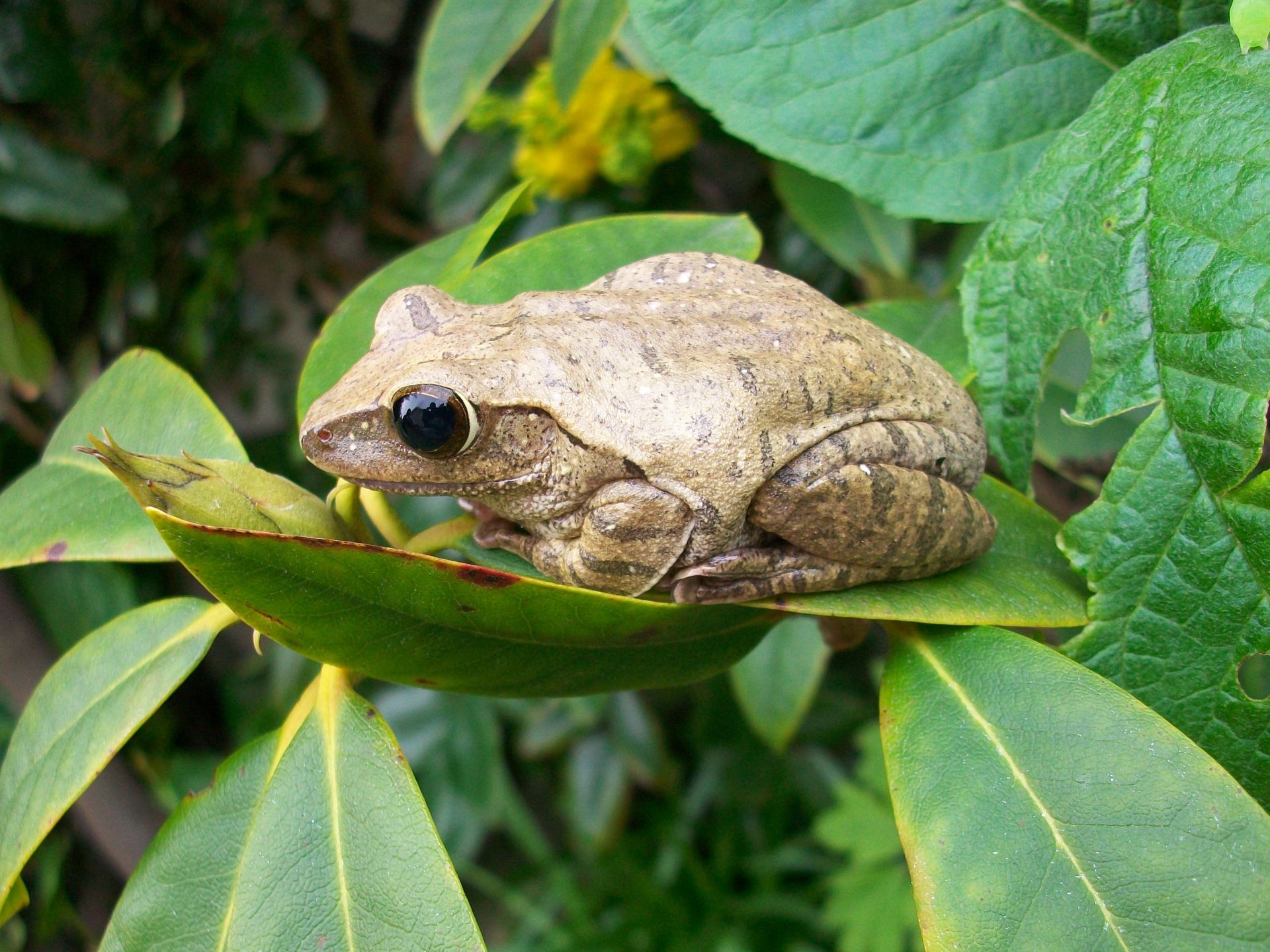
Pseudis species are a type of frog that belongs to the family Hylidae. There are several species within this family, including Pseudis paradoxa.
Pseudis paradoxa is known for its unique life cycle. It undergoes a process called direct development, where the eggs hatch into tadpoles that resemble miniature adults.
These tadpoles then go through a series of physical changes, eventually transforming into fully formed frogs. This process can take several weeks to a few months, depending on environmental factors.
Pseudis frogs are found in tropical and subtropical regions, typically near water sources. They are semi-aquatic, meaning they spend most of their time in or around water.
Discover more: Frogs of Peru
Pseudis Biology
Pseudis frogs have several adaptations to aquatic life, such as protuberant eyes, robust hind limbs, and fully webbed feet. They belong to the "true" tree frogs, family Hylidae.
Their adult frogs are relatively small, with snout-to-vent lengths ranging from 2.4-6.6 cm (0.9-2.6 in), while their tadpoles can grow to an astonishing 22-27 cm (9-11 in) in length.
Description
These frogs have several adaptations to aquatic life, such as protuberant eyes, robust hind limbs, and fully webbed feet. They belong to the "true" tree frogs, family Hylidae.
Their adult frogs are relatively small, averaging snout-to-vent lengths of 2.4-6.6 cm (0.9-2.6 in), with some species reaching up to 3.4-7.6 cm (1.3-3.0 in) in length.
In contrast, their tadpoles can grow to enormous sizes, sometimes reaching lengths of 22-27 cm (9-11 in) in certain species.
Breeding and Feeding
Pseudis tadpoles feed mostly on a wide range of algae, but also take small invertebrates.
These tiny tadpoles are quite the opportunistic eaters, snatching up whatever they can find in their aquatic environment.
As they grow, adult frogs take over, and their diet shifts to land-based insects and spiders, which they catch with ease.
Adult Pseudis frogs are also known to munch on other land-based or aquatic invertebrates, and in some species, they even eat small frogs.
In addition to their varied diet, some Pseudis species have been known to supplement their meals with plant material.
Species
The Pseudis genus is quite diverse, with seven recognized species.
Pseudis bolbodactyla, described by Lutz in 1925, is one of the species in this genus.
There are also several other species, including Pseudis cardosoi, which was described by Kwet in 2000.
Pseudis fusca, described by Garman in 1883, is another species within this genus.
The lesser swimming frog is the common name for Pseudis minuta, a species described by Günther in 1858.
Pseudis paradoxa, described by Linnaeus in 1758, is known as the paradoxical frog.
Here's a list of the recognized species in the Pseudis genus:
Pseudis platensis, described by Gallardo in 1961, is another species in this genus, although its validity as a separate species from Pseudis paradoxa is questionable.
Pseudis Evolution
Pseudis Evolution is a fascinating topic, and it's interesting to see how these frogs have evolved over time. They were once thought to be part of several different families, including Ranidae, Leptodactylidae, and Hylidae.
For a long time, their phylogenetic position was a matter of debate, but recent morphological and molecular phylogenetic reconstructions have finally placed them within the subfamily Hylinae with Scarthyla as a sister group.
Pseudis frogs have a highly derived body plan, likely due to their mostly aquatic habits. This has led to a unique evolutionary path that sets them apart from other frogs.
A recent study using molecular evidence proposed a new phylogenetic tree for the genus Pseudis. This tree shows the relationships among the different species within the genus.
Here's a simplified version of the intrinsic phylogeny tree for the genus Pseudis:
These species have been grouped together based on molecular evidence, and it's interesting to see how they're related to each other.
Life Cycle
The life cycle of Pseudis frogs is truly unique. They start as huge tadpoles, up to 9 inches long, which is three to four times larger than an adult frog.
The growth rate of these tadpoles is similar to other tropical species, but they just keep on growing and developing until they undergo metamorphosis into adults. This means that the males have already begun to produce sperm and are essentially mature, and the females have eggs in development, which is unusual for a juvenile frog stage.
The tadpoles' extraordinary size comes from their long and deep tail, which is lost during metamorphosis, causing the adult frog to "shrink" in size. In most other frogs, the adult starts small and then grows larger.
Here's a comparison of the tadpole and adult sizes:
The loss of the tail is a key factor in the adult frog's smaller size, as it was the main contributor to the tadpole's size. The adult frog's body length is comparable to the mature adult, but the loss of the tail makes it appear smaller.
You might like: Surinam Horned Frog
Frequently Asked Questions
What is the diet of the pseudis paradoxa?
The Pseudis paradoxa primarily feeds on a diverse range of invertebrates, including insects, arachnids, crustaceans, and annelids. Larger females tend to consume larger prey than smaller individuals.
Featured Images: pexels.com