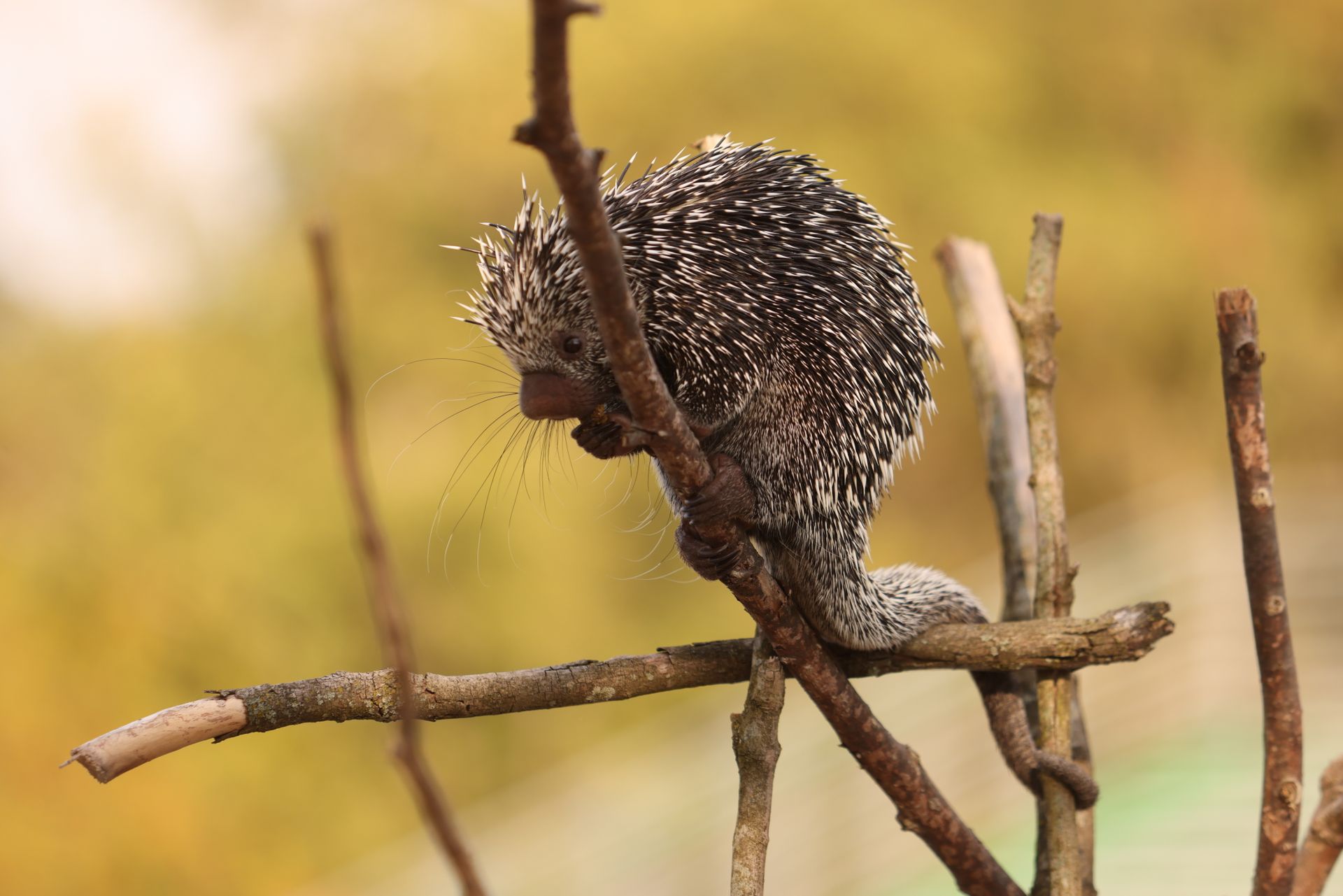
The prehensile-tailed porcupine is a unique creature found in the tropical forests of Central and South America. Its name comes from the fact that it has a long, thin tail that acts like a fifth limb.
This remarkable tail allows the porcupine to grasp branches and climb through the trees with ease. It's a vital adaptation for its arboreal lifestyle.
In the wild, these porcupines are primarily herbivores, feeding on leaves, fruits, and flowers.
For more insights, see: New World Porcupine
Physical Characteristics
The prehensile tailed porcupine's physical characteristics are quite unique. Their upper body coloration varies from light yellow to almost black. The under-body is generally gray.
Their long tail is a remarkable feature, lacking quills, but modified for use as a prehensile appendage. It contributes 9% of the total body weight.
The hands and feet are specialized for climbing, working in cooperation with their tail. Average length, from head to tail, is 35 to 40 inches. Average weight is 9 to 12 pounds.
Species and Taxonomy
The prehensile-tailed porcupine is a unique and fascinating creature. The family of New World porcupines, to which it belongs, is known as Erethizontidae.
There are two subfamilies within this family: Erethizontinae and Chaetomyinae. The Erethizontinae subfamily includes the genus Coendou, which the prehensile-tailed porcupine belongs to.
The prehensile-tailed porcupine is a member of the Coendou genus, which includes several other species of prehensile-tailed porcupines.
Here's a breakdown of the taxonomy of the prehensile-tailed porcupine:
- Kingdom: Animalia
- Phylum: Chordata
- Subphylum: Vertebrata
- Class: Mammalia
- Genera: Coendou
- Species: prehensilis
How to Help
To help prehensile tailed porcupines, you can support conservation efforts by visiting the Chattanooga Zoo and participating in a Prehensile Tail Porcupine Wild Encounter. A portion of the proceeds goes towards awareness programs and protected areas.
By supporting the Chattanooga Zoo, you're partnering with them in saving and protecting wildlife worldwide. They're part of the Association of Zoos and Aquariums' Species Survival Plan (SSP) for prehensile tailed porcupines.
You can also support Zoo New England, which participates in the prehensile-tailed porcupine Species Survival Plan. By sharing research and knowledge, participating institutions work together to ensure the health of captive populations.
Here are some ways to make a difference:
- Visit the Chattanooga Zoo and participate in their Prehensile Tail Porcupine Wild Encounter.
- Support Zoo New England's conservation efforts.
- Look for zoos and aquariums that participate in SSP programs to support their conservation efforts.
Brazilian Porcupine
The Brazilian Porcupine is a 3-4 foot long rodent that's active at night, using its quills and whiskers to navigate the rainforest.
It gets its name from its long, muscular tail that can grip branches, allowing it to climb trees with ease.
These porcupines have a unique way of foraging for food, moving from tree to tree each night to find something to eat.
Their nocturnal lifestyle means they rely heavily on their whiskers to feel around in the darkness.
Very little is known about how Brazilian Porcupines court each other, as their courtship hasn't been well observed in the wild.
They don't have a regular breeding season, which adds to the mystery surrounding their reproductive habits.
Additional reading: What Does a Cat Do When It Loses Its Tail?
General Information
Prehensile-tailed porcupines are nocturnal animals, which means they're most active at night.
They have poor eyesight, but their other senses like touch, hearing, and smell are highly developed.
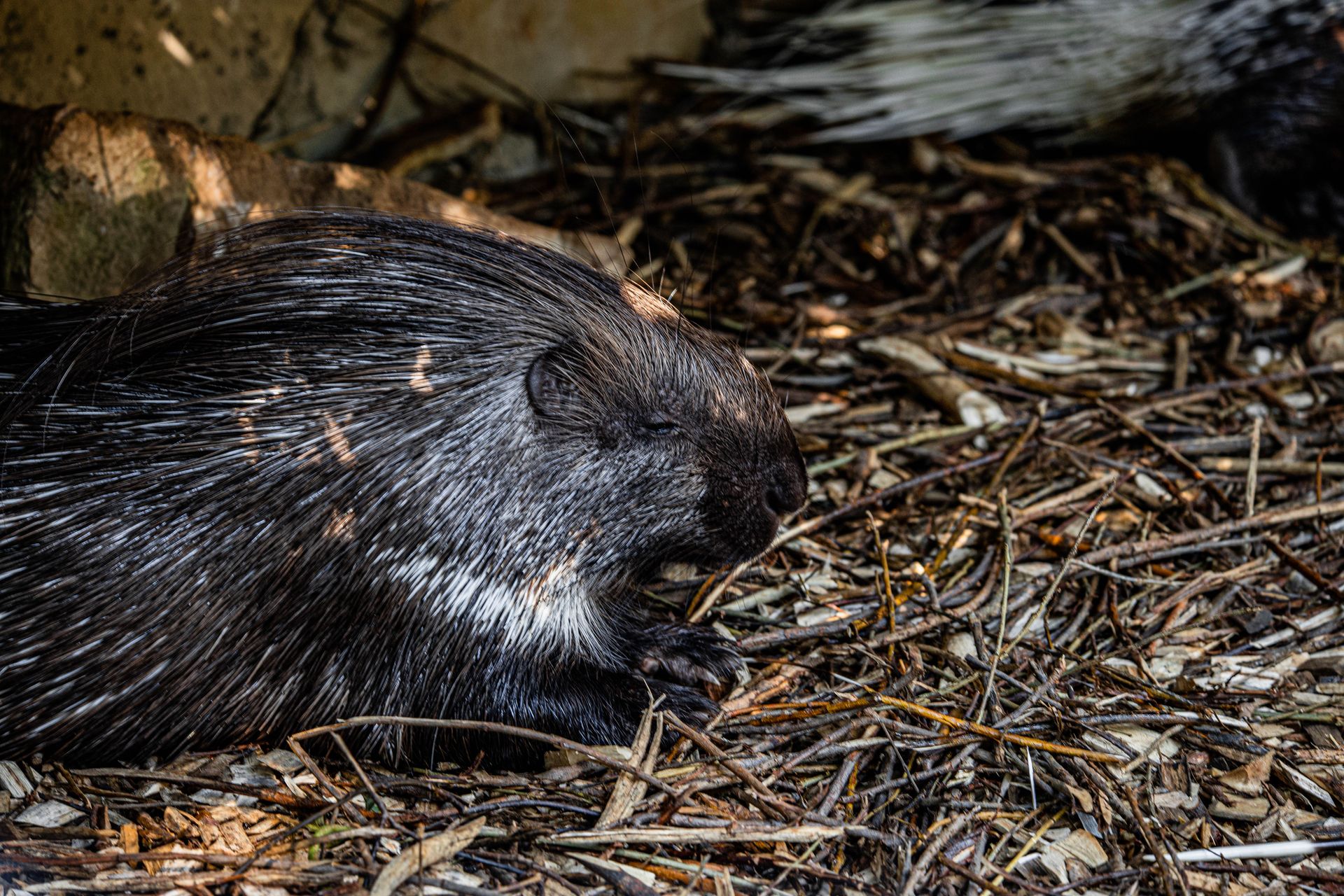
During the day, they sleep, often in small groups, and are difficult to spot because they rest high up in the trees or in hollow tree cavities.
They don't move much and blend in well with their surroundings.
Prehensile-tailed porcupines are covered in short, thick spines that give them a speckled appearance.
Their spines vary in color from cream to yellow to brown to almost black.
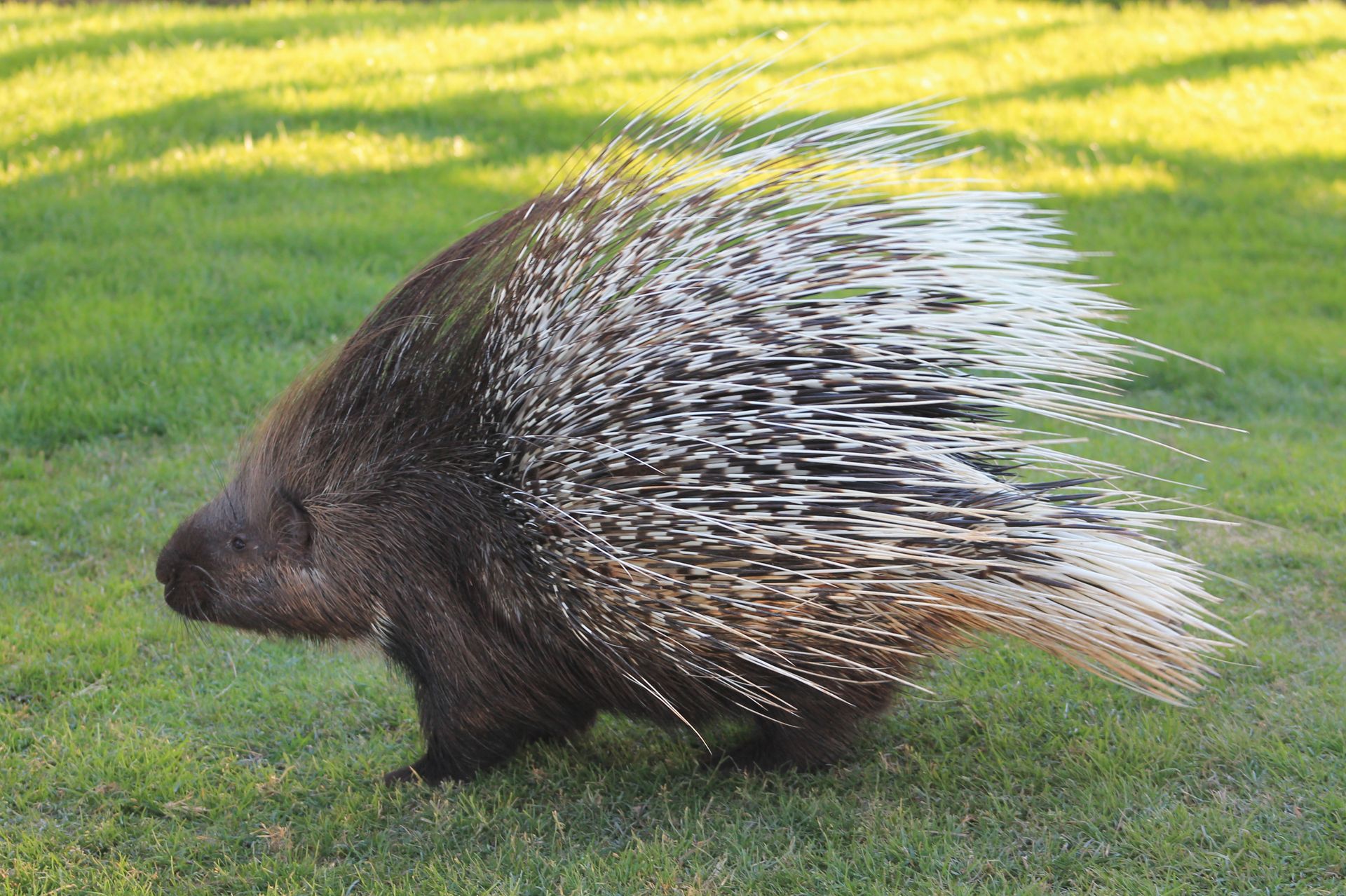
The spines normally lay flat, but are raised when the animal feels threatened.
They're not fond of being threatened and will take action to defend themselves.
They stamp their hind feet, growl, cry, and sit on their haunches and shake their spines to appear larger and more threatening.
As a last resort, they'll curl up into a ball to expose their spines on all sides.
Habitat and Range
The prehensile-tailed porcupine is a unique creature that calls the forested areas of South Panama home.
They can also be found in the Andes mountain range, stretching from northwest Columbia to north Argentina and northwest Brazil.
These porcupines thrive in low-lying jungles, where they can easily navigate and forage for food.
Facts
Prehensile-tailed porcupines are quite the impressive creatures, and here are some interesting facts about them.
They are brown or yellowish with short black and white quills, and have a distinctive large, round, furless nose and long tail.
Prehensile-tailed porcupines are herbivores that eat a variety of plants, including leaves, flowers, roots, and bark. They also enjoy fruits, vegetables, and monkey biscuits.
Their gestation period is approximately 203 days, during which the female gives birth to a single offspring that weighs around 14 ounces.
Newborn prehensile-tailed porcupines are covered in red fur and soft spines, which harden shortly after birth. They are also born with their eyes open and can walk and climb within days.
These animals are primarily arboreal, using their prehensile tails as a fifth limb to roam through the trees. They can move trees each night to find food and only descend to the ground when necessary.
Prehensile-tailed porcupines are nocturnal and often spend the day sleeping in trees. They are solitary or paired, but may be found in small social groups during the day.
Their quills are short and barbed, and detach easily when touched, embedding themselves in their predator. They cannot shoot their quills, but will raise them and emit a deep growl or high-pitched whine when threatened.
Here are some of the sounds prehensile-tailed porcupines can make: moans, whines, grunts, coughs, shrieks, barks, and wails.
Prehensile-tailed porcupines are found in the South American forests of Venezuela, Guiana, Brazil, Bolivia, Paraguay, Trinidad, and northern sections of Argentina.
Their tail is a remarkable feature, with over half of its weight composed of muscle. This allows them to use it to hang upside down and grasp when climbing and perching in trees.
Here's a quick rundown of the prehensile-tailed porcupine's size: they are 12-24 inches long, with their tail adding another 13-19 inches. They weigh between 4-11 pounds, with their tail accounting for 9% of their total weight.
Behavior and Threats
Prehensile-tailed porcupines are almost strictly arboreal, rarely descending to the ground except to feed or move to another tree.
Their poor eyesight is compensated by keen senses of touch, hearing, and smell. They're nocturnal and shy, often living in small groups or pairs.
They're preyed upon by large mammals, including humans, who use them as food in many parts of South America.
Life Cycle
In the wild, prehensile-tailed porcupines can live a relatively short life of 6 to 8 years.
Females mate again right after the last young is born, showing their remarkable reproductive abilities.
After a 203 day gestation period, a single young is born, making each birth a unique and special event.
Infants are born with their eyes open and are able to walk, which is impressive considering their tiny size.
They can climb trees at only a few days old, a skill that serves them well in their forest habitats.
In captivity, these amazing animals can live up to 20 years, a testament to proper care and nutrition.
A fresh viewpoint: Are Rottweilers Born with Tails
Behavior
Prehensile-tailed porcupines are almost strictly arboreal, meaning they spend most of their time in trees.
They rarely descend to the ground, only doing so to feed or move to another tree.
Their poor eyesight is a result of being near-sighted.
However, they make up for it with their keen senses of touch, hearing, and smell.
As nocturnal animals, they tend to be active at night.
Their shy nature means they prefer to live in small groups or in pairs.
Threats and Status
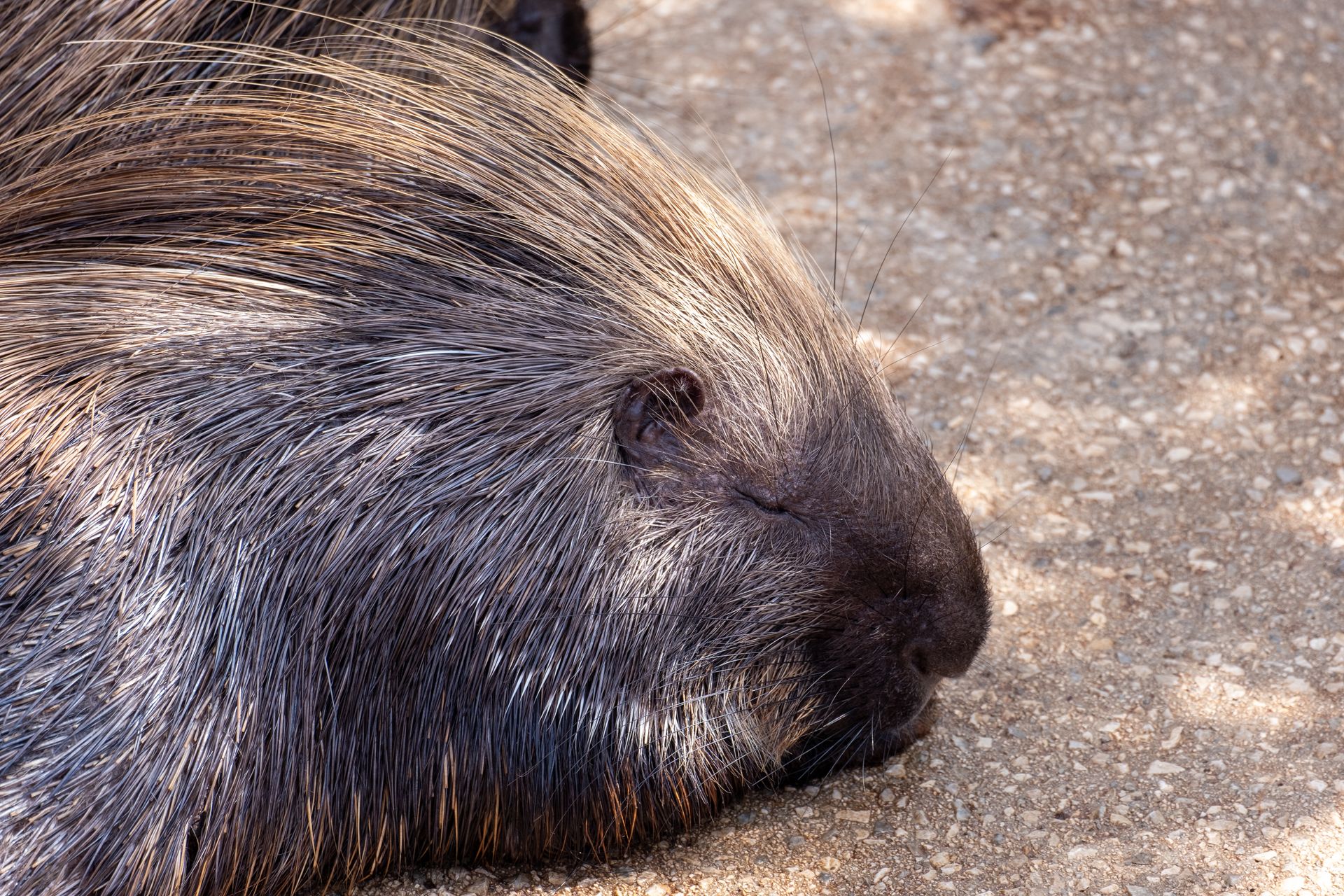
Prehensile-tailed porcupines face threats from habitat destruction, which affects them adversely.
They are preyed upon by large mammals, including humans, who use them as food in many parts of South America.
Despite these threats, prehensile-tailed porcupines are not currently endangered.
Featured Images: pexels.com