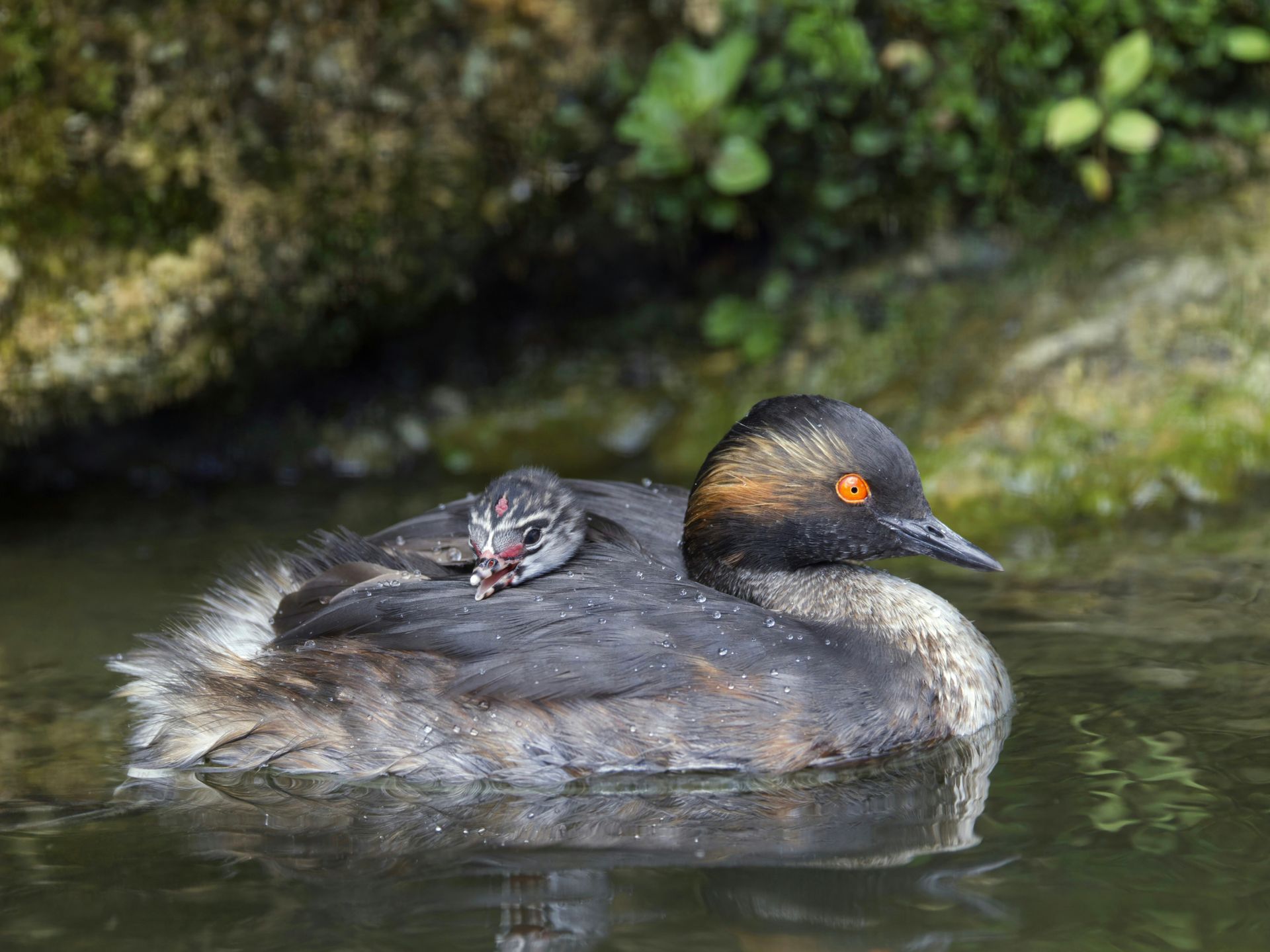
The Podiceps nigricollis, also known as the Black-necked Grebe, is a bird species that belongs to the family Podicipedidae.
It is a medium-sized grebe with a distinctive black neck patch and a white eye ring.
This bird is known for its unique breeding habits, where it forms long-term monogamous relationships with its mates.
Its breeding season typically occurs from April to July, during which time it builds a nest on the ground or on a floating platform.
Taxonomy and Classification
This species was first described by Carl Ludwig Hablitz in 1783 as Colymbus caspicus, from a bird in Bandar-e Anzali.
The International Commission on Zoological Nomenclature suppressed the name Colymbus caspicus to resolve the confusion.
The genus name Dytes is sometimes used for this species and its closest relatives, a placement which was preferred by Robert Ridgway in 1881.
The bird was originally thought to be a synonym for the horned grebe, until Erwin Stresemann discovered that the description applied more to the black-necked grebe in 1948.
The earliest description of this bird was given by Christian Ludwig Brehm in 1831, who gave this bird its current scientific name of Podiceps nigricollis from a German bird.
This bird is closely related to the South American silvery grebe and Junin grebe.
The extinct Colombian grebe P. andinus is particularly closely related, and is often considered to be a subspecies of P. nigricollis; it is genetically nested within it.
Physical Characteristics
The Black-necked Grebe has a small and characteristically up-turned bill.
Its bill is a distinctive feature that sets it apart from other grebes. The steep forehead of the Black-necked Grebe makes its head look 'peaked'.
In summer plumage, the Black-necked Grebe has golden tufts of feathers on its face, contrasting with its black head and neck.
These golden tufts are a striking feature that makes the Black-necked Grebe unmistakable in summer. In winter plumage, it is predominately white with a poorly defined black cap.
Habitat and Distribution
Podiceps nigricollis, also known as the Black-necked Grebe, can be found breeding in vegetated areas of freshwater lakes across various parts of the world.
It breeds in temperate Europe, Asia, eastern and southern Africa, interior southwestern Canada, and the southwest and western United States.
This species has a wide breeding range, covering multiple continents.
After breeding, the Black-necked Grebe migrates to saline lakes to moult.
Following moulting, it waits for several months before migrating to its wintering grounds.
It winters in places such as the south-western Palearctic and the eastern parts of both Africa and Asia.
In the Americas, it winters as far south as Guatemala, and occasionally further south in Central America.
The Black-necked Grebe's habitat preferences change depending on the time of year, with a shift from freshwater lakes to saline lakes and coastal estuaries post-breeding.
Its habitat is primarily saline lakes, sheltered inshore seas, and coastal estuaries when not breeding.
It favors vegetated freshwater lakes for breeding and migrates to saline lakes and coastal estuaries post-breeding.
Behavior and Migration
The Black-necked Grebe is a reluctant flier, often avoiding flight except during migration. It's not the most efficient flyer in the bird world, but it makes up for it with its impressive migratory journeys.
This bird can travel up to 6,000 kilometers during migration, which is no small feat. It's a remarkable example of endurance and navigation.
During the moulting period, Black-necked Grebes become flightless for two months, which is a crucial time for them to fatten up before their winter migration. They gorge on invertebrate prey to build up their fat reserves, which will sustain them on their long journey.
Behaviour
The Black-necked Grebe is a reluctant and inefficient flier, often avoiding flight except during migration.
It's not uncommon for birds to be skilled at one thing but not another, and for this grebe, flying is definitely not its strong suit.
During migration, the Black-necked Grebe can travel up to 6,000 kilometers, which is an impressive feat considering its aversion to flying.
This bird's reluctance to fly is so pronounced that it becomes flightless for two months during the moulting period, a time when it needs to focus on shedding and regrowing its feathers.
Moult and Migration
Black-necked grebes undergo a crucial moult and migration process after breeding. This involves a moult migration to saline lakes with abundant invertebrate prey.
Most black-necked grebes wait until after a moult migration to moult their remiges, which happens between August and September. This timing makes them temporarily unable to fly.
The moult is preceded by a significant increase in weight, during which the breast muscles atrophy. This weight gain is essential for the birds' survival.
The additional fat stored during the moult is concentrated in the abdomen, with the thorax being the second most fatty area. The chest has the least amount of fat.
Birds typically leave on a clear night with lower than average surface temperatures. This suggests that they have a good sense of timing for their migration.
Species and Conservation
The Black-necked Grebe is classified as Least Concern by the IUCN, with an estimated population of 3.9-4.2 million individuals.
Its large population and extensive range have contributed to its stable conservation status. However, potential threats like oil spills and disease outbreaks are not considered significant risks to the overall population.
The Black-necked Grebe's population trend is uncertain, with some populations decreasing, while others are stable or increasing. Its large population and extensive range have led to its classification as Least Concern.
The species is vulnerable to unknown biotoxins, pathogens, and the impairment of feather waterproofing, which can lead to hypothermia and avian cholera. Human disturbance, including collisions with power transmission lines, also contributes to declining populations in certain areas.
Here are some potential threats to the Black-necked Grebe's population:
- Oil pollution
- Disease outbreaks, such as avian cholera
- Human disturbance, including collisions with power transmission lines
Subspecies
The Black-necked Grebe has three accepted subspecies, each with its unique characteristics. The nominate subspecies, P. n. nigricollis, is found across the temperate Palearctic region.
The African Black-necked Grebe, P. n. gurneyi, is the smallest subspecies and has a greyer head and upper parts. It's worth noting that some field guides and photographic evidence contradict the claim that this subspecies does not have a winter plumage.
The Eared Grebe, P. n. californicus, has a longer bill than the other subspecies and is found in the interior southwestern Canada and western United States.
Here's a breakdown of the three subspecies:
Similar Species
The Black-necked Grebe can be confused with other grebe species, but its distinctive breeding plumage and vocalizations help differentiate it.
One species that might be mistaken for the Black-necked Grebe is the Red-necked Grebe.
The Red-necked Grebe is actually quite similar in appearance to the Black-necked Grebe, but the Black-necked Grebe's breeding plumage is a more vibrant black and white.
Conservation Status
The Black-necked Grebe is classified as Least Concern by the IUCN, with an estimated population of 3.9-4.2 million individuals.
Despite potential threats, oil spills and disease outbreaks are not considered significant risks to the overall population. However, unknown biotoxins, pathogens, and impaired feather waterproofing can lead to hypothermia and avian cholera.
The grebe is vulnerable to oil pollution, especially since it usually winters on the coast. Large-scale disease, such as avian cholera, could threaten the species.
Human disturbance, including collisions with power transmission lines, contributes to declining populations in certain areas. The species was previously threatened in North America by the millinery industry and egg collectors.
Here's a summary of the potential threats to the Black-necked Grebe population:
- Oil pollution
- Disease outbreaks, including avian cholera
- Human disturbance, such as collisions with power transmission lines
- Hunting for commercial and recreational purposes
General Information
The Black-necked Grebe, also known as the Eared Grebe, is a striking member of the grebe family.
It breeds on shallow, well-vegetated lakes, and in winter, you can find it on estuaries, lakes, gravel pits, and reservoirs.
This bird is a rare breeding bird, with only about 50 breeding pairs, and it's also uncommon in winter with only 130 individuals overwintering.
In summer plumage, the Black-necked Grebe has golden tufts of feathers on its face, contrasting with its black head and neck, making it unmistakable.
Brehm, CL 1831
Christian Ludwig Brehm is a notable figure in the field of ornithology, having described the black-necked grebe in 1831. Brehm's description of this species was a significant contribution to the field.
Brehm described the black-necked grebe as Podiceps nigricollis. This species was first described in Germany, which serves as its type locality.
Here's a breakdown of the subspecies of the black-necked grebe:
- Podiceps nigricollis: breeds in temperate Eurasia, eastern and southern Africa, and parts of North America.
- Podiceps nigricollis nigricollis: is locally found in Eurasia.
- Podiceps nigricollis gurneyi: is found in sub-Saharan Africa.
- Podiceps nigricollis californicus: breeds in Canada and Mexico, and winters in Guatemala.
Podiceps Nigricollis
The Black-necked Grebe, also known as the Eared Grebe, is a striking member of the grebe family. It's characterized by its distinctive breeding plumage, which includes a black to blackish-brown head, neck, and breast, and ochre-colored feathers that fan out behind the eyes over the ear coverts.
This bird was described in 1831 by Christian Ludwig Brehm, and there are currently three accepted subspecies, including the nominate subspecies.
The Black-necked Grebe has a unique breeding plumage, featuring a distinctive ochre-coloured plumage that extends behind its eye and over its ear coverts. The rest of the upper parts, including the head, neck, and breast, are coloured black to blackish brown.
The bird's flanks are tawny rufous to maroon-chestnut, and the abdomen is white. In non-breeding plumage, this bird has greyish-black upper parts, including the top of the head and a vertical stripe on the back of the neck.
Here's a breakdown of the different subspecies and their characteristics:
- Podiceps nigricollis californicus: has a usually longer bill
- Podiceps nigricollis gurneyi: has a greyer head and upper parts, smaller size, and lacks a non-breeding plumage
The Black-necked Grebe is present in parts of Africa, Eurasia, and the Americas.
Frequently Asked Questions
What are Grebes known for?
Grebes are known for their elaborate courtship displays and unique breeding habits. They're a fascinating bird group to learn more about!
Featured Images: pexels.com