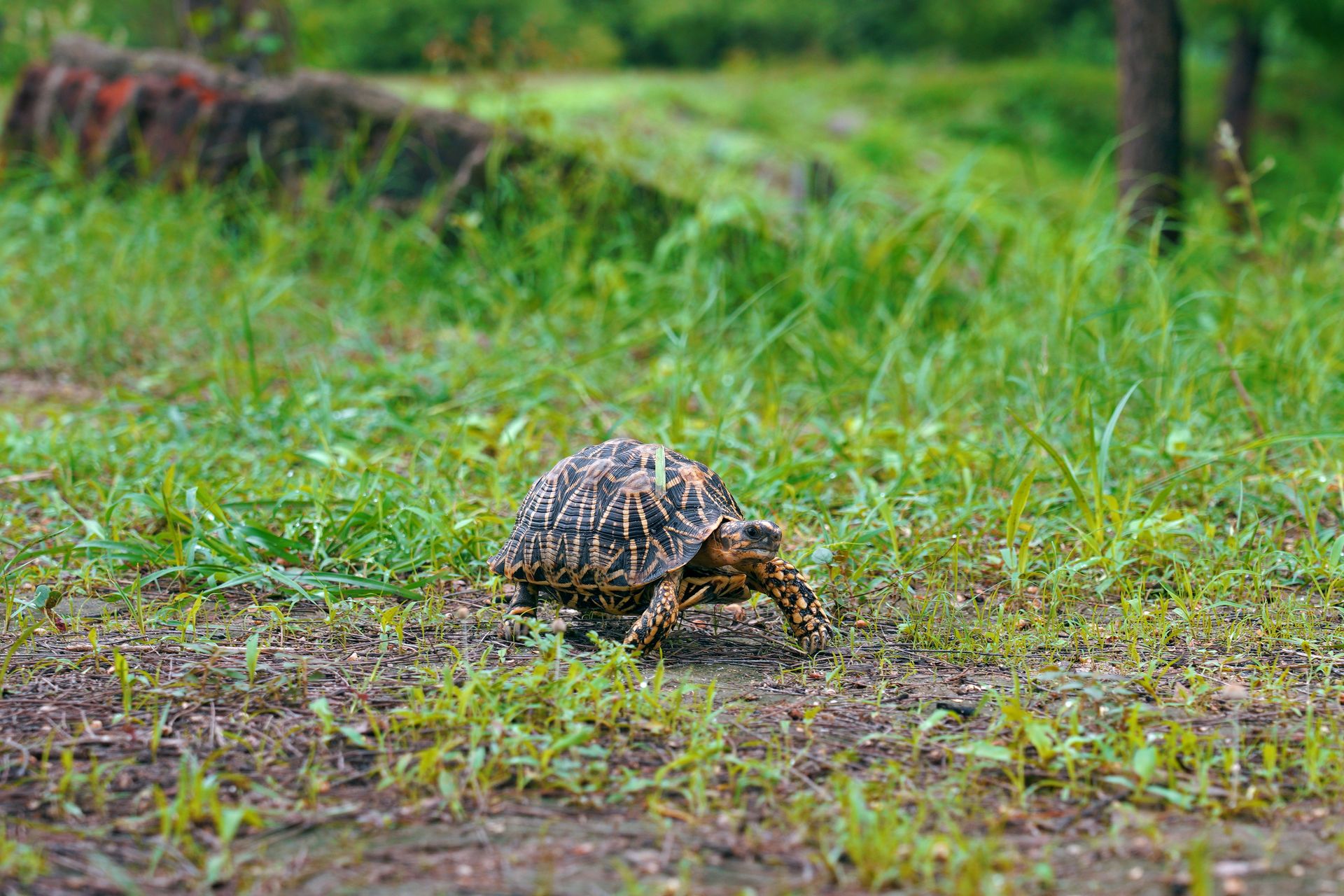
Pleurodira are found in the southern hemisphere, specifically in South America, Madagascar, and Australia. They inhabit freshwater environments, such as rivers, lakes, and ponds.
These turtles are primarily nocturnal, meaning they're most active at night. This behavior helps them avoid predators and regulate their body temperature.
Their diet consists mainly of aquatic plants, including algae and water lilies.
What Are Pleurodira?
Pleurodira are a group of turtles identified by the way they withdraw their heads into their shells.
They bend their necks in the horizontal plane, drawing their heads into a space in front of one of their front legs. This leaves some of the neck exposed after retraction.
The different methods of bending the neck require completely different anatomies of the cervical vertebrae. In Pleurodira, these vertebrae are narrow in cross-section and spool-shaped.
All extant turtles studied so far have eight vertebrae in the neck. In Pleurodira, these vertebrae have biconvex centra on one or more of the cervicals, which act as a double joint.
This unique anatomy allows for a large degree of sideways movement and provides a means of folding the neck onto itself in the lateral plane.
Classification and Taxonomy
Pleurodira, the suborder of side-necked turtles, has a complex classification system. It is divided into three families: Chelidae, Pelomedusidae, and Podocnemididae.
The Pleurodira suborder is a part of the order Testudines, which includes all turtles. It is also a member of the clade Pan-Pleurodira, a group of side-necked turtles that share a common ancestor.
Pleurodira turtles are found primarily in the Southern Hemisphere, with over 70 species distributed across Australia, South America, and Africa.
The Chelidae family, also known as Austro-South American side-necked turtles, is one of the three families within the Pleurodira suborder. It includes several genera, such as Acanthochelys and Chelus.
The Pelomedusidae family, also known as African mud terrapins, is another family within the Pleurodira suborder. It includes several genera, such as Pelomedusa and Pelusios.
The Podocnemididae family, also known as American side-neck river turtles, is the third family within the Pleurodira suborder. It includes several genera, such as Erymnochelys and Podocnemis.
Here's a breakdown of the Pleurodira suborder's classification:
Physical Characteristics
Pleurodira turtles have eight vertebrae in the neck, which are narrow and spool-shaped with biconvex bones called centra.
These centra serve as double joints, allowing the neck to fold onto itself horizontally and move sideways. This is a unique feature among turtles.
A piece of bone called the mesoplastron remains embedded in the lower shell or plastron of Pleurodira turtles, to which their pelvic girdles are fused.
Size
The size of turtles can vary greatly depending on the species. The Arrau turtle can grow up to 3.5 ft in length.
Most African side-neck turtles are relatively small, ranging from 8 to 12 inches in size. Females are slightly larger than males.
Austro-South American side-necked turtles are generally smaller, measuring around 6 to 9 inches in length.
Characteristics
Side-necked turtles have a unique neck structure, with eight vertebrae that are narrow and spool-shaped, featuring biconvex bones called centra.
These centra serve as double joints, allowing the neck to fold onto itself horizontally and move sideways.
The neck vertebrae of side-necked turtles are unlike those of hidden-necked turtles, which fold onto themselves in the vertical plane due to wide and flat cervical vertebrae.
A key feature of side-necked turtles is the presence of a thirteenth scute on their plastron, which is not found in hidden-necked turtles.
This additional scute is called the intergular, and it's one of the distinguishing characteristics of side-necked turtles.
The total number of scutes on the plastron of side-necked turtles is therefore thirteen, whereas hidden-necked turtles have only twelve.
Side-Necked Turtles
Side-necked turtles are a unique group of turtles that can be identified by their distinctive shell shape and size. They possess eight vertebrae in the neck, which are narrow and spool-shaped with biconvex bones called centra.
These centra serve as double joints, allowing the neck to fold onto itself horizontally. This is in contrast to other turtles, where the neck folds onto itself in the vertical plane.
Side-necked turtles have a piece of bone called the mesoplastron embedded in their lower shell or plastron, which is fused to their pelvic girdles.
Their shell shapes and sizes vary greatly, with the largest turtle, the Arrau turtle, reaching a carapace length of up to 3.5 ft (1.07 m).
Distribution and Habitat
Side-necked turtles, also known as Pleurodira, can be found in freshwater habitats in the Southern Hemisphere.
They inhabit areas in Africa, Madagascar, South America, Australia, and some islands in the Indian Ocean.
In the past, Pleurodira were widespread across the globe and even lived in marine environments during the Cretaceous Period.
Their diverse range of habitats is a testament to their adaptability and ability to thrive in various environments.
Behavior and Diet
Pleurodira, also known as side-necked turtles, are primarily carnivores.
They feed on a variety of invertebrates such as snails, slugs, and insects.
Their diet also consists of small vertebrates like fish and even other turtles.
Pleurodira have been observed to eat carrion, although this is not a preferred food source.
Some species of Pleurodira have been known to eat plant material, but this is rare.
Frequently Asked Questions
Why is it called a sideneck turtle?
The sideneck turtle gets its name from its unique defensive posture, where it lays its head and neck to the side beneath the shell for protection. This distinctive behavior sets it apart from other turtle species.
Featured Images: pexels.com


