The Eastern Rosella is a stunning bird species, and as we dive into the world of Platycercus eximius, you'll see why it's a favorite among bird enthusiasts.
Native to Australia, specifically the eastern regions, the Eastern Rosella is a medium-sized parrot that thrives in woodlands, forests, and even backyards with the right conditions.
These birds are known for their vibrant plumage, with a mix of blue, green, and red feathers that make them a treat to spot.
Eastern Rosellas are social birds that often live in small groups, foraging for food and interacting with each other in a lively manner.
General Information
The Eastern Rosella, also known as Platycercus eximius, is a small parrot native to southeastern Australia. It's a common sight in the region, with its distinctive cheek patches and vibrant plumage.
The Eastern Rosella is known to reach lengths of up to 30cm, making it a relatively small bird. It's also known for its distinctive call, which sounds like "tink-tink", "pseet-it", or "tock-swit-it".
(Shaw, G 1792)
The Platycercus eximius was first described by Shaw in 1792. Shaw's work marked the beginning of the species' recorded history.
The type locality of Platycercus eximius is New Holland, which is now known as New South Wales. This is according to Mathews, who provided additional information on the species' range.
Platycercus eximius can be found in southeastern Australia, including Tasmania. This covers a significant portion of the country's eastern coast.
Here's a breakdown of the subspecies of Platycercus eximius:
- Platycercus eximius eximius: southeastern New South Wales, Victoria, and southeastern South Australia
- Platycercus eximius elecica: eastern Australia (southeastern Queensland and northeastern New South Wales)
- Platycercus eximius diemenensis: Tasmania
Rosella, Eastern
The Eastern Rosella is a small parrot with distinctive cheek patches. It's native to southeastern Australia, including Tasmania, and can be found in the wild.
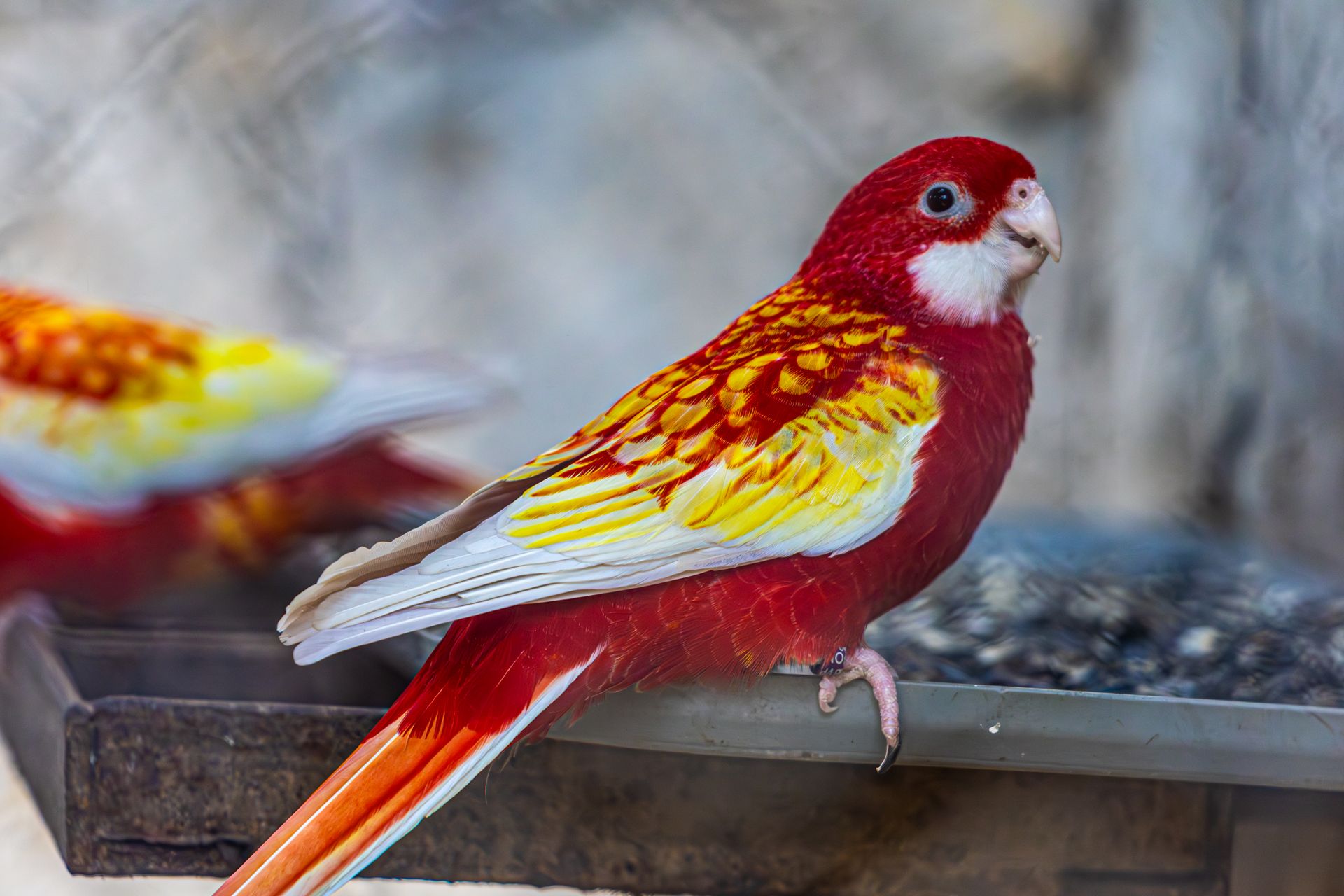
This species is known for its bright colors, with a red head and breast, white cheeks, and a yellow to green belly. The blue on its wings is a striking feature.
The Eastern Rosella is a common species in the wild, but its call is quite unique - it's described as a "tink-tink" or "pseet-it" sound.
To sex an Eastern Rosella, you'll notice the cock has brighter and more sharply defined colors than the hen. The cock's red head reaches further down the back of the neck and is sharply delineated.
Here are some key differences between the cock and hen:
Common Names
The Eastern Rosella is known by many names, including the Redheaded or White-cheeked Rosella, Golden Mantle, Polly Parrot, Rosehill Parakeet, and Rosy.
Classification
The platycercus eximius is classified under the animal kingdom, specifically as a chordate and a jawed vertebrate.
Its taxonomy places it within the tetrapoda group, which includes four-limbed animals.
The platycercus eximius is a bird, and as such, it belongs to the class aves.
Within the aves class, the platycercus eximius is further classified as a neornithes, a group that includes modern birds.
The platycercus eximius is a member of the psittaciformes order, which includes parrots and related species.
Its family is the psittacidae, a group that includes parrots and cockatoos.
Broaden your view: Platycercus Caledonicus
Physical Characteristics
Eastern Rosellas are medium-sized parrots.
Their distinctive white cheek patches make them easily recognizable.
The head, neck, and breast are a vibrant red colour.
The underbelly is a bright yellow, and the rump is a beautiful yellow-green to blue-green, with a red undertail.
The shoulders are a stunning bright blue.
Females are slightly duller than males, and young birds are dull and can be aged by their bill colour.
Behavior and Call
The platycercus eximius, or as I like to call it, the bird with the most distinctive call.
A sharp repeated 'chut-chit-chut' in flight is a dead giveaway that you're looking at a platycercus eximius.
When perched, these birds let out a high-pitched 'pee-pt-eee' or 'kwink kwink' that's music to the ears of any bird enthusiast.
Here's an interesting read: Platycercus Elegans
Conservation
The platycercus eximius is a species that's doing okay globally, but there's a catch. It's not listed under the EPBC Act 1999, which means it's considered secure at a national level.
However, there's a specific population of this species in Tasmania that's facing some challenges. The Tasmanian population, known as Platycercus eximius diemenensis, is listed as Near Threatened.
This population has seen a significant decline over the last century, with its numbers almost halving. This is a concerning trend that warrants closer attention.
Habitat and Resources
The Eastern Rosella's habitat is quite diverse, but they tend to thrive in open areas with some trees nearby. They can be found in open woodland, grassland, farmland, and remnant bushland.
For their survival, they need cleared feeding areas free from predators. This is crucial for their well-being.
In Canberra, they have a preference for more open, grassed areas with trees nearby, such as parks and golf courses. This type of environment seems to suit them well.
Associated Vegetation Community
The Eastern Rosella's home is in open areas with trees nearby, like parks and golf courses in Canberra.
In these open spaces, you can spot the Eastern Rosella foraging for food and taking refuge from predators.
The species thrives in areas of open woodland, grassland, farmland, and remnant bushland, making it adaptable to different environments.
In Canberra, the Eastern Rosella tends to prefer more open, grassed areas with trees nearby, providing the perfect balance of shelter and foraging opportunities.
This unique combination of open spaces and nearby trees helps the Eastern Rosella survive and thrive in its natural habitat.
Limiting Resources
Limiting Resources is a crucial aspect of a species' survival. Mature trees provide suitable nesting hollows, which are essential for their survival.
Having a reliable source of food is also vital. Cleared feeding areas free from predators are important for their survival.
Artificial nest boxes can be used as an alternative to natural nesting hollows, which is a great option when natural ones are scarce.
Reproduction
Reproduction is a fascinating aspect of the platycercus eximius's life cycle.
Birds partner for life, which is a unique trait that sets them apart from many other species.
They are active around nesting hollows from mid-August to mid-October, which is the perfect time for them to focus on building their nests and raising their young.
A clutch size is usually 5, which means these birds typically lay 5 eggs at a time.
Eggs need 19 days of incubation, which is a crucial period for their development.
Young birds spend 32 days in the nest during December and January, which is a long time for them to grow and mature.
Dependant young can be seen mostly in January and February, which is a great time to spot them in their natural habitat.
Featured Images: pexels.com