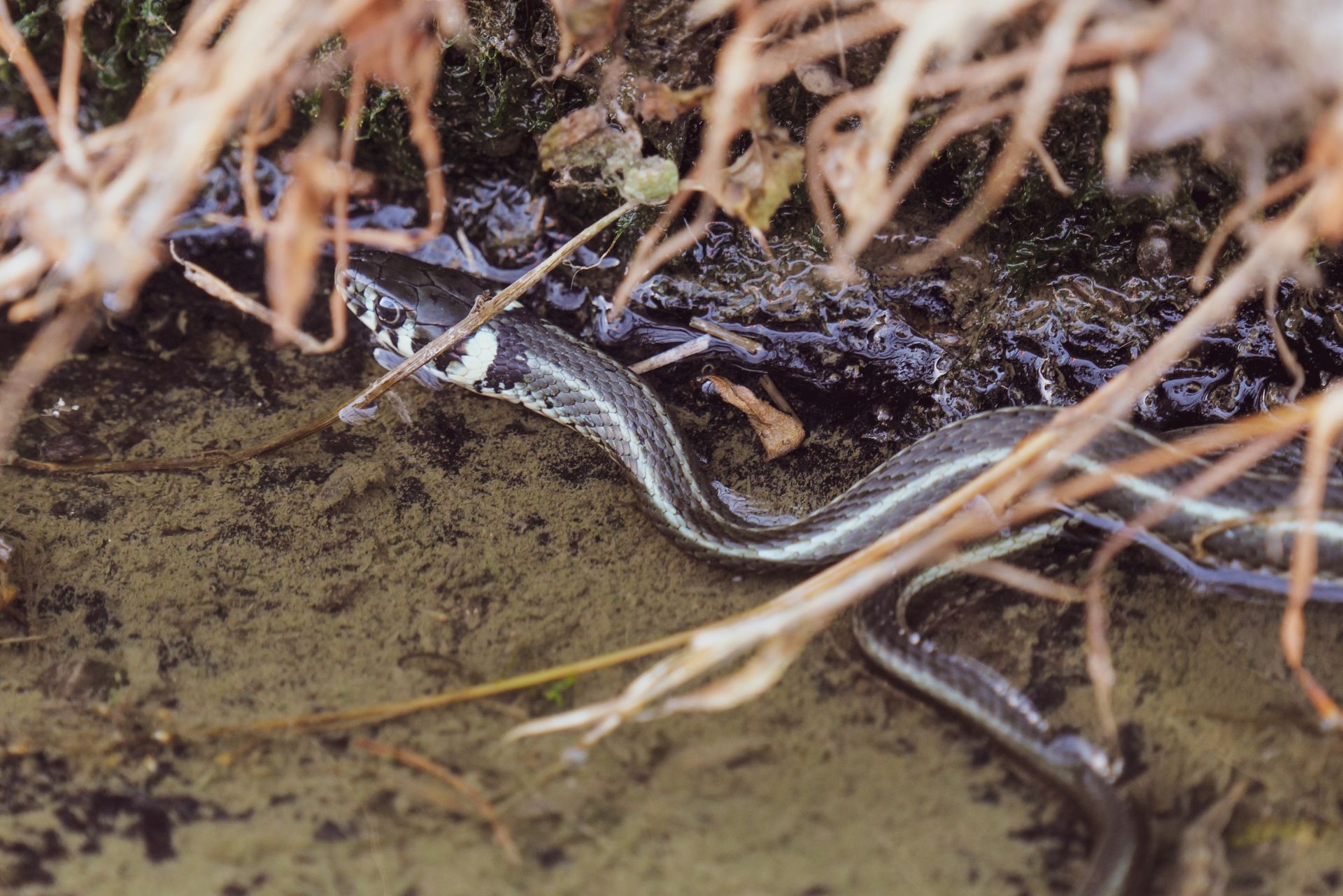
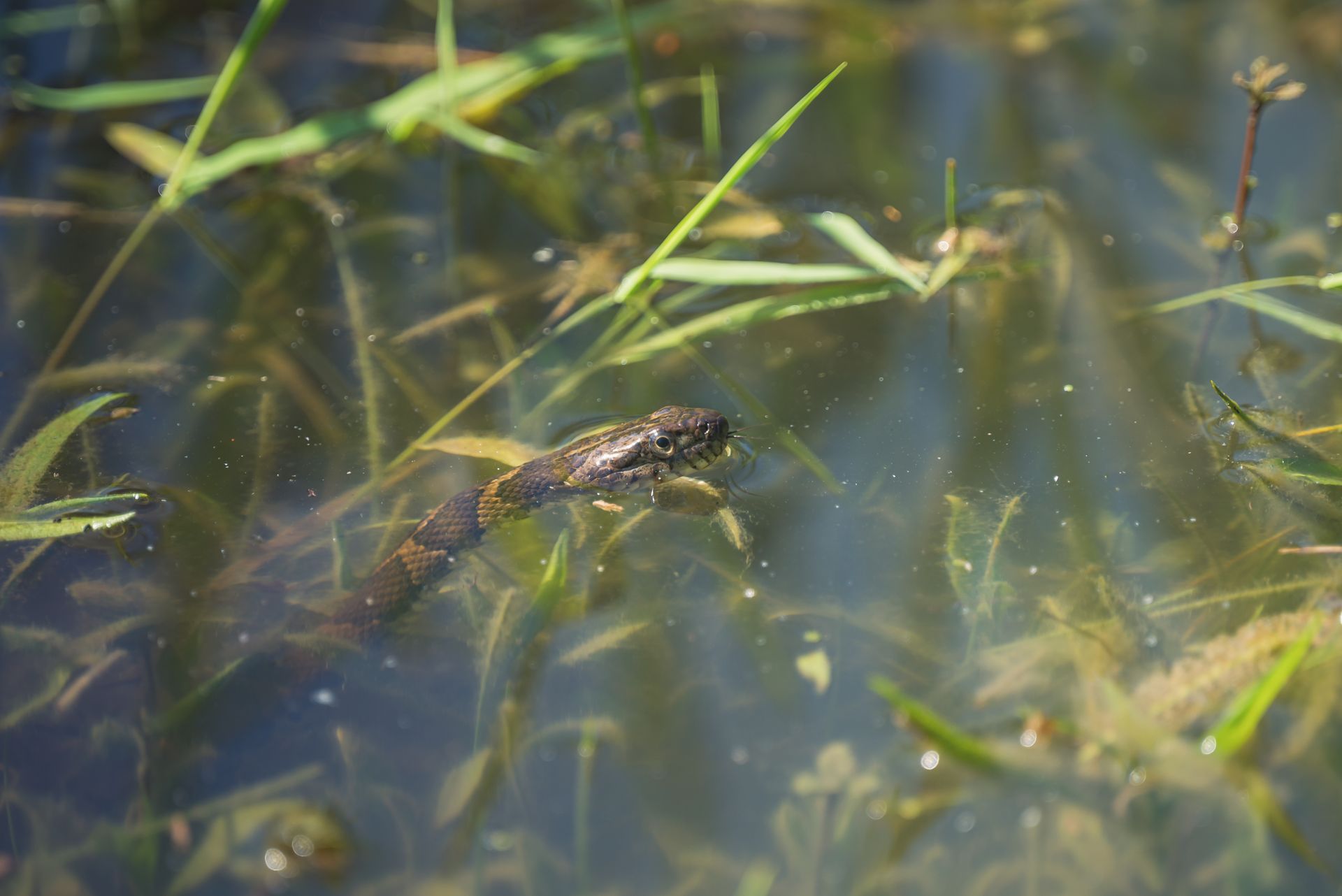
The plain bellied watersnake is a fascinating creature.
They are a non-venomous snake species that can be found in the southeastern United States.
These snakes are semi-aquatic, meaning they spend a lot of time in the water.
They are excellent swimmers and can stay underwater for up to 20 minutes.
Plain bellied watersnakes are relatively small, typically growing to an average length of 20-30 inches.
You might enjoy: Stop Birds
Physical Characteristics
The plain-bellied watersnake is a large, solid-colored snake with a distinctive appearance. They typically range in length from 76 to 122 cm, with a record length of 163.6 cm.
Their dorsal coloration varies among black, gray, olive-gray, brown, and pink, and can be tinted with red, gray, or green. Some specimens show faint crossbars and lighter colored snakes can exhibit dark dorsal blotches.
Juveniles have a different appearance, with mid-dorsal blotches alternating with lateral blotches, and their dorsal coloration is lighter than that of adults.
Adult plain-bellied watersnakes are ectothermic, meaning they regulate their body temperature using external sources. They are also heterothermic, meaning they can have a different body temperature than their surroundings.
The average adult mass is 286 g for males and 516 g for females, with females growing to a larger size than males.
Habitat and Environment
Plain-bellied watersnakes are semi-aquatic snakes that use both terrestrial and freshwater aquatic habitats. They're excellent swimmers and can often be spotted sunning themselves on riverbanks or floating lazily near the water's edge.
These snakes can be found in a variety of habitats, including rivers, lakes, ponds, swamps, and cypress strands. In central North America, they're commonly found in wetlands, swamps, rivers, and ponds.
Plain-bellied water snakes are found in warm temperate regions, but some subspecies extend into tropical climates. They use terrestrial habitats like forests, grasslands, and scrublands as travel corridors, aestivation sites, hibernation sites, and occasional feeding sites.
Aquatic habitats include ephemeral ponds or temporary pools, permanent lakes and ponds, swamps, bogs, marshes, small rivers, and riverine sloughs. They also use crayfish burrows near wetlands for hibernation.
Here are some specific habitats where plain-bellied watersnakes can be found:
- Temperate regions
- Tropical regions
- Terrestrial habitats (forests, grasslands, scrublands)
- Freshwater habitats (rivers, lakes, ponds, swamps)
- Wetlands (marshes, bogs, swamps)
- Agricultural areas
- Suburban areas
They can travel quite far from water sources, with individuals found several hundred meters from the nearest water.
Behavior and Diet
Plain-bellied Watersnakes feed primarily on amphibians and freshwater fishes. They overpower their prey by simply grabbing it in their jaws and quickly swallowing it alive.
Their diet is quite varied, allowing them to hunt both on land and in the water. They primarily feed on fish, frogs, and small amphibians using their quick reflexes to catch prey in the water.
They don't constrict their prey; instead, they rely on their sharp teeth and fast strikes to capture and swallow prey whole.
Diet and Behavior
Plain-bellied Watersnakes primarily feed on amphibians and freshwater fishes. They overpower their prey by grabbing it in their jaws and quickly swallowing it alive.
Their diet consists of fish, frogs, and small amphibians, which they catch using their quick reflexes in the water. On land, they hunt small mammals and other reptiles.
Plain-bellied water snakes have a varied diet, allowing them to thrive in diverse ecosystems. They don't constrict their prey, instead relying on their sharp teeth and fast strikes to capture and swallow prey whole.
Their adaptability to hunt in both water and on land makes them successful hunters. They take advantage of their environment to catch whatever prey is available.
Defensive Behavior

Plain-bellied Watersnakes are not typically aggressive, but they will strike at an attacker if cornered. This behavior is a last resort, used only in defense.
These snakes are generally shy and prefer to avoid humans, but can become defensive if they feel threatened. They're non-venomous, so there's no real threat to people.
If grabbed or pinned, Plain-bellied Watersnakes will flatten their head and body, bite the attacker, and release a foul-smelling musk from glands in the base of their tail. This is a defense mechanism, not an attack.
Fleeing for shelter or into the water is the typical response when approached by a Plain-bellied Watersnake. This is their go-to move to avoid confrontation.
Non-Venomous
Non-Venomous Snakes are generally harmless to humans, but some species can still inflict painful bites.
Most non-venomous snakes are carnivores, feeding on small animals like rodents, birds, and lizards.
Some species of non-venomous snakes are specialized hunters, using their keen sense of smell to track down prey.
The Burmese python is a large non-venomous snake that can grow up to 23 feet in length and weigh over 200 pounds.
Non-venomous snakes often shed their skin as they grow, a process called ecdysis.
The ball python is a popular pet snake that is non-venomous and can be handled gently.
Non-venomous snakes play an important role in the ecosystem, helping to control populations of small animals.
The garter snake is a common non-venomous snake found in many parts of North America.
A different take: Plains Hognose Snake
Snake Traits and Life Cycle
The plain-bellied water snake is a remarkable creature, and understanding its traits and life cycle can help us appreciate it even more.
These snakes are easily recognizable by their solid-colored belly, which can range from yellowish to red. Their backs can vary from dark brown to greenish gray, providing excellent camouflage in both water and on land.
They typically grow to about 2 to 4 feet in length, but some adults can reach 6 feet, making them quite impressive.
Snake Traits
The plain-bellied water snake has a solid-colored belly that can range from yellowish to red. This is a distinctive feature that sets it apart from other water snakes.
Their backs can vary from dark brown to greenish gray, providing excellent camouflage in both water and on land. This helps them blend in with their surroundings and stay safe.
These snakes typically grow to about 2 to 4 feet in length, although some adults can reach up to 6 feet. Their sturdy, muscular bodies are perfect for swimming and navigating dense vegetation.
Snake Life Cycle
The life cycle of a plain-bellied water snake is quite fascinating. After mating in the spring, the female will carry the developing embryos inside her body for several months.
She gives birth to a brood of live young, usually between five and 30 babies, in late summer or early fall. The young snakes are independent from birth.
They must immediately fend for themselves, capable of catching tiny prey and growing rapidly as they mature into adults. Like many reptiles, they shed their skin as they grow.
Their growth rate is influenced by the amount of food they consume, with studies showing a significant relationship between food intake and growth from birth to seven months of age.
Conservation and Classification
The plain-bellied watersnake has a complex conservation status. It is listed as threatened by the U.S. Fish and Wildlife Service and endangered in the states of Michigan, Ohio, and Indiana.
The species' conservation status varies globally, with the IUCN Red List categorizing it as Least Concern. However, this does not necessarily mean the species is not threatened in specific regions.
Here is a summary of the species' conservation status:
The plain-bellied watersnake belongs to the family Colubridae and genus Nerodia. It is a species of water snake that is specialized for swimming and lives in freshwater environments.
Conservation Status
The Copperbelly Water Snake, Nerodia erythrogaster neglecta, has a complex conservation status.
The U.S. Fish and Wildlife Service lists it as Threatened, but in some states, it's even more vulnerable. In Michigan, Ohio, and Indiana, it's considered Endangered.
Here's a breakdown of its conservation status:
- IUCN Red List: Least Concern
- US Federal List: Threatened
- State of Michigan List: Endangered
It's interesting to note that while it's listed as Threatened at the federal level, it's not considered a species of special concern under CITES.
Classification
Classification is a crucial part of understanding the Plainbelly Water Snake's place in the natural world.
The Plainbelly Water Snake belongs to the kingdom Animalia, which includes all animals.
Within Animalia, the Plainbelly Water Snake is further classified as a chordate, a group characterized by the presence of a notochord, a dorsal nerve cord, and a post-anal tail.
As a chordate, the Plainbelly Water Snake is a vertebrate, meaning it has a backbone.
Vertebrates are divided into several classes, and the Plainbelly Water Snake belongs to the class Reptilia, which includes turtles, snakes, lizards, and their relatives.
Reptilia is a diverse group, and the Plainbelly Water Snake is part of the order Squamata, which includes snakes and lizards.
Squamata is further divided into several families, and the Plainbelly Water Snake belongs to the family Colubridae, which includes non-venomous snakes.
The Plainbelly Water Snake is a member of the genus Nerodia, which includes several species of water snakes.
Here's a breakdown of the Plainbelly Water Snake's classification:
Species and Subspecies
Plain-bellied water snakes are a bit tricky to pin down in terms of classification, with some experts recognizing different subspecies and others not.
One of the potential subspecies is the Copperbelly water snake.
Other possible subspecies include the Redbelly water snake, Yellowbelly water snake, and Blotched water snake.
These subspecies may or may not be distinct enough to be considered separate species, but they're definitely worth noting.
Subspecies
Subspecies can be a bit tricky to understand. Some species have distinct subspecies, while others don't.
The plain-bellied water snake is a great example of this. It's believed by some to have multiple subspecies, including the Copperbelly water snake, Redbelly water snake, Yellowbelly water snake, and Blotched water snake.
These subspecies are not universally recognized, however. Some experts consider them to be the same species, rather than distinct subspecies.
Here's a list of the potential subspecies of plain-bellied water snakes:
- Copperbelly water snake
- Redbelly water snake
- Yellowbelly water snake
- Blotched water snake
It's worth noting that the plain-bellied water snake is a solitary creature, and its subspecies are not well-defined.
Nerodia Erythrogaster Snake
The Nerodia erythrogaster snake is a species of water snake found in North America.
It is also known as the diamondback water snake due to the distinctive diamond-shaped markings on its back.
This snake is a member of the Colubridae family and is characterized by its slender build and brown or grayish-brown coloration.
The Nerodia erythrogaster snake is found in a variety of aquatic habitats, including swamps, marshes, and slow-moving rivers.
It is a carnivorous snake that feeds on small fish, frogs, and other aquatic animals.
The Nerodia erythrogaster snake is a relatively small species, typically growing to a maximum length of about 2.5 feet.
It is a non-venomous snake and is not considered a threat to human safety.
Check this out: What Does It Mean When a Dog Shows Its Belly
Predation and Ecosystem
Plain-bellied water snakes have it tough when it comes to predators. They're preyed on by a large number of medium to large aquatic, terrestrial, and avian predators.
If cornered, these snakes will strike fiercely in self-defense. They'll even discharge an odorous musk to deter their attackers.
Here are some of their known predators:
- Medium to large aquatic predators
- Terrestrial predators
- Avian predators
These snakes play a crucial role in their ecosystem as both predators and prey. They feed on frogs and toads, insects, and fish, helping to keep prey populations in balance.
Observations and Social Behavior
Plain-bellied water snakes are generally shy and prefer to avoid humans. They're not ones to seek out attention or interaction.
If they do feel threatened, they can become defensive, but it's worth noting that they're non-venomous and pose no real threat to people.
Share Your Observations
You can help scientists better understand the biology and distribution of the species by sharing your observations. Send photos or videos of interesting observations, along with associated information, by emailing the herpetology staff at the Florida Museum for documentation in the Museum's Herpetology Master Database.
You can also post your observations on iNaturalist. This platform allows you to share your findings with a community of users who can provide feedback and insights.
Snakes' Social Behaviors
Snakes' Social Behaviors are quite fascinating, and it's interesting to note that some species are more defensive than others.
Plain-bellied Water Snakes are generally shy and prefer to avoid humans.
While they may not be the most social creatures, they can become defensive if they feel threatened.
Fortunately, they're non-venomous and pose no real threat to people.
It's worth noting that their defensive nature is a natural response to protect themselves from potential harm.
Frequently Asked Questions
How do you get rid of plain bellied water snakes?
Get rid of plain bellied water snakes by modifying their habitat through techniques like cutting long grass and trimming overhanging branches. Effective control often starts with exclusion methods
What is the difference between a plain bellied water snake and a water moccasin?
Distinguish a water moccasin from a plain-bellied water snake by its thick, heavy body and short, thick tail, unlike the slender body and longer tail of the harmless water snake
Are red belly water snakes poisonous?
No, red-bellied watersnakes are not poisonous. They are non-venomous snakes that live in freshwater environments, such as Georgia's waterways.
Featured Images: pexels.com