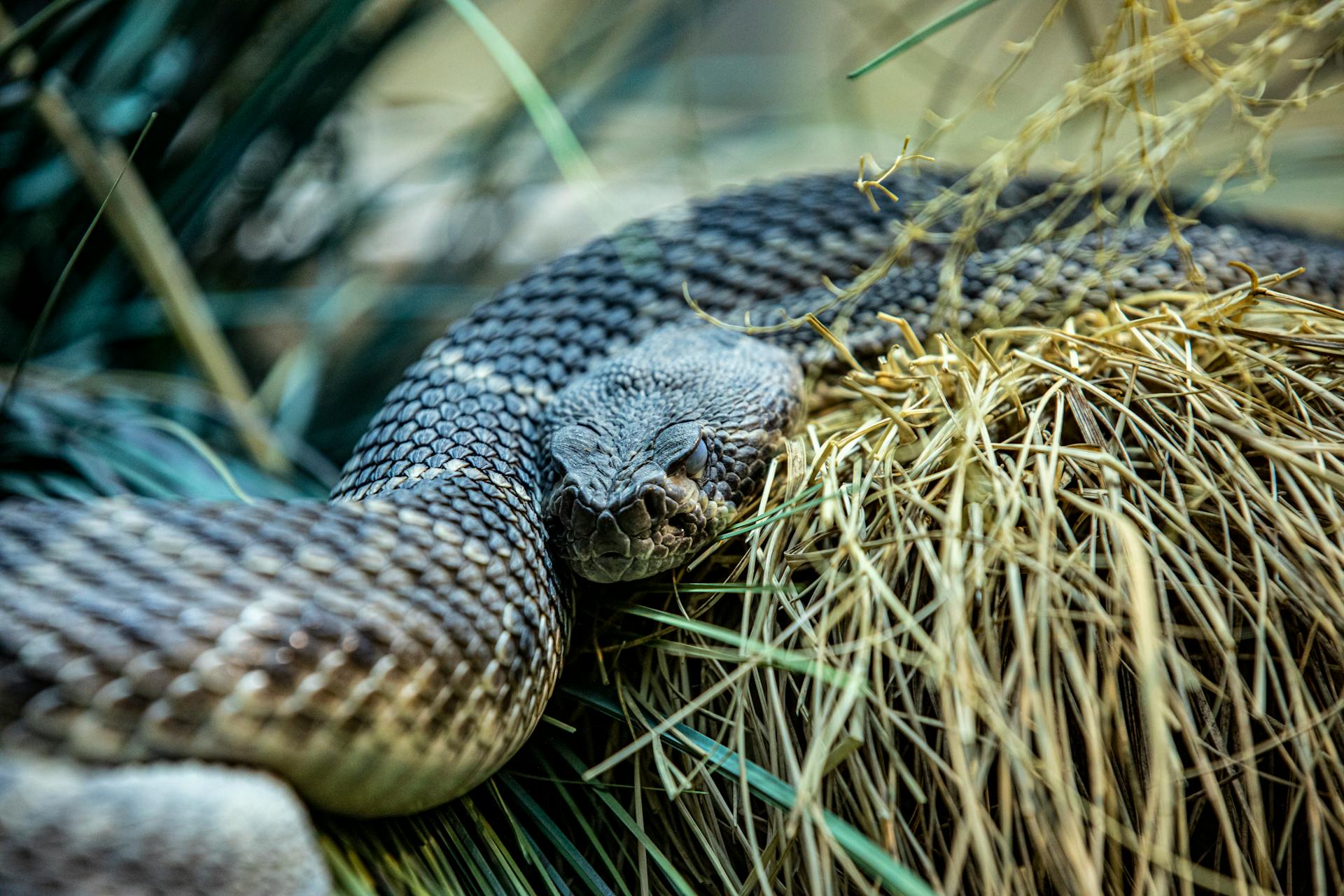
The bullsnake, also known as Pituophis catenifer sayi, is a non-venomous snake species native to North America.
They can grow up to 8 feet in length and weigh up to 5 pounds.
Bullsnakes are known for their distinctive appearance, with a brown or grayish-brown coloration and a pattern of darker blotches.
Their diet consists mainly of small mammals, such as rodents and rabbits, which they hunt using their keen sense of smell and agility.
Physical Characteristics
Adult bullsnakes can grow up to 8 ft 4 in (2.5 m) in length, with some specimens reaching an impressive 110 in. (279 cm.).
Their weight can range from 1–1.5 kg (2.2–3.3 lb), but heavier specimens can tip the scales at 3.6–4.5 kg (7.9–9.9 lb).
The scales of an adult bullsnake are strongly keeled, meaning they have a longitudinal ridge on each scale.
The color of an adult bullsnake's head is normally the same as the surrounding ground, with dark straight lines running through the top labial scales.
Curious to learn more? Check out: Adult California Kingsnake
A dark line stretches diagonally from the eyes to the posterior part of the throat, while dark patches on the back can extend from the neck to the tip of the tail.
These patches can be dark brown to almost black, and may even fade to a dull color towards the tail, although in some cases they can be nearly red.
Tiny spots can be found on the sides of the snake.
Bullsnakes have a unique scale count that can help distinguish them from other juvenile gopher snakes.
They typically have 33 ‒ 66 dark dorsal blotches on the body, usually 41 or more, and 9 ‒ 19 on the tail.
The dorsal scale rows range from 27 ‒ 37 at midbody, usually 29, 31, or 33.
A large, narrow rostral scale (the scale at the tip of the nose) is a distinguishing feature of bullsnakes, protruding above adjacent scales and giving the snout a relatively pointed appearance when viewed from above.
Expand your knowledge: Red Tail Boa Constrictor Snake
Habitat and Behavior
Bullsnakes are quite defensive and have a reputation for their perceived "bad attitude". They're known to rear up and make themselves look as large as possible when threatened.
Their primary defense is to lunge and backtrack at the same time in an attempt to escape. They're often mistaken for rattlesnakes due to their similar coloration and dorsal pattern.
Bullsnakes are experts at mimicking rattlesnakes, even going so far as to vibrate their tail rapidly amongst the brush or leaves to create a convincing "rattle" sound. They'll also flatten their head to take on a more triangular shape, making them almost indistinguishable from the real thing.
Geographic Range
The bullsnake's geographic range is quite extensive, covering a vast area from southern Saskatchewan and Alberta, Canada, south into Mexico, including Nuevo León and Tamaulipas.
It's found in many states in the US, including Colorado, Illinois, Indiana, Iowa, Kansas, Minnesota, Missouri, Montana, Nebraska, New Mexico, North Dakota, Oklahoma, South Dakota, Texas, Wisconsin, and Wyoming.
Broaden your view: Reptiles in South America
This snake's habitat is diverse, spanning across the Great Plains and parts of the Midwestern United States.
Here's a breakdown of the specific regions where you can find the bullsnake:
- Canada: Western Canada, specifically southern Saskatchewan and Alberta
- United States: Colorado, Illinois, Indiana, Iowa, Kansas, Minnesota, Missouri, Montana, Nebraska, New Mexico, North Dakota, Oklahoma, South Dakota, Texas, Wisconsin, and Wyoming
- Mexico: Nuevo León, Tamaulipas, San Luis Potosi, Veracruz, and Hidalgo
Behavior
Bullsnakes are quite defensive and known for their perceived "bad attitude". They can be aggressive and posturing due to feeling threatened.
Most bullsnakes will rear up and make it look as large as possible when threatened by anything as large as a human. They then begin lunging and backtracking at the same time in order to escape.
Bullsnakes often get mistaken for rattlesnakes and killed by laypersons due to their similar coloration and dorsal pattern. This is because they superficially resemble the Western Diamondback Rattler.
To scare away threats, bullsnakes will hiss and forcibly exhale through a bisected glottis, producing a very convincing "rattle" sound. They'll also take on a rattlesnake-like "S-curve" body posture, as if they're going to strike.
Bullsnakes will commonly vibrate their tail rapidly amongst the brush or leaves, and flatten their head to make it take on a more characteristic triangular-shaped head of the rattlesnake. This is all part of their impressive rattlesnake mimicry.
In contrast to rattlesnakes, bullsnakes tend to keep their tail in contact with the ground, in order to beat it against something to make a sound. This is a key difference between the two species.
Diet
Bullsnakes are carnivores and their diet consists of small mammals like mice, rats, and ground squirrels.
They also eat ground nesting birds, birds' eggs, and lizards.
In fact, juvenile bullsnakes primarily feed on small lizards, frogs, and baby mice.
For more insights, see: Ground Squirrel California
Conservation and Care
Pituophis catenifer sayi requires a specialized habitat with loose, dry soil and sparse vegetation to thrive in the wild.
To create a suitable enclosure for a pet pituophis catenifer sayi, a minimum of 2x3x4 feet in size is recommended, with a temperature range of 75-85°F (24-29°C) and a humidity level of 30-50%.
A diet rich in small mammals, such as mice and rats, is essential for the pituophis catenifer sayi's survival and growth, with juveniles requiring more frequent feeding than adults.
Recommended read: Pituophis Catenifer Catenifer
Bullsnake Enclosures
Bullsnakes need a large enclosure to move around, with a minimum size of 8x4x4 feet.
Providing a secure and escape-proof enclosure is crucial to prevent the bullsnake from escaping or getting injured.
A substrate of deep sand or gravel is ideal for burrowing, which is a natural behavior for bullsnakes.
A temperature range of 75-85°F (24-29°C) is recommended for bullsnakes, with a basking spot at 90°F (32°C).
Bullsnakes are nocturnal, so they don't need UVB lighting, but a photoperiod of 10-12 hours of light and 12-14 hours of darkness is still recommended.
Bullsnakes are carnivores and need a diet rich in mice, rabbits, and other small mammals.
Breeding
Breeding is a crucial aspect of Bull Snakes' life cycle. They breed in March, with some females laying eggs in September as well.
In the wild, Bull Snakes typically lay 12 eggs in unsafe locales, such as in the sand. The eggs are then left to incubate.
A clutch of Bull Snake eggs can have anywhere from 5 to 122 eggs. Each egg is 70 mm (23/4 in.) long and has an elliptical shape.
After incubation, the eggs hatch in the eighth or ninth month. The little Bull Snakes that hatch are usually around 20 to 46 centimeters (8 to 18 in) in length.
Scientific Classification
The Bull Snake, scientifically known as Pituophis Catenifer Sayi, has a complex classification. It belongs to the Kingdom Animalia.
The Bull Snake's classification can be broken down into several categories. Here's a breakdown of its taxonomic hierarchy:
Frequently Asked Questions
Is pituophis catenifer poisonous?
No, Pituophis catenifer is a non-venomous species of snake, meaning it is not poisonous to humans.
Featured Images: pexels.com