The Phoenicoparrus jamesi, also known as the James's flamingo, is a unique bird species. It's found in the Andes mountain range in South America, specifically in Chile and Argentina.
These birds are known for their striking pink feathers, which get their color from their diet rich in beta-carotene. They're a type of flamingo, but they're actually quite different from the more well-known Caribbean flamingo.
James's flamingos live in shallow lakes and salt pans, where they feed on small crustaceans, algae, and plankton. They're social birds that often live in large colonies.
In the wild, James's flamingos can live up to 30 years, which is impressive for a bird of their size.
Physical Description
James's flamingos are a unique species within the Phoenicopteridae family, with some distinct physical characteristics. They are typically pale pink in color, with some black flight feathers and bright crimson streaks around their necks and on their backs.
One of the most notable features of James's flamingos is their bright yellow bills with black tips, which are smaller than those of other species. Their deep crimson patches around their eyes are also a distinguishing characteristic.
James's flamingos stand at approximately 0.9 to 1.0 m in height, weighing 1.5 to 3.0 kg with a 1.0 to 1.6 m wingspan. Their small size can make it difficult to distinguish them from immature Andean flamingos.
Their bills are at least 1.5 cm shorter than that of other species, and they have exceedingly narrower upper jaws, measuring a mere 0.55 cm. This is less than one-half the average width of flamingos.
Here's a summary of James's flamingo's physical characteristics:
- Height: 0.9 to 1.0 m
- Weight: 1.5 to 3.0 kg
- Wingspan: 1.0 to 1.6 m
- Bill length: at least 1.5 cm shorter than other species
- Upper jaw width: 0.55 cm
It's worth noting that James's flamingos are endothermic, meaning they regulate their own body temperature, and have bilateral symmetry.
Habitat and Distribution
James' flamingos are found in the high-altitude Andean plateaus, where they thrive in the unique ecosystem of this region. This habitat is characterized by shallow, saline lakes that are conducive to their feeding behaviors.
Their average habitat elevation is approximately 4000 meters above sea level, but they can be found in tropical regions in South America at lower elevations. In fact, they can migrate to as low as 2300 meters above sea level in the non-breeding season.
James' flamingos are adaptable birds, and they can be found in various aquatic biomes, including rivers and streams, temporary pools, and brackish water. They also inhabit wetlands, specifically marshes.
Here are some key facts about the habitat and distribution of James' flamingos:
- Habitat Regions: tropical, saltwater or marine, freshwater
- Aquatic Biomes: rivers and streams, temporary pools, brackish water
- Wetlands: marsh
They breed on the high Andean plateaux of Peru, Chile, Bolivia, and Argentina.
Behavior and Diet
Phoenicoparrus jamesi, or James's flamingo, is a specialized filter feeder that consumes diatoms and other microscopic algae. Their unique feeding method involves using a deeply keeled bill and numerous lamellae to trap food particles.
They primarily feed in shallow waters, often stirring up food with their webbed feet. This feeding behavior allows them to efficiently gather food particles from the water.
Home Range
James' flamingos likely have relatively small home ranges as they nest colonially in close proximity to others.
Their exact territory size is currently unknown, but nesting in groups suggests they don't need a lot of space to feel secure.
This social behavior is a key part of their home range, as they rely on the safety and support of their fellow flamingos to thrive.
Breeding
Breeding begins at 6 years of age, with the frequency being irregular.
The female lays a single egg on a mud nest, which both parents incubate for 26-31 days.
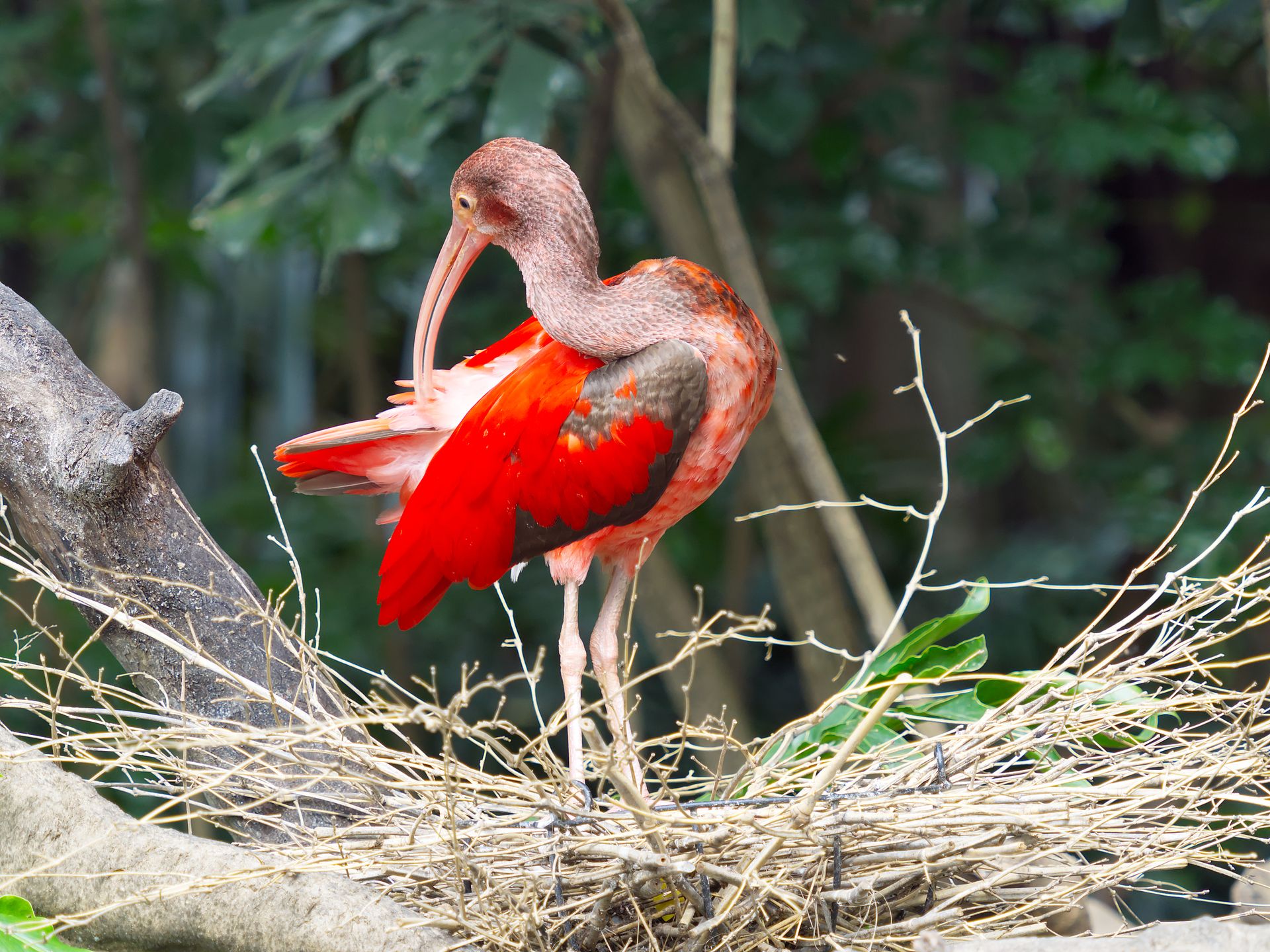
Chicks are born with straight, red bills and grey and white feathers, which later develop into the curved bill and adult plumage.
Diet and Feeding
James's flamingo is a specialized filter feeder, consuming diatoms and other microscopic algae.
They have the finest filter-feeding apparatus among their kin, with a deeply keeled bill and numerous lamellae for trapping food particles.
Feeding primarily in shallow waters, they often stir up food with their webbed feet.
Predation
James' flamingos have a unique defense mechanism against predators. They live in large groups, which acts as an anti-predation mechanism.
Humans are actually the main predators of James' flamingos, collecting and selling their eggs for food. This is a significant threat to their population.
In fact, humans are the only known predators of James' flamingos.
Classification and Taxonomy
The Phoenicoparrus jamesi, also known as James's flamingo, belongs to the kingdom Animalia.
Within the kingdom Animalia, Phoenicoparrus jamesi is classified under the phylum Chordata, which includes chordates.
Phoenicoparrus jamesi is a vertebrate, classified under the subphylum Vertebrata.
Here's a breakdown of Phoenicoparrus jamesi's classification:
- Kingdom: Animalia
- Phylum: Chordata
- Subphylum: Vertebrata
- Class: Aves
- Order: Phoenicopteriformes
- Family: Phoenicopteridae
- Genus: Phoenicoparrus
- Species: Phoenicoparrus jamesi
It's worth noting that Phoenicoparrus jamesi is a monotypic species, meaning it is the only species within its genus.
Sclater, 1886
In 1886, Philip Sclater proposed the term "fauna" to describe the animal inhabitants of a region.
This term was first used in a paper titled "Further Observations on the Fauna of the Lower Miocene Strata of Bengal." Sclater's work laid the groundwork for modern taxonomy.
Sclater's idea of a fauna was a collection of animals that lived in a specific geographic area, such as a country or region.
This concept is still used today in ecology and biology, helping us understand the diversity of life on Earth.
By grouping animals by their geographic range, Sclater's faunal concept allowed scientists to identify patterns and relationships between species.
Sclater's work had a lasting impact on the field of taxonomy, influencing how scientists classify and understand the natural world.
Taxonomy
Taxonomy is the way we organize living things into groups based on their characteristics and relationships. This helps us understand how different species are connected and how they evolved over time.
The James's flamingo, for example, is a monotypic species, which means it's the only one in its genus. This is a unique characteristic that sets it apart from other birds.
The James's flamingo is related to the Chilean Flamingo and the Andean Flamingo, which are both part of the Phoenicopteridae family. This family includes several species of flamingos, each with their own distinct characteristics.
Here's a breakdown of the James's flamingo's taxonomy:
- Genus: Phoenicoparrus (Andean flamingos)
- Species: Phoenicoparrus jamesi (James's flamingo)
- Family: Phoenicopteridae (flamingos)
- Order: Phoenicopteriformes (flamingos)
- Class: Aves (birds)
- Subphylum: Vertebrata (vertebrates)
- Phylum: Chordata (chordates)
- Kingdom: Animalia (animals)
Category
Category is a way to group similar things together, like a filing system. It's a crucial part of classification and taxonomy.
A category can have subcategories, which are smaller groups within the category. For example, the category "Phoenicoparrus jamesi" has 3 subcategories.
Subcategories can be further divided into even smaller groups, such as "Phoenicoparrus jamesi (captive)" and "Phoenicoparrus jamesi (illustrations)".
Categories can also be classified into larger groups, such as "Species of Phoenicopteridae" and "IUCN Near Threatened species". This helps us understand the relationships between different categories.
Here's a breakdown of the subcategories of "Phoenicoparrus jamesi" and their characteristics:
- Phoenicoparrus jamesi (captive) - 1 subcategory
- Phoenicoparrus jamesi (illustrations) - 3 files
Similar Species
In the world of classification and taxonomy, understanding similar species is crucial. James's flamingo is similar to the Andean and Chilean flamingos.
One key difference is its lighter plumage. The Andean and Chilean flamingos have a more vibrant coloration compared to James's flamingo.
James's flamingo can be distinguished by its smaller size. This is noticeable when compared to its similar species, the Andean and Chilean flamingos.
Its bill coloration and structure are also distinct. James's flamingo has a finer bill structure, which sets it apart from its similar species.
Conservation and Ecology
Phoenicoparrus jamesi, also known as James' flamingo, is a species that's facing some serious threats to its survival. It's classified as Near Threatened on the IUCN Red List, which means conservation efforts are necessary to protect it.
One of the main reasons for its threatened status is habitat destruction by humans and environmental factors that impact the availability of its food sources. In fact, climate change is affecting diatom abundance, which is a crucial food source for James' flamingos.
Conservation efforts are underway to protect this species and its habitat. The Eduardo Avaroa National Faunal Reserve in Bolivia is already being protected, and international and national conservation programs have been set up in each of the four countries where P. jamesi is endemic.
Here are some conservation efforts that have been put in place:
- Yearly surveys during the breeding season to monitor the population
- Increasing the protected area to include common habitats found in Argentina
- Amalgamating the management of sites in each country to preserve breeding colonies and frequented areas
- Identifying James' flamingos as Natural Monuments in Argentina for added protection
By understanding the conservation status of Phoenicoparrus jamesi and the efforts being made to protect it, we can better appreciate the importance of preserving this species and its habitat.
Conservation Status
James' flamingos are classified as Near Threatened, a status that was first assigned by the IUCN in 2008.
The primary threats to their survival include habitat destruction by humans and environmental factors that impact the availability of their food sources. Climate change, in particular, is affecting diatom abundance, resulting in less available food for James' flamingos.
Conservation efforts are in place to protect this species and its habitat. The Eduardo Avaroa National Faunal Reserve in Bolivia is already being protected to conserve James' flamingos in this region.
Several conservation programs have been set up in the four countries where James' flamingos are endemic, including international and national programs. These programs aim to continuously monitor the population and increase the region of the currently protected area to include common habitats found in Argentina.
Here are some key conservation facts about James' flamingos:
- Classified as Near Threatened by the IUCN
- Populations declined throughout the twentieth century but have since begun showing signs of improvement
- Conservation efforts include protecting the Eduardo Avaroa National Faunal Reserve in Bolivia and setting up international and national conservation programs
- Key threats include habitat destruction, environmental factors impacting food availability, and climate change
Ecosystem Roles
In areas with high concentrations of James's flamingos, competition for food increases, causing diatoms and aquatic algae populations to deplete at an accelerated rate.
The flamingos' constant stirring of sediment in wetlands not only helps to aerate the water but also provides fertilization through their waste products.
The flamingos' use of wetlands can be beneficial for conservation, as their activities can help maintain the health and biodiversity of these ecosystems.
Their presence in wetlands also highlights the importance of preserving these areas, not just for the flamingos themselves, but for the entire ecosystem.
Species Information
The James's flamingo is a high-altitude dweller of the Andean plateaus.
This species is a smaller counterpart to the Andean flamingo, and is roughly equivalent in size to the lesser flamingo of the Old World.
The James's flamingo has a body length of about 90–92 cm.
Its plumage is a very pale pink, adorned with bright carmine streaks around the neck and back.
The black flight feathers become visible when the bird is perched, contrasting with the otherwise light coloration.
Adult James's flamingos boast yellow eyes surrounded by bright red skin.
Their legs are a brick red hue.
The bill is a striking yellow with a black tip.
Featured Images: pexels.com