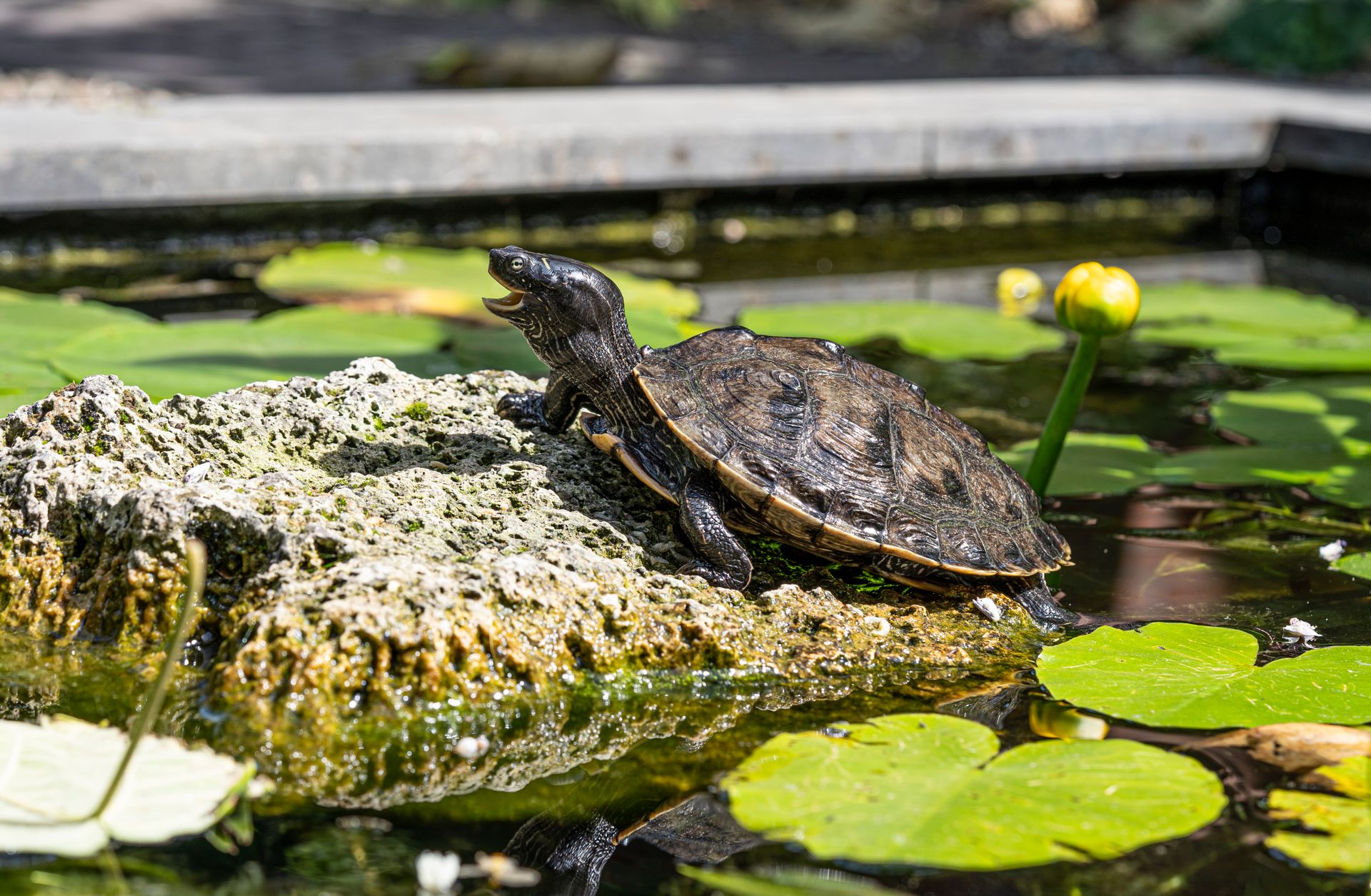
The Pelomedusidae family of turtles is found in sub-Saharan Africa, specifically in the savannas, grasslands, and woodlands of the region. They inhabit areas with still or slow-moving water, such as rivers, lakes, and ponds.
Pelomedusidae turtles are primarily aquatic, spending most of their time in the water. They have webbed feet and can swim efficiently, but they also bask in the sun on rocks or logs.
These turtles are generally solitary animals, only coming together during the breeding season. Males engage in a form of combat to establish dominance and mating rights.
Classification and Taxonomy
The Pelomedusidae family is a group of freshwater turtles found in sub-Saharan Africa. They are classified under the suborder Pleurodira, which is characterized by their unique way of retracting their heads sideways under their shells.
The family Pelomedusidae is more closely related to Podocnemididae, also known as American side-necked river turtles, than to Chelidae, Austro-South American side-necked turtles. This relationship is reflected in their taxonomy.
Here are the two genera and 27 extant species of African side-necked turtles:
- Pelomedusa
- Pelusios
Note that the family Pelomedusidae has undergone revisions in the past, with some species being reclassified or declared extinct. For example, Pelusios seychellensis was once considered a species endemic to the Seychelles, but mitochondrial evidence revealed it was actually the same as the West African side-necked turtle.
Systematics and Taxonomy
The family Pelomedusidae is a group of freshwater turtles that belong to the suborder Pleurodira. They are native to sub-Saharan Africa and are also known as African side-necked turtles.
These turtles have a distinctive way of retracting their heads sideways under their shells, which is how they got their name. This unique characteristic sets them apart from other turtles.
The family Pelomedusidae is more closely related to Podocnemididae, which includes American side-necked river turtles, than to Chelidae, which includes Austro-South American side-necked turtles.
There are two genera within the Pelomedusidae family: Pelomedusa and Pelusios. These genera contain 27 extant species of African side-necked turtles.
Here is a breakdown of the two genera:
- Pelomedusa: This genus includes several species of African side-necked turtles.
- Pelusios: This genus also includes several species of African side-necked turtles.
Pelomedusidae diverged from Podocnemidae at least by the Cretaceous period, which was at least 110 million years ago.
Mashona Hinged
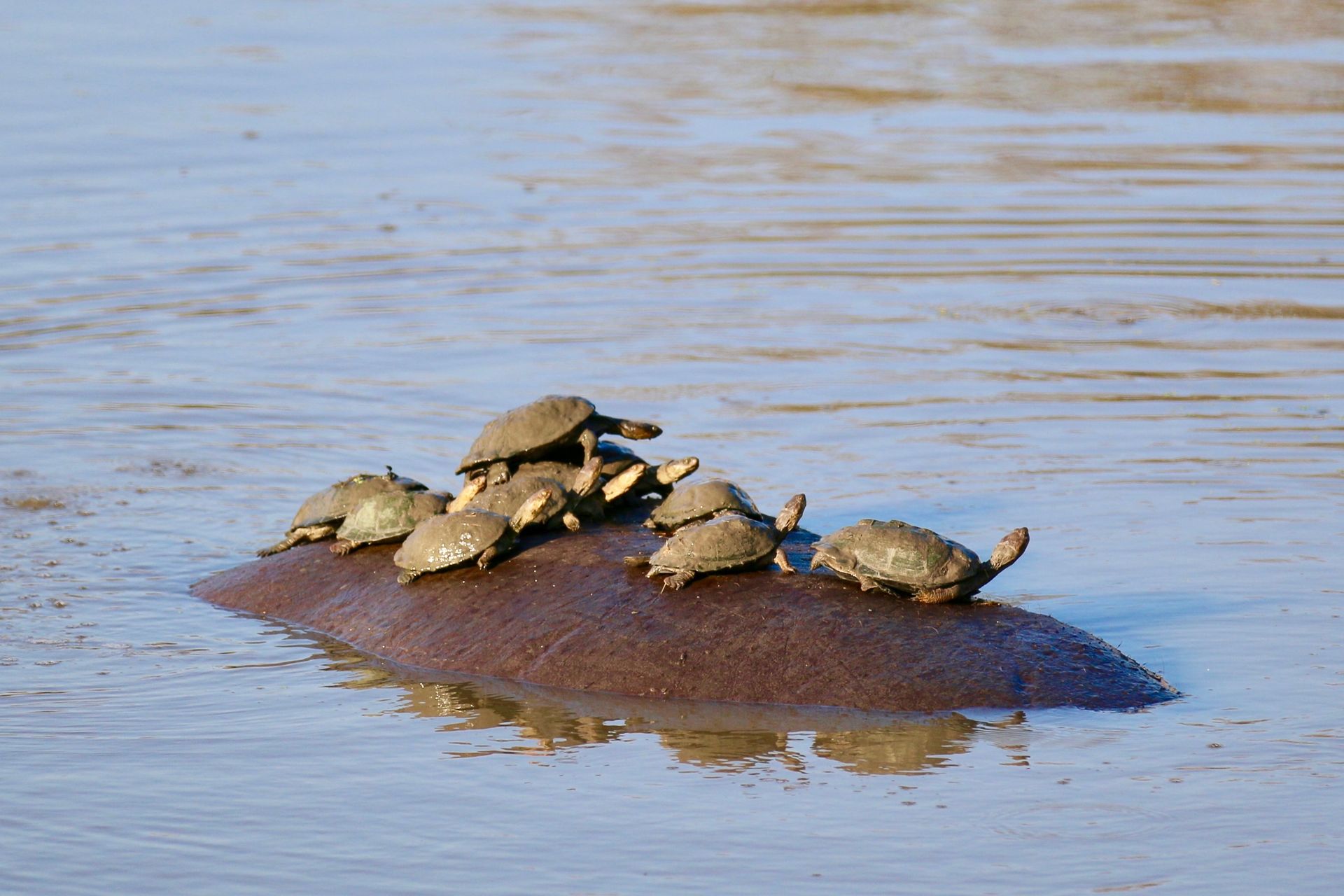
The Mashona Hinged Terrapin is a fascinating species within the Pelusios genus. It's found in various parts of Africa, including Zimbabwe, where it's known for its unique characteristics.
The scientific name of the Mashona Hinged Terrapin is Pelusios rhodesianus, and it's also referred to as the variable mud turtle or Rhodesian mud turtle. This species is part of the subniger group, which includes Pelusios with black plastrons.
One of the distinctive features of the Mashona Hinged Terrapin is its oval and elongated carapace, which is black in coloration. The plastron is also black, although there have been reports of specimens with yellow plastrons or patches.
The Mashona Hinged Terrapin is a relatively large species, with a length of up to 10 inches (25.5 cm).
Here's a breakdown of the Mashona Hinged Terrapin's classification:
- Scientific Name: Pelusios rhodesianus
- Other Common Names: variable mud turtle, Mashona hinged terrapin, and Rhodesian mud turtle
- Length: 10 inches (25.5 cm)
- IUCN Red List Status: Least Concern
Telling East & West Apart
The West African Mud Turtle has a distinctive pattern on the top of its head, which is made up of light to yellow reticulations that are more or less defined.
This pattern is a key identifier that sets it apart from the East African Mud Turtle, which has an unmarked head.
You can also look for a "figure 8" shaped plastron, which is a characteristic shared by both the West African Mud Turtle and the East African Mud Turtle.
A hinged plastron is another feature that both species exhibit, which differentiates them from the African helmeted turtle, which has a fixed plastron.
It's worth noting that females of both species dig nest cavities and lay their eggs in late winter or early spring.
Physical Characteristics
Pelomedusidae turtles are generally small to medium in size, usually less than 12 in (30 cm) in length.
The plastron can be either hinged or unhinged, depending on the species. For example, the Pelusios species has a hinged plastron, while the Pelomedusa species has an unhinged plastron.
Some species have a relatively extensive plastron, while others have a more rigid and firmly attached plastron. The neural series is highly variable, with four to eight present in some species.
Here's a comparison of the shell length of some Pelomedusidae species:
These turtles can be found in a variety of freshwater habitats, from permanent lakes and rivers to streams, marshes, and swamps.
Keeled
Keeled turtles are a type of freshwater turtle that can be found in central Africa. They have a distinctive carapace that is broad and flattened, typically brown to olive in color.
In terms of size, keeled turtles are generally small to medium in length, with a maximum shell length of around 13 inches (33 cm). Their plastron is rigid and firmly attached to the carapace.
A notable feature of keeled turtles is the presence of a pair of small triangular mesoplastral bones between the hyo- and hypoplastra. These bones are widely separated in this species.
Here are some key characteristics of keeled turtles:
- Scientific Name: Pelusios carinatus
- IUCN Red List Status: Least Concern
Keeled turtles are carnivorous and can be found in freshwater bodies in moist savannahs.
Serrated Hinged
The Serrated Hinged Terrapin is one of the largest species of the genus Pelusios, with a carapace length of 16 to 22 inches.
They have a dark-colored carapace, which is black in juveniles and adults with yellow markings around the scutes. Their plastron is yellow and hinged.
Males are smaller than females, but they have longer, thicker tails. The posterior of the terrapin is strongly serrated when young.
Here's a comparison of the carapace lengths of different Serrated Hinged Terrapin species:
The Serrated Hinged Terrapin can be found in rivers and lakes, and they prefer large and permanent water bodies.
Size
Side-necked turtles come in a wide range of sizes, from the tiny African dwarf mud turtle, which reaches only about 4 in (10 cm) in adulthood, to the largest species, the Arrau turtle, which can grow up to 3.5 ft (1.07 m) long and weigh around 200 lb (90 kg).
The African dwarf mud turtle is the smallest of the species, reaching only about 4 in (10 cm) in adulthood. In contrast, the largest side-necked turtle, the Arrau turtle, can grow up to 3.5 ft (1.07 m) long and weigh around 200 lb (90 kg).
Male side-necked turtles typically grow up to 10 inches in length, while females are generally larger.
Here's a comparison of the size range of some side-necked turtles:
The serrated hinged terrapin, specifically, can grow up to 22 inches (55 cm) in length, making it one of the larger species of side-necked turtles.
Distribution and Habitat
Pelomedusidae turtles can be found in various parts of Africa, including the sub-Saharan region, Madagascar, Seychelles, and even some parts of Asia, specifically Yemen.
They inhabit freshwater habitats, such as rivers, lakes, and ponds, but also venture into temporary pools and marshes. In some areas, they can be found in stagnant water bodies, like farm dams and flooded quarries.
Some species, like the African helmeted terrapin, prefer large and permanent water bodies, while others, like the serrated hinged terrapin, can be found in rivers and lakes.
Here's a list of some of the countries where Pelomedusidae turtles can be found:
- Guinea
- Ghana
- Senegal
- Liberia
- Congo
- Angola
- Madagascar
- São Tomé
- Seychelles
- Yemen
- Botswana
- Lesotho
- Mozambique
- Namibia
- South Africa
- Democratic Republic of the Congo
- Zambia
- Zimbabwe
- Eswatini (formerly Swaziland)
- Ethiopia
- Kenya
- Malawi
- South Sudan
- Tanzania
2. Cape
The Cape Terrapin is a fascinating creature that can be found in a variety of habitats across South Africa.
Their scientific name is Pelomedusa galeata, and they can grow up to 8 inches in length.
The Cape Terrapin is quite large, with a regular carapace length of 26 cm.
The largest recorded specimen was 32.5 cm.
They can be found in stagnant water bodies such as farm dams, flooded quarries, and seasonal pans.
These habitats are perfect for the Cape Terrapin, as they avoid forests and mountainous terrains.
The Cape Terrapin is predominantly carnivorous, feeding on insects, snails, worms, and other small aquatic animals.
Occasionally, they will eat water weeds.
The breeding season for the Cape Terrapin begins in late spring to autumn, and gravid females lay up to 30 eggs.
Distribution and Habitat
These turtles can be found in a variety of freshwater habitats, including rivers, lakes, ponds, and marshes. They are often semi-aquatic, spending most of their time in or near water.
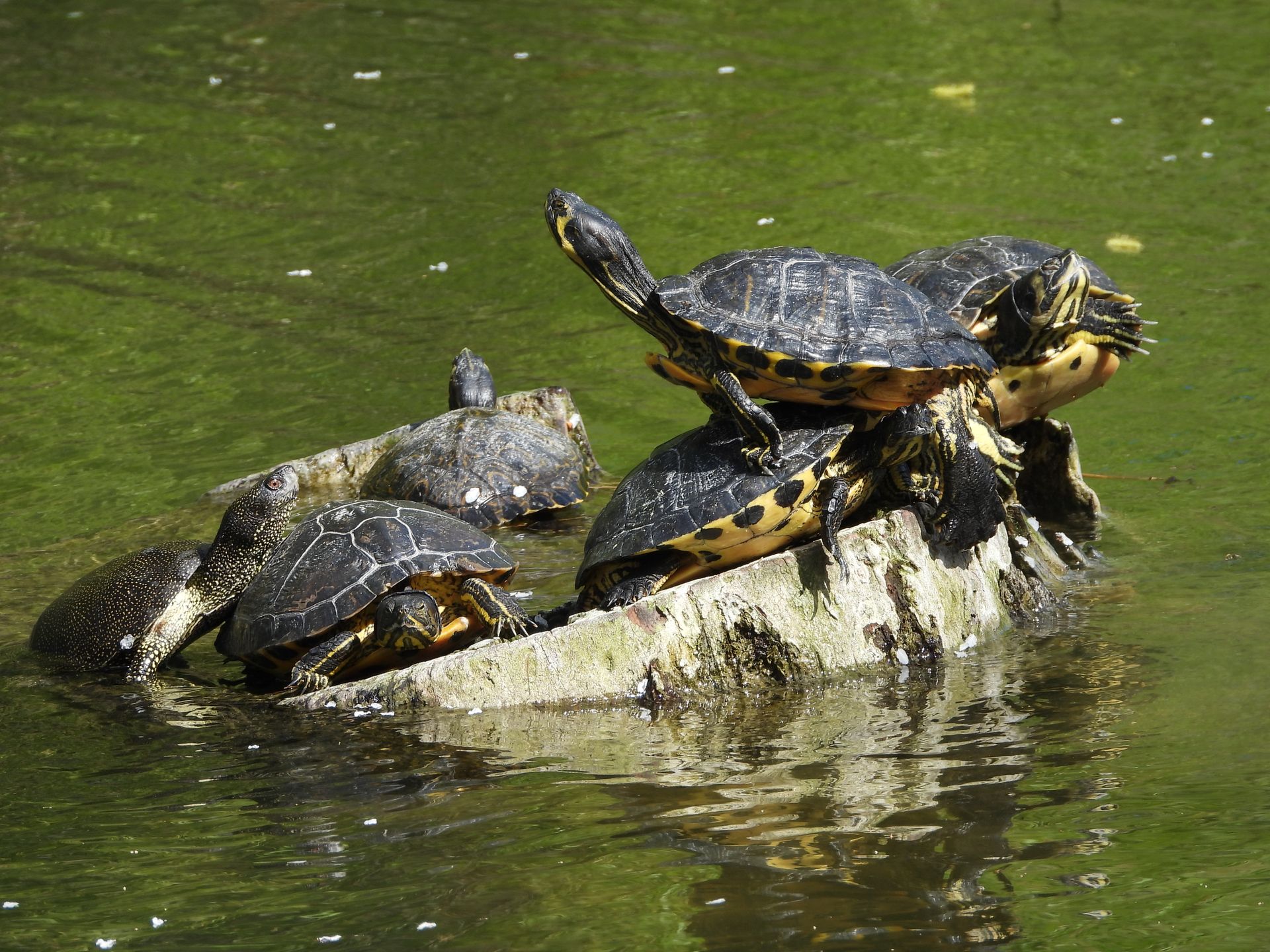
Some species, like the African side-necked turtle, are found in sub-Saharan Africa, while others, like the Cape Terrapin, are found in southern Africa. The Cape Terrapin can be found in countries such as South Africa, Eswatini, and Mozambique.
The Lake Turkana Hinged Terrapin is confined to Lake Turkana, giving it its name. It's found in the Kenyan portion of the lake and may also occur in the Ethiopian portion.
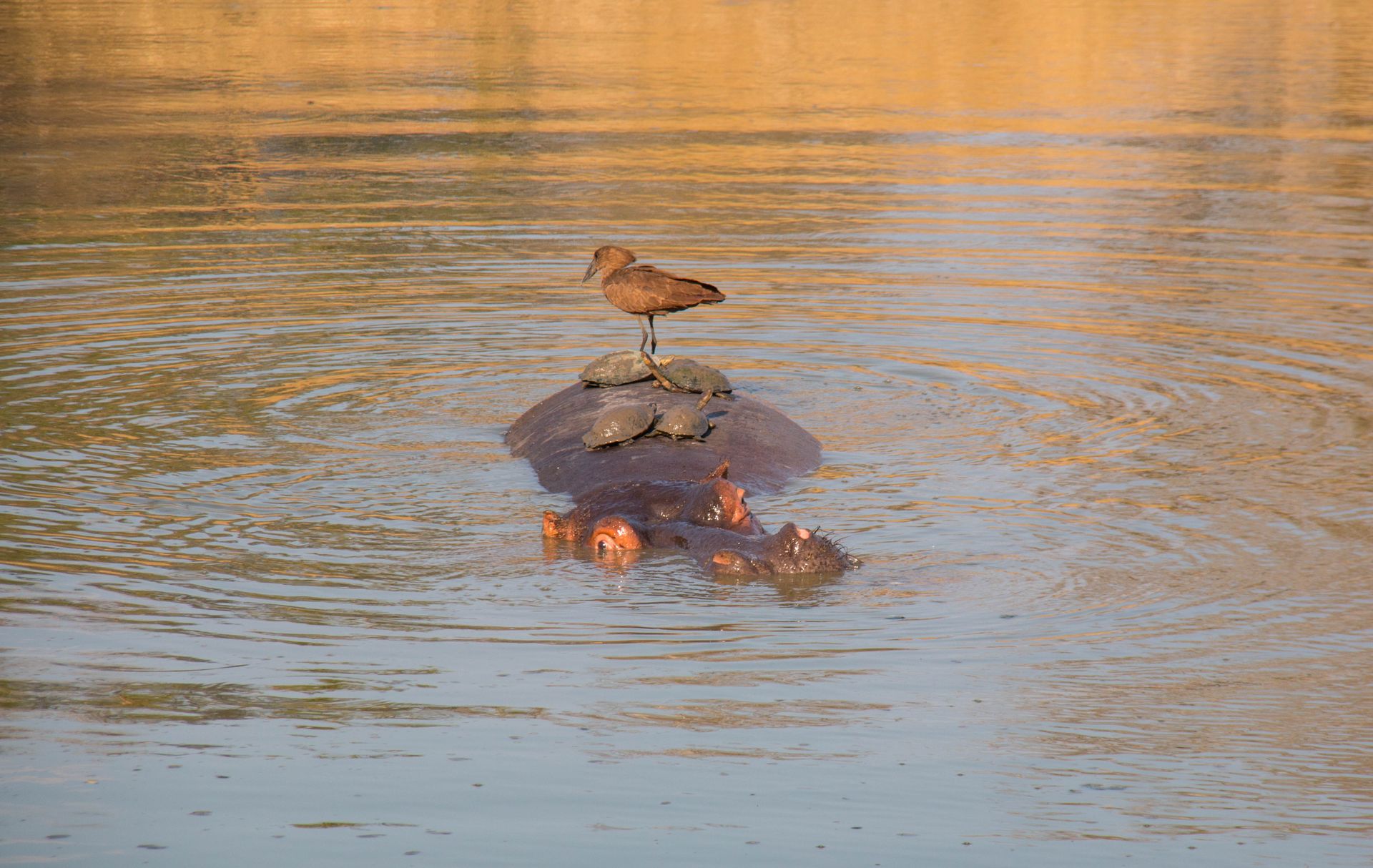
In general, these turtles prefer permanent water bodies, but some species, like the Serrated Hinged Terrapin, can be found in rivers and lakes. They often bask on mud banks, rocks, logs, and even on hippopotami.
Some species, like the Okavango Mud Turtle, are found in clear but deep portions of rivers and vegetation-choked swamps. They are semi-aquatic and can be found in an aquatic habitat most of the time.
Here are some examples of the different habitats where these turtles can be found:
- Rivers: African side-necked turtle, Serrated Hinged Terrapin
- Lakes: Lake Turkana Hinged Terrapin, Okavango Mud Turtle
- Ponds: Cape Terrapin
- Marshes: African side-necked turtle
- Swamps: Okavango Mud Turtle
Species and Subspecies
The Pelomedusidae family is home to several species and subspecies of mud turtles. The East African Black Mud Turtle (P. subniger) is a moderately sized species, reaching a carapace length of 20 cm or 8 inches, and is endemic to East Africa and the Seychelles.
This species has two subspecies: P. s. subniger and P. s. parietalis. P. s. parietalis is critically endangered, with less than 250 adults remaining, and is found only in the Seychelles.
The Seychelles Yellow-bellied Mud Turtle (P. castanoides) is another species within the Pelomedusidae family. It has two recognized subspecies: P. c. castanoides and P. c. intergularis. Both subspecies have unique carapace colorations, with P. c. castanoides having a black, olive, or yellow carapace, and P. c. intergularis having a dark carapace with a veined or mottled pattern of brown and yellow.
Here is a list of the species and subspecies mentioned:
- P. subniger (East African Black Mud Turtle)
- P. s. subniger (East African black mud turtle subspecies)
- P. s. parietalis (Seychelles black mud turtle subspecies)
- P. castanoides (Seychelles Yellow-bellied Mud Turtle)
- P. c. castanoides (East African yellow-bellied mud turtle subspecies)
- P. c. intergularis (Seychelles yellow-bellied mud turtle subspecies)
Genus Pelomedusa
Genus Pelomedusa is a fascinating group of turtles that can be found in various parts of Africa. They are also known as African helmeted terrapins.
Some species of Pelomedusa can grow quite large, with the largest recorded African helmeted turtle reaching over a foot in carapace length. They have a dark-colored carapace and a yellowish plastron.
Pelomedusa turtles are omnivores and feed on a variety of food sources, including insects, snails, worms, and even small birds. They also consume plant matter occasionally.
One of the most interesting things about Pelomedusa turtles is their preference for stagnant freshwater bodies. They can be found in dams, pans, swamps, and lakes, and are rarely found in areas that are arid, forested, or mountainous.
Here's a list of some of the species within the genus Pelomedusa:
- African helmeted terrapin (Pelomedusa subrufa)
- East African black mud turtle (Pelomedusa subniger)
- Seychelles yellow-bellied mud turtle (Pelusios castanoides)
These turtles are found in various parts of Africa, including East Africa, South Africa, and the Seychelles islands. They are also known to inhabit Madagascar and southern Yemen.
Dwarf
The term "Dwarf" in the context of species refers to a group of creatures that are significantly smaller than their counterparts. The African Dwarf Mud Turtle, for instance, is one of the smallest turtle species in Africa, measuring just 4 inches in length.
Discover more: African Helmeted Turtle
This tiny turtle can be found in Central Africa, specifically in countries such as the Democratic Republic of the Congo, Angola, Malawi, and Zambia. Its brownish carapace with black streaks is quite distinctive.
The African Dwarf Mud Turtle's coloration is not just limited to its carapace; its entire body is brown to black in color. In fact, males have a longer, thicker tail and a more concave plastron, while females have a shorter tail and a flattened plastron.
Here are some key facts about the African Dwarf Mud Turtle:
- Scientific Name: Pelusios nanus
- Length: 4 inches (10 cm)
- Lifespan: 50 years
- IUCN Red List Status: Not Evaluated
Adanson's
Adanson's Mud Turtle is a species found in north-central Africa. Its scientific name is Pelusios adansonii.
This turtle can be found in 12 countries including Sudan, South Sudan, Senegal, Nigeria, Niger, Mauritania, Mali, Ethiopia, Chad, Central African Republic, Cameroon, and Benin.
It has a tan carapace with brown markings, and a lightly colored plastron, usually yellowish.
There are at least three separate subpopulations of this species.
This species is not listed as endangered on the IUCN Red List, but it is still hunted and its habitats are being degraded due to agricultural developments.
Behavior and Ecology
Pelomedusidae turtles are quite the travelers, often migrating overland between bodies of water. This means you'll frequently spot them on land or basking at the water's edge.
They're also surprisingly resilient, able to estivate in mud for extended periods until the next rains come. In southern Africa, they even hibernate terrestrially in the ground or under leaves during the winter.
Adult helmeted turtles tend to be more active at dawn or night, but their young ones forage day and night, which is quite a difference in behavior.
Feeding Ecology and Diet
African Mud Turtles are primarily carnivorous, feeding on a wide variety of prey including annelids, mollusks, crustaceans, insects, fish, amphibians, and carrion.
As they grow, some Mud Turtles become at least partly herbivorous, eating water lettuce, aquatic grasses, or fruits. They've even been known to attack larger prey, such as birds, as a group, and feed on the ticks on the hide of rhinoceroses when they enter waterholes.
In captivity, it's essential to provide a balanced diet that includes commercial floating turtle sticks, supplemented with more carnivorous fare like crickets, earthworms, and snails. This will help ensure your turtle gets the nutrients it needs to thrive.
Adult Mud Turtles tend to feed mostly at dawn or during the night, but hatchlings forage day and night, so it's essential to provide a varied diet that meets their changing needs. Strong, semi-webbed feet with sharp nails aid the turtle in climbing and ripping food items apart.
To support your turtle's calcium needs, it's a good idea to provide a cuttlebone in the habitat, allowing it to self-regulate its intake. You can also sprinkle reptile calcium often over food to ensure they're getting enough.
Reproductive Biology
Reproductive biology is a fascinating topic, and for this family of species, it's still a bit of a mystery.
Most species apparently nest in late spring or summer, from October to January.
The eggs are quite unique, with elongate shapes and leathery shells.
Clutch sizes can range from six to 48, which is a pretty big variation.
It's likely that some species can have multiple annual clutches, but this hasn't been confirmed yet.
Temperature-dependent sex determination is a common trait among these species, where warm temperatures produce females and cooler temperatures produce males, with intermediate temperatures producing mostly males.
Conservation and Status
The conservation status of Pelomedusidae is a bit of a mixed bag. Most of the species within this family haven't had their conservation status adequately assessed.
The only two species listed as Vulnerable on the IUCN Red List are Pelusios broadleyi in Lake Turkana in Kenya, and P. seychellensis in the Seychelles. These species have restricted distributions, which might contribute to their vulnerable status.
Human impact hasn't been extensive on species that are widespread and adaptable, like the one that benefits from pond and waterhole construction for livestock and wildlife. This construction has actually provided new habitats for the species.
No species within the family Pelomedusidae is designated as endangered, but one subspecies, P. s. parietalis, is critically endangered with fewer than 250 adults remaining.
Conservation Status
The conservation status of the Pelomedusidae family is a complex issue. Most of the species have not been adequately assessed.
Only two species are listed as Vulnerable on the IUCN Red List: Pelusios broadleyi in Lake Turkana in Kenya, and P. seychellensis in the Seychelles.
The widespread distribution of one species across Africa has actually benefited it, with human impact being minimal. This is due to the construction of ponds and waterholes for livestock and wildlife.
No species within the family Pelomedusidae is designated as endangered. However, a subspecies, P. s. parietalis, is considered critically endangered with less than 250 adults remaining.
With more data, it's likely that the conservation statuses of many species in this family would change.
Lifespan
African side-necked turtles are long-lived animals, with a lifespan that can easily span a few decades in the wild. They can live over 50 years in captivity and with proper care.
Their longevity is a testament to their adaptability and resilience as a species. In the wild, they face numerous challenges, including habitat loss and predation, yet they continue to thrive.
Living over 50 years in captivity is a remarkable feat, especially when you consider the proper care and conditions required to support their health and well-being. This highlights the importance of responsible turtle ownership and conservation efforts.
Suggestion: Nile Monitor Lizard Care
Featured Images: pexels.com