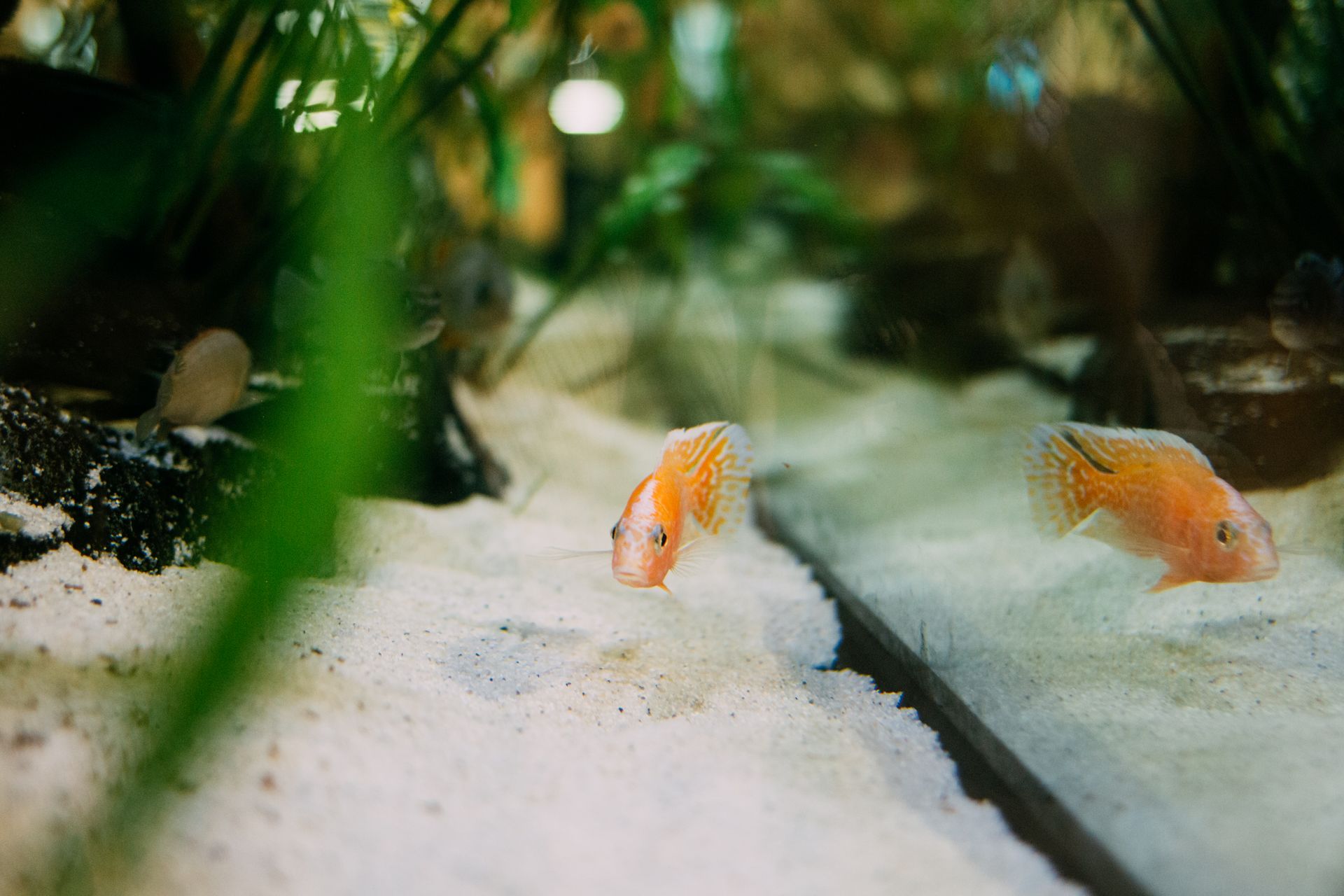
The Madagascar Cichlid genus, Paretroplus, is a group of fascinating fish that call the island of Madagascar home.
Paretroplus species are found in the rivers and streams of Madagascar, where they inhabit a variety of aquatic environments, from slow-moving waters to fast-flowing rivers.
These fish are quite diverse, with over 20 species identified within the genus, each with unique characteristics and adaptations to their specific environments.
One of the most interesting things about Paretroplus is their ability to thrive in a range of water conditions, from acidic to alkaline, and from warm to cool temperatures.
Broaden your view: Lake Malawi Fish
Species and Classification
The Paretroplus genus consists of 13 recognized species, with an additional undescribed species from the P. damii–loisellei species group found in northwestern Madagascar.
The Paretroplus genus can be divided into several clades, with the clade including P. lamenabe, P. nourissati, and P. tsimoly considered worthy of placement in their own genus Lamena. This clade also includes P. damii and P. loisellei.
Here is a list of the 13 recognized species of Paretroplus:
- Paretroplus dambabe
- Paretroplus damii
- Paretroplus gymnopreopercularis
- Paretroplus kieneri
- Paretroplus lamenabe (Big red cichlid)
- Paretroplus loisellei
- Paretroplus maculatus
- Paretroplus maromandia
- Paretroplus menarambo
- Paretroplus nourissati
- Paretroplus petiti
- Paretroplus polyactis
- Paretroplus tsimoly
The Paretroplus genus belongs to the family Cichlidae and the subfamily Etroplinae, and is found in freshwater environments in Madagascar.
Description
The Paretroplus genus is made up of 13 species, 5 of which have been described in the 21st century. These species are found in rivers and lakes of Madagascar.
Paretroplus species range in length from 15 to 40 cm. They have a moderately high to very high body in the back, a pointed snout, and a terminal or slightly downturned mouth.
The species living in flowing waters are generally more slender, while those living in stagnant waters are very high. Paretroplus species have a unique characteristic - they have only one row of teeth in each jaw.
Their scales are rounded with smooth edges, and they have numerous spines on their anal fin (7-11). The teeth in their jaw are not numerous, have a single point (unicuspide), are shovel-shaped, and are quite far apart.
Those at the front, especially those on the intermaxillary bone (premaxilla), are larger than those at the back.
Taxonomie Genre
The genus Paretroplus can be divided into several clades, with some species, like P. lamenabe, P. nourissati, and P. tsimoly, considered worthy of placement in their own genus Lamena.
These species are part of a larger clade that also includes P. damii and P. loisellei. There are currently 13 recognized species in the Paretroplus genus, with an undescribed species known from the Ankofia River basin in northwestern Madagascar.
The Paretroplus genus is part of the family Cichlidae, which includes over 1800 species of freshwater fish, mostly from South and Central America, Mexico, and tropical Africa.
Here is a breakdown of the taxonomic classification of the Paretroplus genus:
Geographic Distribution
Paretroplus are found in the rivers and streams of Madagascar, a large island nation off the coast of East Africa. They inhabit freshwater environments, which is a key characteristic of their distribution.
The species are widely distributed throughout the island, with different species found in different regions. For example, Paretroplus griermonti is found in the northern part of the island.
Paretroplus are generally found in areas with slow-moving water and a sandy or rocky substrate. This is because they are a type of catfish that prefers to burrow into the sediment.
A fresh viewpoint: Inaccessible Island Rail
Species
There are currently 13 recognized species in the Paretroplus genus, with an undescribed species known from the Ankofia River basin in northwestern Madagascar.
The genus can be divided into several clades, including the P. lamenabe, P. nourissati, and P. tsimoly clades, which have been considered worthy of placement in their own genus Lamena.
Here are the 13 recognized species in the Paretroplus genus:
- Paretroplus dambabe
- Paretroplus damii
- Paretroplus gymnopreopercularis
- Paretroplus kieneri
- Paretroplus lamenabe
- Paretroplus loisellei
- Paretroplus maculatus
- Paretroplus maromandia
- Paretroplus menarambo
- Paretroplus nourissati
- Paretroplus petiti
- Paretroplus polyactis
- Paretroplus tsimoly
Some of these species are considered to be part of a higher-level clade that also includes P. damii and P. loisellei.
Frequently Asked Questions
What is the lifespan of a pinstripe damba?
The lifespan of a pinstripe damba is 8-12 years with proper care. Proper aquarium maintenance is crucial to maximizing their lifespan.
Featured Images: pexels.com