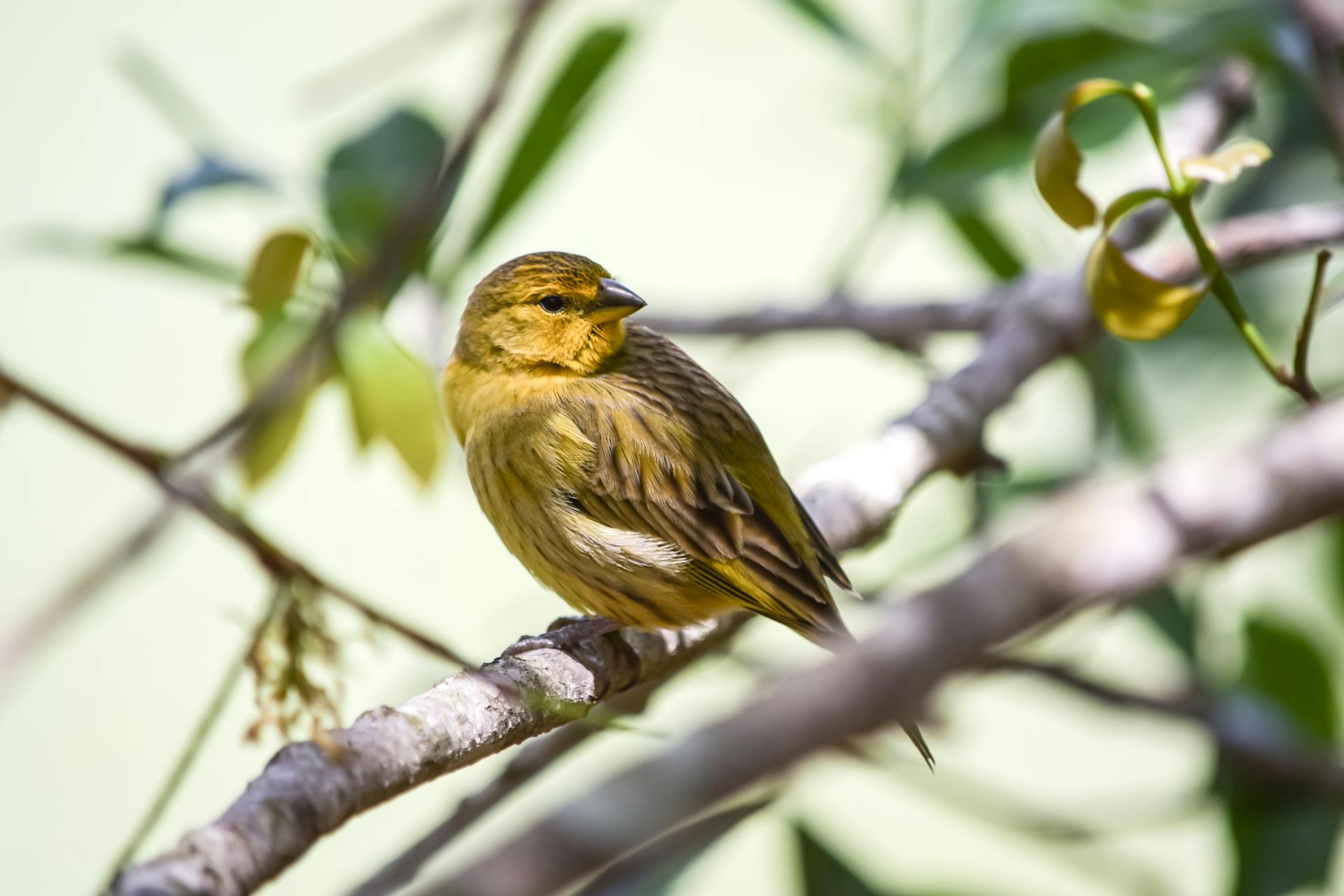
Pardalotes are tiny birds that are native to Australia and New Zealand. They are known for their distinctive calls and are often referred to as "peepers" due to their high-pitched sounds.
These birds are small, ranging in length from 9 to 12 centimeters, and weigh between 6 and 9 grams. They have a distinctive black stripe above their eyes and a greyish-brown back.
Pardalotes are social birds that live in small groups, often with multiple males and females. They are known to form long-term pair bonds, with some pairs staying together for many years.
Physical Characteristics
Pardalotes are noisy, generally bright colored, conspicuous, beautiful, dumpy little birds, with short bills and tails.
They have 12 rectrices and short pointed wings with a vestigial 10th primary.
All have some combination of yellow, brown, and black with white spots or streaking, which gives them the name "diamond bird".
Most species are monomorphic in plumage, with juvenile plumage muted.
The sexes are similar in plumage, with no notable differences.
They typically weigh around 0.38 oz (10.7 g) and measure 3.5–3.9 in (9–10 cm) in length.
Taxonomy and Systematics
The taxonomy and systematics of pardalotes are quite fascinating. The genus Pardalotus was introduced in 1816 by French ornithologist Louis Pierre Vieillot to accommodate a single species, the spotted pardalote, which is considered the type species.
The genus name Pardalotus comes from Ancient Greek, meaning "spotted like a leopard". The family Pardalotidae (as a subfamily Pardalotinae) was introduced in 1842 by English naturalist Hugh Strickland.
Pardalotes consist of four species contained in a single genus, Pardalotus. Genetic analysis has shown that the pardalotes are more closely related to the Acanthizidae family, which includes scrubwrens, gerygones, and thornbills.
The four species of pardalotes are the Spotted Pardalote, the Forty-spotted Pardalote, the Red-browed Pardalote, and the Striated Pardalote. The relationships between the subspecies of these species are unclear, although it is thought that the Forty-spotted Pardalote is closely related to the Spotted Pardalote.
Here is a summary of the four species of pardalotes:
The Striated Pardalote contains six subspecies that are sometimes elevated to four separate species, and one subspecies of the Spotted Pardalote is sometimes treated as a separate species.
Species Accounts
The Pardalote species is quite diverse. The Spotted Pardalote, Pardalotus punctatus, is one of the most well-known species.
There are four main species of Pardalotes. Let's take a closer look at each one.
The Forty-spotted Pardalote, Pardalotus quadragintus, has a unique name that reflects its distinctive appearance. Its name is a bit of a mouthful, but it's a great conversation starter.
Here are the four main species of Pardalotes:
- Spotted Pardalote (Pardalotus punctatus)
- Forty-spotted Pardalote (Pardalotus quadragintus)
- Red-browed Pardalote (Pardalotus rubricatus)
- Striated Pardalote (Pardalotus striatus)
Habitat and Distribution
The pardalotes are endemic to Australia, which means they're found nowhere else in the world. They have a unique distribution, with some species being more widespread than others.
The Forty-spotted pardalote has the most restricted distribution, being endemic to Tasmania. This means you won't find it anywhere else in Australia.
The Striated pardalote, on the other hand, is found throughout Australia, but it's absent from some of the driest areas of the inland central and western deserts. If you're planning a trip to these areas, you might not spot this bird species.
The Red-browed pardalote is widespread in the north and west of Australia, which is a vast region. You can imagine how diverse the habitats must be in this area.
The Spotted pardalote is found closer to the coast in southern and eastern Australia. This species seems to prefer the coastal regions.
Pardalotes are eucalyptus forest specialists, which means they thrive in forests dominated by eucalyptus trees. They occupy a wide range of eucalypt habitats, from tall forests with a canopy over 30 metres high to low mallee woodlands with a canopy of just 3 metres.
Here's a breakdown of the different eucalypt habitats pardalotes can be found in:
- Tall forests with a canopy over 30 metres high
- Low mallee woodlands with a canopy of just 3 metres
These habitats provide the perfect environment for pardalotes to live and thrive.
Behavior and Ecology
Pardalotes are almost exclusively insectivores, making up the majority of their diet.
They will occasionally consume some plant materials, including seeds, but this is not a significant part of their diet.
In fact, there has been a recorded observation of one striated pardalote beating and then eating a lizard, showing their adaptability to different food sources.
During the breeding season, pardalotes tend to forage singly or in pairs.
However, in the winter months, they have been recorded as joining mixed-species feeding flocks, highlighting their social nature.
The majority of foraging occurs on Eucalyptus trees, with other trees being used much less frequently.
Among the eucalyptus, trees from the subgenus Symphyomyrtus are preferred.
Pardalotes forage by gleaning insects from the foliage, as opposed to catching insects while flying.
This unique foraging method allows them to target specific areas, like leaves and twigs, with their scoop-shaped bills.
Lerps, a honeydew casing exuded by insects of the family Psyllidae, form a major component of their diet and the one to which they are most adapted.
In fact, a study of pardalotes in Australia estimated that 5% of a pardalote's day is spent evading honeyeater attacks, which aggressively defend the resource.
Conservation Status
The Forty-spotted Pardalote is listed as Endangered by the IUCN and under Australian legislation.
Its population is small and fragmented, with only about 3,000 birds in six disjunct populations. This decline is likely due to competition with spotted pardalotes.
Habitat loss is a major threat, resulting from land clearing and commercial forestry in native eucalypt forests. This leads to the loss of foraging habitat, nesting hollows, and forest linkages essential for dispersal.
The Forty-spotted Pardalote's distribution is restricted to a narrow habitat range, making it more vulnerable to threats. The Noisy Miner, a colonial honeyeater, is a major competitor for resources.
Parasitism is also a significant threat, with a higher parasite load and virulence found in Forty-spotted Pardalote nests compared to Striated Pardalotes. This leads to high nestling mortality.
The population is expected to stabilize with habitat protection. However, climate change effects are uncertain but anticipated, and may lead to further reductions in the distribution of the Striated Pardalote.
Species Information
The Pardalote is a fascinating bird with four distinct species. The Spotted Pardalote, Pardalote punctatus, is one of the species that can be found in the wild.
These birds are known for their unique characteristics, and the Spotted Pardalote is no exception. It's a small bird with a distinctive spotted pattern.
Four species of Pardalote exist, and they are all worth learning about. The Forty-spotted Pardalote, Pardalote quadragintus, is another species that can be found in the wild.
The Red-browed Pardalote, Pardalote rubricatus, is a striking bird with a distinctive red brow. It's a great example of the diversity within the Pardalote species.
One of the most interesting species is the Striated Pardalote, Pardalote striatus. This bird has a distinctive striated pattern on its back.
Here are the four species of Pardalote, listed out for your convenience:
- Spotted Pardalote, Pardalote punctatus.
- Forty-spotted Pardalote, Pardalote quadragintus.
- Red-browed Pardalote, Pardalote rubricatus
- Striated Pardalote, Pardalote striatus.
Frequently Asked Questions
What is the lifespan of a Pardalote?
Pardalotes typically live up to 4 years in the wild. Their relatively short lifespan is a characteristic shared by many small bird species.
Where do you put a pardalote nesting box?
Place a pardalote nesting box on a sturdy limb of a mature white gum or other eucalypt tree, ideally below the leaf canopy and out of direct sunlight. Clustering boxes in suitable trees is a better option than scattering them widely.
Featured Images: pexels.com