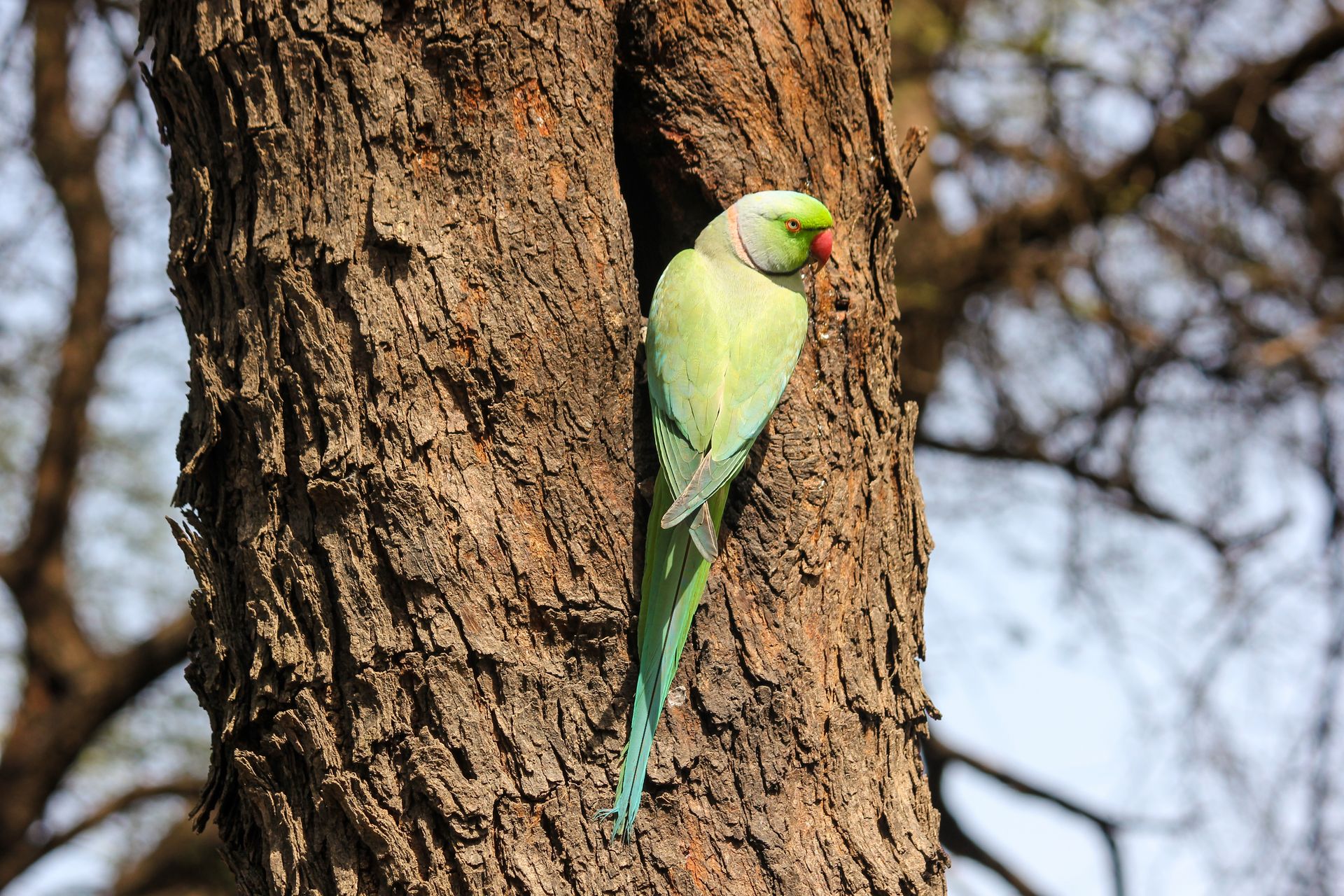
Parakeets in New Zealand have a unique breeding cycle, with most species breeding in the spring and summer months. This is due to the country's temperate climate, which provides optimal breeding conditions.
In the wild, parakeets typically nest in tree cavities or rock crevices, but in captivity, they can be encouraged to breed using a nesting box specifically designed for their species.
Some parakeet species, such as the Indian Ringneck, can be quite aggressive during breeding season, so it's essential to provide a safe and secure environment for both the birds and their human caregivers.
If you're planning to breed parakeets, research the specific needs of the species you're interested in, as some may require special care or housing.
A different take: Parakeets Eat Wild Bird Food
Conservation and Threats
Yellow-crowned parakeets are preyed on by stoats, rats, and possums, particularly while they are nesting and roosting in holes.
Predation rates can be very high during rat and stoat plagues that occur in beech forests following beech mast, leading to low nesting success.
In many places, they are conspicuously rare at low altitudes but more common higher up where rats and perhaps stoats are less common.
Yellow-crowned parakeets are noticeably more abundant on predator-free islands, where they have been successfully translocated to three islands.
Breeding and Behavior
Yellow-crowned parakeets are mostly summer breeders, but they can breed throughout the year when food is abundant, and raise multiple broods. They're quite adaptable when it comes to food availability.
They nest in holes in trees, often in large trees up to 32 meters off the ground, and specifically like to use knot holes. The female lays 2-9 eggs on rotten wood.
The male remains attentive and feeds the female by regurgitation near the nest, showing a clear display of parental care.
Distribution and Habitat
Yellow-crowned parakeets were previously found in forests throughout the main islands of New Zealand and on many offshore islands.
They are still present in most large native forests in the three main islands, though they are absent from Mt Egmont, north Taranaki and Northland.
Yellow-crowned parakeets have been successfully introduced to Mana Island, and to Long Island and Motuara Island in Queen Charlotte Sound.
On the mainland yellow-crowned parakeets are mostly confined to tall forests, but on islands they are also common in low scrub and even open grassland.
In fact, on Mana Island, you can spot them in open grassland, which is quite different from their mainland habitat.
Yellow-crowned parakeets can be found on various islands, including Little Barrier, the Hen and Chickens, the Chetwodes Islands, Titi Island, Codfish Island, and Fiordland.
The Auckland Islands are also home to this beautiful species.
A unique perspective: South Island Kokako
Breeding
Yellow-crowned parakeets are mostly summer breeders, but they can breed throughout the year if food is abundant.
They nest in holes in trees, often in knot holes of large trees up to 32 meters off the ground.
The female lays 2-9 eggs on rotten wood, and she's the only one to incubate them.
The male remains attentive and feeds the female by regurgitation near the nest.
Explore further: Female Dog Mothering New Puppy
Behaviour and Ecology
Yellow-crowned parakeets spend most of their time high in trees eating seeds, buds and invertebrates.
They are strong fliers and sometimes fly high above the canopy.
They occasionally come down to the forest floor to eat seeds and to bathe.
Because they mostly forage high in trees they are most often detected by their calls, particularly their chatter.
They associate in pairs when breeding, but at other times they can form large flocks.
Interesting Facts
The kākāriki karaka is New Zealand's smallest parrot. It's amazing to think about how such a tiny bird can thrive in its native environment.
The name 'kākāriki' in te reo Māori translates as 'to be green'. This is a fitting description, given the parrot's vibrant plumage.
These parrots are found in New Zealand, where they inhabit a variety of ecosystems.
Final Thoughts
New Zealand's parakeets have adapted surprisingly well to their environment, with many thriving in the wild despite being introduced by humans.
Their ability to learn and mimic human speech is quite impressive, with some parakeets even learning to recognize and respond to their owners' names.
In fact, many parakeet owners in New Zealand report that their birds can learn to recognize and respond to over 100 words, including their owners' names, colors, and even simple phrases.
However, their ability to learn and adapt also makes them vulnerable to the introduction of invasive species, which can outcompete them for resources and habitat.
Parakeets in New Zealand have also been known to form long-lasting pair bonds, with some pairs staying together for up to 10 years in the wild.
Their ability to form strong social bonds is likely a key factor in their ability to thrive in the wild, where they often live in large flocks.
Parakeets in New Zealand are also known to be quite curious, often exploring their surroundings and investigating new objects and sounds.
This curiosity can sometimes get them into trouble, as they may be tempted to investigate potentially hazardous materials or objects.
Overall, the parakeets in New Zealand are a remarkable and resilient species, capable of adapting to a wide range of environments and situations.
You might enjoy: New Zealand Birds Also Known as Owl Parrots
Frequently Asked Questions
What is a parakeet in Maori?
In Māori, a parakeet is known as "kākāriki", which translates to "small green parrot". This refers to the beautiful forest birds that inhabit New Zealand.
Is a kākāriki a parakeet?
Yes, a kākāriki is a type of parakeet, specifically belonging to the genus Cyanoramphus. They are native New Zealand parakeets, part of the Psittaculidae family.
Which bird is only found in New Zealand?
The kiwi is a flightless bird found only in New Zealand. Native to the country, it's a unique species within the Apterygiformes order.
Featured Images: pexels.com