The Paradoxurus Hermaphroditus, also known as the Asian palm civet, is a fascinating creature. It belongs to the Viverridae family and is native to Asia.
Its scientific name is derived from the Greek words "paradoxos", meaning strange, and "hermaphroditus", referring to its unique reproductive system. This species is characterized by its slender body, short legs, and bushy tail.
The Paradoxurus Hermaphroditus is primarily a solitary animal, only coming together with others during mating season. In the wild, they inhabit a variety of environments, from tropical forests to grasslands and agricultural areas.
Physical Characteristics
Asian palm civets, also known as "weasel cats", are small animals weighing about three kilograms and measuring 50 centimeters in body length. They have a tail that's almost as long as their head and body combined.
Their elongated bodies are supported by short legs, and their nose is pointed, protruding from their small face. They have faces mostly like cats, but with longer and flatter skulls. Their large dark eyes and pointed ears are relative to their head.
Palm civets have short, coarse coats that are usually black or gray with black-tipped guard hairs all over. They can be recognized by the dark stripes down their back and the three rows of black spots freckled on each side of their body and covering their legs.
Their neck hair grows backwards, a distinguishing factor from other civets. Palm civets have more specialized teeth for an omnivorous diet than other civets.
Physical Description
Asian palm civets are small mammals, weighing about three kilograms and measuring 50 centimeters in body length, with a tail that's almost as long as their head and body combined.
Their elongated bodies are supported by short legs, and their nose is pointed, protruding from their small face.
Palm civets have large dark eyes and large pointed ears relative to their head. Their coat is short, coarse, and usually black or gray with black-tipped guard hairs all over.

The face of an Asian palm civet is banded, with a white patch of fur below and above the eyes and on each side of the nose. They can be recognized by the dark stripes down their back and the three rows of black spots freckled on each side of their body and covering their legs.
However, these markings are less prominent in juveniles. Unlike other civets, Asian palm civets have tails that are just tipped black on the very end, rather than having black rings.
Here are some key physical features of Asian palm civets:
- Endothermic
- Bilateral symmetry
Their neck hair grows backwards, whereas other members of the civet family have forward growing neck hair. This, along with their plantigrade feet, makes them excellent climbers and helps them hunt.
Lifespan/Longevity
Asian palm civets are known to live quite a long life, especially when compared to other similar species. They can live anywhere from 15 to 20 years in the wild.
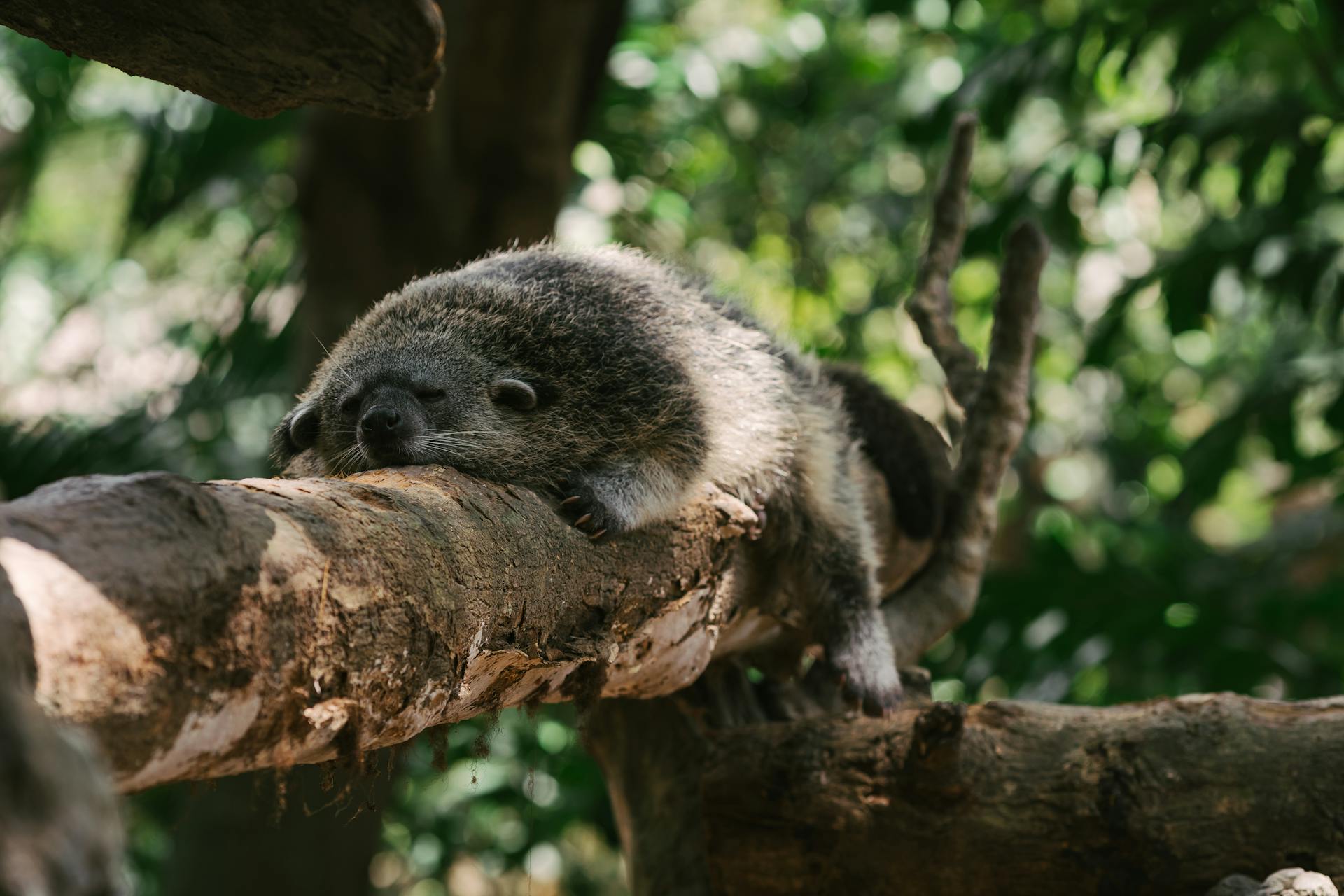
Their lifespan in captivity is even more impressive, with some individuals living up to 24 years and 5 months. In fact, the average lifespan of an Asian palm civet in captivity is around 22.4 years.
Here's a breakdown of their lifespan in both the wild and captivity:
In general, Asian palm civets can live for 15 to 25 years in captivity, and 15 to 20 years in the wild.
Classification and Taxonomy
The Asian palm civet, Paradoxurus hermaphroditus, belongs to the kingdom Animalia, which includes all animals. Animalia: information (1) lists various resources on this kingdom.
In the phylum Chordata, chordates are characterized by their notochord, a precursor to a spinal cord. Chordata: information (1) provides more information on this phylum.
Vertebrates, which include mammals, are classified under the subphylum Vertebrata. Vertebrata: information (1) explains this classification further.
The Asian palm civet is a mammal, classified under the class Mammalia. Mammalia: information (1) provides an overview of this class.
The order Carnivora includes carnivores, and the family Viverridae includes civets, genets, linsangs, and relatives. Carnivora: information (1) and Viverridae: information (1) offer more information on these classifications.
Here is a breakdown of the taxonomy of Paradoxurus hermaphroditus:
Taxonomy
Taxonomy is the process of grouping living things into categories based on their characteristics and evolutionary relationships. It's a way to make sense of the vast diversity of life on Earth.
The taxonomy of the Asian palm civet is quite complex, with multiple levels of classification. Here's a breakdown of its taxonomy:
The Asian palm civet's scientific name is Paradoxurus hermaphroditus, which tells us that it belongs to the genus Paradoxurus and the species hermaphroditus.
Paradoxurus Laotum
Paradoxurus Laotum is a subspecies of the Asian palm civet, specifically Paradoxurus hermaphroditus. It's a fascinating example of how taxonomy can be complex.
Gyldenstolpe first mentioned Paradoxurus hermaphroditus laotum in 1916, as recorded in the Biodiversity Library. This early mention laid the groundwork for further research.
Paradoxurus hermaphroditus laotum was also studied by Sanborn in 1952, who contributed additional information to our understanding of this subspecies. The details of Sanborn's findings can be found online.
The taxonomy of Paradoxurus hermaphroditus laotum was revisited by Wozencraft in 2005, who noted the possibility of misidentification. This highlights the importance of careful classification.
Smith and Xie also studied Paradoxurus hermaphroditus laotum in 2008, and their findings provide valuable insights into the taxonomy of this subspecies. The full details of their research can be accessed online.
Here are the sources that mention Paradoxurus hermaphroditus laotum:
- Gyldenstolpe (1916)
- Sanborn (1952)
- Wozencraft (2005)
- Smith & Xie (2008)
Dongfangensis
Dongfangensis is a genus of extinct mammals that lived during the Paleocene epoch. It was first discovered in China and is known for its primitive characteristics.
Dongfangensis was a small mammal, weighing around 1-2 kilograms. Its fossils have been found in the same geological formations as other early mammals.
The genus Dongfangensis is classified as a part of the order Perissodactyla, which includes modern horses, rhinos, and tapirs. This classification is based on its dental structure and limb morphology.
Northern Palm Civet
The Northern Palm Civet is a fascinating creature. It belongs to the family Viverridae, which is a group of carnivorous mammals.
These mammals are known for their distinctive appearance, with the Northern Palm Civet having a stout body, short legs, and a short, bushy tail.
The Northern Palm Civet is native to Southeast Asia, specifically in Indonesia and Malaysia.
Habitat and Distribution
Asian palm civets can live in a variety of habitats, including temperate and tropical forests, as well as developed areas like parks, suburban gardens, and fruit orchards.
They are arboreal, spending most of their time in fruit trees and fig trees, preferring the tallest trees with very dense canopies and vines for seclusion and protection.
Asian palm civets can be found in a range of elevations, up to about 2,000 feet, and in different types of habitats, including urban, suburban, and agricultural areas.
Here are some key features of their habitat:
Asian palm civets are native to regions within and around Asia, ranging as far east as the Philippines and as far west as Kashmir.
Hainanus

Hainanus is a unique island ecosystem located in the South China Sea, approximately 30 kilometers off the coast of Hainan Island in China. It has a subtropical monsoon climate.
The island is home to a diverse array of flora and fauna, with many species found nowhere else on Earth. The Hainan gibbon, a critically endangered primate, is endemic to the island.
The terrain of Hainanus is characterized by dense forests and rugged mountains, with elevations reaching up to 1,300 meters. This unique landscape supports a wide range of plant and animal species.
The island's remote location and limited access have helped to preserve its natural environment, but it also poses a challenge for conservation efforts.
Geographic Range
Asian palm civets are found in a wide range of habitats, from temperate and tropical forests to parks, suburban gardens, and fruit orchards. They're quite adaptable, really.
They're arboreal, which means they spend most of their time in trees, particularly fruit trees and fig trees. These trees provide them with the seclusion and protection they need.
Their elevation range extends up to about 2,000 feet, and they can be found in various terrestrial biomes, including forests and rainforests.
Some specific countries where you can find Asian palm civets include southern China, northern Himalayas, southern India, and islands in the Indian Ocean, South China Sea, and the Philippine Sea.
Here are some of the countries and regions where Asian palm civets have been spotted:
- Sumatra
- Bhutan
- Java
- Borneo
- Sri Lanka
- Thailand
- Vietnam
- Cambodia
- Malaysia
- Indonesia
- Laos
- Nepal
- Singapore
- Sundas Islands
- Philippines
- Kashmir
Behavior and Predation
Asian palm civets are nocturnal, arboreal, and solitary animals. They are active at night, resting in trees during the day, and tend to be more active on darker nights.
Their nocturnal behavior is thought to be a way to avoid predators that are active during the day, such as large cats and reptiles. These predators include tigers, leopards, snakes, and crocodiles.
Palm civets are skilled climbers, aided by their claws and strongly grasping hind feet. They are also expert foragers and hunters, stalking prey from a distance and then pouncing.
Here are some key behaviors of Asian palm civets:
- arboreal
- scansorial
- nocturnal
- motile
- sedentary
- solitary
Males are more active than females, and dominant males are more active than submissive ones. Palm civets typically rest in the same tree every day when food supplies are steady in their region.
Behavior
Asian palm civets are nocturnal animals, meaning they're active at night and rest during the day. They're expert climbers, aided by their claws and strongly grasping hind feet, which allow them to move through trees with ease.
Their nocturnal behavior is likely a result of avoiding predators that are active during the day. In fact, males are more active than females, and dominant males are even more active than submissive ones.
Males travel further in a day than females, with a typical range of movement of seventeen square kilometers. They're also more likely to wander into other territories when food is scarce.
Asian palm civets are both foragers and hunters, using their agility and sharp senses to catch prey. They often stalk their prey from a distance before pouncing, and they're also skilled at searching for fruit in trees.
Here are some key behaviors of Asian palm civets:
- arboreal
- scansorial
- nocturnal
- motile
- sedentary
- solitary
Predation
Palm civets have developed arboreal and nocturnal characteristics to avoid predators.
Their nocturnal behavior allows them to hunt and move around under the cover of darkness, making it harder for predators to spot them.
Large cats, like tigers and leopards, are among the predators that palm civets need to evade.
Reptiles, such as large snakes and crocodiles, also pose a threat to palm civets.
- Known Predators
- Large cats (tigers and leopards)
- Reptiles (large snakes and crocodiles)
Asian Palm Civet: Nocturnal Mammal
The Asian Palm Civet is a small mammal native to Southeast Asia, including Cambodia. It's often confused with a cat, but this nocturnal species is important for forest ecosystems as it helps disperse seeds and supports biodiversity.
Asian Palm Civets are omnivorous, feeding on fruits, small insects, and even nectar. Their love for ripe coffee cherries has made them vital to the production of civet coffee.
Their digestive process helps germinate seeds, promoting reforestation and plant diversity. Without them, forest regeneration could be severely impacted.
In the wild, Asian Palm Civets play a unique role in their habitats. They are crucial to their ecosystems, but unfortunately, they face severe threats.
Here are some key facts about Asian Palm Civets:
- Asian Palm Civets are native to Southeast Asia, including Cambodia.
- They are often confused with cats, but are actually a unique species.
- They are omnivorous, feeding on fruits, small insects, and nectar.
- Their digestive process helps germinate seeds, promoting reforestation and plant diversity.
Conservation Status

Asian palm civets, also known as paradoxurus hermaphroditus, are not considered to be in danger of extinction. However, they are protected in their native areas, such as Malaysia and Sichuan, China, and listed as vulnerable under China's red list due to excessive hunting.
Their wide distribution, large populations, adaptability, and stable population trend have led the IUCN to classify them as Least Concern.
Despite this, their habitats are facing threats from over-logging and clearing of land for palm oil plantations.
The rate of logging is being monitored, and developers are required to obtain permits or licenses to do so.
Some efforts have been made to replant lost forests.
Here's a summary of their conservation status:
- IUCN Red List: Least Concern
- US Federal List: No special status
- CITES: Appendix III
Frequently Asked Questions
Is palm civet a cat?
No, palm civets are not cats, but rather a distinct species more closely related to mongooses. They are commonly known as 'Musang' in the Malay Language, a unique and fascinating creature worth learning more about.
What is the common name of Paradoxurus hermaphroditus?
The Asian palm civet is also known as the common palm civet, toddy cat, and musang. It is a native species to South and Southeast Asia.
Featured Images: pexels.com