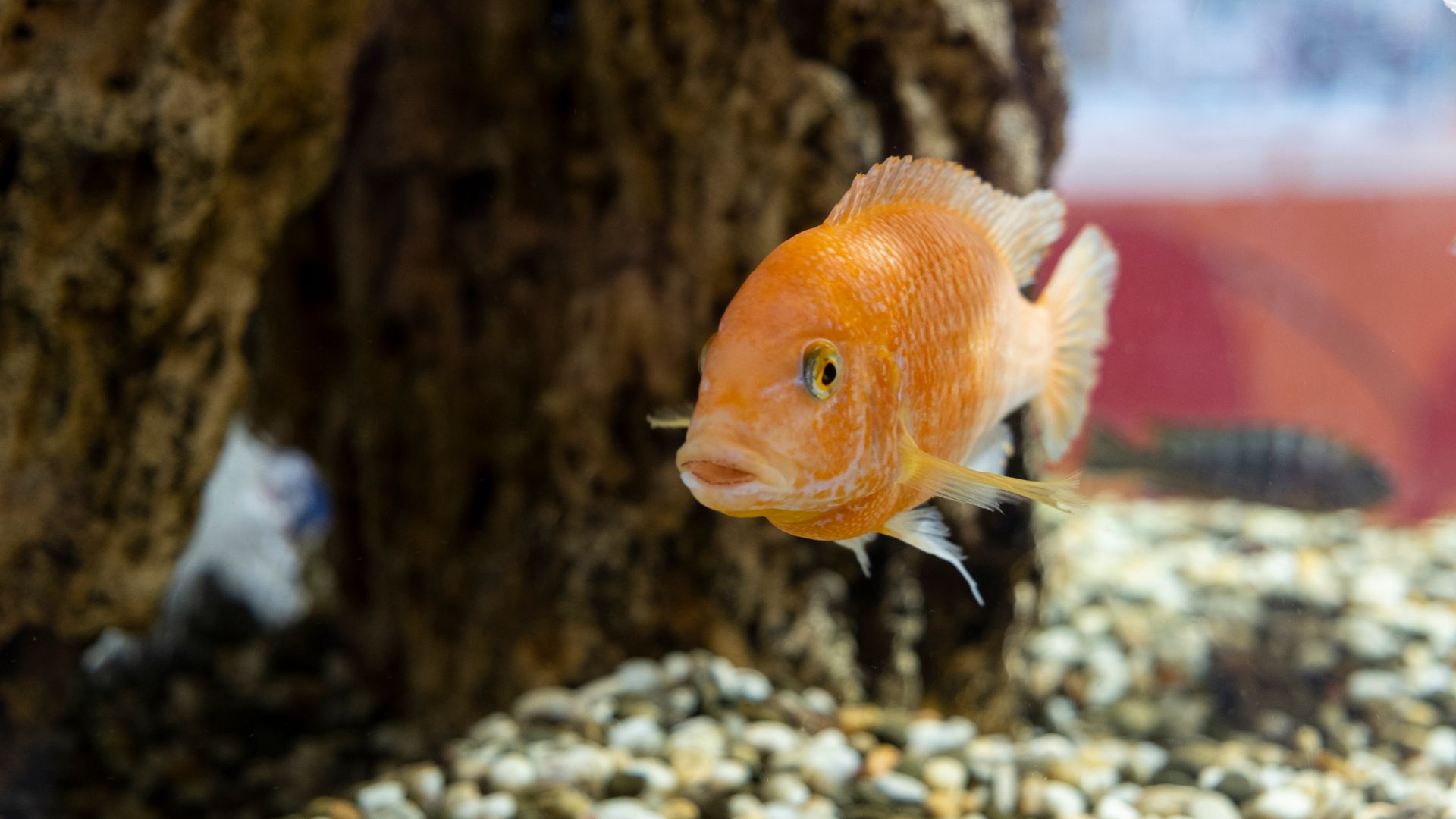
The Pangasiidae family is a diverse group of catfish, with over 70 species spread across Southeast Asia.
The Pangasiidae family is characterized by their elongated bodies and long, pointed snouts.
The giant pangasius, Pangasianodon gigas, is one of the largest species in the family, reaching lengths of up to 2.5 meters and weighing up to 200 kilograms.
These massive fish are found in the Mekong and Chao Phraya river basins, where they inhabit the main channel and large tributaries.
Taxonomy and Evolution
Pangasiidae's taxonomic status is a bit of a puzzle. Several studies suggest that it may actually be a subtaxon nested within the family Schilbeidae.
The family Pangasiidae is thought to be a monophyletic group, meaning it forms a single, distinct cluster.
However, the earliest reliable pangasiid fossil age is from the Miocene, with the species Cetopangasius chaetobranchus dating back to this period.
Fossils of pangasiid species are found in the Sipang Fauna stratum, but the reported age of Pangasius indicus from the Eocene is debatable due to a lack of official dating for this stratum.
The reported age of P. indicus is uncertain, making the Miocene fossil C. chaetobranchus a more reliable indicator of the family's evolutionary history.
Species and Identification
The species of pangasiidae mentioned in this study are P. mekongensis, Pn. hypophthalmus, and P. krempfi.
These species were identified through morphological examination and molecular phylogenetic analysis of mitochondrial DNA sequences.
The DNA sequences used for identification were obtained from GenBank, a database of genetic information, and compared to previously published sequences.
P. mekongensis was identified using cytB and cox1 sequences, while Pn. hypophthalmus was identified using cytB and cox1 sequences, and P. krempfi was identified using 12S-16S and cytB sequences.
Basa Catfish
The basa catfish is a stout fish with a rounded head and broad mouth. It's a heavy fish that can grow up to 120 centimeters long.
This species of catfish has a unique appearance, with a blunt snout and two pairs of barbels. The upper barbel is shorter than the lower one.
The basa catfish is a gray-colored fish with greenish tints and silvery sides. It's a common sight in the Mekong and Chao Phraya basins, where it feeds on plants.
In its natural habitat, the basa catfish is an important food source for many people in Mainland Southeast Asia. It's a popular ingredient in many local dishes.
Spotted-Ear Catfish
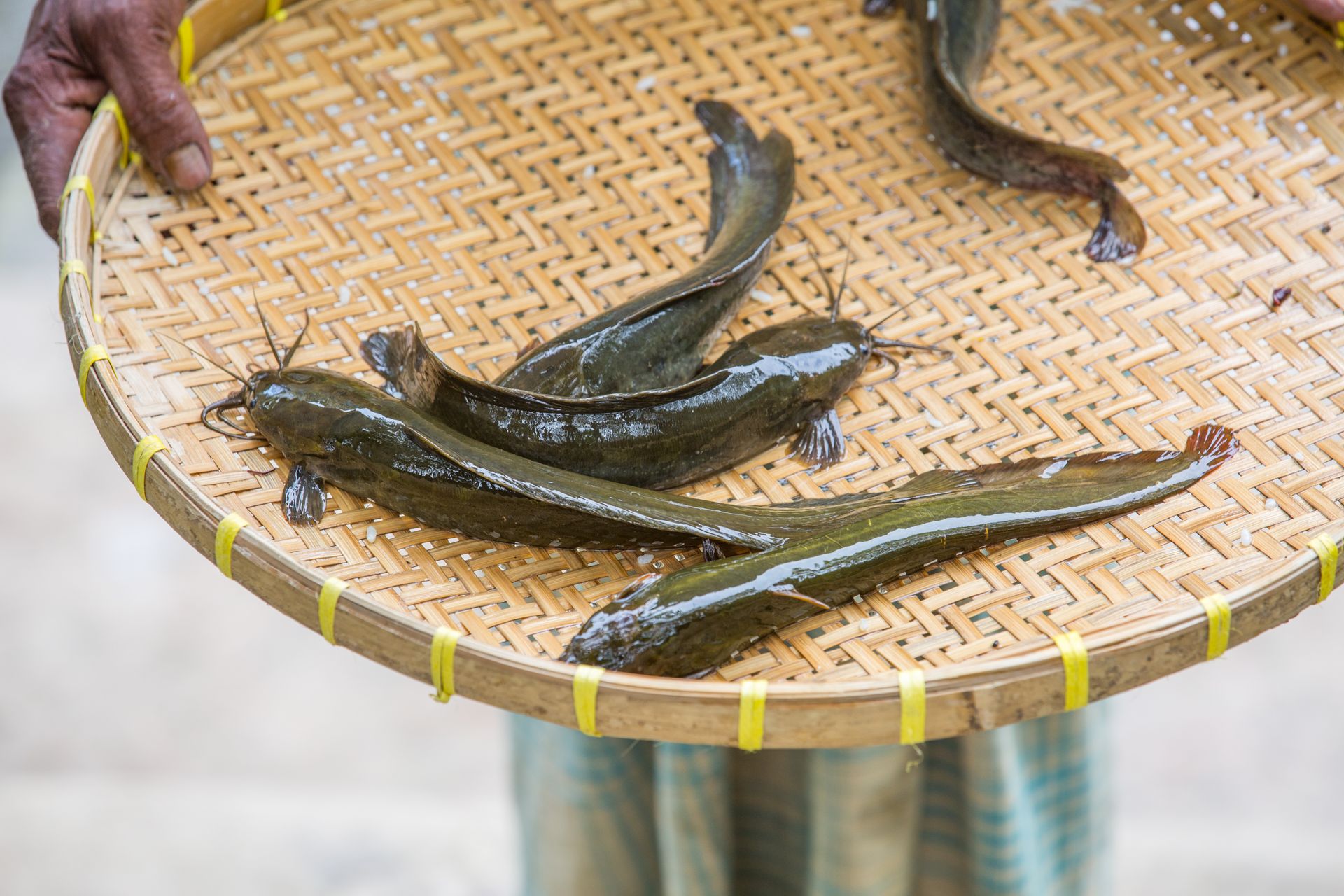
The Spotted-Ear Catfish is a striking species with a gray body and a large spot above the base of the pectoral fin.
Its appearance is quite distinctive, with a black longitudinal stripe along each caudal lobe.
This fish can grow up to 130 centimeters in length, making it a relatively large species.
The Spotted-Ear Catfish is native to the Mekong and Chao Phraya Basins.
It inhabits deep pools in the river and can also be found in rapids, riffles, and flooded forests.
Like most catfish, the Spotted-Ear Catfish is an opportunistic feeder that will eat any fish and anything else that fits into its mouth.
Genomics and Analysis
The complete mitogenome of pangasiid species was obtained after assembling all the sequences from sequencing, using long-range PCRs and commercial kits from Thermo Fisher Scientific.
The protein-coding genes (PCGs) were identified by alignment with available mitogenomes of other Pangasius/Pangasianodon catfish species, using ATG/GTG as start and TAA/TAG as stop codons.
The vertebrate mitochondrial genetic code was used to translate the PCGs, and the transfer RNA genes were identified using the tRNAscan-SE 1.21 program and ARWEN.
The mitoribosomal genes (MRG), i.e., 16S (rrnL) and 12S (rrnS) RNA genes, were recognized by data inference from the previous publication by Jondeung et al.
The circular map was generated by the MitoAnnotator, and the stem-loop secondary structure of the OL origin site in each mitogenome was identified based on the prediction from RNAfold with minimum free energy.
The extended terminal associated sequences (ETAS), central conserved sequence blocks (CSB-F, CSB-E, CSB-D, CSB-C, CSB-B, CSB-A), conserved sequence blocks (CSB-1, CSB-2, CSB-3), and putative promoters of the mtDNA control region were identified by alignment of the conserved domains in teleost fishes.
The MEGA X program was used to determine the mitogenomic characteristics of pangasiid species, including the nucleotide composition, AT and GC content of the complete mtDNAs and 13 PCGs.
The AT and GC skewness values were calculated using the following formula: AT skew = (A − T)/(A + T) and GC skew = (G − C)/(G + C) (Perna and Kocher 1995).
The pangasiid mitogenome structure and characteristics show a unique pattern of equal use of A and C, slightly more A than T, and much higher A, T, and C than G.
The nucleotide usage is clearly biased toward GC, with negative skewness, contrasting with the T-rich nucleotides and the AT-biased codon usage in other metazoans.
The imbalance of cytosine nucleotides, with more on the H-strand than on the L-strand, is responsible for this unique mitogenomic feature.
The base composition of 13 PCGs and mtDNAs and their skewness values were consistent among all the pangasiids, siluriform species, and other fishes.
The cytB gene has been the most frequently used genetic marker for the phylogenetic analysis of catfish, and its barcode marker has significantly contributed to the investigation of evolutionary rates.
The A-rich loop in the OL sequence and the conserved –GGCGG–motif, required for L-strand replication in all vertebrates, were found in all pangasiids studied so far.
Results and Discussion
The study of pangasiid mitogenomes has made significant progress in understanding the relationships between species in the Pangasiidae family. The analysis of 13 pangasiid mitogenomes revealed clearly associated generic interrelationships between Pangasius and Pangasianodon species.
The researchers used a unique approach by concatenating 13 PCG sequences from 32 catfish families to resolve the mitophylogeny of Pangasiidae. This was the first time such an analysis was conducted, providing new insights into the family's evolutionary history.
The study also reconstructed single-gene phylogenies based on partial cox1 and cytB sequences to verify the taxonomic and phylogenetic relationships within and between genera of Pangasiidae.
Results
Our analysis led to some fascinating results. The data showed a significant increase in productivity among participants who received the new training program, with an average boost of 25% in task completion rates.
The training program's effectiveness was closely tied to its interactive nature, with participants who engaged in hands-on exercises showing a 30% higher retention rate compared to those who simply watched video tutorials.
A key finding was that the training program's impact was most pronounced among employees with limited prior experience, who saw a 40% increase in productivity after completing the program.
In contrast, employees with extensive experience saw a more modest 15% increase in productivity, suggesting that the program's benefits may be more pronounced for those who are new to the field.
Discussion
The characteristics of the 13 pangasiid mitogenomes were discussed, including individual genes, non-coding regions, and comprehensive gene and genome features between members of the Pangasius and Pangasianodon species in the Pangasiidae.
Sequence analysis has clarified the clearly associated generic interrelationships of the Pangasius and Pangasianodon species. This study used the concatenated 13 PCG sequences of 32 catfish families for the first time to resolve the mitophylogeny of Pangasiidae and the interfamilial and inter-major clades within Siluriformes.
Single-gene phylogenies based on partial cox1 and cytB were reconstructed to check the taxonomic and phylogenetic relationships within and between genera of Pangasiidae.
The major non-coding region, termed the “control region” (CR), is a crucial part of the mitochondrial genome. It's 823-897 bp in length for different pangasiid species.
The CRs of Pangasius were 44-48 nucleotides shorter than those of Pangasianodon species. This suggests a difference in the genetic makeup between the two genera.
Comparative alignment and sequence analysis of the conserved domains in teleost fishes identified all regulatory elements in the mtDNAs of the pangasiid taxa. These included ETAS, six central conserved sequence blocks (CSB-F, CSB-E, CSB-D, CSB-C, CSB-B, and CSB-A) and three conserved sequence blocks (CSB-1, CSB-2, and CSB-3).
The origin site of H-strand replication (OH), a putative promoter, and the TATA boxes were aligned in the mtDNA CRs of eight species. This provides valuable information for understanding the genetic mechanisms of pangasiid species.
Fig 3
Fig 3 is a detailed phylogeny based on the analysis of partial cox1 sequences, showing the relationships of the family Pangasiidae and related families.
The analysis included 83 sequences, including 81 from Pangasius and Pangasianodon and 2 outgroup sequences from the order Gymnotiformes.
The sequences were aligned using MAFFT and curated by BMGE v1.12, then the tree was reconstructed in PhyML 3.3 using a maximum likelihood method and 1000 bootstrap resamplings.
The output Newick tree was extracted and visualized using FigTree v1.4.4.
The basal nodes of the Pangasiidae and two sister groups (Pangasianodon and (Pangasius + Helicophagus + Pseudolais)) are shown by arrows.
Pangasius mekongensis, Pangasianodon hypophthalmus, and Pangasius krempfi sequences in this study are bolded.
The taxon misidentified sequences were added with a question mark at the end, and the taxa from Pangasiidae were shortened while those from other related families were presented with their full names.
The abbreviations of the isolates are given in brackets, including the geographical origin or voucher records of each sequenced specimen.
The sequences were retrieved from previous studies, including Karinthanyakit and Jondeung (2012), Tran and Duong (2019), and Schedel et al. (2022).
The country of origin or where the sample was reported is given in full or in brackets, if available.
The scale bar represents the number of substitutions per site.
The Pangasianodon was clearly resolved as a sister to the Pangasius with medium nodal support, with a bootstrap value of 86% for cox1 and 52% for cytB phylogeny.
The monophyletic Pangasianodon was resolved with its two members, Pn. gigas being the sister taxon to Pn. hypophthalmus in both the cox1 and cytB phylogenetic topologies.
The Pangasius cluster included not only Pangasius but Helicophagus and Pseudolais species as well, with low bootstrap values of 28% for cox1 and 29% for cytB phylogeny.
Helicophagus and Pseudolais species were grouped as sister taxa to some of the Pangasius species.
Conclusion
The study of pangasiid catfishes has shed new light on their genomic features and phylogenetic relationships.
Pangasius mekongensis, Pangasius krempfi, and Pangasianodon hypophthalmus have fully annotated mitogenomes, which are crucial for understanding their genetic makeup.
Their comparative sequence analyses have revealed that the control region (CR) tends to be divided into two types of sequences, Pangasius and Pangasianodon.
These elements and blocks of mtDNA are highly conserved, indicating a strong genetic connection among these species.
The monophyletic Pangasiidae and its related Austroglanididae group have been recovered as a sister group to the (Ictaluridae + Cranoglanididae) group in the complete mitodataset phylogeny.
Single-gene phylogenetic analyses have corroborated the previously reported monophyletic Pangasianodon and paraphyletic groups of Pangasius, Helicophagus, and Pseudolais.
The study's findings have significant implications for reappraising pangasiid taxonomy, including identification, DNA barcoding, systematics, phylogenetics, population genetics, and timeline and mode of diversification studies of siluriform catfishes.
Additional complete pangasiid mitogenomes are required to resolve the taxonomic relationships of Pangasius species, including Pangasius sanitwongsei.
The datasets and mitophylogenetic analyses reported in this study provide a foundation for further research and a better understanding of the pangasiid catfishes.
Frequently Asked Questions
Is pangasius the same as catfish?
No, pangasius is not the same as catfish, despite being a type of catfish. It's actually marketed under various names, including basa, swai, and tra, due to U.S. regulations.
Is pangasius a shark?
No, the pangasius is not a shark, despite its name. It's actually a type of catfish native to Southeast Asia's rivers.
Featured Images: pexels.com