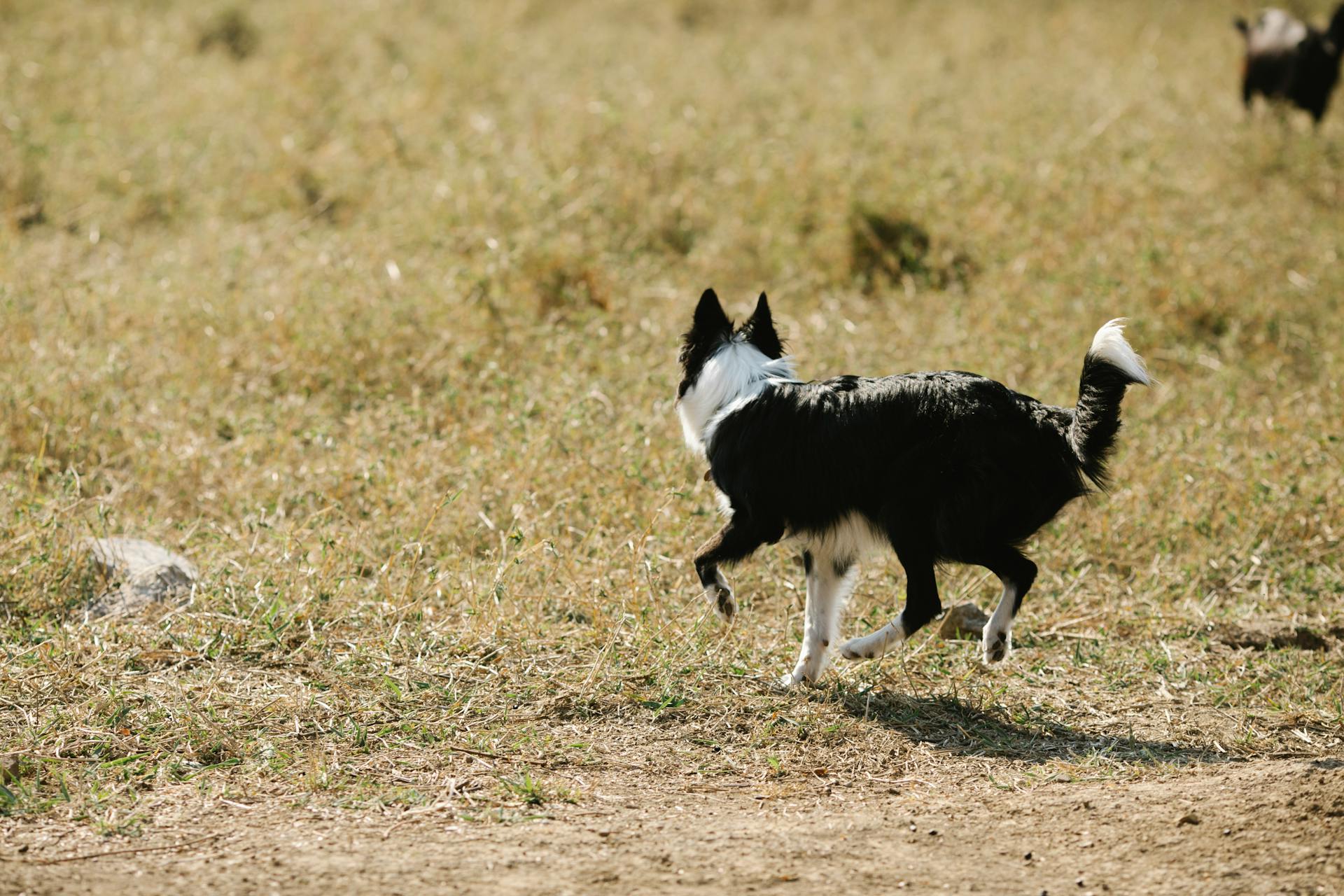
Outdoor dog agility course training is a fun and rewarding experience for dogs and their owners. It's a great way to provide exercise and mental stimulation for dogs, and can be adapted to suit dogs of all ages and abilities.
With a well-designed course, dogs can run, jump, and play their way through tunnels, jumps, and other obstacles. A standard agility course typically includes a series of jumps, tunnels, weave poles, and contact obstacles like A-frames and dog walks.
Dogs can start training on an agility course as early as 12 weeks old, and it's essential to introduce new obstacles gradually to prevent injury or frustration. A good rule of thumb is to start with simple jumps and tunnels and gradually increase the difficulty as your dog becomes more confident and skilled.
Whether you're a seasoned competitor or just starting out, an outdoor dog agility course is an excellent way to spend quality time with your dog and create lifelong memories.
Check this out: Diy Dog Agility Jumps
Planning and Preparation
Before building your outdoor dog agility course, it's essential to plan carefully.
Consider the available space in your yard, as this will determine the size and complexity of your course. You should also think about the types of obstacles you want to include.
To ensure a safe and enjoyable experience for your dog, plan your course with your dog's abilities and limitations in mind. If you're new to dog agility, start with simple obstacles and gradually add more complex ones as your dog becomes more confident.
The available space will also help you determine the number of obstacles you can fit in your course. Don't overcrowd your yard, as this can make the course difficult to navigate and may even lead to accidents.
Obstacles should be placed at a safe distance from each other, with enough space for your dog to run and jump without feeling crowded. This will help prevent your dog from feeling anxious or overwhelmed.
Remember to review and adjust your course design as needed, just like judges do before a competition.
Course Design and Equipment
Before building your outdoor dog agility course, it's essential to plan carefully. Consider the available space in your yard and the types of obstacles you want to include.
When choosing equipment for your course, select items that suit your dog's size, age, and fitness level. Start with basic obstacles like jump bars, weave poles, and a teeter-totter.
A typical agility course includes several key pieces of equipment, such as agility jump bars, teeter-totters, and weave poles. These obstacles help your dog build strength, improve its sense of spatial awareness, and challenge its agility and coordination.
Agility jump bars are a fundamental component of any agility course. They help your dog build strength in its hindquarters and improve its sense of spatial awareness. You can adjust the jump bars to different heights to increase the difficulty as your dog becomes more proficient.
Weave poles challenge your dog's agility and coordination. This obstacle consists of a series of upright poles that your dog must navigate by weaving in and out. A good approach is to start with three poles and gradually increase to six or more as your dog improves.
Here are some key obstacles to include in your course:
- Agility jump bars
- Teeter-totter
- Weave poles
Remember to consider your dog's breed characteristics when choosing equipment, as some breeds may benefit from specific exercises.
Outdoor Locations
Outdoor locations for an outdoor dog agility course are crucial to consider. Each ring usually requires at least 5,000 square feet of space.
In heavily populated areas, it's common to rent a site for the weekend as real estate is often too expensive to devote entirely to agility. Popular locations include large parks and covered horse-riding arenas.
To ensure a smooth competition, the ground must be non-slip and level, often being packed dirt, grass, carpeting, or padded matting.
Parks for Rent Near You
Large parks are a popular location for agility competitions, offering ample space for multiple rings and competitors to move around.
Each ring typically requires at least 5,000 square feet of non-slip, level ground, usually made of packed dirt, grass, carpeting, or padded matting.
Competitors often bring pop up canopies or screenroom awning tents for shade, and dogs are usually left to rest in exercise pens, crates, or dog tents.
Parking must be available for all competitors, and in areas that offer camping, space needs to be provided for caravans and tents, as well as small fenced enclosures or gardens.
Top Private Parks on Sniffspot
Sniffspot is a popular platform for dog owners to find and book private off-leash parks for their furry friends. There are many amazing private parks to choose from, but here are some of the top ones.
One of the top private parks on Sniffspot is the 5-acre park in California that offers a fully fenced area for dogs to run free.
This park is a favorite among dog owners because it has a large, grassy area for dogs to play and exercise.
Another top private park is the 2-acre park in Colorado that features a dog agility course and a separate area for smaller dogs.
This park is perfect for dog owners who want to challenge their pets with obstacle courses while also providing a safe space for smaller dogs to play.
The 3-acre park in Oregon is also a top choice among dog owners, featuring a pond and a wooded area for dogs to explore.
This park is a great option for dog owners who want to give their pets a more natural and varied environment to play in.
You might enjoy: Quail Run Park off Leash Dog Area
Contact Obstacles
Contact obstacles are a crucial part of any outdoor dog agility course. They provide a fun and challenging way to engage your dog's mind and body. Our dog agility training program at Paw by Paw features various contact obstacles that will put your dog's skills to the test.
Tunnels are a great example of contact obstacles. They come in different shapes and sizes, but all provide a fun way for your dog to navigate through a confined space. At Paw by Paw, our tunnels are designed to be safe and sturdy, allowing your dog to run through them with confidence.
Weave poles are another type of contact obstacle that are perfect for outdoor dog agility courses. They require your dog to weave in and out of poles, improving their agility, coordination, and focus. Our weave poles are adjustable, so we can tailor them to your dog's skill level.
Jumps are also a type of contact obstacle that are essential for any outdoor dog agility course. They come in different heights and lengths, but all provide a fun way for your dog to practice their jumping skills. At Paw by Paw, our jumps are designed to be safe and durable, allowing your dog to jump with confidence.
Curious to learn more? Check out: Dog Agility Pole Weaving
Here are some common types of contact obstacles you can expect to find in an outdoor dog agility course:
- Tunnels
- Weave poles
- Jumps
These obstacles are designed to be fun and challenging for your dog, while also providing a great workout for their body and mind. At Paw by Paw, our experienced trainers will guide you and your dog every step of the way, ensuring that you get the most out of your agility training experience.
Competition and Training
In an outdoor dog agility course, competition is a great way to challenge your dog and provide mental stimulation.
The best time to start training your dog for agility is between 6-12 months old, when they are still young and energetic.
A well-designed course can be tailored to suit dogs of all ages and abilities, making it perfect for beginners and experienced dogs alike.
To get started, you'll need to choose a course that suits your dog's fitness level, with obstacles such as tunnels, jumps, and weave poles.
Competition Basics

Competition is a normal part of life, whether it's in sports, business, or everyday interactions.
The concept of competition can be traced back to the idea of scarcity, where limited resources lead to rivalry among individuals or groups.
Competition can be intense, but it's also a driving force for improvement and innovation.
In a competitive environment, individuals or teams must adapt quickly to changing circumstances and learn from their mistakes.
This ability to adapt and learn is crucial in any competitive setting, whether it's a business meeting or a sports tournament.
The goal of competition is often to win, but winning isn't everything – it's also about personal growth and development.
In fact, research has shown that competition can have a positive impact on motivation and performance, especially when the competition is fair and respectful.
Suggestion: Dog Agility Competition 2024
Training
Training is key to improving performance and increasing chances of winning in competitions.
Regular practice helps to develop muscle memory, which is essential for executing complex movements with precision and speed.
According to research, athletes who train for at least 3-4 hours a day are more likely to achieve their goals than those who train for less than 2 hours a day.
Consistency is also crucial in training, and it's been shown that training 4-5 times a week is more effective than training 2-3 times a week.
Incorporating visualization techniques into training can also help improve performance by allowing athletes to mentally rehearse and prepare for different scenarios.
Proper nutrition and recovery are also essential components of a training program, as they help to fuel the body and aid in the repair of muscle tissue.
Curious to learn more? Check out: Two Dog Names
Course Management and Events
Having a well-designed outdoor dog agility course is crucial for a fun and safe experience for both you and your furry friend. A typical course consists of 10-20 obstacles, including tunnels, jumps, and weave poles.
The course should be designed with your dog's age, size, and skill level in mind. For example, a puppy course might focus on basic jumps and tunnels, while an advanced course could include more complex obstacles like contact equipment.
You might like: Dog Agility Wing Jumps
A good rule of thumb is to start with shorter courses and gradually increase the length and difficulty as your dog becomes more confident and skilled. This will help prevent frustration and keep your dog excited about the course.
Regular maintenance is essential to keep the course safe and functional. This includes cleaning and repairing obstacles, as well as checking for any hazards like sharp objects or loose debris.
Safety and Injuries
Between 32% and 41.7% of dogs incur injuries from agility related activities.
Strains, sprains, and contusions are the most common types of injuries.
The most commonly injured areas are the shoulders, iliopsoas muscle, digits, and lumbar spine/lumbosacral area.
Border Collies are more likely to be injured than other breeds.
In Australia, the highest percentage of injuries is reported, while the United States reports the lowest percentage.
Interactions with bar jumps, A-frames, and dog walk obstacles are the most common causes of injuries.
There is no relationship between the use of warm-up and cool-down exercises and injuries.
International and Competitive
International dog agility competitions are a thrill to watch and participate in. The Fédération Cynologique Internationale (FCI) regulates these events globally, but some organizations have restrictions for dogs without pedigrees.
The FCI's Agility World Championships are held annually and are the oldest and best-known international competition. They're restricted to registered pedigree dogs only.
Other notable international competitions include the International Mix & Breed Championship in Agility (IMCA), which has been held annually since 2000 and allows dogs of any breed or mixed-breed regardless of pedigree. The International Federation of Cynological Sports (IFCS) has also organized a biannual world agility championship since 2002, open to any breed or mixed-breed dog.
Here are some of the most popular international dog agility competitions:
- Fédération Cynologique Internationale Agility World Championships
- International Mix & Breed Championship in Agility (IMCA)
- International Federation of Cynological Sports (IFCS) World Agility Championship
- Cynosport World Games
- European Open
- World Agility Open Championships (WAO)
- Junior Open Agility World Championships
Awards and Titles
Awards and titles are a big part of competitive agility, and they're usually given for placements and qualifying scores. Awards can be flat ribbons, rosettes, commemorative plaques, trophies, medals, or pins.
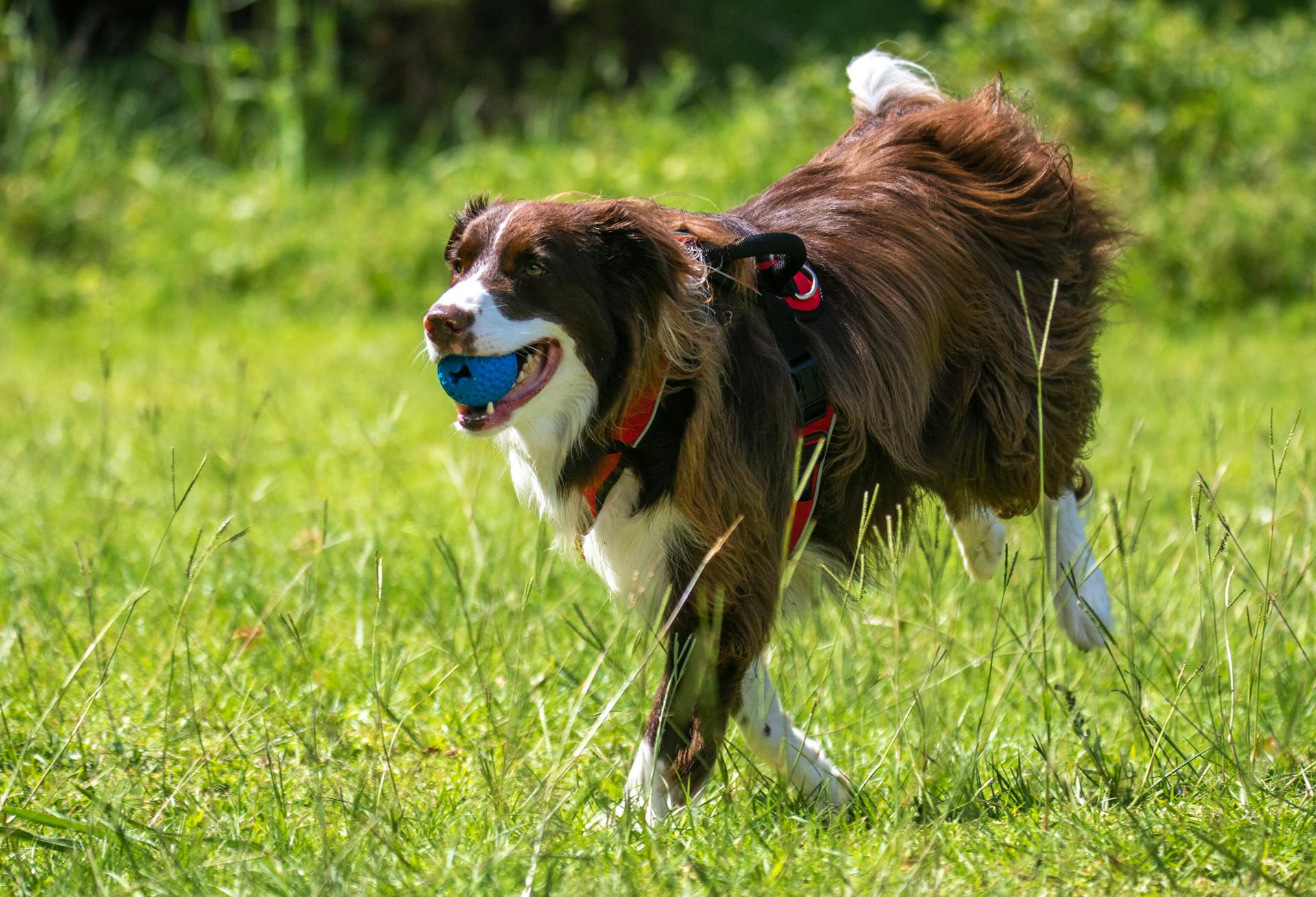
Many clubs award high-in-trial awards, calculated in various ways, or other special awards for the trial. Some clubs require three qualifying scores in any level to get the corresponding title.
In the United States, most sanctioning organizations award titles to dogs and handlers who earn sufficient qualifying runs. These runs must have no more than a certain number of faults and be faster than the maximum standard course time.
Under USDAA rules, a dog can earn novice-level titles in various classes by earning three qualifying runs in each. The dog can also earn intermediate-level titles and masters-level titles in the same classes.
To earn the Championship, the dog's qualifying runs must be earned in a specific way, depending on the organization. For example, in AKC, the dog's qualifying runs must be earned two at a time on the same day.
Most champion titles have "CH" in the title, such as NATCH, ADCH, CATCH, MACH, TACH, and ATCH.
Consider reading: Sheepdog Trials
International Competitions
International competitions in dog agility are a thrilling spectacle, bringing together talented handlers and their dogs from all over the world. The Fédération Cynologique Internationale (FCI) regulates and runs these competitions, along with its member organizations and national kennel clubs.
One of the most prestigious events is the FCI Agility World Championships, held annually since 1996. The championship is restricted to registered pedigree dogs only.
The International Mix & Breed Championship in Agility (IMCA) was created as a response to the FCI's pedigree-only championships. This event allows dogs of any breed or mix to participate, and it's been held annually since 2000.
The International Federation of Cynological Sports (IFCS) organizes a biannual world agility championship, open to any breed or mixed-breed dog regardless of pedigree. This event has been gaining popularity since 2013 and is now held every year.
Other notable international competitions include the Cynosport World Games, the European Open, the World Agility Open Championships (WAO), and the Junior Open Agility World Championships.
Expand your knowledge: Akc Agility All-american Dog Breed
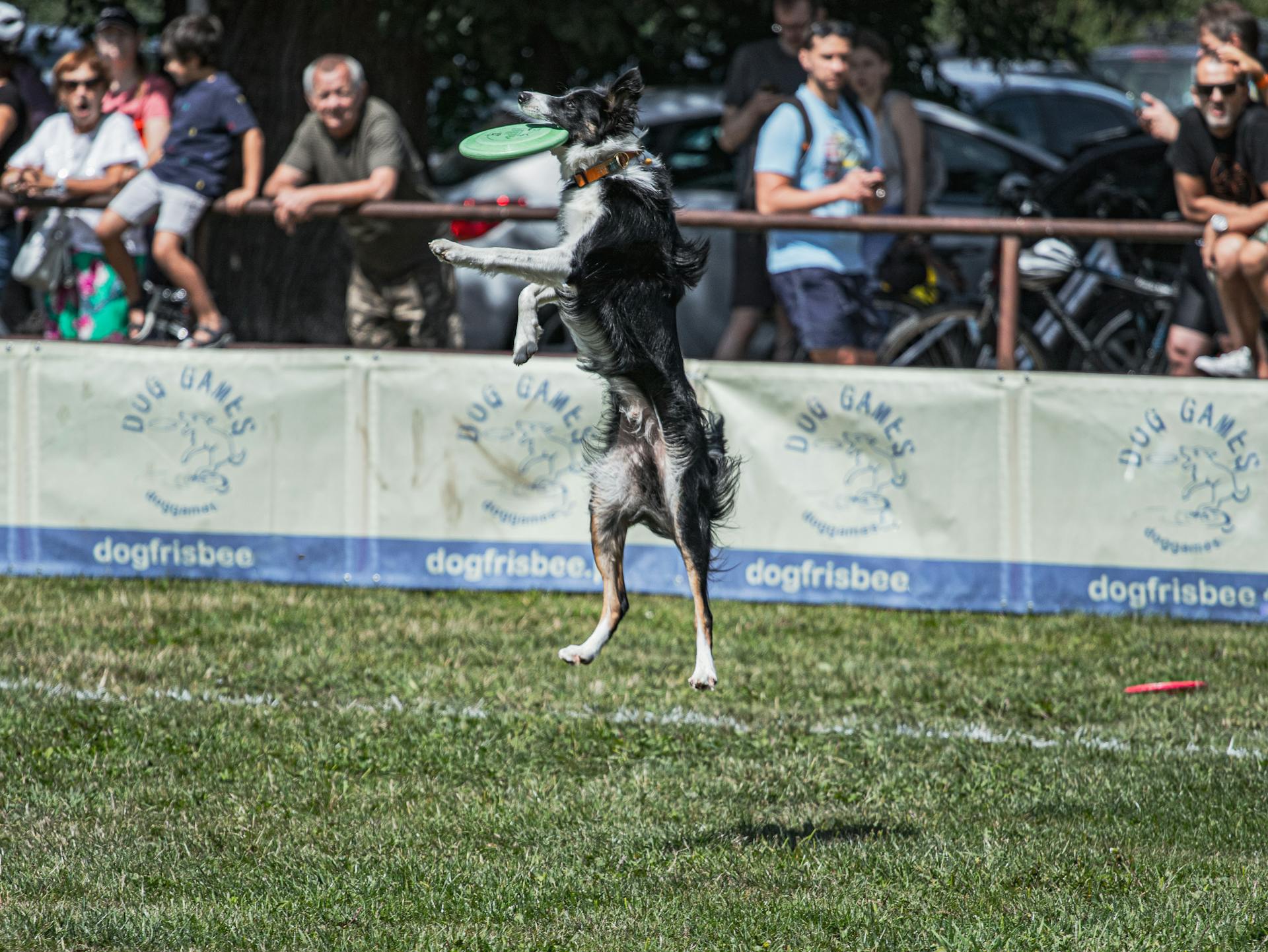
Here's a list of some of the notable international competitions:
- Fédération Cynologique Internationale (FCI) Agility World Championships
- International Mix & Breed Championship in Agility (IMCA)
- International Federation of Cynological Sports (IFCS) World Agility Championship
- Cynosport World Games
- European Open
- World Agility Open Championships (WAO)
- Junior Open Agility World Championships
In 2015, Pavol Vakonič from Slovakia made history by achieving a double victory, earning both silver and gold medals with his dogs Ikea and Fiona.
Get Started
Agility is one of the fastest-growing dog sports in the country, providing incredible exercise for both you and your dog.
To get started in Agility, attend a competition or "trial" to see it firsthand, as it's exhilarating to watch your dog navigate obstacles.
You don't need to be a world-class sprinter to do agility with your dog, as training and good communication are key to becoming part of the sport.
Assess your dog's temperament to ensure he's right for Agility, considering factors like high energy levels, enjoyment of running and responding to instruction, and getting along with other dogs.
Dog agility is a sport where you direct your dog through a pre-set obstacle course within a certain time limit, with courses typically having between 14-20 obstacles.
Broaden your view: Sleepypod Clickit Sport Crash-tested Car Safety Dog Harness
All breeds, including mixed breeds, can participate in Agility, from the smallest to the largest of dogs.
Take a class at an AKC club near you to introduce you and your dog to obstacles and provide the basics of how to compete, meeting once a week for an hour or so.
Related reading: Dog Breeds Watch Dogs
Frequently Asked Questions
How long does it take a dog to learn agility?
Learning agility with a well-behaved adult dog can take 1-2 years, while starting puppies early can accelerate the process. With consistent training and a patient handler, your dog can master agility skills in no time.
Is it too late to train my dog for agility?
You're never too old to start agility training with your dog, but it's best to begin when they're at least a year old. With early training, your puppy can develop the skills and physical ability to excel in agility from a young age.
Featured Images: pexels.com