
Octodon Degus are small, furry rodents native to South America, specifically the Andes mountains.
They are primarily herbivores, feeding on a variety of plants, including grasses, leaves, and fruits.
These animals are highly social, living in large groups in the wild, and are known to form close bonds with each other.
In the wild, Octodon Degus can live up to 10 years, although their average lifespan is around 5-7 years.
You might enjoy: Microhydromys
Classification
The genus name Octodon comes from Ancient Greek words meaning "eight" and "tooth", likely due to the shape of their molars and premolars.
Octodon is a genus of rodents that belongs to the family Octodontidae. The genus includes five species of degus.
Here's a breakdown of the taxonomic classification of Octodon:
Some of the species of Octodon include the Bridges's degu, the common degu, the moon-toothed degu, the Pacific degu, and Ricardo Ojeda's degu.
Physical Characteristics
Octodon is a medium-sized rodent, with a total body length ranging from 200 to 390 mm.
Their tail makes up a significant portion of their body, measuring between 81 and 170 mm and representing 70 to 80% of the head + body length.
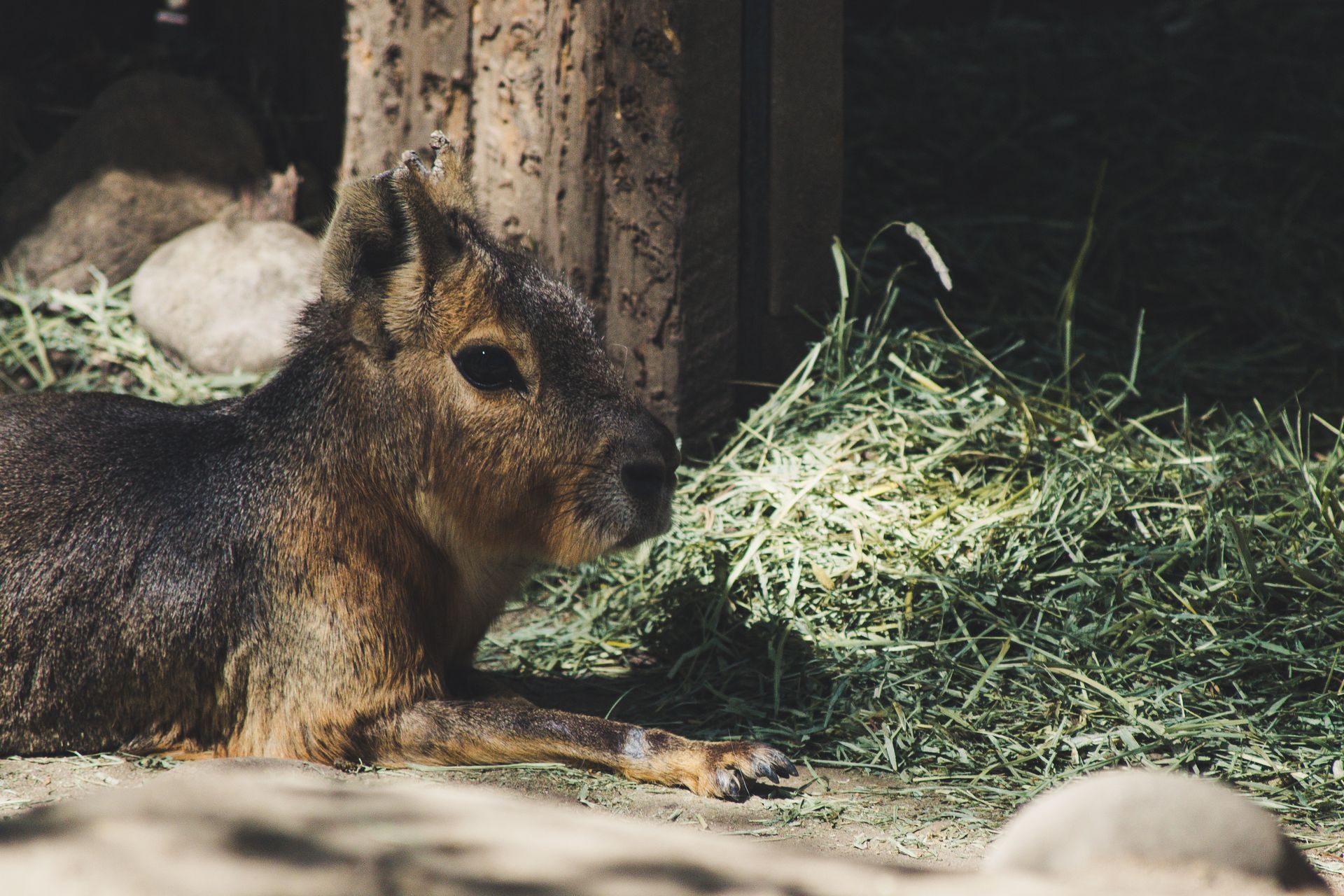
The coat color of Octodon is typically grayish with orange highlights, turning creamy yellow on the belly.
The ears of Octodon are quite large and protrude widely from the head, except in O. pacificus, where they are less prominent.
Their lower limbs are well-suited for jumping, with pads on the soles of their paws that prevent slipping.
The forelegs of Octodon have four clawed fingers, along with a poorly developed fifth finger with a nail.
The glans of the penis in Octodon is characterized by a variable number of spikes, typically 5 or more on each side.
In contrast, the common degu, a type of Octodon, has a much smaller body length of 25.0 to 31.0 cm.
Their fur is yellow-brown above and creamy-yellow below, with a long, thin tail and dark, sparsely furred ears.
The common degu's hind feet are bristled, and their cheek teeth are shaped like figures-of-eight.
Their diet consists mainly of grasses, leaves, and seeds, and they are specially adapted to a high fibre intake.
In the wild, common degus will also perform coprophagy, reingesting their own faeces to extract more nutrition from their diet.
Behavior
Octodons are primarily diurnal, meaning they're active during the day and rest at night.
Their social behavior is quite complex, with some species living in pairs, while others are solitary or form small groups.
In the wild, octodons are primarily herbivores, feeding on a variety of plants, including grasses, leaves, and fruits.
Animals Burrowing Behavior Testing
Ants are highly social creatures that live in complex underground colonies, with some species excavating intricate tunnel systems that stretch for miles.
In the lab, scientists use specialized equipment to test the burrowing behavior of ants, including cameras and sensors to track their movements and digging patterns.
Some species of moles are expert burrowers, capable of digging complex networks of tunnels and chambers in a matter of hours.
Researchers have found that moles use their powerful front legs and long claws to excavate soil and create burrows, often with a smooth, rounded entrance.
The burrowing behavior of animals like rabbits and groundhogs is often studied in the context of habitat creation and soil turnover, with these animals playing a crucial role in shaping their ecosystems.
Predation
Predation is a significant threat to Octodon bridgesi's survival. They're small and easy prey for many birds and average-sized mammals.
Barn owls, for example, represent up to 10% of their diet during winter. This is a major concern, especially during the harsh winter months.
Kodkods and Culpeos are also known to target Octodon bridgesi. These predators play a crucial role in maintaining the balance of their ecosystem.
Humans have also been known to hunt Octodon bridgesi, with evidence dating back to between 4400 and 1500 B.C. This highlights the long history of human interaction with this species.
The introduction of invasive species like black rats, European rabbits, and goats can further threaten their habitat and natural resources.
Geography
The Octodon bridgesi is native to Chile, specifically inhabiting central Chile, where its habitat is unfortunately shrinking due to human activity.
It can also be found in Argentina, notably in the Lanin National Park.
This species inhabits a wide range of altitudes, from sea level to 1200 meters, although its exact distribution area remains unknown.
Geographical Distribution
The Octodon bridgesi is native to Chile, but its habitat is shrinking due to human activity. This is a concern for conservation efforts.
It can be found in central Chile and the Lanin National Park in Argentina. The Maule region in Chile is also home to this species, where it inhabits agricultural and forest areas.
The Octodon bridgesi has been spotted in Nahuelbuta, spanning across the Bío Bío and Araucanía Regions, and even in the Andes. It has been recorded at altitudes as high as 1200 meters.
This species adapts to a variety of environments, including forest areas and mountain valleys. It takes shelter in thickets and rocks to hide from predators.
Type Locality
In geography, it's essential to understand the concept of type locality. This refers to the specific location where a species was first discovered or described. Type locality is crucial for scientists to accurately identify and study species.
The type locality of a species can be clarified or restricted over time as new information becomes available. For example, the type locality of a certain species was initially identified as "St. Jago", but was later clarified to "Santiago, Chile" by W. H. Osgood in 1943.
A more precise location was further restricted by R. Cadenillas and G. D'Elía in 2021 to "Chile, Región Metropolitana, Santiago, Quebrada de La Plata (33°29'30.1"S 70°53'55.5"W)." This level of detail is vital for scientists to accurately pinpoint the location of a species.
Common Name and History
The common name "Octodon" is derived from the Greek words "okto" meaning eight and "odous" meaning tooth, likely referring to the animal's distinctive dental characteristics.
Octodon is a genus of rodents that belongs to the family Octodontidae.
In the past, Octodon was considered a member of the family Caviidae, but it was later reclassified due to its unique characteristics.
Original Name
The original name of a species is a crucial piece of information that scientists use to identify and classify it. The original name of the species we're discussing is Octodon Cumingii E. T. Bennett, 1832.
This name was first described by Edward Turner Bennett in 1832, which is a significant date in the history of taxonomy.
Intriguing read: Eastern Gray Squirrel Scientific Name
Common Degu
Degus are native to South America, specifically the Andes mountains in present-day Chile, Argentina, and Bolivia.
They are also known as brush-tailed rats, which is a nod to their distinctive tail.
Degus have been kept as pets for over a century, with the first recorded instance in 1890.
Research and Methods
To study the behavior of Octodon, researchers conducted a field study in the Andes mountains of Chile.
The study was conducted over a period of 12 months, with a team of scientists observing the animals in their natural habitat.
The team used camera traps to capture images of the Octodon, which helped them to identify individual animals and track their movements.
A total of 20 camera traps were placed in the study area, with images taken every 10 minutes.
Materials and Methods
We collected data from a variety of sources, including online surveys and social media platforms, to gather information about people's attitudes towards sustainable living.
The surveys were designed to be concise and easy to understand, with a total of 20 questions that took around 10 minutes to complete.
We used a combination of multiple-choice and open-ended questions to gather both quantitative and qualitative data.
The surveys were distributed through email and social media, with a total of 1,000 participants recruited for the study.
The data was then analyzed using a statistical software package to identify trends and patterns.
The results showed that 75% of participants believed that sustainable living was important, but only 25% reported making changes to their daily habits to support it.
We also found that younger participants were more likely to prioritize sustainability than older participants.
The data from social media platforms provided additional insights into people's attitudes and behaviors related to sustainable living.
We analyzed posts and comments from 500 social media users to understand how they discussed and shared information about sustainable living.
The results showed that 80% of participants used social media to share information about sustainable living, but only 20% reported making changes to their behavior as a result of what they saw online.
Overall, our study suggests that while people may be interested in sustainable living, they often struggle to make changes to their daily habits to support it.
Elisa Measurements of Aßx-40 and Aßx-42 in DeGU Brain Tissues
To confirm Aß accumulation in degu brains, the researchers used ELISA measurements on brain tissue samples. Five 30 μm hippocampus-containing coronal slices were prepared from each brain.
The slices were then used to create formic acid-extracted brain homogenates in a 320 ml formic acid-containing solution. This process was described in previous studies.
After centrifugation at 20,000 g for 30 minutes at 4°C, the supernatants were collected. The neutralized supernatant was then applied to each ELISA assay.
The ELISA analysis was conducted using quantitative sandwich ELISA kits for human Amyloid Beta 40 and Amyloid Beta 42.
Cummingii
Cummingii is a fascinating subspecies of the Octodon genus.
It's found in the Andes mountain range.
This subspecies is primarily distinguished by its darker fur color.
Their diet consists mainly of grasses, fruits, and vegetation.
Frequently Asked Questions
Is a degus a rat?
While degus resemble rats, they are actually a unique species of rodent found in South America, distinct from true rats.
What is the diet of the Octodon?
Octodon degus are herbivorous rodents that primarily eat a fibrous diet with moderate-to-low sugar levels. They thrive on a diet rich in nutrients similar to what they would naturally consume in the wild.
Featured Images: pexels.com

