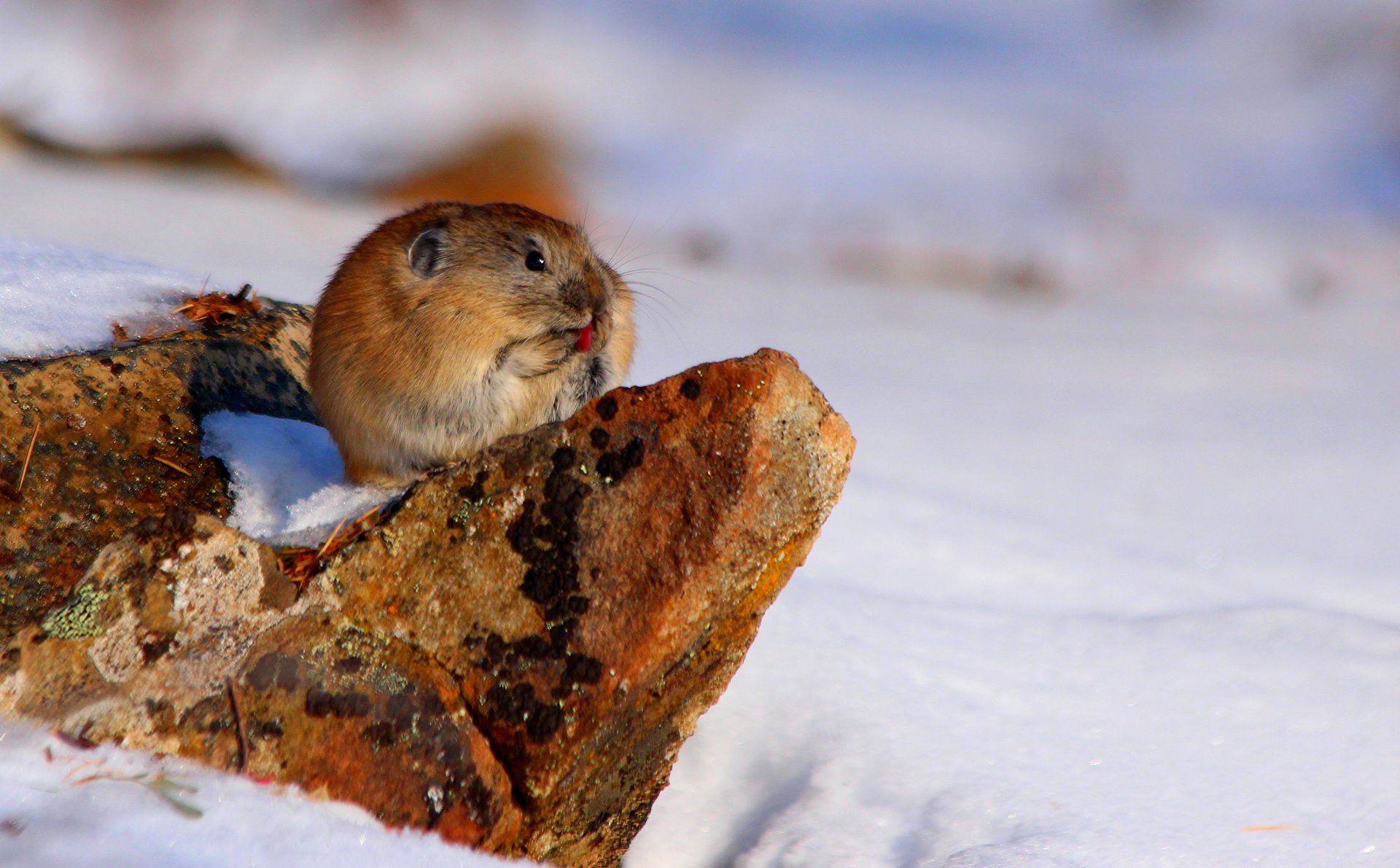
The Ochotona hyperborea, also known as the Northern Pika, is a small mammal that's native to the mountainous regions of Asia.
These adorable creatures can be found in the high-altitude habitats of the Tibetan Plateau and surrounding mountain ranges.
They're well adapted to their harsh environment, with a thick coat of fur that helps them withstand freezing temperatures and strong winds.
Northern Pikas are herbivores, feeding on a variety of plants including grasses, sedges, and mosses.
Physical Characteristics
The northern pika is a small, adorable creature. It grows to a length of between 12.5 and 18.5 centimeters (4.9 and 7.3 in) with a tail of 0.5 to 1.2 centimeters (0.20 to 0.47 in).
Its fur is quite remarkable, changing color with the seasons. In the summer, it's reddish-brown, while in the winter, it's much grayer with a hint of brown coloration.
The northern pika has small rounded ears and short legs with five toes on each foot, and its feet are heavily furred on the underside. This unique feature helps it to grip onto rocky terrain.
One of the most distinctive features of the northern pika is its fur, which is long, dense, soft, and fine. It's also bilaterally symmetrical, meaning it has the same body plan on both sides of its midline.
Here are some key physical characteristics of the northern pika:
- Length: 12.5-18.5 cm (4.9-7.3 in)
- Weight: Not specified
- Tail length: 0.5-1.2 cm (0.20-0.47 in)
- Leg length: Short, with five toes on each foot
- Fur color: Reddish-brown in summer, grayer in winter
The northern pika's physical characteristics are well adapted to its environment, allowing it to thrive in the rocky terrain of the Old World.
Habitat and Distribution
Ochotona hyperborea can be found in the talus region of rocky terrain in moist coniferous forests. It's a pretty specific habitat, but one that the northern pika seems to thrive in.
These areas are typically found in temperate regions, which means they have a moderate climate with warm summers and cold winters. The terrain is also terrestrial, meaning it's land-based rather than aquatic.
The northern pika is found on scree and rocky slopes in mountainous areas, often near the edge of large areas of rock. It makes shallow burrows in the turf nearby, which is a clever way to stay safe and cozy.
Here are some specific locations where Ochotona hyperborea can be found:
- Urals
- Putorana Plateau
- Eastern and southern Siberia
- Sakhalin Island
- Northern Mongolia
- Manchuria
- North Korea
- Hokkaido
Ochotona hyperborea can be found at altitudes between 400 and 2,000 metres (1,300 and 6,600 ft). This is generally higher than the Alpine pika, which is found at lower elevations.
Behavior and Ecosystem
Northern pikas are active at all times of the day, but mostly in the morning and evening hours. They don't hibernate, which is unusual for a small mammal.
Pikas have been observed sunning themselves on exposed rocks, and during the summer months, both sexes frequently give short calls. They also accumulate hay piles, which is a crucial part of their behavior.
In the wild, I've noticed that northern pikas are territorial, and males and females defend their territories throughout their lifespan. Males tend to trespass onto nearby territories, while females stay within their own.
Here are some key behaviors associated with northern pikas:
- terricolous
- diurnal
- crepuscular
- motile
- sedentary
- territorial
- social
Pikas play a vital role in their ecosystem, and their food stores are an important resource for other animals. During the winter months, ungulates like reindeer and snow sheep, as well as hares, marmots, and voles, feed on pika food stores.
Behavior
Northern pikas are active at all times of the day, but mostly in the morning and evening hours. They're not like bears, which hibernate during the winter.
Pikas have been observed sunning themselves on exposed rocks, which is a pretty cool way to spend the day. I can imagine it's nice to soak up some warmth after a chilly night.
Both males and females give short calls from summer to fall, kind of like a warning signal to other pikas. These calls are an important part of their communication.
In the summer months, pikas accumulate hay piles, which is a crucial part of their survival. They collect and store this hay to eat during the winter when food is scarce.
Males are known to steal hay from other pikas in different territories, which is a pretty sneaky behavior. This is an example of kleptoparasitism, where one species benefits at the expense of another.
Here are some key behaviors of northern pikas:
- Terriculous: meaning they live on the ground
- Diurnal: active during the day
- Crepuscular: active at twilight hours
- Motile: able to move around
- Sedentary: staying in one place
- Territorial: defending their territory
- Social: interacting with other pikas
Ecosystem Roles
Northern pikas play a unique role in their ecosystem, particularly during the winter months. They store food, which is then eaten by other animals like reindeer, snow sheep, hares, marmots, and voles.
These animals, in turn, compete with pikas for foliage resources, highlighting the interconnectedness of the ecosystem.
Reindeer, snow sheep, hares, marmots, and voles are some of the animals that feed on pika food stores.
Here are some of the animals that rely on pika food stores:
- Reindeer (Rangifer tarandus)
- Snow sheep (Ovis nivicola)
- Hares (Lepus)
- Marmots (Marmota)
- Voles (Arvicolinae)
Pikas may also promote plant growth in the area by leaving behind remnant food stores, which can nurture nitrophylic plants.
Classification and Naming
Ochotona hyperborea, the northern pika, belongs to the kingdom Animalia, which is home to a vast array of animals, with over 22,000 pictures and 7,109 specimens documented.
The northern pika is a chordate, a group of animals characterized by their possession of a notochord, a flexible rod-like structure that provides support and stiffness. This group has 15,213 pictures and 6,829 specimens documented.
At the class level, the northern pika is classified as a mammal, a group that includes all warm-blooded animals. There are 4,389 pictures and 6,622 specimens of mammals documented.
Here is a summary of the classification levels for Ochotona hyperborea:
Classification
Classification is a way to group living things based on their shared characteristics. There are several levels of classification, each providing more specific information about an organism.
The kingdom is the highest level of classification, and it's divided into several groups. For example, the kingdom Animalia is home to animals, with over 22,000 pictures and 7,109 specimens available for reference.
The phylum is the next level down, and it's further divided into subphyla. In the case of the kingdom Animalia, the phylum Chordata is home to chordates, with over 15,000 pictures and 6,829 specimens available.
Vertebrates are a type of chordate, and they're further divided into classes. The class Mammalia is home to mammals, which have a range of characteristics, including the ability to produce milk for their young.
Mammals are then further divided into orders, such as Lagomorpha, which includes hares, pikas, and rabbits. This order has a relatively small number of pictures and specimens available, with only 137 pictures and 38 specimens.
The family Ochotonidae is a type of lagomorph, and it's home to pikas. This family has a small number of pictures and specimens available, with only 41 pictures and 9 specimens.
Finally, the genus Ochotona is a type of pika, and it's further divided into species. The species Ochotona hyperborea, also known as the northern pika, has a single picture and a single information entry available.
Here's a breakdown of the classification levels and the number of pictures and specimens available for each:
Vernacular Names
In different parts of the world, the Northern Pika has various names. The German name for the species is Nördlicher Pfeifhase.
The Northern Pika is also known as the Northern Pika in English. This name is widely used in scientific and educational contexts.
In Spanish, the species is referred to as Pica de Siberia. This name is likely used in regions where Spanish is the primary language.
The French name for the Northern Pika is Pika de Sibérie. This name is commonly used in France and other French-speaking countries.
In Japan, the species is known as キタナキウサギ, which is a Japanese translation of the species' scientific name.
The Russian name for the Northern Pika is Северная пищуха, which translates to "Northern Pika" in English.
Here are some of the vernacular names for the Northern Pika in different languages:
- Deutsch: Nördlicher Pfeifhase
- English: Northern Pika
- español: Pica de Siberia
- français: Pika de Sibérie
- 日本語: キタナキウサギ
- русский: Северная пищуха
Conservation and Status
Ochotona hyperborea, also known as the Arctic groundhog, is listed as Least Concern on the IUCN Red List.
The US Federal List, CITES, and State of Michigan List all have no special status for this species.
In terms of its natural range, Ochotona hyperborea can be found in the Arctic tundra biome, which includes high mountain summits with low vegetation.
Here's a breakdown of the conservation status for Ochotona hyperborea:
- IUCN Red List: Least Concern
- US Federal List: No special status
- CITES: No special status
- State of Michigan List: No special status
Species Account and Breeding
The northern pika, also known as the Siberian pika, is slightly larger than the American pika, with a body length of 7 to 12 inches and a weight of about 7 ounces.
They have medium brown fur on their upper bodies and orange to cream fur on their undersides. This distinctive coloring helps them blend in with their surroundings.
Northern pikas are herbivores, meaning they eat mainly plants, and their diet consists mostly of grasses and herbs. They also build hay piles of grasses that they feed on during the harsh winters.
Male and female pairs of northern pikas usually live in colonies with other pikas, and they are believed to be monogamous, meaning a male and female pair for life. This social behavior is a key part of their survival strategy.
Both male and female northern pikas defend territories by marking the boundaries with scent or urine, and a territory is usually occupied by a pair of pikas. Males sometimes stray into other territories, but this is relatively rare.
The population of northern pikas is usually stable, with one litter of up to nine offspring being produced each year. However, in the more southerly part of their range, two smaller litters may be produced.
Featured Images: pexels.com