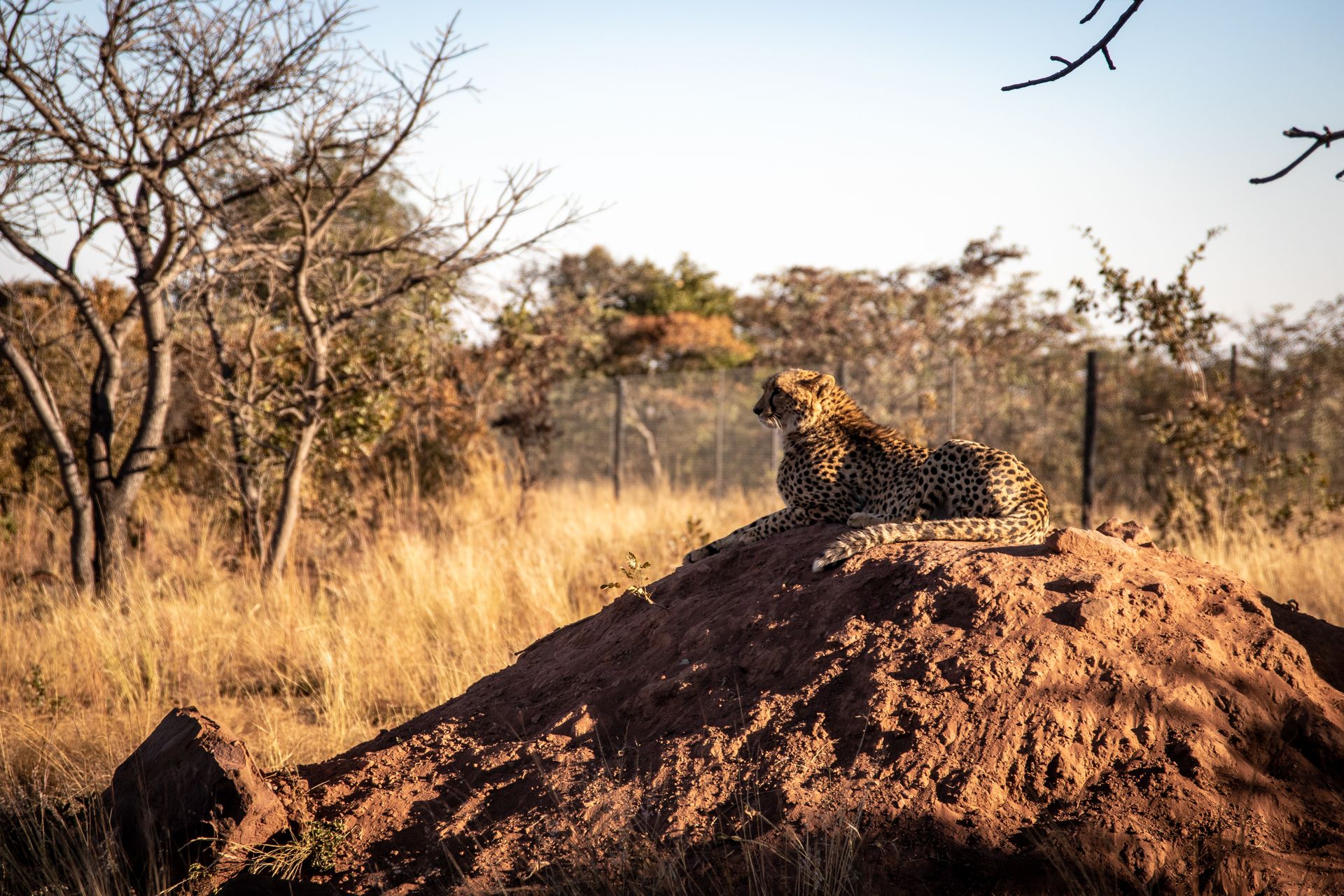
The Northwest African cheetah is a subspecies of cheetah that's found in a relatively small region of North Africa.
They are the rarest big cat in the world, with estimates suggesting there are fewer than 250 individuals remaining in the wild.
These majestic creatures have a unique appearance, with a pale yellowish-brown coat and black spots that help them blend in with their desert habitat.
Their slender build and long legs make them well-suited for speed, allowing them to reach incredible velocities when chasing prey.
See what others are reading: Reintroduction of Cheetah in India
Physical Characteristics
The Northwest African cheetah is quite different in appearance from other African cheetahs. Its coat is shorter and nearly white in color, with spots that fade from black over the spine to light brown on the legs.
The face of the Northwest African cheetah has few or even no spots, and the tear stripes are often missing. This unique feature sets it apart from other cheetahs.
The body shape of the Northwest African cheetah is basically the same as that of the sub-Saharan cheetah, except that it is somewhat smaller. This smaller size is a notable characteristic of this subspecies.
The Northwest African cheetah's fur is shorter and almost white, making it a distinct-looking animal. The spots on its back are black, but they fade to light brown on its legs.
Habitat and Distribution
The Northwest African cheetah's habitat is a fascinating topic. They primarily live in small, fragmented populations in the western and central Sahara desert and the Sahel region.
These cheetahs were once widely distributed across North-Western Africa, but now they only occupy about 9% of their former habitat range. This drastic reduction in habitat is a major concern for their survival.
The largest population of Northwest African cheetahs is believed to exist in the Ahaggar highlands of Algeria, but this is based on limited data from 2009. Besides Algeria, their range is also thought to include Togo, Niger, Mali, Benin, and Burkina Faso.
More than 50 cheetahs are thought to live in Algeria, compared to 10 or fewer in Niger. In Niger, you can find them in the northern Ténéré desert and in the W National Park.
Here's a breakdown of the estimated cheetah populations in some of the countries where they are found:
Sadly, these cheetahs are thought to be gone from countries like Morocco, Senegal, and Ghana. In 2010, a camera trap took a picture of a cheetah in Niger's Termit Massif. Between 2008 and 2010, four cheetahs were seen by camera traps in Ahaggar National Park in Algeria.
Their Lifestyle
The Sahara desert is a tough place to live, but Northwest African cheetahs have adapted to survive in this harsh climate. Temperatures can go above 40 degrees Celsius during the day, making it hard for them to hunt during the day.
They've learned to be mostly active at night, from sunset to early morning, which helps them avoid the extreme heat. This nocturnal behavior is a key adaptation that helps them thrive in the Sahara.
Their main food source is antelopes that can live in dry places, such as the addax, Dorcas gazelle, and dama gazelle. These antelopes have also adapted to the arid environment.
Cheetahs can get all the water they need from the blood of their prey, so they don't always need to find water to drink directly. This is a clever adaptation that helps them survive in areas where water is scarce.
Here are some key facts about their lifestyle:
They travel long distances to find food and water, and they exist at a lower density compared to other cheetah subspecies living in the savannah. This is likely due to the harsh climate and limited resources available in the Sahara.
Conservation Status
The Northwest African cheetah is Critically Endangered on the IUCN Red List.
Climate change, habitat destruction, and human hunting are major causes of their endangerment.
Their genes also pose threats to their continued survival.
With a very low rate of reproduction, their population does not grow, making it hard for them to adapt to environmental changes.
Why Is Endangered
The Northwest African cheetah is Critically Endangered on the IUCN Red List. Their genes pose threats to their continued survival.
Climate change, habitat destruction, and human hunting are major causes of their endangerment. These factors are affecting their ability to thrive in the wild.
Their low rate of reproduction is another significant issue. They are not always able to reproduce, which means their population does not grow.
This lack of growth makes it difficult for them to adapt to changes in the environment. As a result, their numbers continue to decline.
Population Remaining
The population of Northwest African cheetahs is a pressing concern. Unfortunately, reliable data on their population status and distribution is insufficient.
In 2008, their population was suspected to consist of less than 250 adult individuals. This estimate is concerning, to say the least.
A 2016 survey estimated the largest population of Northwest African cheetahs to consist of 191 individuals. This was found in the Adrar des Ifoghas in Mali, Ahaggar in south-central Algeria, and Tassili n'Ajjer in northeastern Mali.
Camera traps set up in Ahaggar National Park between 2008 and 2010 recorded 4 individuals. This is a small but hopeful sign.
In Niger, populations exist in the Ténéré desert and the southern savannah area of the W National Park. This is a critical habitat for the subspecies.
Interesting Facts
The Northwest African cheetah is one of the rarest big cats in the world.
This subspecies is also known as the Saharan cheetah, native to the Sahara desert and Sahel in Africa.
The Northwest African cheetah has a light color coat with fewer spots compared to other subspecies of cheetah, and it often has no tear strips.
In appearance, it resembles the sub-Saharan cheetah, but it's slightly smaller.
Here's a comparison of the Northwest African cheetah's physical characteristics:
Tear stripsOften has no tear strips
The Saharan cheetah can survive in extreme conditions, such as water scarcity and high temperatures (up to 40 ℃ or 104 ℉ in the daytime), due to its harsh habitat.
This remarkable ability allows it to fulfill most of its water requirements from the blood of its prey, as water is scarce in its habitat range.
The population of Northwest African cheetah was estimated to be 457 individuals between 2007 and 2012 in an area of 1,037,322 km², although this number might be short or large due to insufficient data.
In 2008, the population was suspected to be less than 250 adult individuals, which is why the IUCN Red List included the Northwest African cheetah in the list of Critically Endangered species.
Scientific Information
The Northwest African cheetah's scientific name is Acinonyx jubatus hecki, given to it by German zoologist Max Hilzheimer in 1913.
The scientific name of the subspecies is derived from the genus name Acinonyx, which refers to the cheetah's unique characteristics.
The genus name Acinonyx is a combination of the Greek words "akis" meaning "without" and "onyx" meaning "claw", referring to the cheetah's non-retractable claws.
Consider reading: Acinonyx Jubatus Venaticus
Diet and Adaptations
The Northwest African cheetah is an obligate carnivore, meaning it relies heavily on meat to survive. It fulfills more than 70% of its dietary requirements from the meat of other animals.
Its preferred prey includes antelopes that are adapted to the aired environment of its habitat range. These antelopes include addax, Dorcas gazelle, dama gazelle, and rhim gazelle.
Smaller mammals like hares are also on the menu for the Northwest African cheetah.
General Information
The Northwest African cheetah is a subspecies of cheetah that's found in the wild only in North Africa. They are also known as the Sahara cheetah.
They have a distinctive golden-brown coat with black spots, which helps them blend in with their desert surroundings. Their coat is also lighter in color to reflect the sun's rays and keep them cool.
They are solitary animals and have a large territory, which they mark with their scent to keep other cheetahs away. They are also skilled hunters, using their speed and agility to catch prey.
The Northwest African cheetah is listed as Critically Endangered on the IUCN Red List, due to habitat loss and poaching. They are also threatened by human-wildlife conflict, as they come into contact with humans more frequently in their fragmented habitats.
Their habitat is the Sahara Desert and the surrounding Saharan regions, where they roam freely in search of prey.
Frequently Asked Questions
What eats the Saharan cheetah?
Saharan cheetahs have no natural predators in the Sahara desert, but they can face threats from humans through hunting and habitat loss.
Featured Images: pexels.com