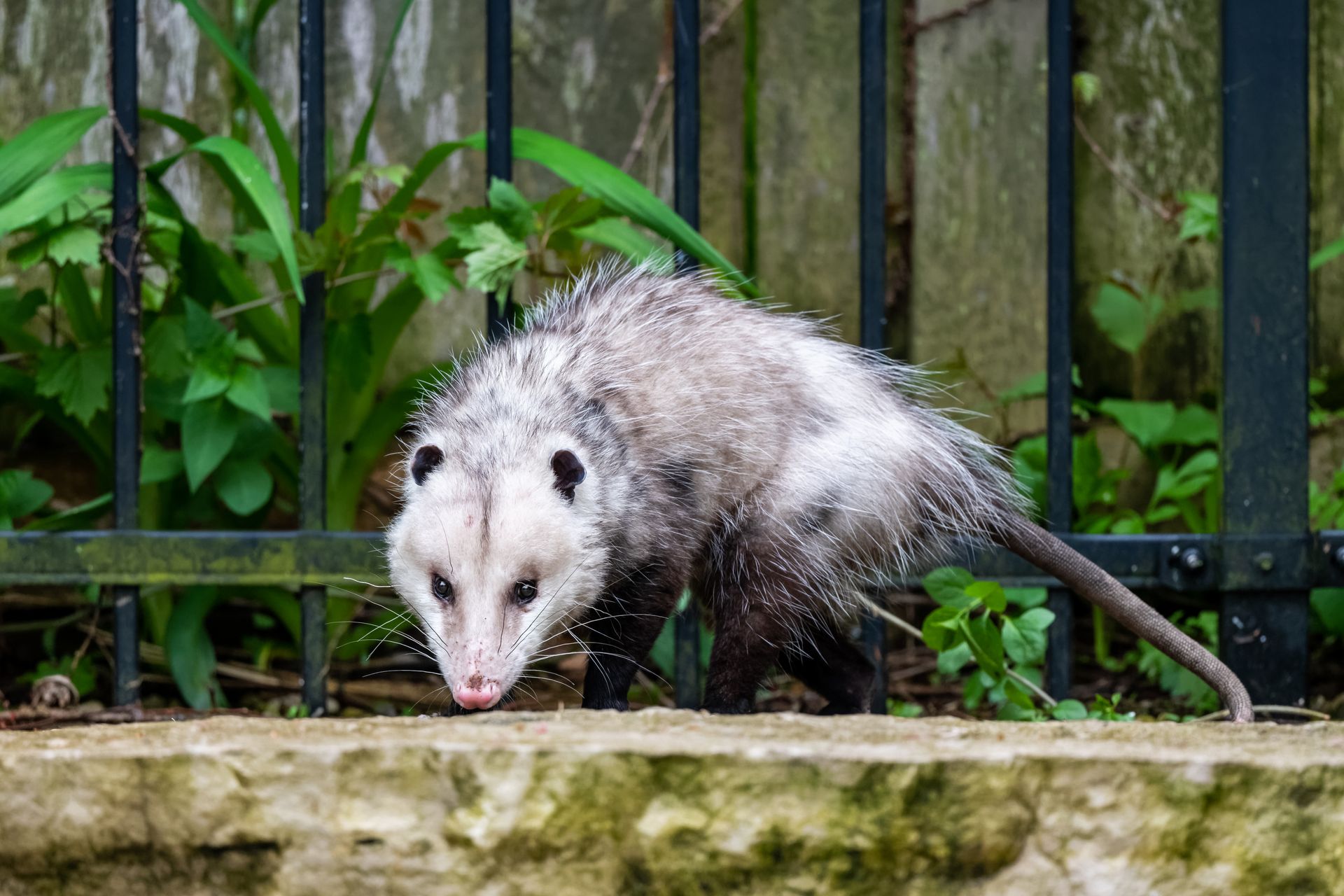
North American opossums are quite fascinating creatures, and here are some interesting facts about their behavior.
They are generally solitary animals, only coming together for mating.
Opossums are known for their ability to "play dead" when threatened, a behavior called thanatosis or death feigning.
This defense mechanism helps protect them from predators, as many animals won't eat a dead animal.
Their prehensile tails also help them climb and balance in trees.
For another approach, see: Eastern Screech Owl Behavior
Physical Characteristics
The North American opossum is a unique creature with some fascinating physical characteristics. Its prehensile tail can be used for grasping like a hand, which is a feature not found in any other mammal in the United States.
Young opossums often hang by their tails, but as they grow up, they become too heavy for this behavior. The opossum's tail is also long and scaly, making it a distinctive feature.
The opossum has four fingers and an opposable thumb on each of its hind feet, which works like a human thumb and allows it to pick up things or hang onto thin branches with ease.
Physical Description
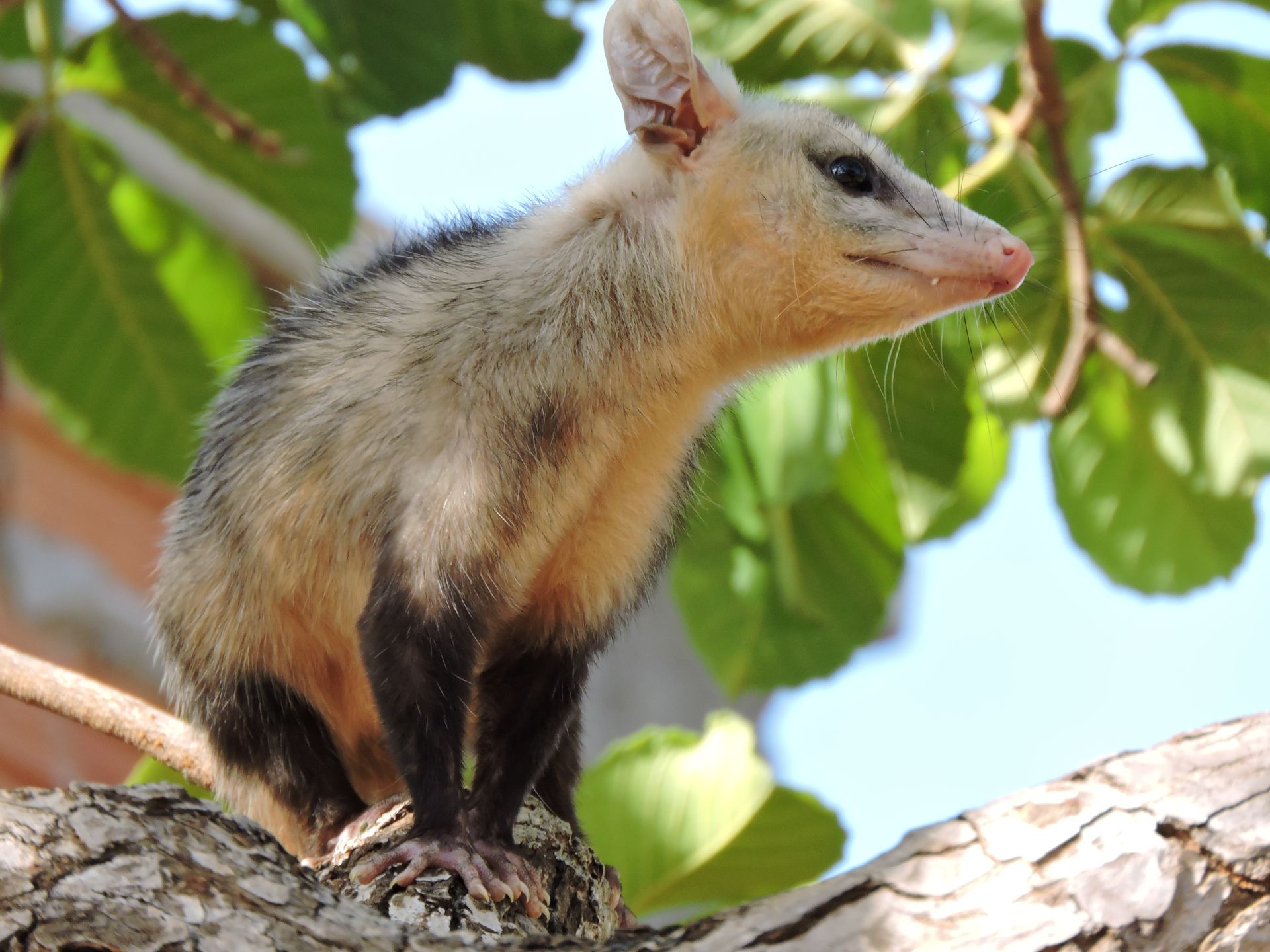
Opossums are marsupials, a primitive group of mammals found most commonly in Australia.
Kangaroos, koalas, and wombats are other well-known marsupials.
They are the only marsupials in North America.
All other mammals are placentals, which means their young develop within a saclike membrane called the placenta inside the mother’s uterus.
Tracks
Tracks are a key way to identify opossum activity, and they can be found in a variety of surfaces including mud, snow, and fine soil.
Opossums also leave tracks on deck railings and downspouts, which they use to gain access to structures.
Their unique opposable hind thumbs create a distinctive print that can point as much as 90 degrees away from the direction of travel.
Behavior and Habitat
North American opossums are generally solitary animals, only coming together for mating. They have a strong instinct to avoid confrontations and will often "play dead" when threatened.
Their solitary nature is likely due to their territorial behavior, with each opossum defending its own territory from others. They have a keen sense of smell and can detect the presence of other opossums from a distance.
In terms of habitat, North American opossums are found in a variety of environments, including forests, swamps, and backyards. They are highly adaptable and can thrive in a range of conditions.
Scavenger Behavior

Opossums are scavengers, and they often visit human homes or settlements to raid garbage cans, dumpsters, and other containers.
They're attracted to carrion and can often be spotted near roadkill, which is a major source of food for them.
Opossums also eat grass, nuts, and fruit, which they forage from gardens and backyards.
They will hunt small animals like mice, birds, and insects, as well as worms and snakes.
Habitat
Opossums are incredibly adaptable creatures that can thrive in a wide range of habitats, from woodland to inner city.
They're not picky about their living arrangements and will take advantage of whatever den sites are available, whether it's an abandoned burrow or a cozy spot under a porch.
Opossums often use the abandoned burrows of other animals rather than digging their own, which is a great way to save energy.
In urban neighborhoods, you might spot an opossum denning under a building, a storage shed, or even a pile of wood.
Females with young tend to be the exception, using the same den sites for weeks at a time to keep their babies safe and warm.
Opossums are also known to use rocky crevices, culverts, and drainpipes as den sites, often preferring spots with easy access to water.
In general, opossums will live almost anywhere as long as they have access to basic necessities like food, water, and shelter.
Breeding and Gestation
Opossums are solitary animals, except when females are with their young, or for brief interludes during breeding season. Males are territorial and will fight violently during mating season.
Only in some southern states do opossums produce two litters a year, while in Virginia, one litter is common. In some cases, a third litter has been observed.
The breeding season begins at the end of winter, in January and February. Female opossums will accept a male only once during the estrus period.
A different take: American Bulldog Breeding
Newborn opossums are about the size of a grain of rice, and they cannot see. They will scramble from their birthplace under their mother's tail and wriggle across her hairy belly to the safety of her pouch.
Most newborn opossums do not survive the journey to the pouch, as they must find a nipple and there are only 13 nipples. Each infant opossum must attach itself to one of her nipples.
After just 1 week of suckling, the babies triple their size. In 1 week, the birth weight increases ten times.
The youngsters' eyes finally open, and they have some control of their body temperatures after about 60 to 70 days in the pouch. At this time, they have grown to the size of a white-footed mouse, weighing about an ounce.
At around 75 to 85 days of age, they are weaned and seldom go back in the pouch.
Trails
Opossums are skilled trail users, often following paths made by other wildlife or humans near creeks, ravines, and wetlands. They also use culverts as a safe way to cross under highways and roadways, just like raccoons and foxes.

You might notice wear marks and hairs around the edges of entry points where opossums are entering a building or crawling under a fence. Opossum hair is long and silver to gray in color, so if you spot some, you might be able to tell if an opossum has been using a particular trail.
In developed areas, trails can occur along buildings and fences, making it easier for opossums to move around.
Trapping
Trapping can be a viable option to deal with opossum conflicts, but it's essential to do it correctly. It's legal to trap an opossum and then release it at the site of capture.
The most effective way to trap an opossum is to use a single- or double-door type live trap that measures 11 x 11 x 36 inches. Bait it with cracked boiled eggs, sliced apples, or other fruit and vegetables to prevent attracting cats or small dogs.
Place the trap where the animal, or evidence of the animal, has been seen. This increases the chances of catching the opossum.
If Not Interested in Attracting
If you're not interested in attracting opossums, there are a few simple steps you can take to discourage them from visiting your yard.
First, make sure to pick fruit and garden crops when they're ripe to prevent opossums from being attracted to the area.
Leaving pet food or trash outdoors at night is like putting out a welcome mat for opossums.
Eliminate brush piles, dilapidated buildings, and holes under concrete slabs – these can serve as cozy opossum hotels.
Opossums occasionally enter homes through pet doors, so be sure to secure them at night.
If an opossum does get inside, don't worry – they can usually be coaxed back outside with a broom.
Playing Possum
The opossum's ability to "play possum" is one of its most fascinating defense mechanisms. This behavior is a surprisingly effective way to deter predators, and it's not uncommon to see an opossum flop onto its side and lie still, with its eyes closed or staring into space.
Opossums can remain in this state for several minutes or even hours, and no amount of prodding will produce a response. They'll even go so far as to extend their tongues and appear to be dead.
This behavior is often triggered when an opossum is threatened by a predator like a dog, fox, or bobcat. By appearing dead, the opossum may put the predator off its guard and give itself an opportunity to escape.
In some cases, opossums will also play dead when confronted by danger, and their eyes will glaze over, baring their teeth and lolling their tongues to the side. It's a convincing portrayal of death, complete with a putrid odor that will deter even the most eager predators.
Despite its effectiveness, the "playing possum" behavior won't save an opossum from all predators. Man and the automobile are two enemies from which this defense mechanism won't provide protection.
Identification and Encounters
North American opossums are relatively easy to identify, with a distinctive pointed snout, hairless prehensile tail, and stocky body.
They have a grayish-white coat with a pinkish nose and ears, and can grow up to 2 feet in length, including their tail.
Opossums are generally nocturnal, so you're more likely to spot them at night, but they can be active during the day as well.
They have a unique way of moving, using their prehensile tail as an extra hand to climb and grasp branches.
Encountering an Animal
Encountering an animal can be a fascinating experience, especially if you're out in nature or have wildlife visiting your backyard. Opossums, for example, are often seen as pests, but they're actually quite harmless.
If you encounter an opossum, it's best to leave it alone. According to Janice Hughlett, known as the "Possum Lady", opossums are generally non-aggressive and will not attack unless they feel threatened.
Opossums are also very good at playing dead, a defense mechanism they use to deter predators. This can be a bit unsettling to see, but it's not a cause for concern.
Viewing
If you're hoping to catch a glimpse of an opossum, your best bet is to do some nocturnal exploring, as they're most active at night. They tend to stick to areas near their dens, but can travel up to 2 miles in search of food.
Opossums are generally solitary animals, so you won't often see them in groups. However, during breeding season or when a female is with her young, you might spot them together.
You can find opossums ambling about on the ground, but they're also decent climbers and swimmers. If you're lucky, you might even spot one climbing a tree to escape, search for food, or rest.
A nighttime walk along a stream or wetland, or down an alley lined with trashcans, can be a great way to spot an opossum looking for food. Just be aware that they're not exactly speed demons, moving at a top speed of about 4 miles per hour.
As you're out observing, keep an eye out for an opossum's distinctive gait, where its tail rotates in circles for balance. It's a pretty unique sight, and a good indication that you've spotted an opossum.
Opossum Facts and Range
Opossums have adapted well to living close to people in urban and suburban environments. They can now be found in most human-occupied habitats in western Washington, except for higher elevations.
Prior to European settlement of North America, opossums were only found in Central America and the southeastern United States. Their range expanded northward and westward during the 1900s.
The Virginia opossum, also known as a "possum", first arrived in Washington in the early 1900s as pets and novelties. Some of these animals later escaped from captivity or were intentionally released.
Reproduction
Reproduction is a fascinating process in opossums. A female opossum gives birth to helpless young as tiny as honeybees.
These babies immediately crawl into the mother's pouch, where they continue to develop. They go in and out of the pouch and sometimes ride on the mother's back as she hunts for food.
Opossums may give birth to as many as 20 babies in a litter, but fewer than half of them survive. Some never even make it as far as the pouch.
Opossum Facts
Opossums are very clean animals, despite their often-raggedy appearance and stinky smell, which is a predator repellant secretion. They groom themselves regularly, bordering on obsessively.
Opossums are immune to most venom, including that of honeybees and scorpions, as well as toxins such as botulism. This makes them fearless eaters, taking on venomous snakes and other potentially deadly prey.
Opossums have opposable "thumbs" on their back feet, giving them agile climbing skills, and prehensile tails that act as an extra hand. They use these adaptations to climb and hang from trees with ease.
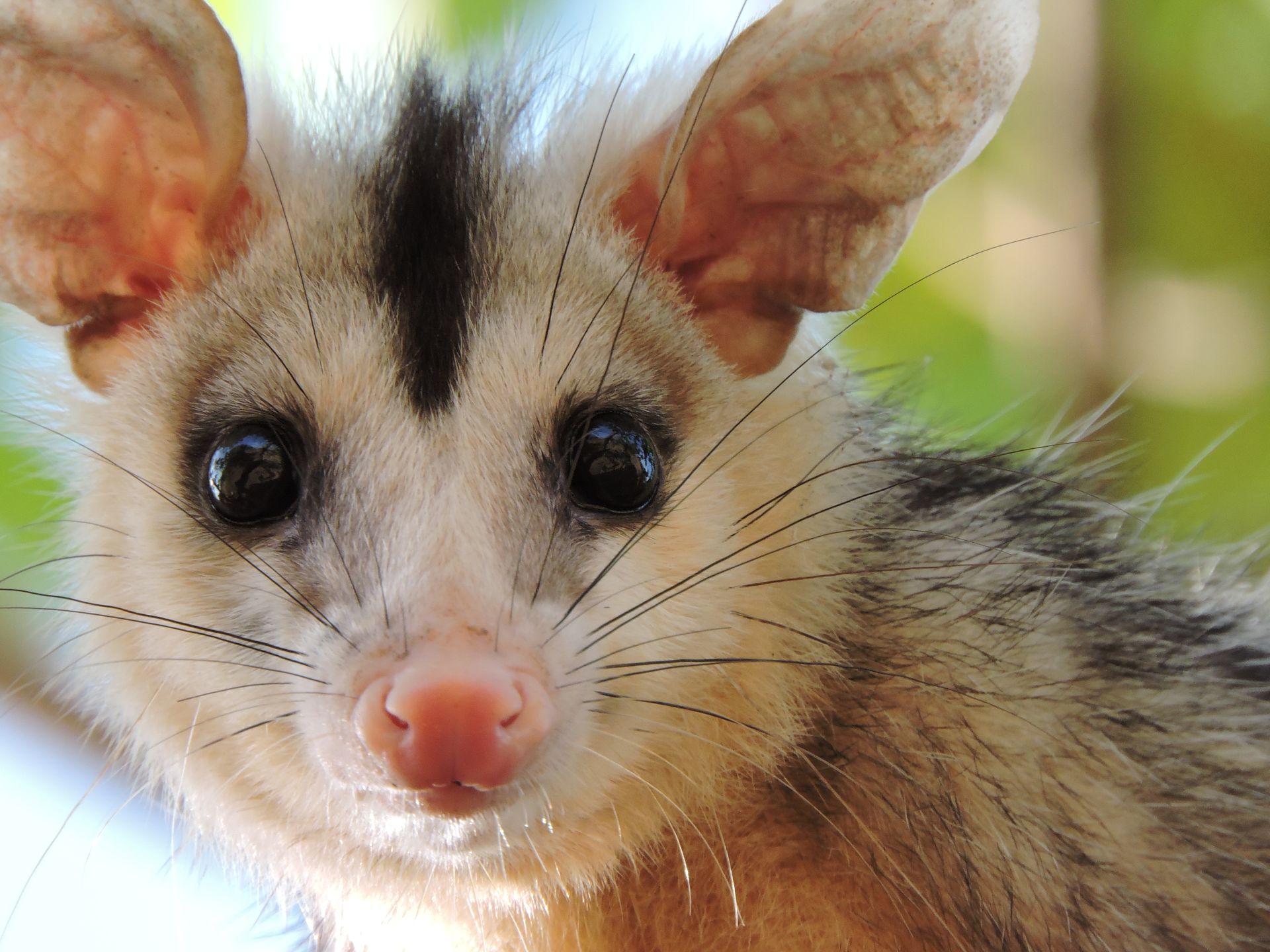
Opossums have huge pupils for seeing at night, their most active period, and 50 teeth in their mouth for eating everything and anything, including bones for calcium. They're truly omnivores!
Opossums can carry diseases such as leptospirosis, salmonella, toxoplasmosis, and coccidiosis, which can be transmitted through contact with their urine or feces. So, it's essential to handle opossums carefully and avoid direct contact.
Opossums are also carriers of equine protozoal myeloencephalitis (EPM), which affects horses when they ingest feces. If you have horses, it's crucial to opossum-proof your home and yard to protect them.
Geographic Range
Opossums have adapted well to living close to people in urban and suburban environments.
Prior to European settlement of North America, the opossum was found only in Central America and the southeastern United States.
Opossums now occupy most human-occupied habitats in western Washington, except for higher elevations.
The opossum's range expanded northward and westward during the 1900s.
Virginia opossums, also known as "possums", first arrived in Washington in the early 1900s as pets and novelties.
Some of these animals, or their offspring, later escaped from captivity or were intentionally released.
The Virginia Opossum
The Virginia Opossum is a unique creature found in the eastern and midwestern parts of the United States.
They have a prehensile tail that they use as an extra hand to climb trees and grasp onto branches.
Opossums are generally small, typically weighing between 8 and 13 pounds and measuring 16 to 21 inches in length.
They are also known for their ability to "play dead" when threatened, a behavior that is often referred to as thanatosis.
This behavior is a defense mechanism that helps to deter predators from attacking them.
Opossums are primarily nocturnal, spending most of their time foraging for food at night.
They are opportunistic omnivores, eating a wide variety of foods including fruits, insects, and even small animals.
In the wild, opossums can live up to two years, although the average lifespan is around one year due to predation and disease.
Frequently Asked Questions
Are opossum the only North American marsupial?
Yes, Virginia Opossums are the only marsupial native to North America. They are a unique and fascinating creature that can often be found visiting backyards throughout the year.
Is the North American opossum endangered?
No, the Virginia Opossum is not considered endangered or threatened, but its population faces threats from habitat loss and vehicle collisions.
What is the lifespan of a North American opossum?
North American opossums typically live 1-2 years in the wild and up to 4 years in captivity, with males generally outliving females.
Featured Images: pexels.com