The New Zealand Fantail is a small, yet fascinating bird species.
It's the only member of the fantail family native to New Zealand.
Native to New Zealand, the Fantail is a common sight in many parts of the country.
Found in a variety of habitats, including forests, wetlands, and backyards, these birds are incredibly adaptable.
Their distinctive fan-shaped tail is a key identifying feature, and it's quite a sight to see one flit through the trees.
The Fantail's diet consists mainly of insects, spiders, and other small invertebrates.
For your interest: Fancy Fantail Goldfish
Taxonomy
The New Zealand fantail's taxonomy has undergone several changes since its formal description in 1787 by Anders Sparrman. He initially placed it with the flycatchers in the genus Muscicapa.
The New Zealand fantail is now one of 51 fantails placed in the genus Rhipidura, which was introduced in 1827 by naturalists Nicholas Vigors and Thomas Horsfield. This genus was named after the fan-like structure of the tail.
The specific epithet of the New Zealand fantail, Muscicapa fuliginosa, comes from Late Latin, meaning "sooty". This refers to the bird's coloration.
Four subspecies of the New Zealand fantail are recognized:
- R. f. fuliginosa: found in South and Stewart Islands (New Zealand)
- R. f. placabilis: found in North Island (New Zealand)
- R. f. penita: found in Chatham Islands (east of South Island, New Zealand)
- † R. f. cervina: extinct, found in Lord Howe Island (east of Australia)
Physical Characteristics
The New Zealand fantail is a bird that's quite easy to spot, thanks to its distinctive plumage.
One of the most notable features of the adult fantail is its greyish head.
The bird's upper breast is a striking white, which provides a nice contrast to its cinnamon-colored belly.
Its back and rump are a rich brown, a color that's echoed in its tail feathers.
The fantail's tail is particularly striking, featuring a mix of white and brown feathers.
Curious to learn more? Check out: New England Bird Identification
Behavior and Ecology
The New Zealand fantail is a social bird that's not afraid to get up close and personal with humans. They'll flit within a few metres of people, especially in forested areas and suburban gardens, in search of small flying insects.
During the breeding season, fantails are fiercely territorial and will chase away any interlopers with their harsh chattering calls. Adults remain on or near their territories in the non-breeding season, while juveniles occasionally gather in loose flocks where prey is readily available.
In cold weather, fantails will huddle together to stay warm, and they're not above foraging on the ground for food. They have a strong association with foraging saddlebacks wherever the two species co-occur, and will often flick their wings and fan their tails to frighten hidden prey into movement.
Behavior
Fantails are always on the move, flitting from perch to perch in search of flying insects. They're not shy birds and will often fly close to people, especially in forested areas and suburban gardens.
Their constant movement is quite impressive, and it's not uncommon to see them huddled together for warmth on cold days. In fact, people who fidget a lot are sometimes called a fantail's tail.
The bird's call is an almost metallic cheep, often repeated as a chattering sound. This call is a key part of their behavior, particularly during the breeding season when they use it to chase away interlopers.
During the breeding season, fantails are fiercely territorial and will chase away any birds that enter their territory with harsh chattering calls. This behavior is essential for protecting their young and territory.
In cold weather, fantails will move about on the ground in search of food, which is a remarkable sight to see. They'll even roost communally, perched tightly together in a sheltered cavity to stay warm.
A different take: New Zealand Birds Also Known as Owl Parrots
Breeding
Fantails are devoted parents, taking turns on the nest through the approximately 14-day incubation period, with both male and female contributing to the process.
Their nests are intricately constructed from fine materials like mosses, dried wood fibres, and cobwebs, often sheltered from above by foliage.
In southern localities and offshore islands, the breeding season is shorter compared to those further north.
The female lays two to five eggs, and the male helps with incubation and feeding the young during the 14-day nestling period.
Recent fledglings have short tails and often stay together, perching side by side.
The male takes care of the fledglings while the female builds the next nest, and in one monitored pair, they reared five broods in a season, totaling 15 fledglings.
Take a look at this: Female Dog Mothering New Puppy
Distribution and Habitat
The New Zealand fantail is a widespread bird species, found from Northland to Stewart Island, and on some islands of the Chathams group.
They can thrive in a variety of habitats, including both native and exotic forest and shrubland.
You can spot them in extensive native forest blocks, small forest patches, scrubland, and even in well-treed suburban parks and gardens.
Their adaptability to different environments has allowed them to colonize new areas, such as the Snares group, although they did disappear after a severe storm in 2001.
The North Island fantail, a subspecies, is not threatened, and its scientific name is Rhipidura fuliginosa placabilis, named in 1921.
Distribution and Habitat
Fantails can be found in a wide range of habitats, from native forests to exotic plantations and even suburban parks and gardens.
The North Island fantail, a subspecies of fantail, is not considered threatened, which is a positive sign for its conservation status.
Fantails are widespread in New Zealand, with a presence on the North Island, Stewart Island, and some islands of the Chathams group, including Chatham, Pitt, Rangatira, Mangere, and Little Mangere.
They can thrive in various types of forests, including native and exotic, as well as shrubland habitats.
The Chathams group, where fantails have been spotted, is a remote island chain, indicating their ability to adapt to different environments.
Fantails have even colonized the Snares group, but unfortunately, they disappeared after a severe storm in 2001.
Broaden your view: South Island Kokako
South Island
The South Island is home to a unique bird species, the South Island fantail. This bird has a semi-precocial nature, meaning it's not entirely helpless at birth but still needs some time to develop.
The South Island fantail is a small songbird with distinctive markings, including a greyish head, white eyebrows, brown back and rump, cinnamon breast and belly, and a long black and white tail.
In the South Island, five percent of the fantail population has a mainly black plumage with black-brown overtones.
The fantail's tail is a notable feature, taking on a characteristic fan shape when spread in display or aerial foraging.
Check this out: Bird Identification New Mexico
Conservation and Threats
The New Zealand fantail is a resilient bird, but it still faces some significant threats. Introduced mammalian pests, particularly ship rats, prey on nesting adults, eggs, and chicks.
The conversion of lowland native forest to farmland has had a limited impact on the fantail population, but it's still a concern.
Birds' Diet
Fantails are insectivores, which means they primarily eat live insects they catch on the wing.
Providing a birdbath is a great way to support Fantails, as they love to splash about in the water.
Insect-friendly plants and leaf litter accumulation are essential for supporting biodiversity in your area, which in turn helps Fantails to prosper.
Threats and Conservation
The fantail is one of the few native forest bird species that has coped reasonably well with the extensive conversion of lowland native forest to farmland.
However, nesting adults, eggs, and chicks are vulnerable to being preyed upon by introduced mammalian pests, particularly ship rats.
The conversion of lowland native forest to farmland has had a significant impact on the fantail's habitat, making it harder for the species to thrive.
Ship rats are a major threat to fantail populations, and their presence can have devastating effects on nesting adults, eggs, and chicks.
The fantail's ability to adapt to its changing environment is impressive, but it's clear that more needs to be done to protect this remarkable species.
Flight and Movement
The fantail's flight is a sight to behold! Its distinctive tail shape, with a rounded apex, helps it navigate through the air with ease when feeding on insects and small fruit.
The fantail's long tail is a notable feature, with most having a tail longer than each wing.
Chick Readies Wings for Leaving Nest
As a bird enthusiast, I've had the pleasure of witnessing the development of chicks into independent birds. Fantail chicks will flaps its wings in readiness for leaving the nest.
This behavior is a clear sign that the chick is getting ready to take to the skies. Around 26 - 44 days is when Fantails become independent, so it's essential to provide them with a safe environment to practice their flying skills.
It's amazing to see how quickly chicks grow and develop their flying abilities. Fantail chicks will flaps its wings in readiness for leaving the nest, and before you know it, they'll be soaring through the air.
If you're raising Fantail chicks, be prepared for them to become independent around 26 - 44 days. This is an exciting milestone, and with patience and practice, your chicks will be flying in no time.
Flight
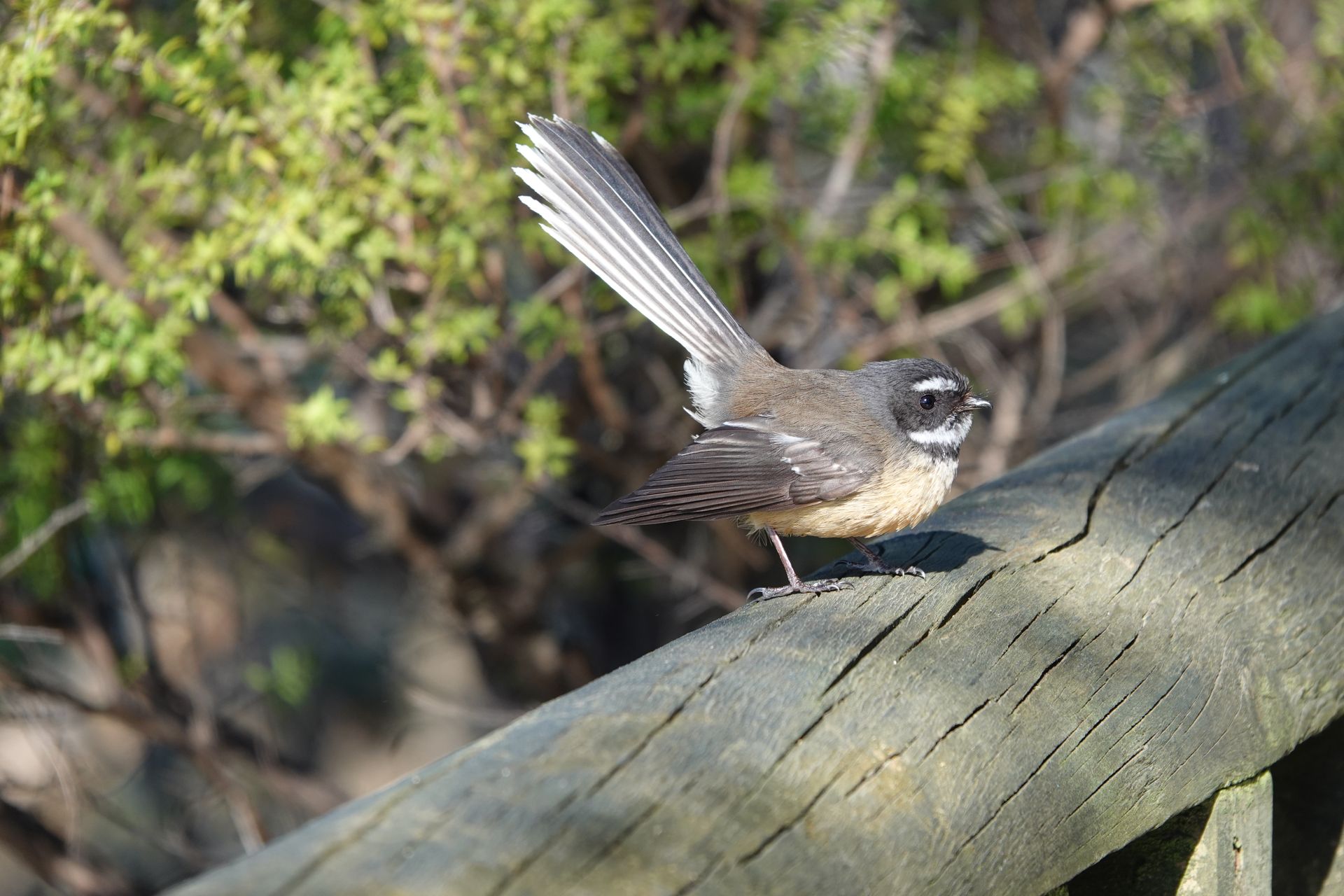
The fantail's flight is truly unique and efficient. Its "fan" shape tail and rounded tail at the apex help with aerial movements when feeding on insects and small fruit.
The fantail's small body length, ranging from 11.5 to 21 cm, allows for agile flight. Its long tail is a distinctive feature, often longer than each wing in most fantails.
The fantail's flight is well-suited for catching insects like moths, flies, beetles, and spiders. This is due to the shape of its tail and wings.
Its long tail provides stability during flight, making it easier for the fantail to maneuver and catch prey.
Related reading: How Long Should I Quarantine a New Bird?
Identification
The New Zealand fantail comes in two colour morphs: pied and black. The adult pied fantail has a distinctive appearance with a greyish head, prominent white eyebrows, brown back and rump, cinnamon breast and belly, and a long black and white tail.
Juvenile pied fantails are mainly brown, lack the striking white eyebrows and chest bands, and have a rufous tint on the breast, eyebrows, and primary coverts. They're quite different from their adult counterparts.
Black fantails, on the other hand, are mainly black with black-brown over the rump, belly, and flight feathers. They occasionally have a white spot over each ear, but never have white on their tail feathers.
Four Subspecies
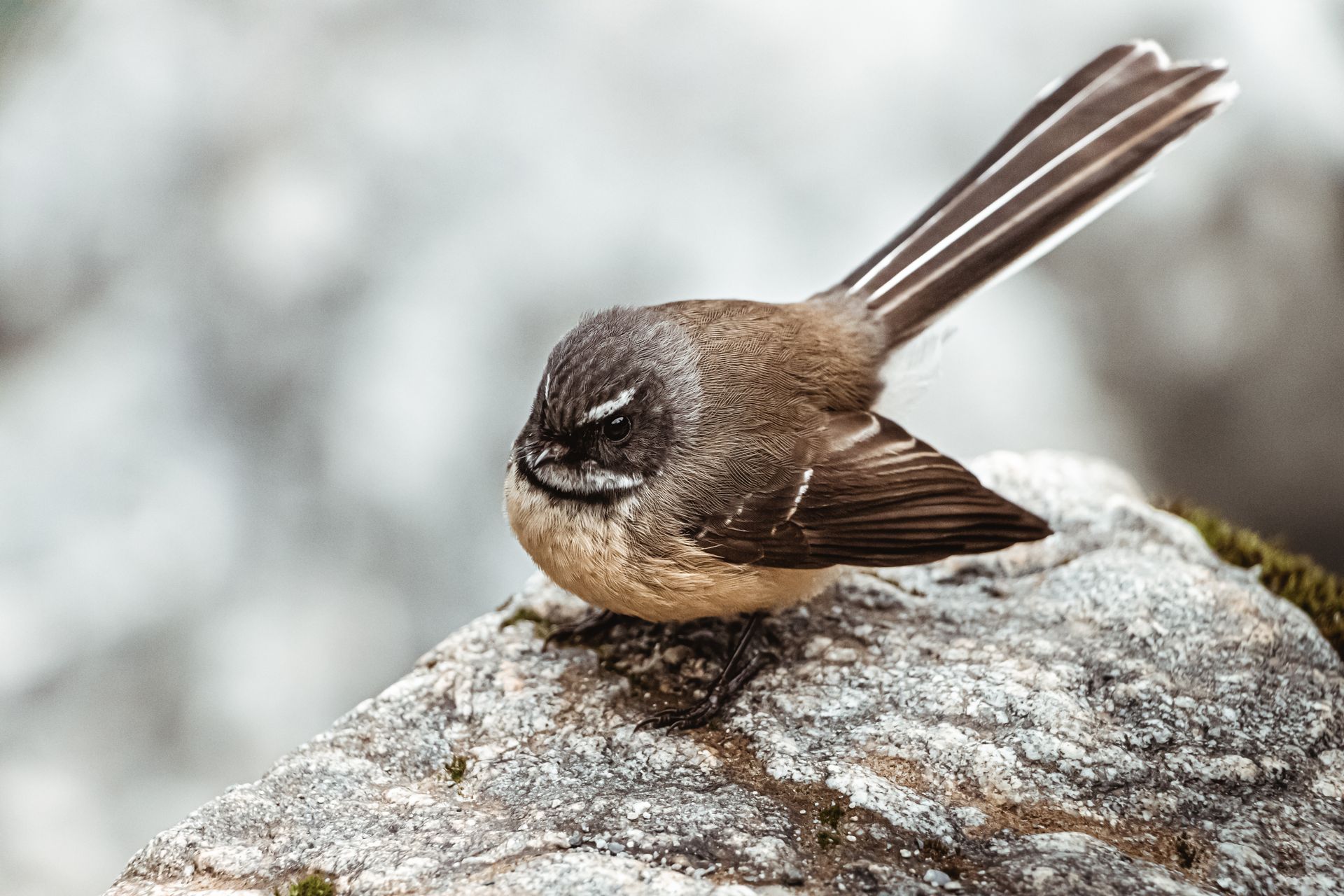
The NZ fantail is a beautiful bird to identify, and one key aspect is its subspecies. There are four subspecies of NZ fantail.
The Lord Howe Island fantail has become extinct, which is a sad reminder of the fragility of species.
Identification
The New Zealand fantail comes in two main color morphs: pied and black.
Adult pied fantails have a distinctive greyish head and prominent white eyebrows.
They also have a brown back and rump, with a cinnamon breast and belly.
The tail feathers are a striking combination of white and black.
Juvenile pied fantails are a bit different, with mainly brown tones over the head and body.
They lack the striking white eyebrows and chest bands of adult pied fantails.
Black fantails, on the other hand, are mainly black, with black-brown over the rump, belly, and flight feathers.
Occasionally, they may have a white spot over each ear.
Juvenile black fantails tend to be darker, with a more dark brown color.
Frequently Asked Questions
What does it mean if a fantail visits you?
If a fantail visits you, it's believed to be a messenger from the Maori people, indicating death or news of death is near. This ancient superstition is rooted in the Maori culture, where the fantail is considered a harbinger of somber news.
Why are fantails so friendly?
Fantails appear friendly because they follow people for food disturbed by their footsteps, not for companionship. According to Māori mythology, their distinctive features are a result of their connection to the demigod Māui.
Featured Images: pexels.com