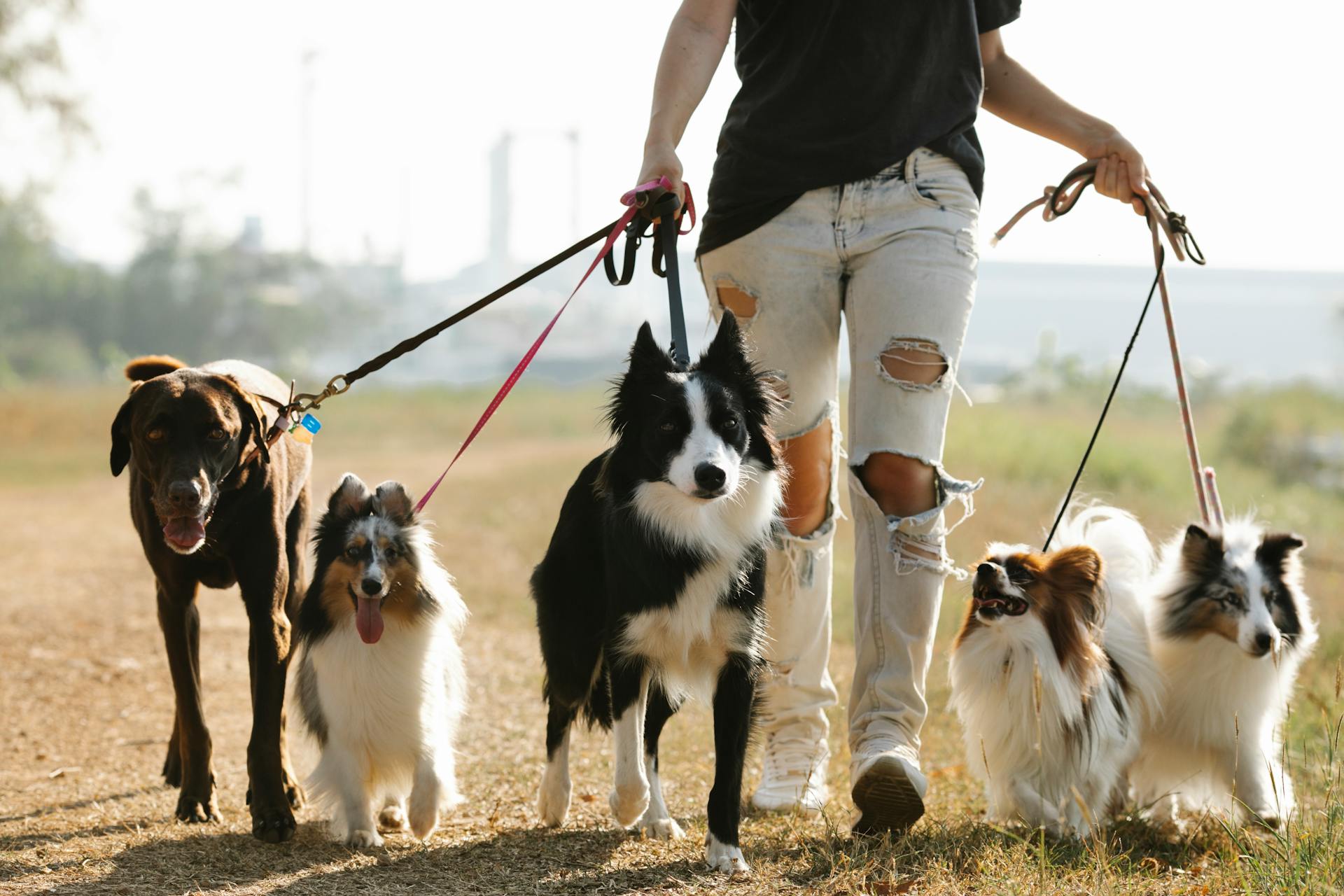
Living with both neutered and unneutered male dogs can be a bit of a challenge. Introducing them to each other requires careful planning to ensure a smooth transition.
Neutered dogs are less aggressive and less likely to fight with other dogs, including unneutered males. This is because neutering reduces the production of testosterone, a hormone that contributes to aggression.
Unneutered male dogs, on the other hand, may exhibit more dominant behavior and territorial marking, which can lead to conflicts with neutered dogs.
In a household with both neutered and unneutered males, it's essential to provide separate spaces and resources to prevent competition and stress.
A fresh viewpoint: Dog Aggression towards Males
Benefits of Neutering
Neutering can have a significant impact on your dog's behavior and overall health. Neutering reduces leg-lifting and marking territory, a common issue with intact males driven by testosterone.
Many intact males become obsessed with marking territory and will even mark inside your house. However, neutering isn't a cure-all, as testosterone is also produced elsewhere in the body.
You might enjoy: Do Male Dogs Have Testosterone
Neutering can also reduce the risk of your dog being attacked by other male dogs, even if he's not aggressive himself. This is because intact males may see him as a potential rival.
Here are some key questions to consider when deciding whether to neuter your male dog:
• Does he mark (lift his leg) excessively?
• Is he aggressive toward people or other dogs?
• Does he mount/hump other dogs, or even your leg?
• Does he pay more attention to other dogs than to you?
If your dog interacts with a lot of other dogs, neutering would be wise, as it can reduce the likelihood of fights and unwanted behaviors.
Potential Drawbacks of Neutering
Neutering can have some potential drawbacks, especially if it's done at the wrong age or for the wrong reasons.
Neutering triples the risk of hypothyroidism, a condition that can lead to weight gain and lethargy. Fortunately, it can be treated with a daily thyroid supplement.
Intact dogs are less likely to suffer from a form of "dementia" that causes disorientation and forgetfulness.
If your male dog has behavior problems like excessive marking, aggression, or mounting, neutering might be a good option. However, it's essential to address these issues with exercise and training first.
Neutering may not change undesired behavior in a male dog, according to European researchers. In fact, neutered dogs may be less confident and more anxious than intact dogs.
Some breeds, like German Shepherds, Irish Setters, and Leonbergers, are prone to perianal fistula, and neutering can reduce the risk of this condition.
If your dog has retained testicles, neutering is a must to prevent cancer.
Neutering at the wrong age can have unwanted consequences for your dog's life. So, it's essential to get all the facts before making a decision.
Here are some situations where neutering might be a good idea:
- If your dog marks excessively
- If your dog is aggressive toward people or other dogs
- If your dog mounts or humps other dogs or people
- If your dog pays more attention to other dogs than to you
- If your dog interacts with many other dogs
- If your dog is a high-risk breed for perianal fistula
- If your dog has retained testicles
- If there's a risk of your dog breeding with an unspayed female
Neutering Considerations
If your male dog marks excessively, is aggressive, or engages in mounting behavior, you should consider neutering him, especially if these issues persist despite increased exercise and respect training.
Neutering can be beneficial for dogs that interact with many other dogs, as it reduces the likelihood of fights with other males and unwanted attention from females.
If your dog is a German Shepherd, Irish Setter, or Leonberger, neutering may be a good idea due to their increased risk of perianal fistula.
Dogs with missing testicles, especially those that have never dropped by a year of age, require neutering to prevent cancer.
If there's a risk of your dog mating with an unspayed female, neutering is a must to prevent unwanted litters.
Here are some specific factors to consider when deciding whether to neuter your male dog:
- Excessive marking (lifting his leg)
- Aggression toward people or other dogs
- Mounting or humping behavior
- Paying more attention to other dogs than to you
- High socialization with other dogs
- Being a German Shepherd, Irish Setter, or Leonberger
- Missing testicles
- Risk of mating with an unspayed female
Neutering Effects on Behavior
Neutering can have a significant impact on a male dog's behavior, particularly when it comes to marking territory and dominance. Neutering reduces leg-lifting and marking territory, but it's not a cure-all, as many dogs will still lift their leg, albeit less obsessively.
Neutering can also reduce the risk of your dog being attacked by other male dogs, as intact males may see him as a rival. This is especially important if your dog interacts with many other dogs, as neutering can help reduce aggression and conflicts.
Consider reading: Male Dogs Marking
Some breeds, such as German Shepherds, Irish Setters, and Leonbergers, are prone to perianal fistula, and neutering can reduce the risk of this condition. Additionally, if your dog has retained testicles, neutering is a must to prevent cancer.
Here are some potential behavioral differences to consider:
- Neutered dogs may be less confident and more anxious than intact dogs.
- Neutered dogs may exhibit fearful behavior and aggression toward other dogs.
- Intact dogs may be more bold and sociable to other dogs.
Ultimately, the decision to neuter your dog should be based on a variety of factors, including his behavior, breed, and individual needs.
Neutering Reduces Leg-Lifting and Marking
Neutering can reduce leg-lifting and marking territory in male dogs. Neutering isn't a cure-all, as testosterone is also produced elsewhere in the body, but it can decrease the obsessive behavior.
Intact males driven by testosterone usually lift their leg when they pee, a behavior known as "marking" their territory. This is more impressive to other dogs the higher they spray their urine.
Many dogs, even when neutered, will still lift their leg, but less obsessively. However, a dominant bossy attitude will need to be addressed through Respect Training.
For more insights, see: Behavior of Unneutered Male Dogs
Some intact males become obsessed with marking territory and will tow their owners toward every tree and telephone pole. This can be frustrating for owners, especially if it happens inside the house.
It's worth noting that neutering won't completely eliminate marking behavior, but it can reduce the frequency and intensity of it.
2. May Growl/Hump
Neutered male dogs might growl at or hump intact dogs, especially if they haven't been around an intact male before. This is due to the intact dog's scent.
Neutered male dogs tend to hump intact males obsessively, which can trigger a fight between the two dogs.
Some female dogs also do a lot of humping, whether they're spayed or not.
Rip, an intact male, doesn't care when other dogs hump him and usually makes a game out of it.
Some dogs will whip around and growl or snarl when a dog is trying to hump them, which can easily trigger a fight.
Neutered male dogs don't try to hump their owners or other dogs in general, except for intact males.
It's not all intact males that try to hump everything, but some do.
My neutered dog does more humping than my intact dog.
On a similar theme: When Do Male Dogs Start Humping
Social and Environmental Implications
Neutered male dogs may exhibit less confident and more anxious behavior than intact dogs, as they were less likely to engage in behaviors such as sniffing another dog's perianal region and resting their chin on another dog.
Differences in social behavior between neutered and intact dogs can be significant, with owners scoring intact dogs as being more bold and sociable towards other dogs.
Neutered dogs were also more likely to exhibit fearful behavior and aggression towards other dogs, according to owners' assessments in a behavior consultancy program.
Some Parks and Daycares Restrict
Some parks and daycares restrict the entry of intact male dogs due to concerns about aggression and dominance.
Some dog parks and dog daycares won't allow intact male dogs, as neutered males may react to their scent and hormones.
You might be able to find a boarding kennel that allows intact male dogs, especially if they have separate kennel space.
Dog parks often have rules against female dogs in heat, but not necessarily against intact male dogs.
It's essential to prioritize your dog's safety, even if they're generally well-behaved.
Readers also liked: Intact Male Dogs
Global Pressure

There's pressure from the "dog sport world" to keep your dog intact, especially if you participate in activities like agility or hunting.
In the hunting dog world, there's a perception that intact dogs are more serious about the sport, although this is just an observation.
Some people in the agility world also seem to think that intact dogs are more desirable, although it's not as strong a pressure as in hunting.
Many successful hunters and agility competitors have neutered dogs, so it's a personal choice that doesn't affect your dog's performance.
Some owners, like the one with a blue tick beagle, choose not to neuter their dogs because they're happy with their current behavior.
In fact, the beagle's owner notes that beagles are prone to wandering regardless of their neuter status, so it's not a guarantee of better behavior.
Discover more: Dog Agility Dogs
Neutering and Health
Neutering can have some surprising health consequences for your dog. Neutering triples the risk of hypothyroidism, which can cause weight gain and lethargy. Fortunately, this can be treated with a daily thyroid supplement.
Some breeds are more prone to certain health issues, and neutering can help. German Shepherds, Irish Setters, and Leonbergers are at risk for perianal fistula, and neutering can reduce this risk.
If your dog has a medical condition, such as retained testicles, neutering is a must. If one or both testicles are missing, they're likely up inside your dog's body, and neutering can prevent cancer.
Here are some situations where neutering might be a good idea:
- Does your dog mark excessively?
- Is your dog aggressive toward people or other dogs?
- Does your dog mount/hump other dogs, or even your leg?
- Does your dog pay more attention to other dogs than to you?
If your dog interacts with many other dogs, neutering can help reduce the risk of fights and unwanted behaviors.
Neutering Reduces Pet Attack Risk
Neutering your male dog can significantly reduce the risk of him being attacked by other male dogs. This is especially true if he's intact and seen as a potential rival by other males.
If your dog isn't aggressive himself, being intact can still make him a target for other intact males. This is a common problem that many dog owners face.
If your dog interacts with a lot of other dogs, neutering can be a good idea. It will make him less inclined to pick fights with other males and less likely to be picked on himself.
Neutering can also reduce the risk of unwanted behavior such as marking excessively, being aggressive towards people or other dogs, or mounting/humping other dogs or even your leg. If your dog exhibits any of these behaviors, it's worth considering neutering.
Here are some factors to consider when deciding whether to neuter your dog:
- Does your dog mark excessively?
- Is he aggressive towards people or other dogs?
- Does he mount/hump other dogs, or even your leg?
- Does he pay more attention to other dogs than to you?
Neutering Increases Hypothyroidism Risk
Neutering increases the risk of hypothyroidism, tripling the chances of developing this condition. This is because the loss of reproductive hormones upsets the endocrine system, leading to low thyroid levels.
Weight gain and lethargy are common symptoms of hypothyroidism, and it can be treated with a daily thyroid supplement for the rest of your dog's life.
Living Lean
Living Lean is definitely a possibility for intact male dogs. My Lab is only 2 years old and has been a very fit and lean dog.
Research suggests that intact male dogs tend to be leaner than their neutered counterparts. It's hard for me to bulk up my intact dog, and people often comment on how he's not a "chunky" Lab like they're used to seeing.
A key difference between my dogs is their food intake. My neutered dog eats 4 cups of food per day, while my intact dog eats 5 cups per day. This is likely due to their different hormone levels.
Both my dogs weigh about 62 pounds and are active, but their intact status seems to have a noticeable impact on their weight and overall health.
Neutering and Social Behavior
Neutering can affect a dog's social behavior, but it's not a straightforward solution. Neutered male dogs may be less confident and more anxious than intact dogs, as observed in a study of 17 neutered and 16 intact male dogs interacting with each other in groups.
The study found that neutered dogs were less likely to engage in behaviors like sniffing another dog's perianal region, and more likely to rest their chin on another dog, indicating a lack of confidence. This is not necessarily a bad thing, but it's essential to consider your dog's individual personality and needs.
If you're introducing two un-neutered males to each other, it's crucial to do it correctly to avoid conflicts. Introduce them on neutral territory, keep them on a lead, and watch for signs of posturing or aggression. If things get out of hand, pull them back and try again when they've calmed down.
Here are some factors to consider when deciding whether to neuter your male dog:
- Excessive marking (lifting his leg)
- Aggression toward people or other dogs
- Mounting or humping other dogs or objects
- Paying more attention to other dogs than to you
If your dog exhibits any of these behaviors, increasing exercise and starting Respect Training may be a good first step. However, if the behavior persists, neutering at the right age may be necessary.
Meaning
An intact male dog is one that hasn't been neutered, meaning his testicles are still intact.
Neutering a dog involves surgically removing his testicles, which is the main source of testosterone.
This can potentially reduce some hormone-driven behaviors.
Neutering can also prevent testicular cancer.
It's worth noting that neutering prevents the dog from breeding.
Introducing Two People
Introducing two people to each other can be a delicate process, just like introducing two dogs. Keep the initial introduction on neutral territory, so neither person feels like they're on guard.
It's essential to have someone to help you, especially if both people are strong-willed or have a history of conflict. Having an extra pair of hands can make all the difference in preventing things from escalating.
Keep the first meeting brief and controlled, allowing both people to see each other and get any initial reactions out of the way before moving in closer. Reassure both people with praise, but avoid giving them treats, as this can create tension.
Additional reading: Why Does My Male Dog Keep Licking My Female Dog
Be on the lookout for signs of posturing or aggression, such as dominant eye contact or physical tension. If you notice these signs, it's best to pause the interaction and take a step back before trying again.
If the two people seem determined to clash, it's best to walk them away and give them time to calm down before trying again. Remember that it may take a few attempts to get things right, so be patient and don't rush the process.
Ultimately, the goal is to create a positive and comfortable atmosphere for both people, just like you would when introducing two dogs.
A different take: How to Introduce 2 Male Dogs
Social Behavior Differences in Neutered
Neutering can have a significant impact on your dog's social behavior, and it's essential to understand the differences between neutered and intact male dogs.
Neutered male dogs tend to be less confident and more anxious than intact dogs, as observed in a study where researchers analyzed video footage of 17 neutered and 16 intact male dogs interacting with each other.
Intact male dogs are generally more sociable to other dogs and exhibit more confidence in social situations, according to owner surveys in the same study.
Neutered dogs are often more trainable than intact dogs, but this may not necessarily translate to better behavior in social situations.
A study of 133 male dogs found that owner scores for "boldness" and "sociability to dogs" were higher in intact dogs than in neutered dogs.
More owners of neutered dogs than intact dogs sought behavioral consultation, indicating that neutered dogs may be more prone to fearful behavior and aggression towards other dogs.
Here are some key differences between neutered and intact male dogs:
It's essential to consider these differences when deciding whether to neuter your male dog, and to discuss any concerns with your veterinarian.
Frequently Asked Questions
What happens if a neutered dog tries to mate?
Although a neutered dog can still impregnate a female dog for up to six weeks after neutering, it will not produce sperm after the procedure and therefore cannot sire future litters
Featured Images: pexels.com