Missouri is a birdwatcher's paradise, with over 400 species documented in the state. The eastern bluebird is a common sight in Missouri, with its vibrant blue and orange plumage a favorite among bird enthusiasts.
These birds are known for their distinctive songs, which can be heard throughout the state. The American robin is another popular species, recognizable by its brown back and red breast.
Missouri's diverse landscape supports a wide range of bird habitats, from forests to grasslands. The bobwhite quail is a prized game bird in the state, with its distinctive call echoing through the prairies.
The American goldfinch is a common visitor to Missouri's backyard bird feeders, with its bright yellow plumage a welcome sight in the spring.
Common Birds in Missouri
The Northern Cardinal is the most common bird in Missouri, according to eBird data, which has seen this species more often than any other bird in the state.
The American Robin is another frequent visitor to Missouri, known for its distinctive red breast and cheerful song.
Missouri's urban and suburban areas are home to a variety of bird species, including the Northern Cardinal and American Robin, which can be found in backyards and parks.
Worth a look: Blue Cardinal Birds
Common Grackle
The Common Grackle is a fairly large, black bird with glossy purple, greenish, bronze, or dark blue highlights, and pale eyes. It has a distinctive long, wedge-shaped tail.
You might spot a Common Grackle foraging for insects, seeds, and other food on the ground in open habitats like farm fields, lawns, or parks. They often move up and down in flight as they search for food.
Common Grackles are vocal birds, frequently giving raspy, metallic calls like "Sherink!" and "kek" calls. Their calls can be a great way to identify them in the wild.
If you're lucky, you might catch a glimpse of a Common Grackle building a bulky cup nest in a conifer. They're quite skilled at constructing these nests, and you might even spot them nesting in odd places like occupied nests of other birds.
Here are some key characteristics of the Common Grackle:
- Fairly large, black bird with glossy purple, greenish, bronze, or dark blue highlights.
- Long, wedge-shaped tail.
- Pale eyes.
- Constructs a bulky cup nest in a conifer.
- Vocal, with raspy, metallic calls like "Sherink!" and "kek" calls.
How Many Native Bird Species?
Missouri is a haven for bird enthusiasts, with a diverse range of species calling the state home.
In total, 439 bird species are native to Missouri. There are 439 species of birds on the Missouri list.
These birds can be found in various habitats, from the forests to the wetlands, and even in urban areas.
The abundance of bird species in Missouri is a testament to the state's varied landscape and climate.
A fresh viewpoint: Bird Identification by Picture
Most Common Bird Species
The Northern Cardinal is the most common bird in Missouri, according to eBird data, which has seen this species more often than any other bird in the state.
This bird's abundance is likely due to its adaptable nature, allowing it to thrive in various habitats throughout the state.
For more insights, see: What Is Iowa's State Bird?
Uncommon Birds in Missouri
Missouri is home to a diverse range of bird species, but some are more uncommon than others. The state's unique geography and climate support a variety of habitats, including forests, grasslands, and wetlands.
The Upland Sandpiper, for instance, is a rare migrant that can be spotted in Missouri's prairies and grasslands. This bird's distinctive call sounds like a loud, whistled "too-oo-oo."
The Black-backed Woodpecker is another uncommon bird found in Missouri, particularly in the state's pine forests. Its black back and white belly make it a striking sight.
European Starling
The European Starling is a common bird in Missouri, known for its distinctive appearance and behaviors.
They're rotund, short-tailed birds with long, sharp beaks and pointed wings, making them a recognizable sight in our state's skies.
In the summer, they have glossy black plumage with purple and green highlights, and some small white spots. In the winter, they have black beaks, white spots, and more reddish colors in their wings.
European Starlings are opportunistic feeders, eating a variety of insects, fruit, and seeds. They're not picky, and will visit bird feeders and forage on the ground in flocks.
One of the most interesting things about European Starlings is their ability to mimic other birds and sounds in their environment. They sing long, jumbled mechanical-sounding songs, like "tiktiktitZHREEree..tiktiktik..ZHREE".
These birds are social creatures, often forming large flocks called "murmurations" that move in coordinated patterns.
Intriguing read: Black Birds
Eurasian Tree Sparrow
The Eurasian Tree Sparrow is Missouri's most sought-after bird, and for good reason. It's a beautiful bird with a distinctive appearance.
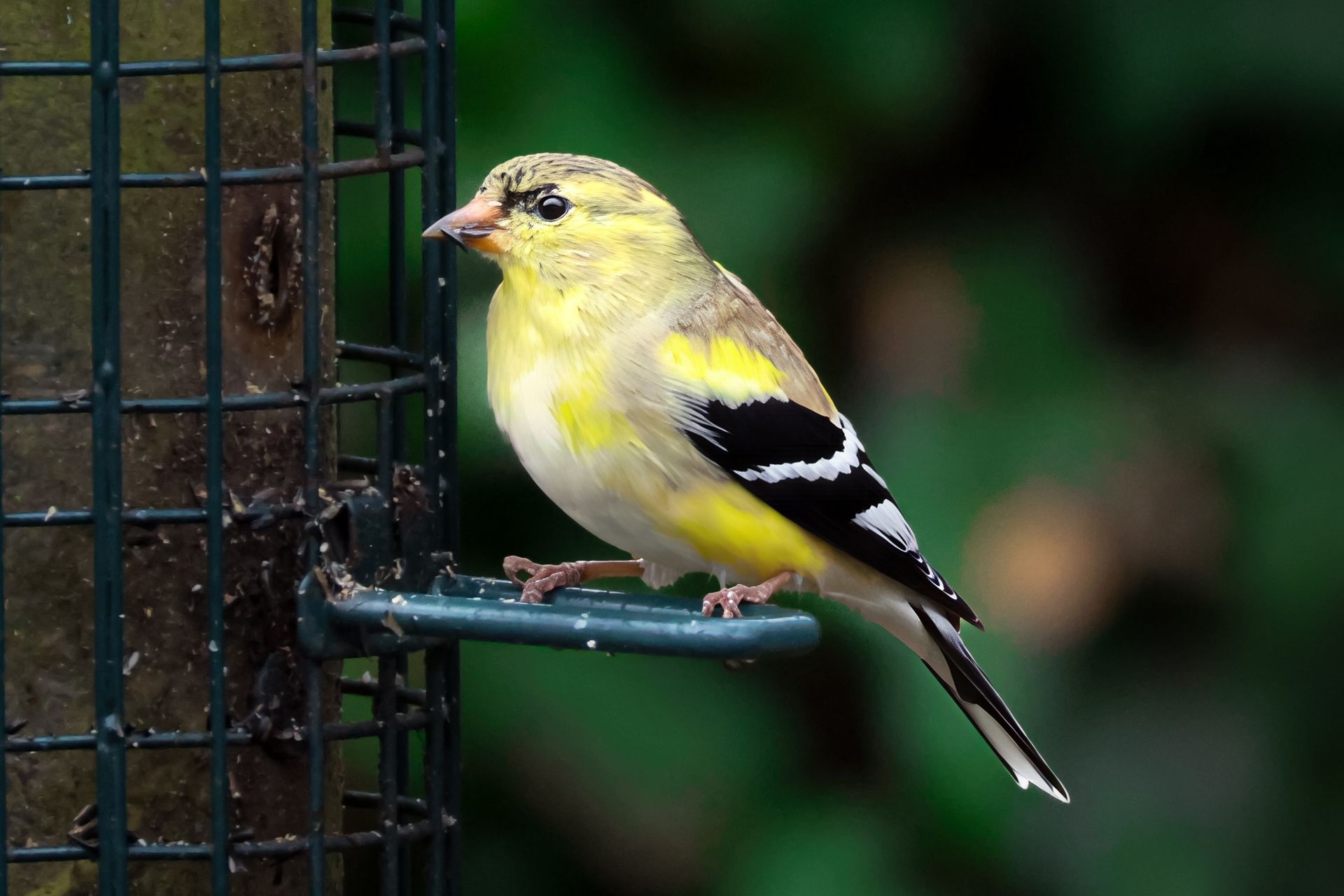
The Eurasian Tree Sparrow is slightly smaller than the House Sparrow and much less aggressive and quarrelsome. They have chocolate-brown crowns, black throats, white cheeks with a black cheek patch, but not the dark breast of the male House Sparrow.
In the St. Louis area, the best time to spot Tree Sparrows is during the winter months when large flocks can be found at Riverlands Environmental Developmental Area. Look for them in the brushy edges of the Mississippi River.
North Riverfront Park is home to Tree Sparrows year-round, including several pairs of breeding birds present from early April through summer. If you're lucky, you might catch a glimpse of them in their natural habitat.
The Eurasian Tree Sparrow can be found throughout the St. Louis area, but for current status and locations, it's best to contact the Webster Groves Nature Study Society at 314-935-8432.
You might like: What Do Birds Do When Their Tree Is Cut Down?
Anhingas
Anhingas are a unique sight to behold in Missouri's waters, with their long necks and straight beaks allowing them to dive and catch fish with ease.
These birds are often mistaken for cormorants, but they have some distinct characteristics that set them apart.
Anhingas are expert swimmers, able to swim with only their neck above the water as they hunt for their next meal.
Bird Identification and Facts
The American Robin is a common sight in Missouri, recognizable by its brown back and red breast.
The Brown Thrasher is known for its distinctive song, but did you know it also has a distinctive white eye ring?
The Northern Cardinal's vibrant red plumage makes it a standout in Missouri's woodlands and backyards, and it's also known for its distinctive song.
Blue Jay
The Blue Jay is a fairly large bird, measuring 11 inches in length and weighing just 3 ounces. It's a crested bird with a straight black bill, and both males and females have the same appearance.
They're blue above and gray and white below, with some small black lines on their faces and a narrow black necklace that goes up to the side of their face and crest. Young birds look like adults but are duller blue.
One distinctive feature of the Blue Jay is its loud call, which sounds like "Nyeah! Nyeah! Nyeah!" They're also known for making messy cup nests at various heights in trees.
Here are some key characteristics of the Blue Jay:
- Crested, fairly large bird with bright blue above and gray below.
- Feeds in trees and at feeders.
- Makes a messy cup nest of sticks in a tree.
- Very vocal.
In flight, Blue Jays often call as they swoop through the trees, making a variety of sounds and even mimicking other birds.
Mourning Dove
The Mourning Dove is a common sight in many backyards, gardens, and urban areas. It's a medium-sized bird with a distinctive grayish-brown color and long tail.
One of the easiest ways to identify a Mourning Dove is by its song, which sounds like a mournful "hooOOA, hoo, hoo, hoo." You might even mistake it for an owl!
Mourning Doves are found in a variety of habitats, including woodlands, gardens, farms, and urban areas. They're often seen visiting feeders, where they eat seeds and grains.
These birds have a unique appearance, with small black spots on their wings and a slender, dark beak. They also have narrow gray eyerings and a black mark on their face.
Here are some key characteristics of the Mourning Dove:
- Plain brown and gray dove with a long, pointed tail.
- Feeds on seeds at feeders and on the ground in open areas.
- Makes a small, messy nest of sticks in trees.
- Sings a sad and owl-like “hooOOA, hoo, hoo, hoo”.
House Finch
The House Finch is a sparrow-sized bird with dark, rounded beaks and fairly long wings. They're quite common, with millions living east of the Rocky Mountains.
These birds are known for their distinctive song, which sounds like "chip,chip,chiprididip,ZREEYachip." Males also make a soft "fidip" call.
House Finches are sparrow-like, reddish or brownish, streaked birds that live in a variety of habitats, including arid zones, parks, and urban areas. They're often seen visiting feeders, but they also forage on the ground and in bushes and trees.
They have a few distinct physical characteristics, including a reddish or rose-red color on their head, throat, and breast, and some red on their rump. Females are mostly streaked, dull brown-gray birds with two white wing bars.
Here are some key facts about House Finches:
- Reddish or plain gray-brown, streaked, sparrow-like bird.
- Eats seeds, flowers, buds, and fruit.
- Makes a soft cup nest in trees, on building ledges, and other places.
- The House Finch often makes a soft, “fidip” call.
House Finches are social birds that often occur in small groups. They're found in southern Canada, most of the USA, Mexico, and Hawaii.
White-Breasted Nuthatch
The White-Breasted Nuthatch is a fascinating bird species, and I'm excited to share some of its unique characteristics with you.
This bird measures between 5.1 to 5.5 inches in length and weighs between 0.6 to 1.1 ounces. Its wingspan is quite impressive, ranging from 7.9 to 10.6 inches.
One of the most distinctive features of the White-Breasted Nuthatch is its frosty white underparts and faces, combined with a gray-blue back. The cap and neck are either black or gray, and the lower belly and under the tail are a chestnut brown.
They have large heads, almost no necks, narrow, straight bills, and very short tails. You might also notice their unique habit of sneaking up and down tree trunks, which is a common way to spot them.
Here are some key identification points to look out for:
- Smaller than a Tufted Titmouse
- Frosty white underparts and faces, gray-blue backs
- Large heads, almost no necks, narrow, straight bills, and very short tails
- Creeping headfirst down tree trunks in search of insects
White-Throated Sparrow
The White-Throated Sparrow is a chunky, gray and brown bird with a white throat and black and white stripes on its head.
It's about 6.75 inches long and weighs just 0.91 ounces, with a wingspan of 9 inches. The males and females look the same, with reddish-brown wings and two white wing bars.
Young White-Throated Sparrows and some adults are duller brown with tan stripes on their heads and a dingy white throat. They're quite easy to spot, especially when they're foraging for seeds and insects on the ground.
They use their feet to scratch and kick away leaves to reveal hidden food items. They also eat fruits in short trees and bushes.
Here are some key characteristics to look out for when identifying a White-Throated Sparrow:
- Large sparrow with a white throat and bold black and white or tan stripes on its head.
- Scratches leaves on the ground to find seeds and insects. They also eat berries.
- Makes a cup nest of grass, bark, and twigs, on the ground, under dense vegetation.
- Flocks of White-Throated Sparrows often make sharp “tink” calls. They also sing a clear, whistled song, “Ohhh Canada Canada Canada” or, “Ohhh, Cana, Cana, Cana”.
The yellow pigment in the patches in front of their eyes comes from eating colorful berries during fall and winter.
Red-winged Blackbird
The Red-winged Blackbird is a medium-sized blackbird species with a sharp, all black bill. They're about 8.75 inches long, weigh 1.8 ounces, and have a wingspan of 13 inches.
Males have a distinctive scarlet patch with a pale yellow border on the shoulder of each wing, which is a great way to identify them. Females, on the other hand, are dark, heavily streaked, brownish-gray birds with an orange-buff eyebrow and throat.
Red-winged Blackbirds are very common birds that live in all sorts of open habitats, including parks, farming areas, and marshes. You can find them in much of Canada, the USA, Mexico, and parts of Central America.
Here are some key features to look out for when trying to identify a Red-winged Blackbird:
- Males are medium-sized blackbirds with a bright red patch on their wings.
- Females are heavily streaked, have a sharp black beak, and buff on the head.
- They feed on seeds, grain, and insects on the ground in many open habitats.
- They build a cup nest in a bush or other low vegetation.
- Red-winged Blackbirds often call, with males singing a loud, "kan-keree!" and both sexes making "check!" calls and a high-pitched whistle-like sound.
In the winter, Red-winged Blackbirds can form huge flocks that feed in farm fields, traveling up to 50 miles daily to and from roosting and feeding sites.
Northern Flicker
The Northern Flicker is a fairly large bird, measuring 12.5 inches in length and weighing 4.6 ounces. Its wingspan is a significant 20 inches.
These woodpeckers have a distinctive appearance, with tan and gray feathers and black barring above, black marks below, and a bright, white rump. They're quite striking to look at, if you ask me.
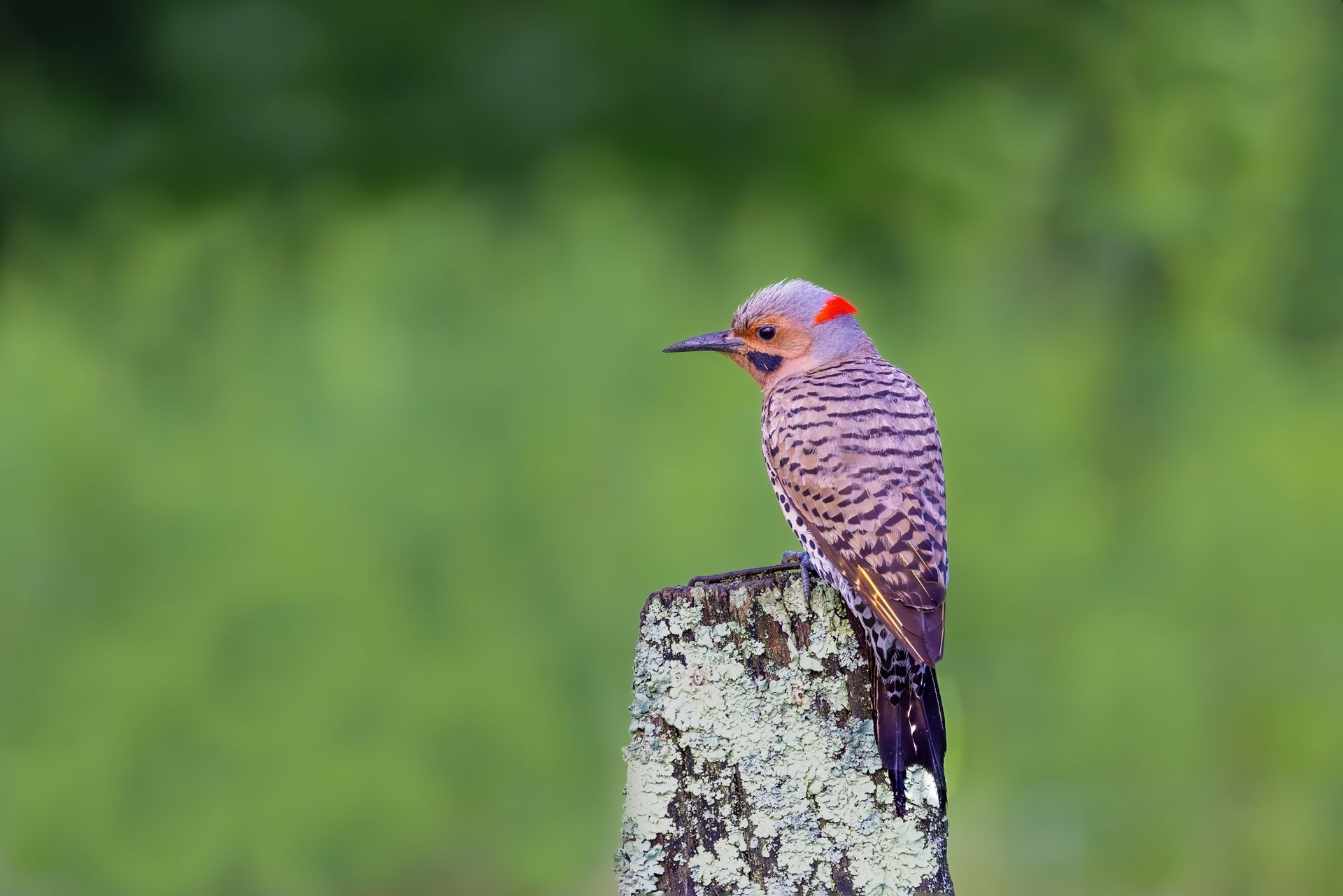
Northern Flickers are known for their loud calls, which can be a real treat to hear. They often give loud, "flicka,flicka,flicka" calls, and another loud, single note that sounds like, "Keer!"
To identify a Northern Flicker, look for its black moustache and small red spot on the back of its head in males, or the lack of these markings in females. The males in the east have a tawny throat and face, while those in the west have mostly gray heads with a red moustache.
In flight, Northern Flickers show off their white rumps and flash color on their underwings, which is bright yellow in eastern birds and reddish in those west of the Rocky Mountains.
Here are some key identification features to look for:
- Tan and gray woodpecker with black barring above, black marks below, and a bright, white rump.
- Forages for ants and other insects on the ground.
- Nests in tree cavities.
- A vocal woodpecker, the Northern Flicker often gives loud, "flicka,flicka,flicka" calls, and another loud, single note that sounds like, "Keer!"
Black-Capped Chickadee
The Black-Capped Chickadee is a small bird with a distinctive black cap and white face.
It's about 5.25 inches long and weighs a mere 0.39 ounces, making it a tiny but mighty creature.
You can spot one by its black throat and stubby black beak, and it's a regular visitor to bird feeders, where it feeds on seeds, fruit, and insects.
Black-capped Chickadees are also known for their acrobatic abilities, often hanging upside down from twigs while foraging for food.
Here are some key characteristics of the Black-Capped Chickadee:
- Length: 5.25 inches
- Weight: 0.39 ounces
- Wingspan: 8 inches
- Song: “see bee, see bee”
Song Sparrow
The Song Sparrow is a common sight in many parts of North America, and it's easy to recognize due to its distinctive appearance.
These birds are streaky brown overall, with thick streaks on their flanks and white chest. Their color and amount of streaking can vary significantly in different parts of their range.
Song Sparrows are slightly larger than Chipping Sparrows, and they have a fairly bulky build with short, stout bills and somewhat rounded heads.
They have broad wings and long, rounded tails, making them a pleasure to watch in flight.
Some Song Sparrows have a more vibrant appearance, with slaty gray and warm red-brown hues on their heads, while others may have duller plumages.
These birds are found in a wide range of open habitats, including suburbs, tidal marshes, and arctic grasslands.
Song Sparrows are omnivores, eating a variety of insects, fruits, and seeds throughout the year.
Some of their favorite foods include grasshoppers, weevils, caterpillars, and spiders.
Here are some key characteristics of the Song Sparrow:
- Streaky brown overall with thick streaks on their flanks and white chest
- Color and amount of streaking can vary significantly in different parts of their range
- Slightly larger than Chipping Sparrows
- Fairly bulky with short, stout bills and somewhat rounded heads
- Broad wings and long, rounded tails
Painted Bunting
The Painted Bunting is a stunning bird species that's a must-see for any bird enthusiast. Its bright red underparts and rump, green back, purple head, and red eye ring make it a true showstopper.
Males have a unique appearance that's hard to miss, but females are a bit more subdued, with a green back and lighter-colored underside. If you're lucky enough to spot one, take note of its distinctive song, which is similar to that of the Indigo Bunting.
Painted Buntings can be found in dense thickets, but they're also known to visit bird feeders, so keep an eye out for them if you're setting up a feeder in your backyard. They're a bit rare in Missouri, but if you're in the southwestern corner of the state from early May to mid-September, you might be able to catch a glimpse of one.
One of the best ways to spot a Painted Bunting is to listen for its song, which is often sung from high perches. To increase your chances of spotting one, try visiting the Henning Conservation Area in Taney County or the nesting area near Diamond and the George Washington Carver National Monument.
Here are some key facts to keep in mind when trying to spot a Painted Bunting:
- Males have bright red underparts and rump, a green back, a purple head, and a red eye ring.
- Females are green above and lighter below.
- Painted Buntings can be found in dense thickets and near bird feeders.
- They're most active between 6 and 8:30 a.m.
Mallard
The Mallard is a large and familiar duck, with males sporting a metallic green head and a chestnut breast. They have a distinctive white ring around their neck.
In terms of size, Mallards are quite substantial, measuring 23 inches in length and weighing 2.4 pounds. Their wingspan is impressive, reaching up to 35 inches.
Mallards are omnivores, feeding on a variety of items including insect larvae, snails, and seeds. They forage by filtering and picking up food items in and near shallow water.
The female Mallard is a bit more subdued in appearance, with a mottled brown and buff plumage and a dark gray and orange beak. She's also the one who makes the classic "quack, quack" sound, while males make softer sounds and a whistling call.
If you're trying to identify a Mallard, look for the green-blue wing patch bordered with white that both sexes display in flight. This distinctive marking can be a dead giveaway.
Here are some key characteristics to look out for when identifying a Mallard:
- Male: metallic green head, yellow bill, white ring around the neck, and chestnut breast
- Female: mottled brown and buff plumage, dark gray and orange beak
- Both sexes: green-blue wing patch bordered with white in flight
Eastern Wood-Pewee
The Eastern Wood-Pewee is a small bird, measuring 6.25 inches in length and weighing just 0.49 ounces. Its wingspan is a bit wider, reaching 10 inches.
One of the most distinctive features of the Eastern Wood-Pewee is its song, which sounds like a whistled "pee-oh-wee!" - a great way to identify this bird in the wild.
This bird's appearance is quite plain, with a grayish-brown color and a faint eyering. It also has two pale wing bars and some white edging on its long wings.
The Eastern Wood-Pewee is a flycatcher, which means it catches insects in flight. It does this by flying out from a high perch to snatch its prey, then returning to the same perch to eat it.
Here are some key facts about the Eastern Wood-Pewee at a glance:
- Length: 6.25 inches
- Weight: 0.49 ounces
- Wingspan: 10 inches
- Song: "pee-oh-wee!"
Red-Shouldered Hawk
The Red-shouldered Hawk is a medium-sized raptor with a distinctive appearance. It's crow-sized, with a dark brown and reddish upper body and reddish-orange underparts.
Males and females look alike, but females are larger. This hawk also has a dark mark on each side of its throat, and black and white wings with a red shoulder.
Red-shouldered Hawks build a bulky stick nest high in a tree. They typically live in hardwood forest habitats, and can be found in southeastern Canada, the eastern USA, and from southern coastal Oregon south to Baja California.
In flight, Red-shouldered Hawks have long, broad wings with a pale, crescent-shaped mark on the base of their primaries. This is a great way to identify them in the air.
Red-shouldered Hawks are vocal raptors that make loud, jay-like, or even gull-like calls. They often make a repeated sound, "Kyeah, Kyeah, Kyeah, Kyeah!", and can also make shorter "Kiyip! Kiyip!" calls.
Here are some key characteristics to look for when trying to identify a Red-shouldered Hawk:
- Crow-sized, with dark brown and reddish upper body and reddish-orange underparts.
- Black and white wings and tail with a red shoulder.
- Long, broad wings with a pale, crescent-shaped mark on the base of the primaries.
- Loud, jay-like or gull-like calls.
Barn Swallow
The Barn Swallow is a beautiful bird with a distinctive appearance. It's a small to medium-sized swallow with a length of 6.75 inches and a wingspan of 15 inches.
The Barn Swallow's plumage is striking, with a dark steel-blue back and peach-orange belly. They also have rich chestnut markings on their throat and above their bill, as well as some white in their tail.
Males and females look similar, but females are paler and have shorter tails. Young birds are similar to females but with even shorter tails.
Here are some key characteristics to help you identify a Barn Swallow:
- Beautiful dark blue and orange swallow with a long, forked tail.
- Forages for insects in flight over fields and other open habitats.
- Constructs a cup nest out of mud in barns and other structures.
- Often makes brief “fwip” calls in flight, and has a long, complex song, “chipchipfitfibitchipfibitfwip”.
Barn Swallows are long-distance migrants, with some individuals flying as far as 5,000 miles to Argentina.
Prothonotary Warbler
The Prothonotary Warbler is a bird of the swamps and streams, normally found around water with standing dead trees, especially those with old woodpecker holes.
This bird is a cavity nester and uses the woodpecker cavities for nesting, or it will use nest boxes placed in the right habitat.
The Prothonotary Warbler is abundant in the Mississippi Lowlands but is quite common throughout most of southern Missouri.
Its song is a ringing "sweet, sweet, sweet, sweet, sweet, sweet" that is quite distinctive.
Big Oak Tree State Park near East Prairie in Mississippi County is a great place to spot a Prothonotary Warbler, as they are common there.
In North Missouri, popular birding spots like Swan Lake NWR and Fountain Grove Conservation Area are also good places to look for them.
The Prothonotary Warbler's brilliant yellow plumage with a prominent black eye makes it one of the most obvious summer residents of its habitat.
You can also find them in the St. Louis area at Busch Wildlife Area, Shaw Nature Reserve, and Cane Bottom in Meramec State Park.
Mississippi Kite
The Mississippi Kite is a bird of striking appearance, with a light gray body and a whitish head. They have a wingspan of 36 inches.
These birds are highly territorial and can be quite aggressive when nesting in suburban trees, often attacking human passersby. They're known for their unique flight pattern, which involves swallow-like gliding and diving to catch insects and small birds.
In the summer, you can find Mississippi Kites in Missouri, particularly in the southeastern parts of the state. They're a bit of a rare sight, but if you're lucky, you might catch a glimpse of one soaring overhead.
One distinctive feature of the Mississippi Kite is its black tail, which sets it apart from other raptors.
Cooper's Hawk
Cooper's Hawks reside in Missouri year-round. They can be found in forests, but also in urban areas.
Their wings have a distinctive blue-gray color on top and horizontal, rusty barring on the underside.
These birds have a rounded tip on their tails that is black and white.
American Kestrel
The American Kestrel is a bird you might spot in Missouri, particularly in the spring and fall. They reside year-round in the state, but are more likely to be seen during these seasons.
These birds are the smallest of the American Birds of prey, and they hunt insects. They have a unique way of hunting, hovering in the air instead of soaring and gliding like other birds.
One way to identify an American Kestrel is by its bright rusty back and tail, bluish-black wings, and orange-brown breast. They also have a blue and rusty head, and a brown barring on the neck.
American Kestrels tend to nest in cavities, in caves, and buildings, rather than in trees or cliffs like most raptors. This is a good thing, because it means you might be able to spot them in urban areas.
What Is the Largest Bird?
The largest bird in Missouri is the American White Pelican, which has a massive nine foot wingspan.
These birds are truly impressive, with some species reaching lengths of 62 inches.
The Trumpeter Swan is another big bird in Missouri, weighing in at 23 pounds and sporting an 80 inch wingspan.
Despite their size, some birds can be quite tall, like the Whooping Crane, which stands at an impressive five feet.
If you're out birdwatching in Missouri, keep an eye out for these incredible birds, and see if you can spot one in person.
What Is the Smallest Bird?
The smallest bird in Missouri is the tiny Calliope Hummingbird, just 3.25 inches long. It's a rare migrant to the state.
The Calliope Hummingbird is only 3.25 inches long, making it the smallest bird in Missouri. Its tiny size is quite remarkable.
The smallest bird in Missouri is a rare sight, but bird enthusiasts know to look out for it.
What's Missouri's Fastest Bird?
Missouri's Fastest Bird is a real speed demon. The Peregrine Falcon is the fastest bird in Missouri and in the world, reaching incredible speeds of 200 miles per hour.
This bird is a sight to behold, with its impressive speed and agility allowing it to dive at incredible velocities.
Specialized Birds in Missouri
Missouri is home to a diverse range of bird species, including the American Golden-Plover, which can be found in the state's wetlands and coastal areas.
The American Avocet's distinctive black and white plumage makes it a standout in Missouri's wetlands, where it can often be seen foraging for small crustaceans and insects.
The state's grasslands and prairies are a haven for birds like the Upland Sandpiper, which migrates through Missouri in the spring and fall.
Greater Prairie-Chicken
The greater prairie-chicken is a unique bird species found in Missouri's virgin tallgrass prairie. Once numbering a million birds, today only around 3,000 remain in the state.
These birds are chicken-sized, heavily barred, and deep brown and gray in color, with a short, dark tail. The male greater prairie-chicken has distinctive orange air sacs on its neck.
Displays of the greater prairie-chicken's courtship ritual can be found in various locations across northern Missouri, including the Dunn Ranch and Audrain county near Mexico. The majority of these displays take place in prairie areas from Hi Lonesome Prairie south to Sedalia and Prairie State Park north of Joplin.
The male greater prairie-chicken's courtship display is a spectacle to behold, with loud cooing and humming sounds that can be heard for a mile. The birds also strut, stomp their feet, leap, and whirl in the air, adding clucking and cackling to their "booming" sounds.
Take a look at this: South Carolina Bird Sounds Identification
Broad-Winged Hawk
The Broad-Winged Hawk is a fascinating bird species that can be found in Missouri. Their wingspan reaches an impressive 33 inches.
These hawks are particularly known for their unique migration patterns, often flocking together in groups of thousands of birds. They can be spotted in the Ozarks and Ozark Border regions, although they're more commonly seen during their migrations.
Their distinctive appearance features a light-colored underside and tapered, pointed black wings.
Pheasants, Grouse, and Allies
Missouri is home to a diverse range of birds, including the pheasants, grouse, and their allies. These birds are terrestrial species, which means they spend most of their time on the ground.
One of the most recognizable birds in this group is the wild turkey. The wild turkey (Meleagris gallopavo) is a common sight in Missouri's woodlands and fields.
The ruffed grouse (Bonasa umbellus) is another bird that can be found in Missouri's forests. These birds are known for their distinctive drumming sounds, which they use to communicate with other grouse.
The greater prairie-chicken (Tympanuchus cupido) is a bird that's native to Missouri's prairies. Unfortunately, this bird is listed as endangered due to habitat loss and other threats.
If you're interested in spotting some of these birds in Missouri, be sure to check out the following species:
- Wild turkey, Meleagris gallopavo
- Ruffed grouse, Bonasa umbellus
- Greater prairie-chicken, Tympanuchus cupido
- Lesser prairie-chicken, Tympanuchus pallidicinctus
- Ring-necked pheasant, Phasianus colchicus
Featured Images: pexels.com