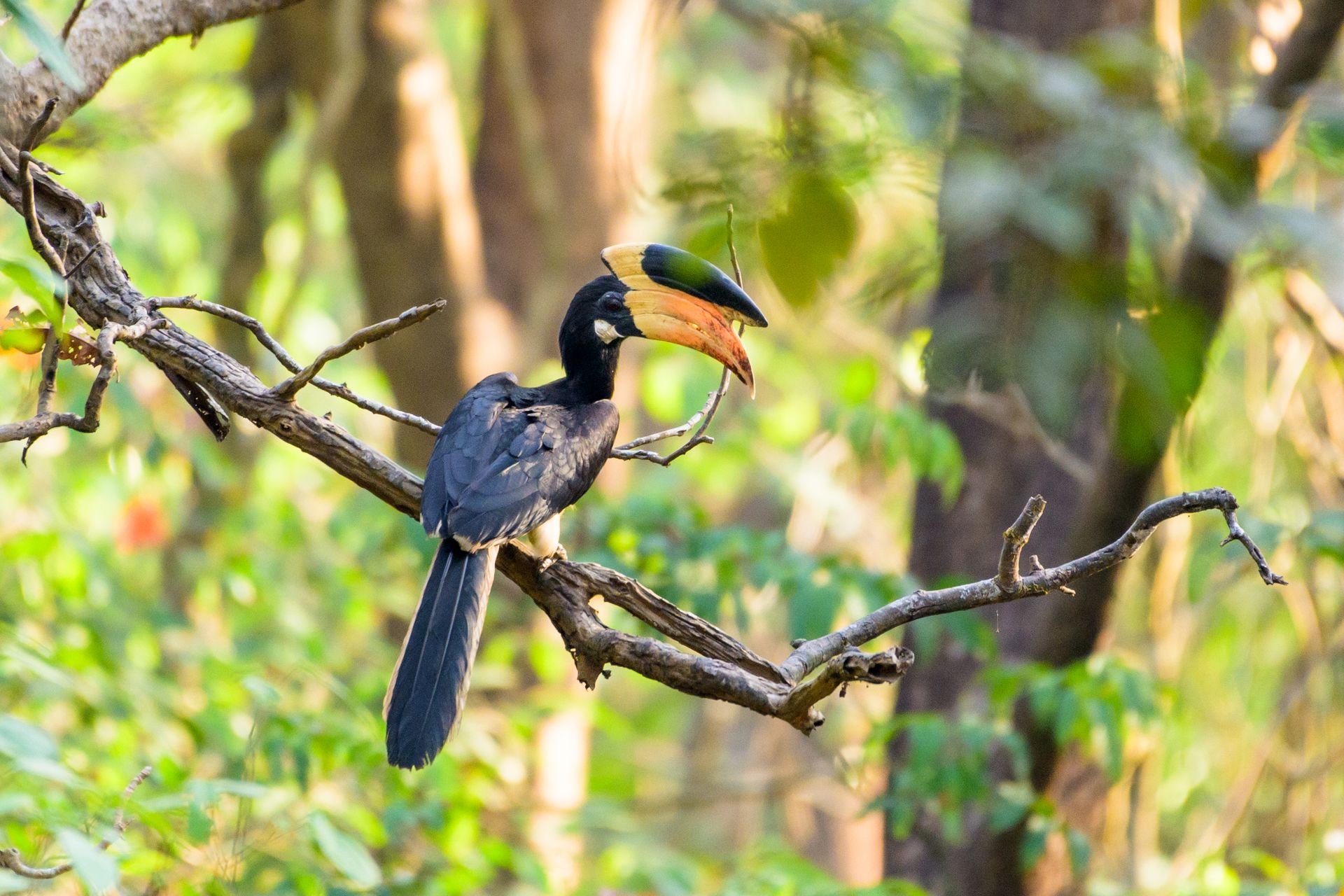
The Malabar Grey Hornbill is a majestic bird species found in the Western Ghats region of India. Its habitat ranges from evergreen forests to semi-evergreen and moist deciduous forests.
The Malabar Grey Hornbill is a large bird, measuring up to 65 centimeters in length. Its distinctive grey plumage and horn-like casque on its beak make it easily recognizable.
These birds are known to inhabit areas with dense foliage, where they can forage for their primary food source: fruit. They also play a crucial role in seed dispersal, helping to spread the seeds of the trees they feed on.
You might like: Malabar Pied Hornbill
Physical Characteristics
The Malabar grey hornbill is a large bird, but it's still the smallest of the Asian hornbills, measuring 45 to 58 cm in length.
Its tail spans about 23 cm, and it boasts a pale or yellowish to orange bill, which is a distinctive feature of this bird species.
Males have a reddish bill with a yellow tip, while females feature a plain yellow bill with a black base on the lower mandible and a black stripe along the culmen.
The Malabar grey hornbill has brown-grey wings, a white carpal patch, and black primary flight feathers tipped with white.
The back is grey, the vent cinnamon, and the long tail is blackish with a white tip.
Here are the key physical characteristics of the Malabar grey hornbill:
- Brownish-grey wings
- Black primaries
- Grey back
- Whitish crown
- Long black, white-tipped tail
- White underparts
- Long curved bill
Immature birds have browner upperparts and a yellow bill, with a dull white or yellow iris.
Habitat and Distribution
The Malabar Grey Hornbill is a fascinating bird species that can be found in the Western Ghats mountain range of India. Its distribution range spans from Nashik in the north to the southernmost hills.
This bird is endemic to the Western Ghats, meaning it can only be found in this specific region. Its elevational distribution range is quite impressive, stretching from about 50 m near the coast to around 1,500 m in the mountains.
The Malabar Grey Hornbill has a strong preference for dense forest habitats, where it can be found in evergreen forests between 500 m and 900 m elevation. However, its population density decreases with elevation.
On a similar theme: Philippine Hornbill
In addition to dense forests, this bird can also be found around rubber, arecanut, or coffee plantations, where tree cover is abundant. This is likely due to the availability of food and shelter in these areas.
Here's a breakdown of the Malabar Grey Hornbill's distribution range:
The Malabar Grey Hornbill is locally common, but it's suffering from habitat loss. This is a major concern, as the loss of its habitat can have a significant impact on the species' survival.
For another approach, see: Where Does the Eastern Gray Squirrel Live
Behavior and Ecology
The Malabar grey hornbill is a social bird that's often found in small groups.
These groups thrive in habitats with good tree cover, where they can easily forage for food.
As large frugivores, they play a vital role in seed dispersal for many species of fruit-bearing forest trees.
They also feed on small vertebrates, and in captivity, they'll readily take meat.
Diet and Feeding
The Malabar Grey Hornbill's diet is quite fascinating. Their main source of food is figs and other forest fruits.
In the wild, they also eat small vertebrates, adding variety to their diet. They are opportunistic feeders, taking advantage of whatever is available.
In captivity, these birds have been known to readily accept meat, showing their adaptability to different food sources.
Breeding and Conservation
The Malabar grey hornbill's breeding season is a fascinating process. It takes place from January to May, with the species preferring large trees with hollows caused by heart-rot or broken branches.
These trees are often found to be of the species Lagerstroemia microcarpa, Terminalia bellirica, or Terminalia crenulata, which hold nearly 70% of all the nests in the Mudumalai area. The female hornbill will seal the entrance to the nest with a cement made from her droppings, trapping herself inside.
The male hornbill will then feed the female through a small gap in the nest, bringing her berries, insects, small rodents, and reptiles. He will tap the tree to beckon the female on arriving with food, and regurgitate berries one at a time before passing them to her.
The clutch typically contains up to 4 white eggs, which are incubated for around 40 days. After fledging, which occurs around 46 days later, the female will break out of the nest.
Breeding
The breeding season for these birds is a fascinating process. It typically takes place from January to May.
The species is monogamous, and pairs use the same nest site year after year. They prefer trees with large cavities, often caused by heart-rot or broken branches.
The female seals the entrance to the nest with a cement made from her droppings, trapping herself inside. She then lays three or four white eggs and undergoes a complete moult of her flight feathers.
The male plays a crucial role in feeding the female and their young, bringing them berries, insects, small rodents, and reptiles. He taps the tree to signal the female's arrival with food.
The female voids excreta and receives food through a narrow aperture in the nest entrance. The male regurgitates berries one at a time, shifting them to the tip of his bill before passing them to the female.
Here's a list of the preferred tree species for nest sites:
- Lagerstroemia microcarpa
- Terminalia bellirica
- Terminalia crenulata
These species make up nearly 70% of all nests in the Mudumalai area. The female typically incubates the eggs for around 40 days, with fledging occurring around 46 days later.
Conservation Status
The Malabar grey hornbill is currently classified as Vulnerable on the IUCN Red List, indicating that it faces a high risk of extinction in the wild. This classification highlights the need for urgent conservation efforts to protect this species.
Conservation status is a crucial factor in determining the effectiveness of breeding programs. The Malabar grey hornbill's vulnerable status on the IUCN Red List is a clear indication that its population is declining.
Explore further: Wildlife Conservation Society
Similar Species
The Malabar Grey Hornbill is often confused with another species, but there's a key difference to look out for. The Indian Grey Hornbill Ocyceros birostris is a similar species, but it lacks a casque, a distinctive feature of the Malabar Grey Hornbill.
The Indian Grey Hornbill also has a black tail, which sets it apart from the Malabar Grey Hornbill.
Featured Images: pexels.com