The Loris lydekkerianus, also known as the Banded Loris, is a small primate native to the Indian subcontinent.
Its scientific classification is within the family Lorisidae, which includes other lorises and bushbabies.
This species is characterized by its distinctive banded fur pattern, which helps it blend in with its surroundings.
The Banded Loris is primarily nocturnal, spending most of its time in trees and using its acute senses to navigate and hunt.
Classification
Classification of Loris Lydekkerianus is a complex and evolving field.
Loris lydekkerianus is a type of slender loris, specifically a subspecies of the genus Loris.
It was first described by Ángel Cabrera in 1908 as the Mysore slender loris (Loris tardigradus lydekkerianus) in Chennai, India.
The species has undergone significant revisions, with Colin Groves recognizing two species, L. tardigradus and L. lydekkerianus, in 1998.
This classification has been widely accepted by the scientific community.
Loris lydekkerianus now includes four geographically separated subspecies: L. l. lydekkerianus (previously L. t. lydekkerianus) and L. l. malabaricus in India, and L. l. nordicus and L. l. grandis in Sri Lanka.
Here are the current recognized subspecies of Loris lydekkerianus:
- L. l. lydekkerianus
- L. l. malabaricus
- L. l. nordicus
- L. l. grandis
The montane slender loris (taxon nycticeboides) has had uncertain classification and has been variously placed as a subspecies of L. lydekkerianus, L. tardigradus, and as a distinct species.
Physical Characteristics
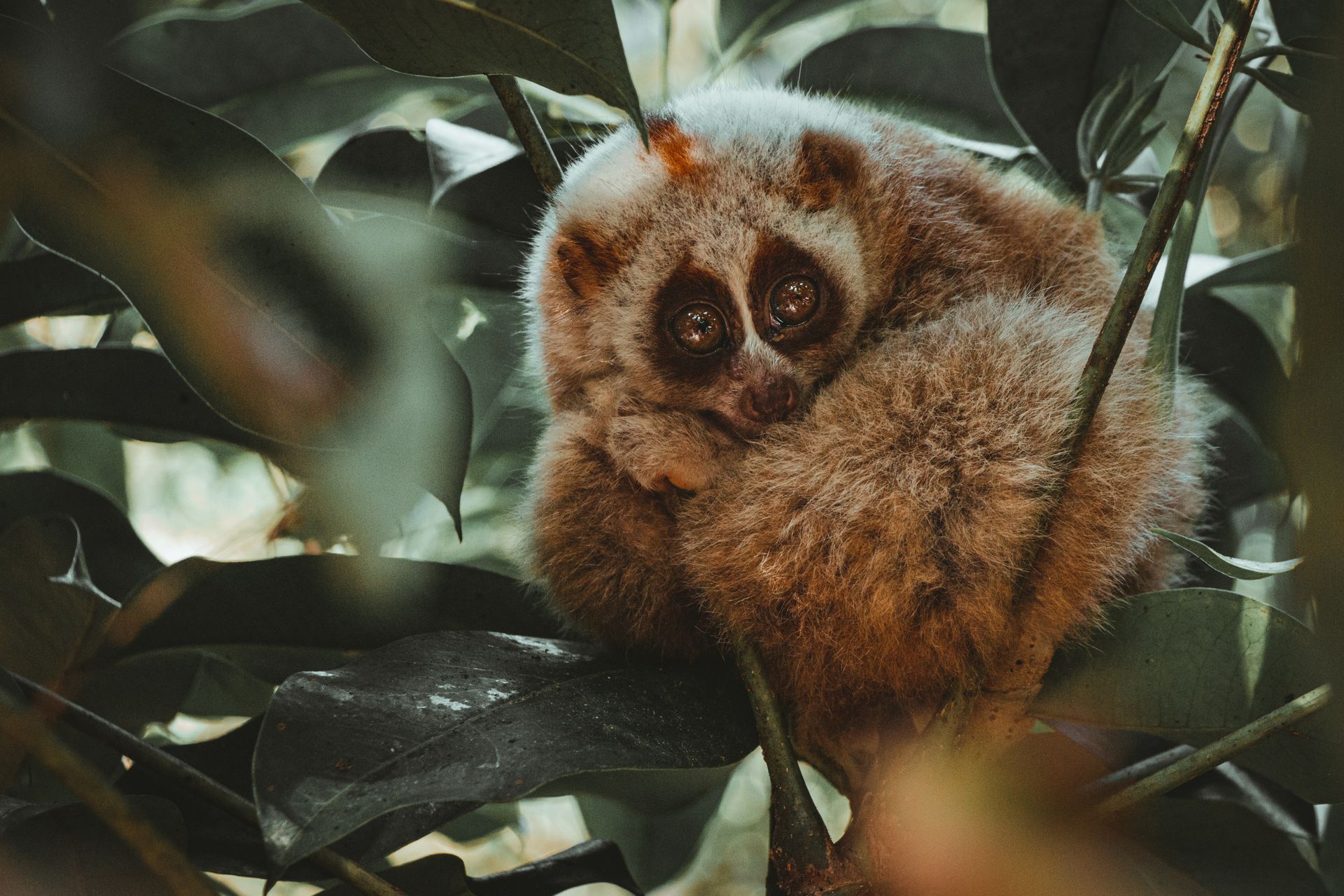
The gray slender loris is a remarkable creature with some truly unique physical characteristics. One of the most distinctive features is their extremely slender limbs, which are even more pronounced in the subspecies Loris lydekkerianus.
Their eyes are also quite remarkable, with a forward-facing orientation that provides excellent stereoscopic vision. In fact, the orbits of the eyes are the closest together amongst all primates.
The gray slender loris has a gray or reddish dorsal pelage with a darker medial stripe and a white ventrum, and their coloring is quite distinctive. The face has circumocular patches, darker preauricular hair, and a white rim between the circumocular patch and preauricular hair.
In terms of size, the average head-body length of a gray slender loris is 18-26 centimeters (7.1-10.2 in), and they weigh between 180 to 290 grams (6.34 to 10.22 oz). Males are slightly larger than females, with an average length of 24.1 cm and females averaging 23.4 cm.
Here are the average weights and lengths for the different subspecies:
The gray slender loris also has some unique adaptations, such as their highly specialized hands, which have a reduced second digit that allows them to cling to small branches. Their tail is also vestigial, and they have a unique non-saltatory locomotor style.
Distribution and Habitat
The gray slender loris is found in southern India and Sri Lanka, inhabiting a variety of habitats including primary and secondary rainforest, dry semi-deciduous forest, and montane cloud forest up to 2,000 meters above sea level.
In south-western India, the Malabar gray slender loris occurs in the wet forests of the Western Ghats, while the Mysore gray slender loris inhabits the tropical dry forests of the Eastern Ghats.
Grey slender lorises can be found in many ecological zones, including wet zones, low dry zones, and low country zones.
Within these habitats, they require plentiful oblique and horizontal surfaces for climbing, feeding, and mating.
Their habitats range from dry forest to wet forest, montane forest, rainforest, and scrub forest.
Here are the different types of habitats where grey slender lorises can be found:
- terrestrial
- tropical
- forest
- rainforest
- scrub forest
The range of Loris lydekkerianus has been expanded due to the careless collection and distribution of plant materials, which can lead to the lorises being inadvertently transported with plant materials.
In India, the Malabar gray slender loris and the Mysore gray slender loris are found, while in Sri Lanka, the northern gray slender loris and the highland slender loris are endemic.
These lorises can tolerate human presence to some extent and can populate secondary forests if there is dense undergrowth.
The gray slender loris is categorized into four subspecies, including the Malabar slender loris, Mysore slender loris, Northern Ceylonese slender loris, and highland slender loris.
The subspecies are separated geographically, with the Malabar gray slender loris found in the wet forests of the Western Ghats and the Mysore gray slender loris inhabiting the tropical dry forests of the Eastern Ghats.
Conservation
Loris lydekkerianus is listed as Least Concern on the IUCN Red List due to its wide distribution and presumed large population. However, its subspecies face more severe threats.
The subspecies Loris lydekkerianus nordicus and Loris lydekkerianus grandis are listed as Endangered, while Loris lydekkerianus malabaricus and Loris lydekkerianus lydekkerianus are listed as Near Threatened. This highlights the need for targeted conservation efforts.
Habitat destruction is a significant threat to the species, caused by human encroachment, deforestation, and the formation of fragmented forest patches. This not only affects the species' survival but also makes conservation in the wild a challenging task.
Grey slender lorises do not breed well in captivity, making conservation efforts in the wild particularly urgent. A reduction in habitat loss, the establishment of corridors between fragmented forest patches, and greater anti-hunting efforts are necessary for the species' continued survival.
Here are some key conservation challenges facing Loris lydekkerianus:
- Subspecies Loris lydekkerianus nordicus and Loris lydekkerianus grandis are listed as Endangered.
- Subspecies Loris lydekkerianus malabaricus and Loris lydekkerianus lydekkerianus are listed as Near Threatened.
- Habitat destruction is a significant threat to the species.
- Grey slender lorises do not breed well in captivity.
Loris Lydekkerianus
Loris Lydekkerianus is a unique species of loris found in the forests of northern Myanmar.
It is a small primate, weighing around 0.7-1.1 kg.
Loris Lydekkerianus
Loris Lydekkerianus is a fascinating creature. It is a species of loris that is endemic to the island of Java in Indonesia.
This loris has a unique appearance, with a reddish-brown coat and a distinctive white stripe on its forehead. Its fur is thick and woolly, helping it to stay warm in its native habitat.
Loris Lydekkerianus is primarily nocturnal, spending most of its time in the trees. It is an excellent climber, using its long arms and sharp claws to navigate through the forest canopy.
Names and Synonyms
The Loris Lydekkerianus has a few different names that scientists use to refer to it.
One of the earliest recorded names for this species is Loris lori lydekkerianus Cabrera, 1908.
This name was later modified to Loris lydekkerianus grandis Brandon-Jones, Eudey, T. Geissmann, Groves, D. J. Melnick, J. C. Morales, Shekelle, & C.-B. Stewart, 2004.
Here are some of the different names associated with the Loris Lydekkerianus:
- Loris lori lydekkerianus Cabrera, 1908
- Loris lydekkerianus grandis Brandon-Jones, Eudey, T. Geissmann, Groves, D. J. Melnick, J. C. Morales, Shekelle, & C.-B. Stewart, 2004
There are actually two subspecies of Loris Lydekkerianus: Loris lydekkerianus lydekkerianus and Loris lydekkerianus lydekkerianus is the most widely recognized subspecies.
Names and Synonyms
Loris lydekkerianus has had its fair share of name changes over the years.
The species was first described by Cabrera in 1908 as Loris lori lydekkerianus.
In 2004, a more comprehensive description was provided by Brandon-Jones and his team, which included the subspecies Loris lydekkerianus lydekkerianus.
Here is a list of the different names and synonyms mentioned in the article:
- Loris lori lydekkerianus Cabrera, 1908
- Loris lydekkerianus grandis Brandon-Jones, Eudey, T. Geissmann, Groves, D. J. Melnick, J. C. Morales, Shekelle, & C.-B. Stewart, 2004
- Loris lydekkerianus lydekkerianus Brandon-Jones, Eudey, T. Geissmann, Groves, D. J. Melnick, J. C. Morales, Shekelle, & C.-B. Stewart, 2004
These names and synonyms provide a glimpse into the complex history of taxonomy surrounding this fascinating species.
Frequently Asked Questions
Is the gray slender Loris venomous?
Slender Lorises, including the gray slender Loris, have a toxic bite used for self-defense. This is not typically considered venomous in the classical sense, but rather a defense mechanism.
Featured Images: pexels.com