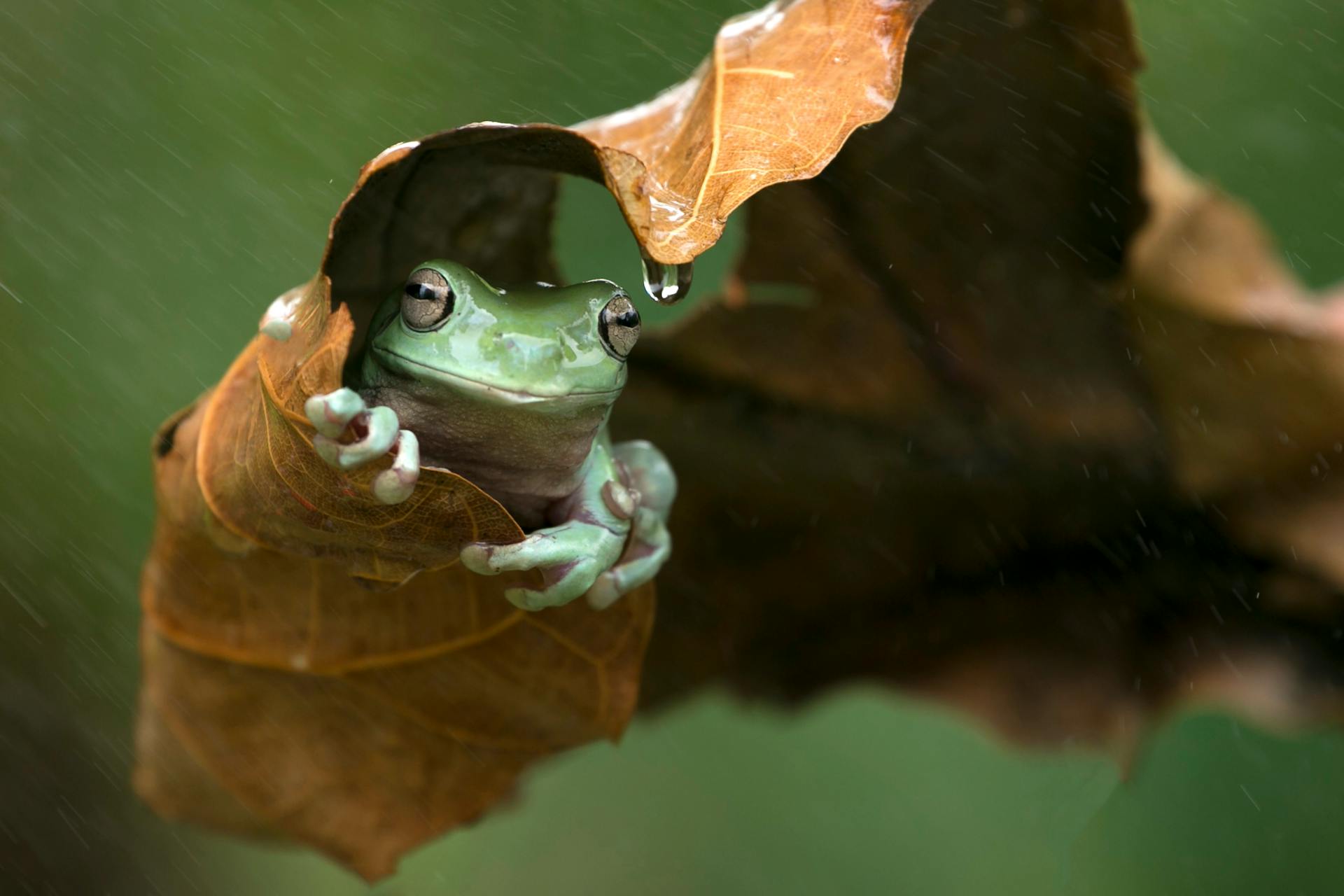
The Limnodynastidae family of frogs is a unique group found only in Australia. They are commonly known as the ground frogs.
These frogs have adapted to living in a variety of environments, from tropical rainforests to arid deserts. They are well-suited to life underground, where they can be found burrowing into soil and leaf litter.
Some species of Limnodynastidae are found in the southern parts of Western Australia. The smooth toadlet is one such species, known for its distinctive smooth skin.
Additional reading: Amphibians of Australia
Physical Characteristics
The Limnodynastidae family is known for its unique physical characteristics. Many species have earth-tone colors, such as brown, greenish brown, tan, and gray, with spots, blotches, or patterns that help them blend in with their surroundings.
Some species, however, are quite brightly colored, like the northern banjo frog, which has bright yellow sides with red and orange splashes of color under its legs.
The first two vertebrae in most Limnodynastidae species are fused, which is a distinct characteristic of this family.
In burrowing species, such as the Notaden and Neobatrachus groups, you'll find short limbs, short heads, and rotund bodies, perfect for digging and burrowing.
The cricoid ring is complete in most Limnodynastidae species, which is a notable feature.
Males and females usually look alike, but during the breeding season, males develop noticeable pads on their front toes and front legs, called nuptial pads, which help them grab hold of the female during mating.
Some species, like the Limnodynastes tasmaniensis group, have a body form that's intermediate between the burrowing and streamlined extremes.
Foam-nesting species exhibit seasonal development of flanges on the second and third fingers in females, which is a unique characteristic of this group.
If this caught your attention, see: Mexican Burrowing Caecilian
Habitat and Distribution
Limnodynastidae frogs can be found in a wide range of habitats, from arid desert and grasslands to woodlands and open forest.
They inhabit areas along perennial and ephemeral streams and around permanent and ephemeral ponds, often at elevations above sea level.
These frogs are found in various vegetation types, including arid habitats, wet/dry tropics, temperate, and subtropical zones.
Their habitats experience summer or winter peaks in rainfall, and they can be found in a variety of climates.
Limnodynastidae frogs range in size from 0.9 to 4.3 inches, with 9 genera and 48 species.
They can be described as small to large frogs, with some species being rotund burrowing forms and others having powerful legs.
Conservation Status
The conservation status of the Limnodynastidae family is a concern. Philoria frosti is listed as Critically Endangered by the IUCN.
Some species within the family are more vulnerable than others. Mixophyes fleayi and M. iteratus are listed as Endangered.
Chytrid fungus has been identified as a potential threat to some species. Mixophyes may have been decimated by this fungus.
Other factors are also contributing to the decline of some species. Unidentified threats are causing declines elsewhere in the Australian Alps.
Heleioporus australiacus is listed as Vulnerable, indicating a need for conservation efforts.
Species Information
Australian ground frogs, which belong to the Limnodynastidae family, are small to large frogs that range in size from 0.9 to 4.3 inches.
These frogs have a wide range of habitats, from arid to wet/dry tropics, and can be found in various vegetation types.
The Giant barred frog, a species of Limnodynastidae, has a distinctive appearance with a brown or gray dorsum and well-defined blotches on the body.
It's worth noting that the Giant barred frog is a relatively large species, with males reaching up to 2.6 inches and females up to 4 inches in length.
The species is found along the Great Dividing Range and eastern coast of Australia, and inhabits the forest floor adjacent to streams.
The Giant barred frog is a crepuscular and nocturnal species, and its diet consists mainly of insects and smaller frogs.
For more insights, see: Giant Frogs in Africa
Species Accounts
Australian ground frogs are quite fascinating, and they come in a range of sizes, from 0.9 to 4.3 inches in length.
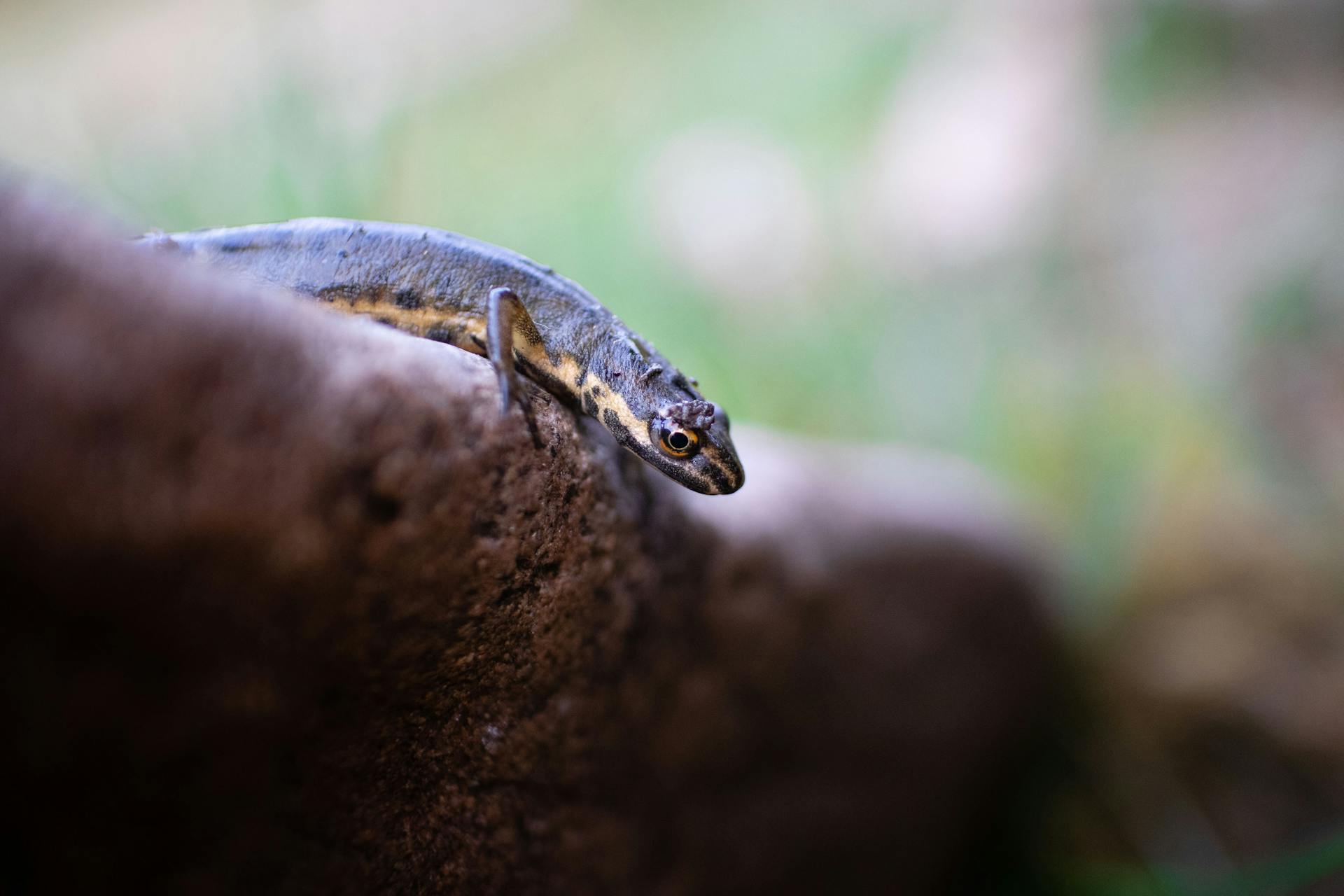
These frogs can be found in various habitats, including arid areas, wet/dry tropics, and even temperate and subtropical zones with distinct rainfall patterns.
They're also incredibly diverse, with 48 different species spread across 9 genera.
Australian ground frogs can thrive in almost any type of vegetation, from dense forests to grasslands and even backyards.
Tusked Frog
The Tusked Frog is a fascinating creature. They have a distinctive appearance with a rounded body and short legs.
One of their most notable features is the presence of a pair of large, fleshy protrusions on their lower jaw, which resemble tusks. These protrusions can be up to 10% of the frog's total body length.
The Tusked Frog is found in the tropical regions of South America, where they inhabit freshwater habitats such as swamps and marshes.
In these environments, they are predators that feed on small invertebrates like insects and crustaceans.
Giant Barred Frog
The Giant Barred Frog is a large and impressive species found in eastern Australia.
It has a proportionately large head, powerful hind limbs, and moderately webbed toes.
Males typically reach 2.4-2.6 inches in length, while females can grow up to 4 inches.
The dorsum is brown or gray with well-defined blotches on the body, stripes on the head, and transverse bars on the limbs.
This species inhabits the forest floor adjacent to streams, where it can be found in the wild.
A crepuscular and nocturnal species, little is known of its behavior other than its reproductive strategy, which involves sitting in the water facing the bank.
The diet consists of insects and smaller frogs, providing a fascinating insight into the frog's place in its ecosystem.
Breeding usually takes place along streams, but sometimes in unconnected pools near streams and drainages away from streams.
The female frog lays a few eggs and then kicks them in a spray of water onto the bank or rock face, where they stick to the surface.
The stream-adapted tadpoles have ventral suctorial mouths, allowing them to thrive in their aquatic environment.
Not threatened, the Giant Barred Frog seems to be secure, possibly due to its broader use of habitat compared to its congeners.
This burrowing species forms a cocoon, which is a remarkable adaptation to survive during periods of drought.
Related reading: Titicaca Water Frog
Name
The name of the Limnodynastidae family is quite interesting. It was given by Lynch in 1969.
The type genus for this family is Limnodynastes, which was first described by Fitzinger in 1843.
You might be wondering why this is important, but understanding the classification of a species is crucial for scientists and researchers.
The type genus, Limnodynastes, is a key part of the family's identity and helps us understand its characteristics and traits.
Here's a quick rundown of the type genus:
- Limnodynastes
Taxonomy and Classification
The Limnodynastidae family is a group of frogs that are commonly found in Australia. They belong to the Anura order.
The Heleioporus genus is a part of the Limnodynastidae family, specifically within the Anura order. It's a group of giant burrowing frogs.
These frogs are native to south-eastern Australia.
Collections and Specimens
The Limnodynastidae family is known for its diverse collection of frogs, with over 70 species found in Australia and New Guinea.
Some of these species are quite rare, like the Gastric-brooding frog, which is now extinct.
The Limnodynastidae family is characterized by its unique reproduction methods, including egg-laying and brooding.
In the case of the Gastric-brooding frog, the female frog carries her eggs in her stomach and then releases tadpoles that have been nourished by her digestive enzymes.
Featured Images: pexels.com


