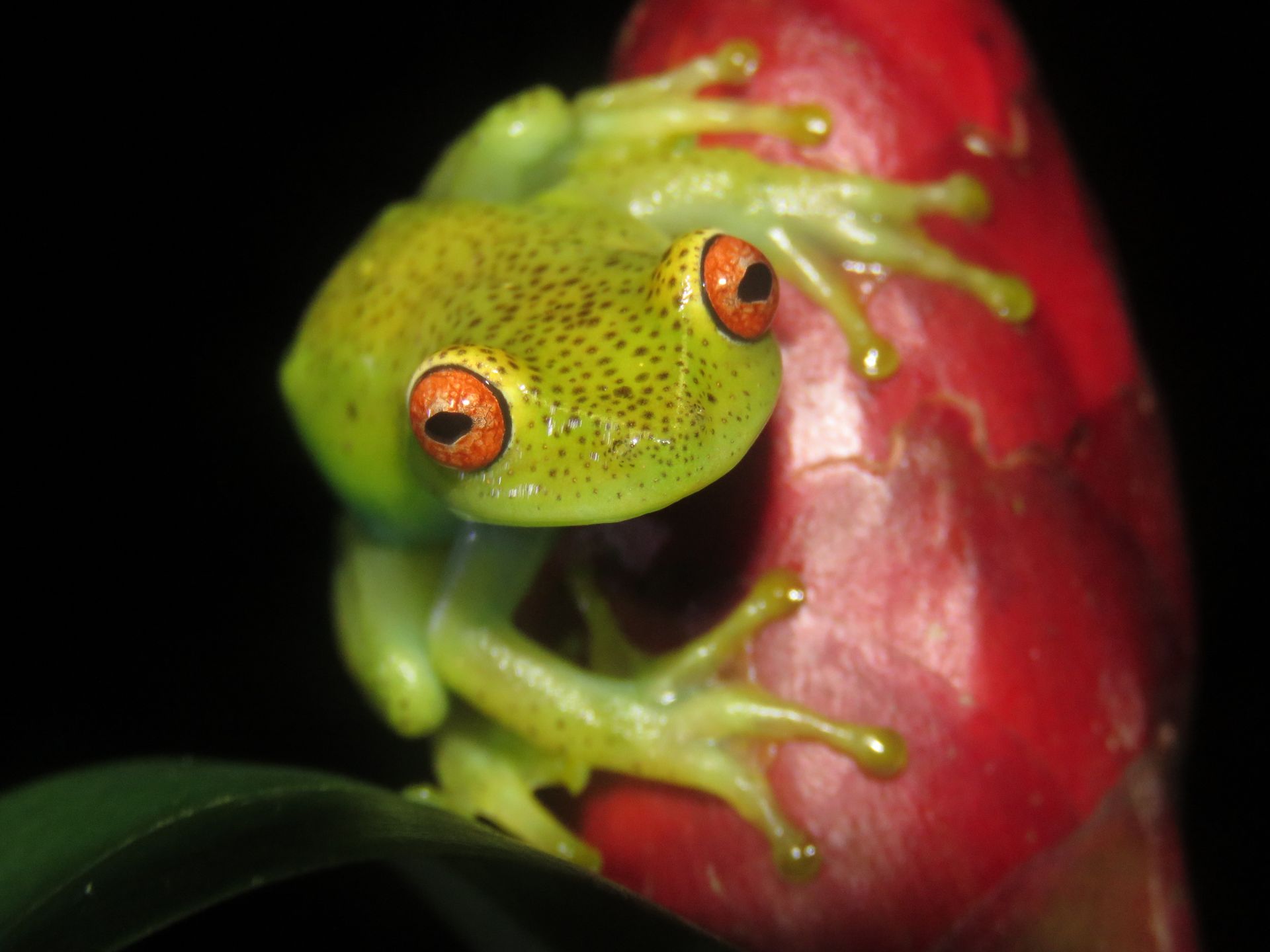
Limnodynastes peronii is a species of frog that's native to Australia. It's also known as the striped marsh frog.
These frogs have a distinctive appearance, with a brown back and a white belly. They have a white stripe running along their back.
In the wild, Limnodynastes peronii can be found in a variety of habitats, including freshwater wetlands and marshes. They're often found near the water's edge, where they can be seen hopping around or perched on vegetation.
Limnodynastes peronii is a relatively small frog, typically growing to a length of about 6-8 centimeters.
Physical Characteristics
Limnodynastes peronii, also known as the striped marsh frog, is a fascinating creature.
Males can grow up to 65 mm in length, with females being slightly smaller.
The dorsal surface of both males and females features a series of dark and light brown stripes, often accompanied by a pale mid-dorsal stripe.
The striped pattern breaks up laterally into blotches.
The ventral surface is white, except for the male's throat, which has a yellow wash and dark brown mottling.
The snout is pointed, and the iris is golden above and dark brown below.
The toes are very long and not webbed, with a small inner metatarsal tubercle.
Females have prominent flanges on their fingers, especially during breeding.
Males have larger forearms than females, a clear example of sexual dimorphism.
Here are some key physical characteristics of Limnodynastes peronii:
- Average length: 65 mm (2.56 in)
- Dorsal surface: dark and light brown stripes
- Ventral surface: white, with yellow wash and dark brown mottling on the male's throat
- Snout: pointed
- Iris: golden above, dark brown below
- Toes: long, not webbed
- Sexual dimorphism: males have larger forearms
Habitat and Distribution
Limnodynastes peronii, also known as the striped marsh frog, is a widespread and adaptable species. It can be found in a variety of aquatic biomes, including lakes and ponds.
This frog is commonly associated with permanent water sources, such as slow-moving streams, swamps, marshes, dams, and ponds. It's especially common under debris on river flats.
In suburban areas, L. peronii often uses outdoor fish ponds as breeding sites. The striped marsh frog is also tolerant of polluted water, which is why it can be found in urban environments.
You might like: Malayan Water Monitor Lizard
Striped marsh frogs are found throughout eastern and south-eastern Australia, including northern Tasmania. They can be found in habitats such as forests, woodlands, and wetlands.
Here are some specific locations where you can find L. peronii:
- Coastal New South Wales
- Southern Victoria
- South-eastern South Australia
- Northern Tasmania
Despite its widespread distribution, L. peronii is not as common in Tasmania as it is in other parts of its range.
Behavior and Ecology
The striped marsh frog is a frequent visitor to backyards on the east coast of Australia, often colonizing garden ponds and becoming victims of unsuspecting pool owners.
They're adaptable creatures, thriving in a variety of water bodies, including ponds, roadside ditches, creeks, dams, and flooded areas.
Males are known to call out to potential mates from hidden areas in vegetation, producing a distinctive "knock" sound reminiscent of hitting a piece of timber with a hammer.
This call is a familiar sound to many Sydneysiders who've set up a garden pond.
The breeding season for striped marsh frogs typically runs from late winter to early spring, during which time females lay eggs in a foamy nest.
Tadpoles can take up to 8-12 months to develop, emerging as pale brown frogs that can grow up to 6.5cm long.
Researchers have found that striped marsh frogs are surprisingly resilient, tolerating polluted water and even low temperatures and high UVB radiation.
Frog Reproduction and Life Cycle
Breeding occurs from August to March, with females depositing 700 to 1,000 small, unpigmented eggs in a foam mass entangled in vegetation at the edge of a slow-moving river or pond.
The tadpoles reach 65 mm in length and are pale brown with the adult dorsal pattern becoming apparent as the tadpole is developing forelimbs.
Striped marsh frogs breed in the warmer months of the year, from spring to autumn, and eggs are laid as a foamy mass on the surface of still or slow-moving water.
The egg mass or frogspawn floats on top of the water and is made up of up to a thousand eggs, looking like washing-up detergent bubbles with little black spots in it.
Tadpoles hatch within a few days and have gills for breathing underwater and a tail so they can swim, mostly staying at the bottom of the water.
Striped marsh frog tadpoles can grow to up to 9.5cm in length, longer than the adult frog, and are black or brown in colour and quite dark.
On a similar theme: Black Legged Kittiwake
As the tadpoles grow, they develop legs and lungs, and frogs in this life stage are called metamorphs, with their tails gradually shrinking as they change into froglets.
Here's a summary of the striped marsh frog's reproductive cycle:
- Breeding season: August to March
- Range number of offspring: 700 to 1,000
- Tadpole growth: up to 9.5cm in length
- Metamorph stage: 7-8 months to develop into frogs
Classification and Taxonomy
Limnodynastes peronii, also known as the Striped Marsh Frog, belongs to the kingdom Animalia.
It's classified under the phylum Chordata, which includes animals with a backbone, and the subphylum Vertebrata, which includes animals with a vertebral column.
The species is further classified as follows: Class Amphibia, Order Anura, Family Limnodynastidae, Genus Limnodynastes, and Species Limnodynastes peronii.
Here's a breakdown of the classification levels:
Taxonomy
Taxonomy is the process of classifying living things into groups based on their characteristics and evolutionary relationships. It's a way to organize and understand the diversity of life on Earth.
The scientific name of an organism is a unique identifier that consists of a genus name and a species name. For example, the scientific name of the Striped Marsh Frog is Limnodynastes peronii.
A genus is a group of related species that share similar characteristics. In the case of the Striped Marsh Frog, its genus is Limnodynastes.
The Kingdom Animalia is the highest taxonomic rank that includes all animals. The Striped Marsh Frog belongs to this kingdom.
Here's a breakdown of the taxonomic ranks for the Striped Marsh Frog:
The Striped Marsh Frog's scientific name authorship is (Duméril & Bibron, 1841), indicating that it was first described by these scientists in 1841.
Duméril & Bibron, 1841
Duméril & Bibron, 1841, provided a detailed description of the Brown Striped Marsh Frog, including its physical characteristics.
Adult males can grow up to 65 mm in length, while females reach 73 mm. The back of the frog is mostly smooth and comes in various shades of brown or russet with darker brown stripes running along the spine.
These stripes are often accompanied by a cream-coloured or reddish stripe down the middle. The sides of the frog usually feature scattered dark spots.
The belly is smooth and white, sometimes with a few brown flecks. The head is fairly long and the snout is narrowly rounded.
A dark brown or black 'mask' runs from the nostril, behind the eye, through the indistinct tympanum (eardrum), down to the shoulder.
A pale, raised stripe runs from under the eye to the top of the arm. The pupil is horizontal and the iris is golden-brown.
The fingers and toes of the Brown Striped Marsh Frog are long and unwebbed, both without pads.
Conservation and Status
Limnodynastes peronii is a species that's currently thriving in eastern Australia, with no IUCN warning listings. However, its population numbers could face a drastic reduction if deforestation and destruction of aquatic habitats occur.
This frog species is listed as Least Concern on the IUCN Red List, which is a positive indicator of its conservation status.
Unfortunately, habitat destruction could have severe consequences for L. peronii, making it essential to protect its natural habitats.
Here's a summary of L. peronii's conservation status:
- IUCN Red List: Least Concern
This species is adaptable and can move from one place to another, but its ability to do so is crucial for its survival in the face of potential habitat loss.
Sounds and Communication
Striped marsh frogs make a unique sound to attract females, a single "tok" or "whuk" repeated every few seconds, reminiscent of two large stones being knocked together.
Their calls can be quite loud, and if there are many males calling at once, it can sound like people playing table tennis.
Male striped marsh frogs are the only ones that call, as they're trying to impress potential mates.
These frogs are masters of stealth, with their brown, striped, and spotted skin allowing them to blend in seamlessly with their surroundings.
Similar Species
Limnodynastes peronii can be easily confused with several other species due to its similar distribution.
One of these similar species is Limnodynastes convexiuslculus.
Another is Limnodynastes fletcheri, which shares a similar distribution with Limnodynastes peronii.
Limnodynastes tasmaniensis is also similar in distribution, although it's worth noting that it has spots on its back, unlike Limnodynastes peronii.
Limnodynastes salmini, however, has distinct salmon-pink or orange stripes, which are lacking in Limnodynastes peronii.
For your interest: Eastern Gray Squirrel Population Distibution Pattern
Collection and Specimen
The Striped Marsh Frog, also known as Limnodynastes peronii, can be found in our collection at the Australian Museum Herpetology Collection.
We have a specimen, AM R.184709, which has been scanned using microCT technology.
This technology allows us to view the frog's internal structure in great detail.
General Information
Limnodynastes peronii, also known as the striped marsh frog, is a species of frog native to Australia.
It's found in eastern Australia, specifically in the states of Queensland and New South Wales.
The striped marsh frog inhabits wetlands, including marshes, swamps, and ponds.
It's a relatively small frog, typically growing to about 4-5 centimeters in length.
Its distinctive feature is the dark stripes that run along its back.
Featured Images: pexels.com