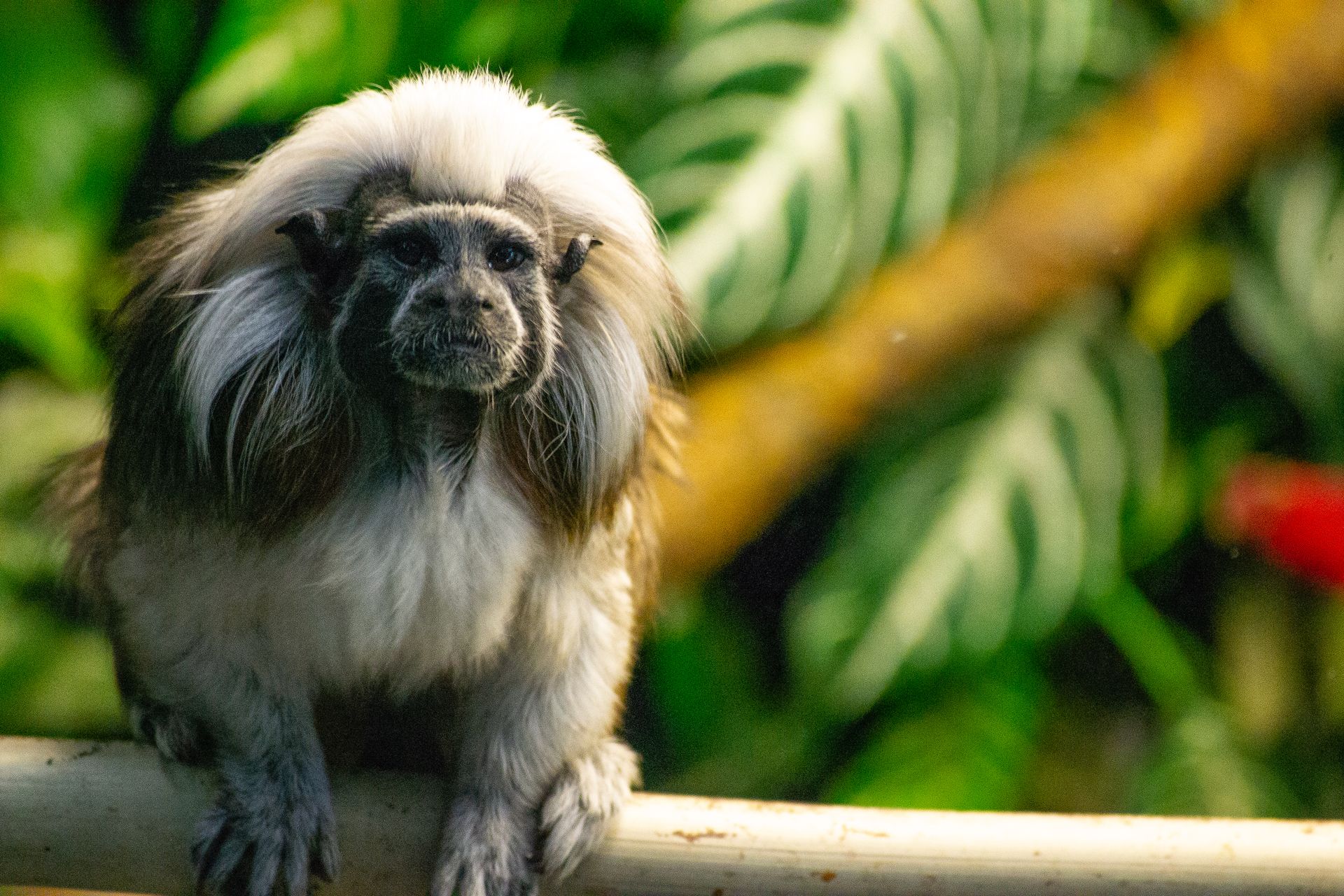
The Leontopithecus chrysomelas, also known as the golden-headed lion tamarin, is a small primate native to Brazil.
This species is a type of tamarin, which is a group of small primates that are known for their distinctive calls and social behavior.
The golden-headed lion tamarin is a critically endangered species due to habitat loss and fragmentation.
Its population has been declining over the years, and conservation efforts are necessary to protect this unique species.
Here's an interesting read: Squirrel Monkey Species Common Characteristics
Physical Characteristics
Golden-headed lion tamarins have relatively large canines with a small head and body. Males and females are similar in appearance and size.
They have non-opposable thumbs and claw-like nails on all digits except for the big toe. Their long digits are used for foraging for small insects and vertebrates.
Golden-headed lion tamarins weigh about 17 to 24.7 ounces and measure 8 to 13 inches in body length plus a 12 to 15 inch long tail. They are quite small, but their size allows them to navigate through dense foliage with ease.
Their striking appearance features a golden-orange mane of hair, contrasting with their mostly black bodies. Their legs and tails also have this golden-orange coloring.
Females are often slightly larger than males, but there is very little sexual dimorphism among golden-headed lion tamarins.
Conservation
The golden-headed lion tamarin is an endangered species, categorized as such by the IUCN Red List in 1982.
Brazil is home to the largest mammal diversity in the world, with over 530 described species, but its Atlantic forest is one of the most endangered ecosystems on earth.
Only one to five percent of Brazil's original Atlantic forest has been left standing, severely fragmenting the forest and isolating lion tamarin populations.
The golden-headed lion tamarin's original range spanned forests from the central Bahian plateau to within a few miles of the coast, but deforestation and habitat loss due to agriculture and sawmills have pushed them out of their native forests.
The Brazilian Institute for the Environment established the International Committee for the Recovery and Management of the species, resulting in a highly successful recovery program.
There are now believed to be more than 6,000 golden-headed lion tamarins in the wild, thanks in part to a well-managed breeding program and studbook for the species.
Threats to Survival
The forest of Bahia, Brazil has been reduced to 2% due to farming, ranching, mining, and urbanization. This drastic loss of habitat is the main reason for the golden-headed lion tamarin's decline.
The Atlantic Forest is highly fragmented, leaving the tamarins with limited space to forage and sleep. The majority of the forest was once dominated by cocoa plants through a method called cabruca, which involved removing middle and understory trees to replace them with cocoa trees.
Farmers abandoned their cocoa plants in 1989 due to a fungus that attacked their harvest, destroying the old growth trees that were once abundant for the tamarins. The old growth was then harvested for timber, cleared for cattle, or used to grow other crops.
Deforestation and habitat loss are the greatest threats to these tamarins, with only one to five percent of Brazil's original Atlantic forest remaining.
Geographic Distribution and Habitat
Golden-headed lion tamarins are found only in the southern part of the state of Bahia, Brazil, due to habitat destruction.
They live in the tall evergreen broadleaf tropical forests and semi-deciduous forests along the Atlantic coast.
Their preferred habitat is evergreen broadleaf tropical forests and semi-deciduous forests, where they can be found roaming at 10 to 33 feet up in the trees.
Habitat destruction has limited their range, but they can also thrive in disturbed and secondary forests as long as there are sufficient food and sleeping sites.
Golden-headed lion tamarins are members of the family Callitrichidae, which include marmosets and tamarins.
In fact, one study found that a population of golden-headed lion tamarins living in a cabruca, an agroforest of cultivated cocoa trees shaded by native forest trees, had better body condition and reproductive success compared to those living in some natural forest types.
Biology and Behavior
Tamarins are believed to be monogamous, with only one female in each group breeding during the warm and wet season between September and March.
They breed once each year, and following a four-month gestation period, the female often gives birth to twins.
Both parents take an equal part in raising their young, which is a remarkable display of cooperation and parental care.
Females reach sexual maturity at about 1.5 years of age, while males reach it at about 2 years of age.
Breeding:
Tamarins are believed to be monogamous, with only one female in each group breeding during the breeding season.
The breeding season typically occurs between September and March, a time of warm and wet weather.
Females give birth to twins after a four-month gestation period.
Both parents take an equal part in raising their young.
Females reach sexual maturity at about 1.5 years of age, while males reach it at about 2 years of age.
Lifespan
Golden-headed lion tamarins have a relatively long lifespan, with a median life expectancy of eight years.
In human care, they can live even longer, which is a testament to the excellent care they receive in captivity.
These primates typically weigh between 17-25 ounces and have a head-to-body length of 8-13 inches.
Their tails add an additional 12-15 inches in length, making them quite the impressive sight.
In captivity, golden-headed lion tamarins are known to live about 15 years, a remarkable feat for such a small creature.
Frequently Asked Questions
What is the meaning of Leontopithecus Chrysomelas?
Leontopithecus Chrysomelas is the scientific name for the Golden-headed lion tamarin, a species of primate. This name is a combination of Greek and Latin words that provide information about the animal's characteristics and classification.
Is the golden-headed lion tamarin a female?
No, the golden-headed lion tamarin is not exclusively female, but rather a species where females are larger than males.
Featured Images: pexels.com