The capybara is indeed the largest rodent in the world, found in South America.
Reaching lengths of up to 130 cm (51 in) and weighing as much as 66 kg (145 lbs), these semi-aquatic creatures are quite impressive.
They have webbed feet, perfect for swimming and diving in their aquatic habitats.
Capybaras are herbivores, feeding on a variety of plants, including grasses, fruits, and aquatic vegetation.
What is a Capybara?
The capybara is the largest rodent in the world, reaching up to 150 pounds and 4 feet in body length.
They are semi-aquatic mammals, thriving in tropical, seasonally flooded grasslands of Central and South America. These neotropical fauna live in large social groups led by a dominant male, who uses scent glands on his nose to mark territory.
Capybaras are strong swimmers, with webbed toes that help them navigate the water. They can even hold their breath underwater for up to five minutes.
Their diet consists mainly of aquatic plants, grasses, and tree bark. They have ever-growing teeth, which they keep in check by chewing on tough vegetation.
One of the most interesting facts about capybaras is their unique behavior of eating their own feces, known as coprophagy. This helps them digest fiber more efficiently.
These gentle giants are native to South America and make their homes near bodies of water, such as lakes, rivers, swamps, ponds, and marshes.
Capybara Facts
Capybaras can weigh up to 150 pounds, making them the largest living rodent.
They live in large social groups led by a dominant male, who uses scent glands on his nose to mark territory. These groups often consist of subordinate capybara males, adult females, and young capybaras.
Capybaras have ever-growing teeth, which they keep in check by chewing on tough vegetation. They also have a unique behavior called coprophagy, where they eat their own feces to digest fiber more efficiently.
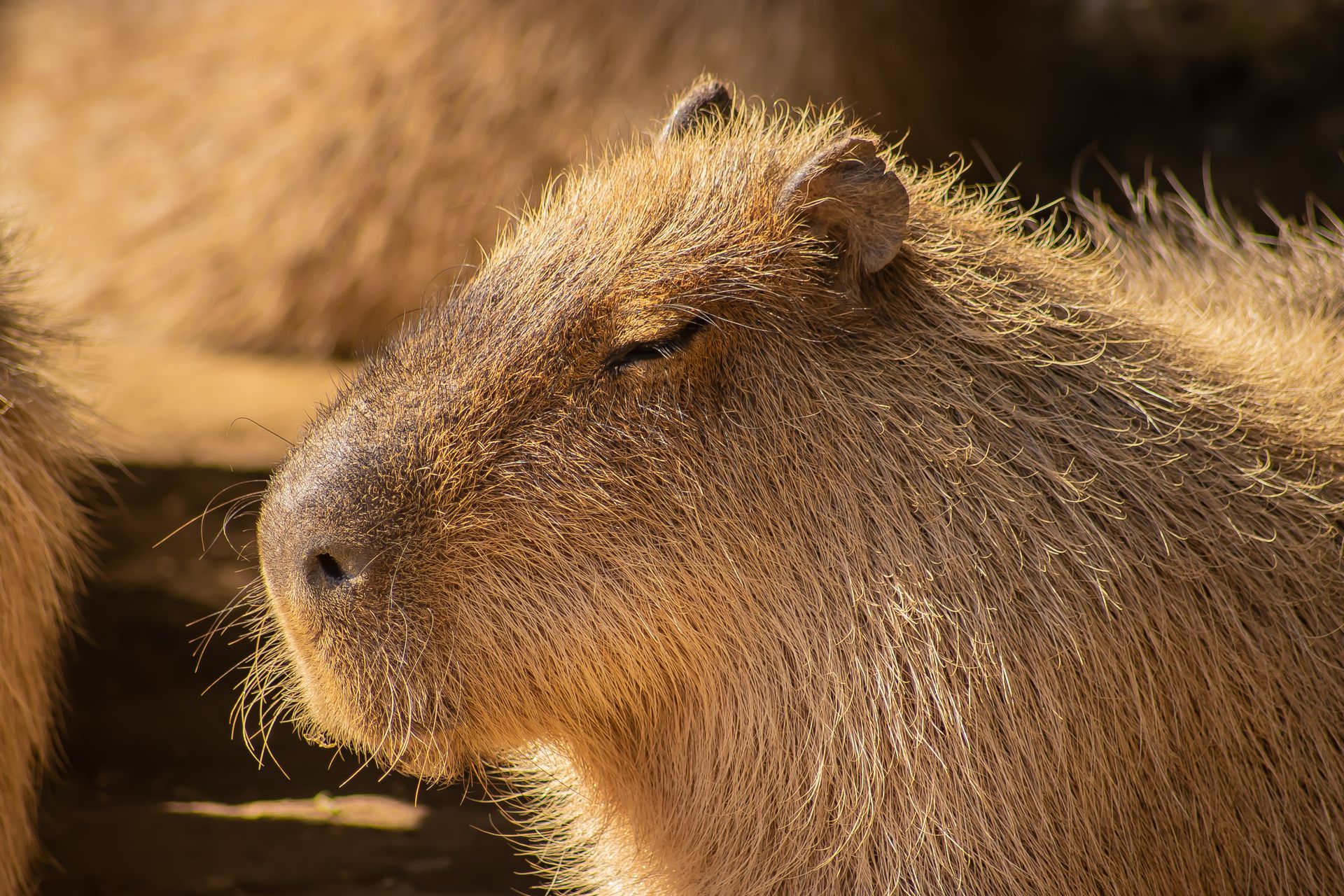
Their barrel-shaped bodies are covered in reddish-brown, brittle fur that dries quickly on land. They're strong swimmers, able to hold their breath underwater for up to five minutes.
Capybaras are highly vocal and enjoy "singing" little songs, using a variety of sounds to communicate with each other.
Classification and Phylogeny
The capybara's classification and phylogeny are quite fascinating. It belongs to the subfamily Hydrochoerinae, which also includes the rock cavies. This subfamily has been recognized since 2002 through molecular phylogenetic studies.
The capybara's closest relative is the rock cavy, and both genera are now placed in the subfamily Hydrochoerinae within the family Caviidae. This reclassification has been adopted in recent years, replacing the previous classification of Hydrochoeridae for all capybaras.
The taxonomy of fossil hydrochoerines is still in a state of flux, with the diversity of fossil species being substantially reduced. This is due to the recognition that capybara molar teeth show strong variation in shape over the life of an individual.
Here's a list of some of the fossil genera that are considered to be capybaras:
- Cardiatherium
- Phugatherium
- Hydrochoeropsis
- Neochoerus
The capybara, like its relative the guinea pig, cannot synthesize vitamin C. This means that capybaras not supplemented with vitamin C in captivity can develop gum disease as a sign of scurvy.
Capybaras Are Fantastic Swimmers
Capybaras are fantastic swimmers, and it's no surprise given their semi-aquatic lifestyle. They can be found living near bodies of water, like lakes, rivers, swamps, ponds, and marshes.
Their webbed feet help them maneuver in water, making them efficient swimmers. They can even hold their breath underwater for up to five minutes.
These incredible rodents are strong swimmers, and their facial features are located towards the top of their large heads to help them see and breathe while they swim. It's a clever adaptation that allows them to thrive in their aquatic environment.
Capybaras are also vigilant about predators, and their semi-aquatic lifestyle helps them avoid danger. They can retreat quickly to the water if needed, escaping predators like anacondas, wild cats, and eagles.
Their strong swimming abilities make them well-suited to their environment, and it's a key part of their survival strategy. By living near water, they can rest, eat, and socialize with their fellow capybaras in safety.
See what others are reading: Largest Salt Water Crocodile
Capybara Size Comparison
The capybara is the largest rodent in the world, and its size is quite impressive. They can weigh up to 150 pounds, which is roughly the same as an adult human.
Their body length can reach up to 4 feet, making them a substantial creature. Female capybaras tend to be slightly heavier than their male counterparts, with an average weight of around 110 pounds.
In comparison, an adult capybara weighs as much as an adult human, with an average weight of around 50 kilograms. However, some capybaras can weigh anywhere between 35 and 70 kilograms.
Their large size is likely an adaptation to their semi-aquatic lifestyle, allowing them to swim efficiently through the water.
Frequently Asked Questions
What is the 2nd largest rodent in the world?
The Patagonian cavy is the second largest rodent in the world. It's a remarkable creature, rivaled only by the capybara in size.
What is the largest rodent ever found?
The largest rodent ever found is Josephoartigasia monesi, a massive rodent species with unique dental features. Its enormous size and distinctive enamel layer make it a fascinating discovery in the world of paleontology.
Featured Images: pexels.com