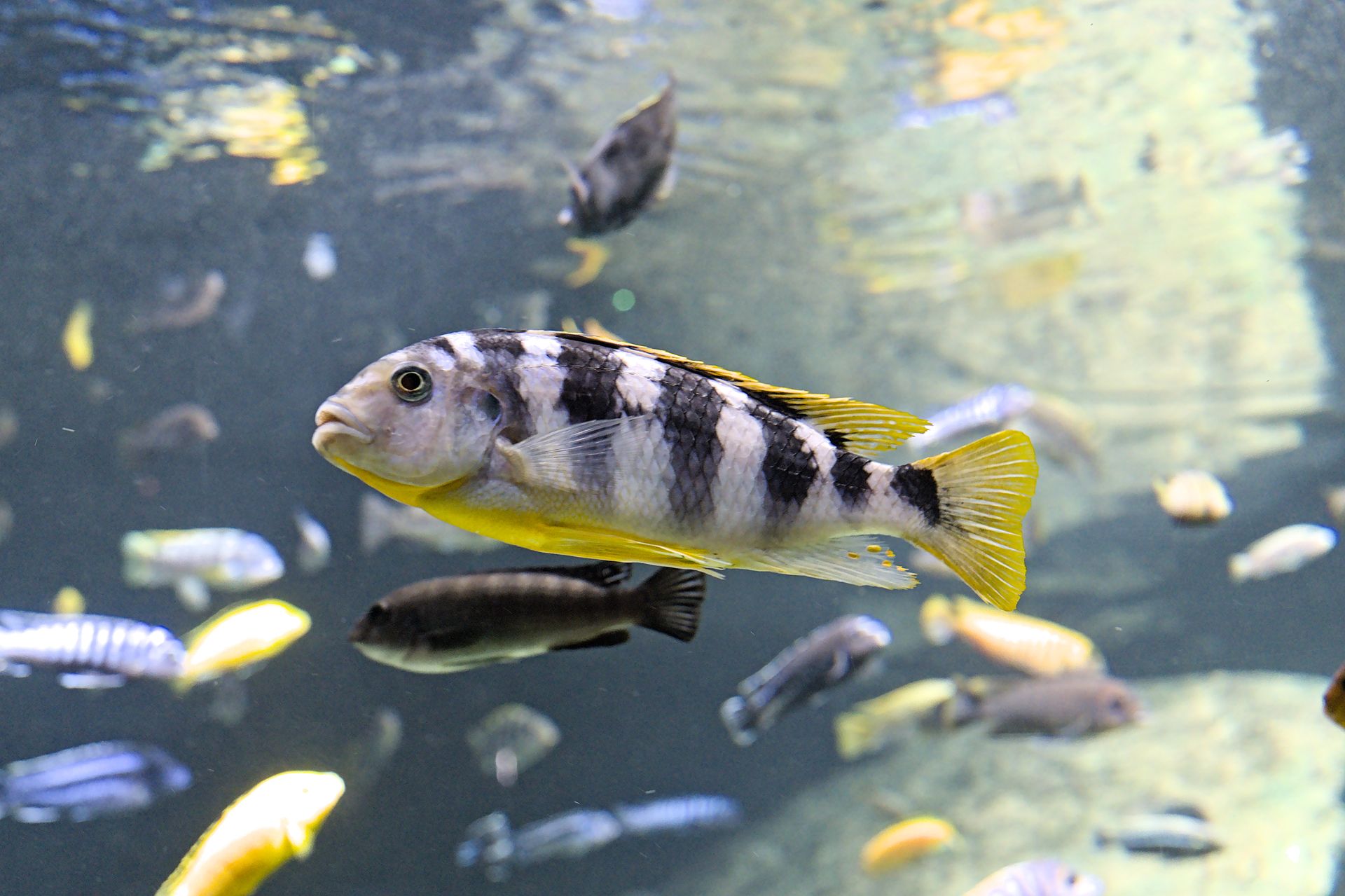
In the wild, Julidochromis are found in rocky areas of Lake Tanganyika, where they inhabit areas with dense vegetation and plenty of hiding places. They are a peaceful species that thrive in small groups.
Julidochromis are known to form long-term monogamous relationships, with pairs staying together for many years. These pairs work together to build and maintain their territory.
They are a relatively small species, reaching a maximum length of about 5-6 inches.
Classification
Classification of Julidochromis is a bit tricky.
Julidochromis species are poorly studied, which makes it hard to determine their exact relationships and systematics.
Chalinochromis is essentially similar to Julidochromis, except for some adaptations for feeding on sponges.
In their mtDNA, Chalinochromis are closer to Julidochromis dickfeldi, Julidochromis ornatus, and Julidochromis transcriptus than to any other living fish.
Julidochromis marlieri and Julidochromis regani are closer to Telmatochromis, however.
There have been successful intergenerichybridization between certain lineages of Julidochromis males and Chalinochromis females, resulting in offspring closer to Telmatochromis.
Alternatively, Julidochromis might need to be split in two, with Chalinochromis included in one lineage.
Julidochromis could also be monophyletic and include Chalinochromis, where males of the common ancestor of J. marlieri and J. regani hybridized with females of the common ancestor of Telmatochromis.
If this caught your attention, see: Telmatochromis
Aquarium Care
Julidochromis are small-growing dwarf cichlids that thrive in hard alkaline water with a pH of 8.5-9.0 and a hardness of 12-14 kH.
To create a suitable environment, you'll want to set up an aquarium with a minimum capacity of 60-80 liters. This will provide your Julidochromis with ample space to swim and thrive.
Rocks should be used to form caves and passageways, which will serve as shelter and help reduce territorial behavior. Julidochromis can be shy in the aquarium, but the use of dither fish may help alleviate this issue.
However, Julidochromis are still cichlids, and as such, they can be aggressive. It's best to keep them with other cichlids, rather than general tropical fish.
If a pair of Julidochromis does split in the aquarium, it's often best to separate them to prevent hostilities from escalating. Fry can be maintained with the parents and should be fed protein-rich foods like baby brine shrimp.
Here's a summary of the recommended aquarium conditions for Julidochromis:
Ecology and Reproduction
Julidochromis species are secretive biparental substrate spawners, retreating to caves or rock crevices.
They are largely monogamous, but the largest male may maintain harems and the largest female may mate with multiple males at multiple nesting sites.
Pairs in Julidochromis species will often break up, with the larger fish driving the smaller one out of the territory, and sometimes killing him in the process.
In some species, like Julidochromis marlieri, females are substantially larger than males, and a female will often dominate a male larger than herself.
Julidochromis species have two spawning rhythms: sometimes they deposit a large number of eggs every four to six weeks, and other times they spawn sequentially, laying a small number of eggs every few days.
This sequential spawning results in fry of different ages living together in the same nest.
They prefer to lay their eggs in caves or other crevices, and both parents tend the eggs by mouthing them to rid of algae and fanning them to increase oxygen flow.
The majority of parental care is done by the smaller fish in a pair, but this is influenced by the degree of size difference within a pair.
A pair of breeding fish must guard their nest from other cichlids trying to eat their offspring, with common intruders including Tropheus, Simochromis, and Petrochromis.
Breeding and Size
Julidochromis are cave spawners and form strong pair bonds, which is a great sign for any aquarist looking to breed them.
They take parental care to the next level by guarding their eggs and fry, and may even continue to raise multiple generations in the same territory.
This level of dedication to their young is impressive, and it's not surprising that they're able to thrive in their natural habitats.
Breeding
Breeding Julidochromis dickfeldi is a unique process. They are cave spawners, meaning the female lays eggs inside a crevice or rock cave.
Both parents play a crucial role in guarding the eggs and fry. They exhibit excellent parental care.
In fact, they may continue to raise multiple generations in the same territory. This behavior is quite remarkable.
Size and Longevity
Size and Longevity is a crucial aspect of caring for these fish. They can grow up to 9 cm in length.
Their lifespan is relatively long, typically ranging from 8 to 10 years in well-maintained conditions. This means you'll have plenty of time to bond with your fish.
Frequently Asked Questions
What is the largest Julidochromis?
The largest Julidochromis species is Julidochromis Regani, reaching up to 5 inches in length in the wild. In aquariums, they typically top out at 4 inches.
Featured Images: pexels.com