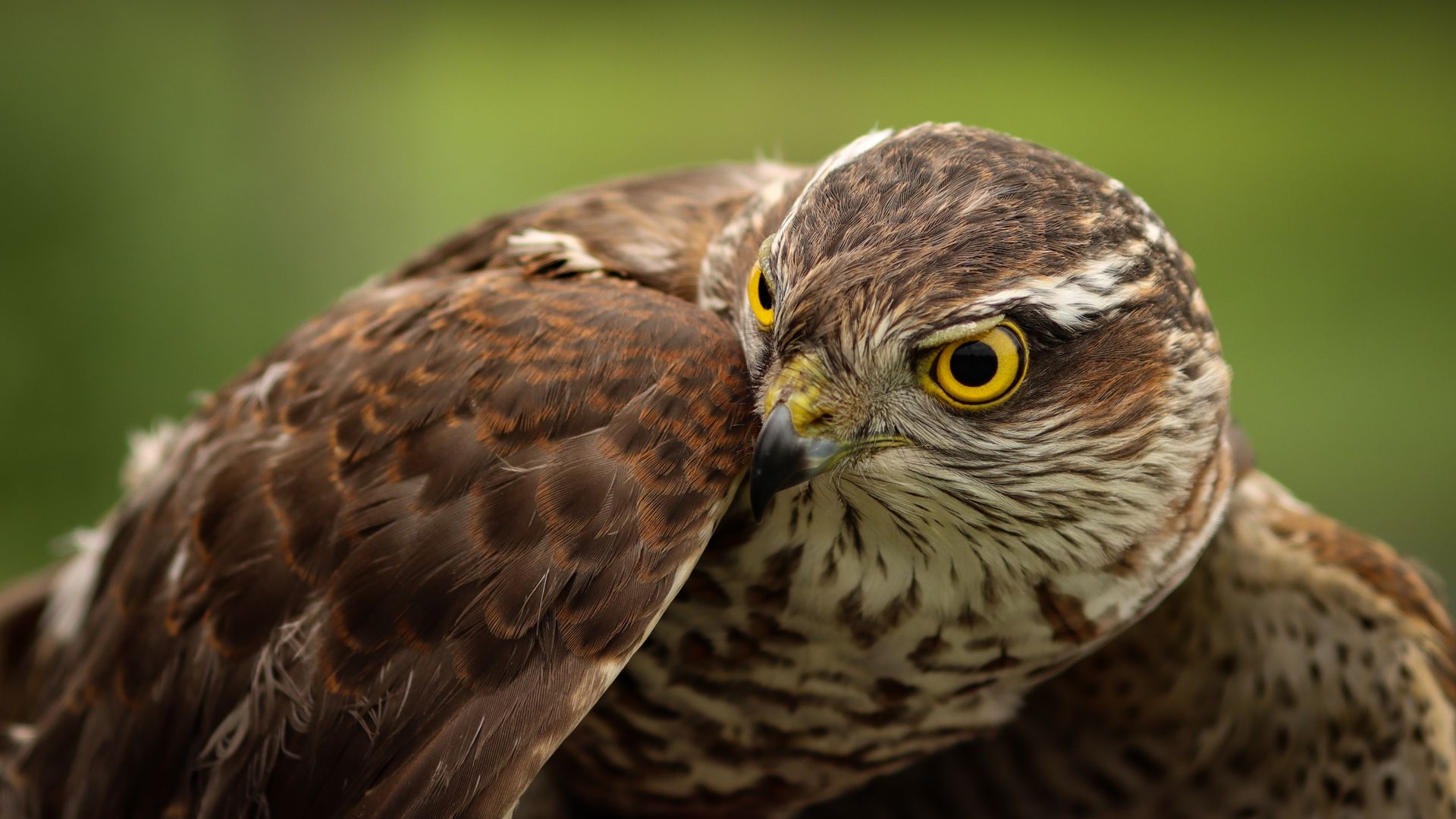
The Japanese Sparrowhawk is a small but mighty bird of prey. It's one of the most common birds of prey in Japan.
Reaching lengths of about 30-35 centimeters, the Japanese Sparrowhawk is a relatively small bird. It's a member of the Accipitridae family, which includes hawks, eagles, and Old World vultures.
These birds are known for their agility and speed, reaching speeds of up to 50 kilometers per hour. They have a distinctive appearance, with a slate-gray back and white underside.
Recommended read: How to Say Bird in Japanese?
Taxonomy and Classification
The Japanese sparrowhawk was formally described in 1845 by zoologists Coenraad Jacob Temminck and Hermann Schlegel. They specified the scientific name Astur (Nisus) gularis, where Nisus was an alternative possible genus introduced by Georges Cuvier in 1800.
The specific epithet gularis is Modern Latin meaning "of the throat" or "throated". This name refers to the bird's distinctive throat characteristics.
The Japanese sparrowhawk was formerly placed in the genus Accipiter, but a comprehensive molecular phylogenetic study in 2024 revealed that the genus was polyphyletic. This led to the division of Accipiter into six genera.
Discover more: Accipiter Trivirgatus
The genus Tachyspiza was resurrected to accommodate the Japanese sparrowhawk and 26 other species previously placed in Accipiter. The genus name combines Ancient Greek and Latin roots, reflecting the bird's characteristics.
Here are the recognized subspecies of the Japanese sparrowhawk:
- T. g. sibirica (Stepanyan, 1959) – Mongolia to east China
- T. g. gularis (Temminck & Schlegel, 1845) – northeast China, Russian Far East and Japan
- T. g. iwasakii (Mishima, 1962) – south Ryukyu Islands (Japan)
The Japanese sparrowhawk is closely related to the Besra, but recent discoveries suggest they may be more closely related to the collared sparrowhawk of Australasia. This highlights the ongoing research and understanding of bird taxonomy.
Physical Characteristics
The Japanese Sparrowhawk's physical characteristics are quite impressive. Their wing feathers are thin, especially towards the outer reaches of their wingspans, and feature distinctive brown barring.
Their chest feathers are downy, providing excellent protection from the cold as they fly at high speeds through the air. This unique adaptation is crucial for their survival in chilly environments.
Their wings are short and rounded, making them well-suited for navigating dense forests and brush. This distinctive wing shape also allows them to be deadly hunters in both open spaces and woodland environments.
Their tail feathers are long, featuring dark bands that arc across the fan and fade slowly from the tips towards the spine. This striking pattern is a notable characteristic of the Japanese Sparrowhawk.
Their slender legs and long middle digits enable them to catch a wide variety of air- and land-dwelling prey. This impressive hunting ability is a testament to their adaptability and agility.
Behavior and Habitat
The Japanese Sparrowhawk is a bird of prey that's found in Japan and parts of eastern Asia. It's a medium-sized hawk with a distinctive appearance.
These birds are known for their agility and speed, reaching speeds of up to 30 kilometers per hour when diving. Their sharp talons and hooked beaks make them well-suited for catching small birds and mammals.
In the wild, Japanese Sparrowhawks can be found in a variety of habitats, including forests, grasslands, and urban areas.
Are They Aggressive
Japanese Sparrowhawks can be quite aggressive in the wild, but they tend to save their energy for other birds that get too close to their nests.
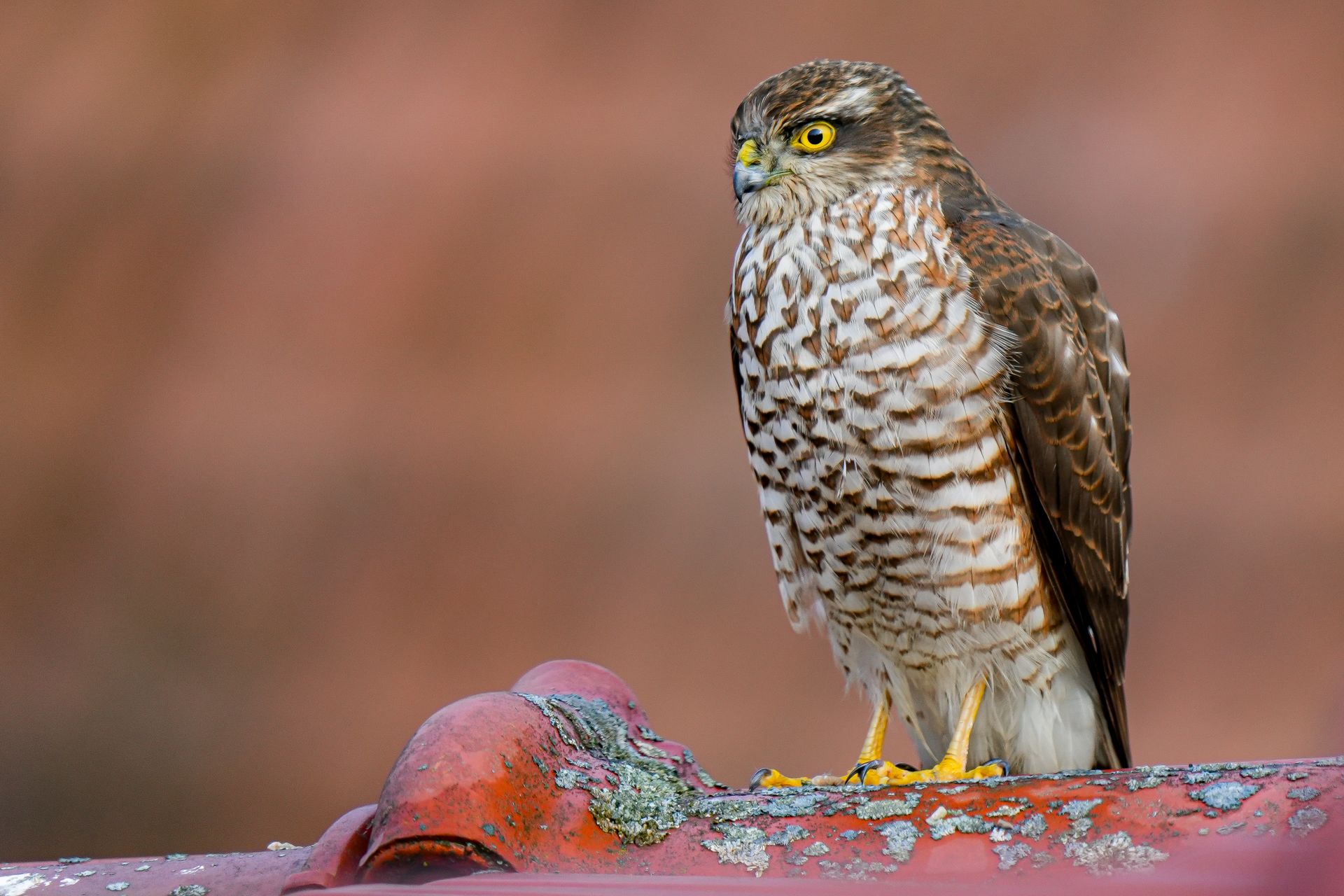
They have a specific defense zone, ranging from 10 to 50 meters, where they'll chase away any other birds that dare to enter.
In contrast, they're generally not a threat to humans or medium-sized mammals like cats or dogs.
Their aggression is mostly a response to feeling trapped, which is understandable, but it's still something to be aware of if you're out and about in their territory.
Their Calls Sounds
Japanese Sparrowhawks are incredibly articulate birds with four primary vocalizations. Their shortest vocalization is the battle cry, which sounds like a sharp and quick "Kit" sound.
Their "Pyoh-pyo" call is distinctive and descending, often used by males to communicate with their mate and by females to declare their territory.
The females also use a shrill and resounding "Kek-kek-kek" call to establish boundaries or as a means of food begging. This call is a key part of their communication.
Mating birds use a gentle "Coo-coo" call for general communication.
Predators
The Japanese Sparrowhawk's predators are a concern, but fortunately, it doesn't have many natural threats.
Its biggest threat is other, larger birds of prey, such as eagles, owls, and other species of hawks.
What They Eat Diet
The Japanese Sparrowhawk's diet is quite varied and impressive. Roughly 90% of their diet consists of small songbirds.
They're not picky eaters and will hunt larger birds like pigeons and partridges during the mating season. This is when they need extra food to rear their young.
In addition to birds, they also hunt rodents, including squirrels. Rodents are a significant source of nutrition for them.
Bats, insects, and even lizards are also on the menu for Japanese Sparrowhawks. They're opportunistic hunters, taking advantage of whatever food source is available.
They have a unique behavior of caching, which means they save leftovers in the branches of trees to return to later. This is especially prevalent during the mating season when they need extra food.
For more insights, see: Japanese Raccoon Dog Diet
Habitat and Distribution
The Japanese Sparrowhawk is a versatile bird that can be found in a variety of habitats.
They typically inhabit forest types such as deciduous, coniferous, and mixed, at elevations up to 1800 meters but usually below 1000 meters. Their preferred habitats include southern taiga and subalpine zones near rivers.
During migration and wintering, they can be seen in villages and open areas where woodlands and shrubs mix with marshes and fields. This adaptability allows them to thrive in different environments.
Their distribution varies by subspecies, with some being migratory and others sedentary. Tachyspiza gularis sibiricus, for instance, migrates from Mongolia to eastern China and is thought to winter in southeast Asia and Indonesia.
They can be found at their breeding grounds in eastern Russia, eastwards to Sakhalin, the Korean peninsula, Japan, and Northeastern China. The South Ryukyu Islands of Japan are home to a sedentary subspecies, Tachyspiza g. iwasakii, which lives solely in evergreen subtropical forests.
The Japanese Sparrowhawk is also known to breed in southern Siberia, the southern side of the Kuril Islands, the Ussuri and Amur regions, Sakhalin, the Korean Peninsula, northern Mongolia, and eastern China.
Breeding/Reproduction Behavior
Japanese Sparrowhawks typically lay clutches consisting of between 2-5 eggs.
Females incubate the clutch for a month or so, and after hatching, the fledgling period usually lasts another month.
The birds usually nest in densely forested areas, with a preference for coniferous trees, such as red pine.
Consecutive year returns to the same mating ground are common, and it's often the case that the pair will mate again.
Most sparrowhawks only venture as far as 20km from where they were born to find a suitable place to breed.
Japanese Sparrowhawks are almost entirely monogamous, but there have been rare observations of extra-pair copulation within the species.
The birds typically craft their nests out of twigs and leaves, hiding them close to the trunk of the tree in order to provide plenty of branch cover.
Conservation and Threats
The Japanese sparrowhawk is listed as Least Concern on the IUCN Red List, indicating that its population is stable with an estimated 13,400 to 67,000 mature adults.
However, the species is protected in China and considered endangered in Japan, where concerns over nesting site declines and breeding success have raised alarms.
The A. g. iwasakii subspecies is classified as endangered in the Red Data Book of the Japan Ministry of the Environment, highlighting the need for conservation efforts in specific regions.
Conservation efforts are not currently being made for the Japanese sparrowhawk, as it does not qualify as a threatened species according to the IUCN Conservation Status scale.
Here's a breakdown of the conservation status of the Japanese sparrowhawk:
Featured Images: pexels.com