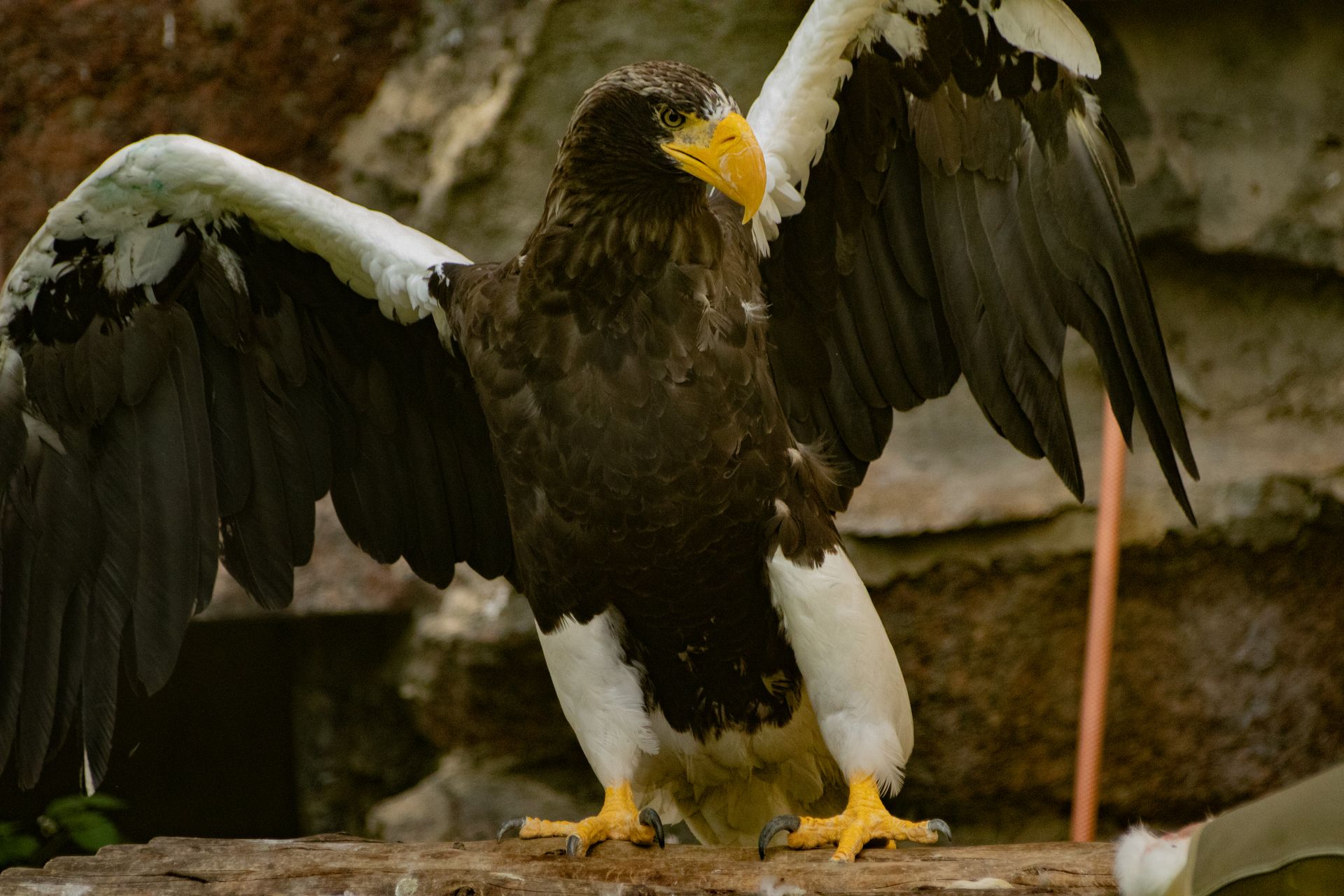
The Bald Eagle is a large, powerful bird of prey, with adults typically weighing between 9 and 14 pounds.
Its impressive wingspan can reach up to 7.5 feet, allowing it to soar and dive with incredible agility.
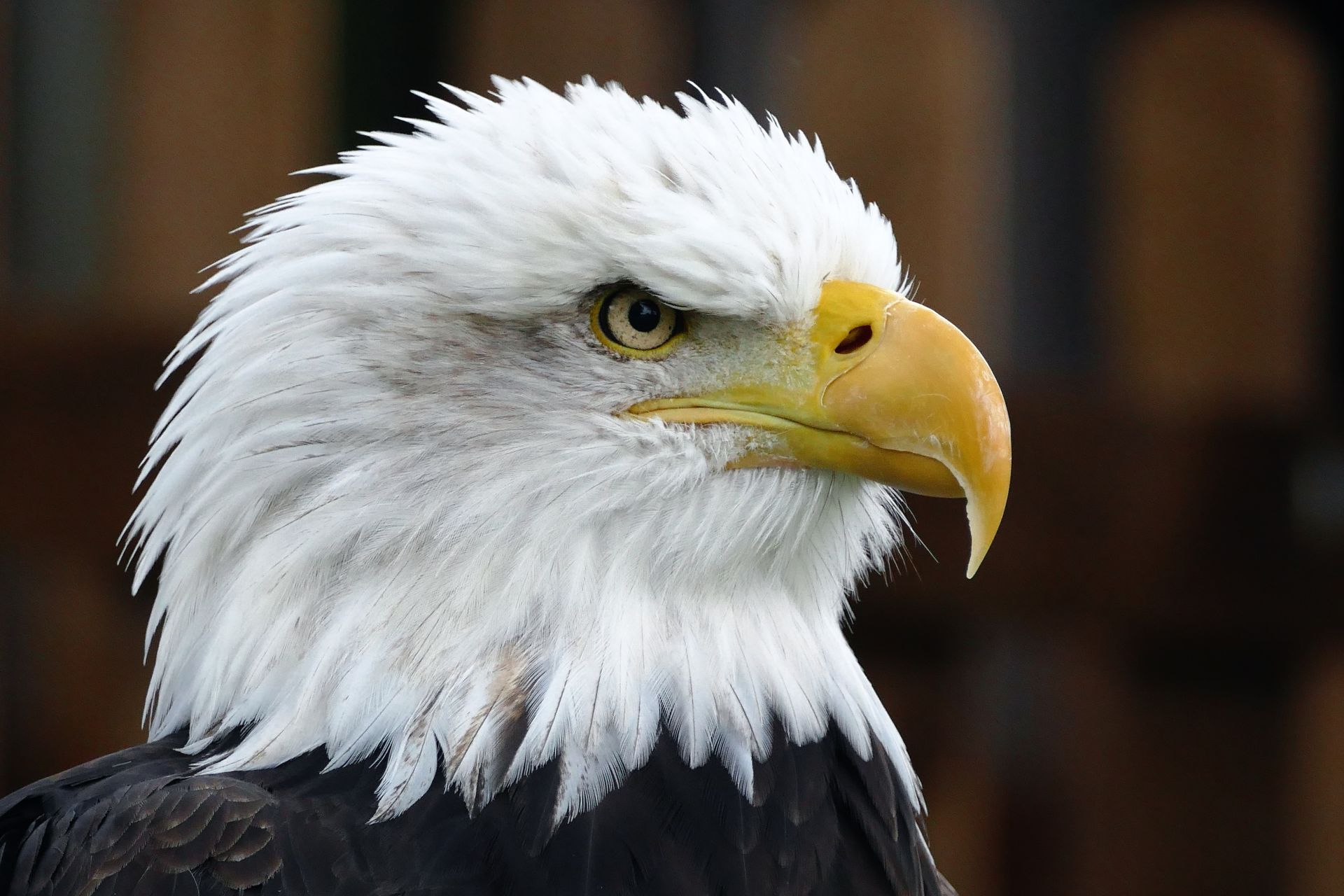
The Bald Eagle's distinctive white head and tail feathers contrast with its dark brown body, creating a striking visual effect.
This striking appearance is not just for show; the Bald Eagle's feathers play a crucial role in its ability to fly and hunt.
Taxonomy
The bald eagle's scientific name is Haliaeetus leucocephalus, and it's part of the genus Haliaeetus, which includes sea eagles.
The genus name Haliaeetus is derived from the Ancient Greek word "haliaetos", meaning "sea eagle." This name was chosen because the bald eagle is a type of sea eagle.
The specific name leucocephalus is Latinized from the Ancient Greek words "leukos", meaning "white", and "kephalē", meaning "head." This refers to the bald eagle's distinctive white head feathers.
The bald eagle was one of the many species originally described by Carl Linnaeus in his 18th-century work Systema Naturae, under the name Falco leucocephalus.
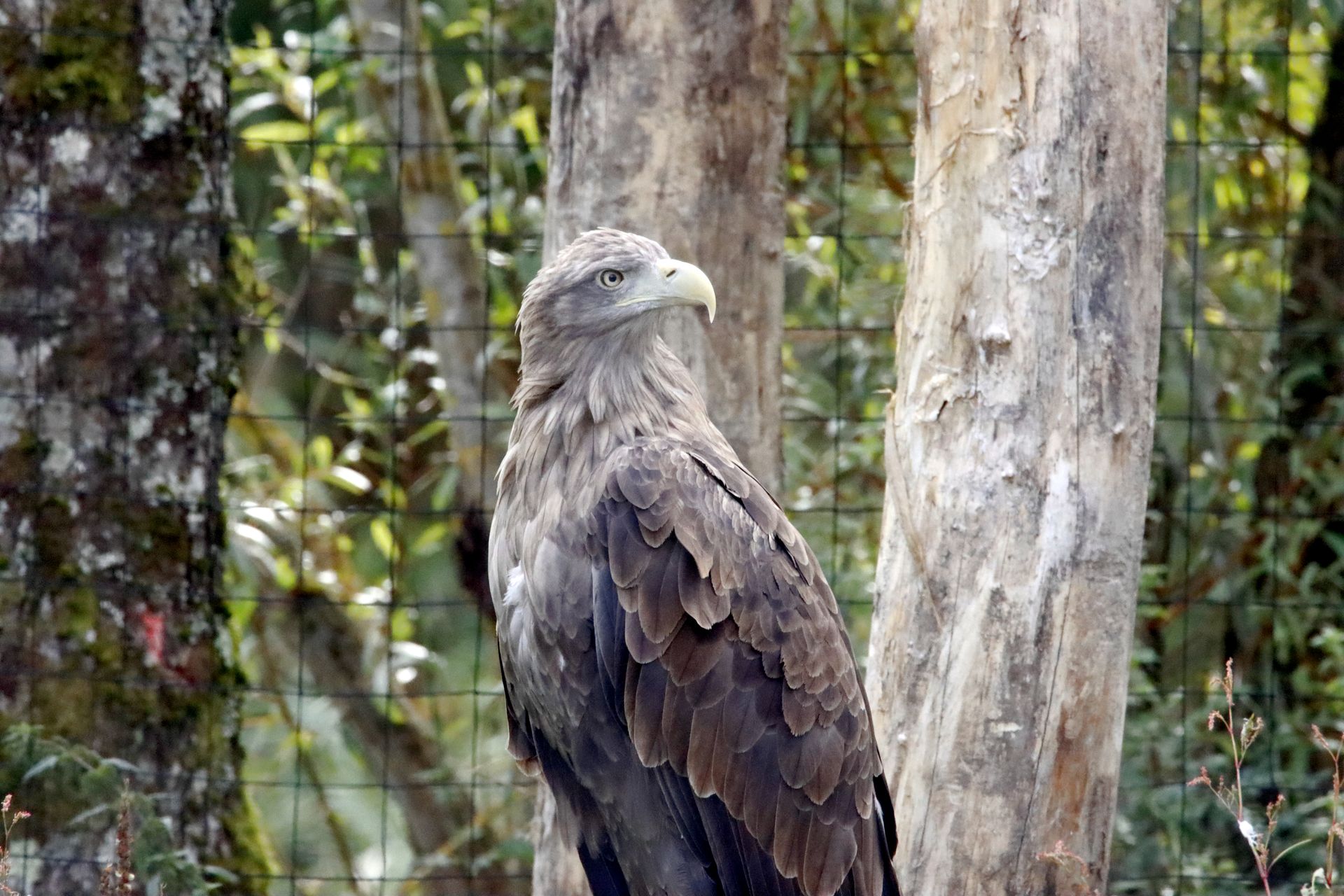
The bald eagle forms a species pair with the white-tailed eagle of Eurasia, which is a tan-headed species with overall paler brown body plumage.
You might enjoy: Haliaeetus Pelagicus
Physical Characteristics
Bald eagles are large, powerful birds with impressive physical characteristics. They have a wingspan of 178 to 229 cm, which is quite impressive.
One of the most distinctive features of bald eagles is their plumage. Adult bald eagles have a white head and tail with a dark brown body, although they may have a few dark spots on their head and tail for several years after reaching maturity.
Their bills and eyes are yellow, and they have sharp talons on their feet. Bald eagles are also known for their large heads, necks, and bodies, which can weigh up to 4.3 kg.
In terms of size, bald eagles can have a wingspan of up to 8 feet, with females being slightly larger than males. Males can weigh up to 10 pounds, while females can weigh up to 14 pounds.
Here's a quick rundown of the average size of bald eagles:
Bald eagles also have a unique way of maturing, with four distinct stages that take around 4-5 years to complete. During this time, their plumage will change from a mottled brown and white to the characteristic white head and tail of a mature adult.
Consider reading: White Bellied Sea Eagle Haliaeetus Leucogaster
Habitat and Distribution
Bald eagles are found in a variety of habitats, but they typically prefer areas near large water bodies such as sea coasts, coastal estuaries, and inland lakes and rivers.
They will often inhabit areas within 3 km of a water source, and their specific habitats may vary depending on their range. Habitat selection depends largely on prey availability, the availability of tall trees, and the degree of human disturbance.
Bald eagles tend to avoid human recreation areas and will even forgo feeding if their foraging area is being disturbed by humans. In some cases, they may inhabit areas further from foraging grounds to avoid human interaction.
In northern regions, bald eagles migrate to southern, milder climates annually. They often nest in the canopy of tall, coniferous trees, surrounded by smaller trees, but in southern Florida, mangroves are used instead.
Here are some common types of aquatic biomes where bald eagles can be found:
- Aquatic Biomes
- lakes and ponds
- rivers and streams
- coastal
In addition to these biomes, bald eagles can also be found in other types of habitats with specific features, such as:
- Other Habitat Features
- estuarine
Bald eagles require a good food base, perching areas, and nesting sites. Traditionally, they were found nesting near rivers, lakes, and marshes, but they are increasingly found in drier areas that are farther from water sources.
In winter, bald eagles congregate in large numbers near open water in tall trees that they use for spotting prey. These trees also provide night roosts for sheltering.
Bald eagles will nest in a wide variety of habitats that provide suitable nest sites close to open water. Nests may be placed in snags or large live trees as well as on constructed platforms or utility poles.
The majority of bald eagles in Canada are found along the British Columbia coast, while large populations are found in the forests of Alberta, Saskatchewan, Manitoba, and Ontario.
Behavior and Diet
The bald eagle is a powerful flier, soaring on thermal convection currents and reaching speeds of 56-70 km/h when gliding and flapping.
It's impressive to see them catch up to and swoop under geese in flight, turning over and thrusting their talons into the other bird's breast.
Bald eagles are surprisingly maneuverable in flight, considering their morphological adaptations.
Behavior
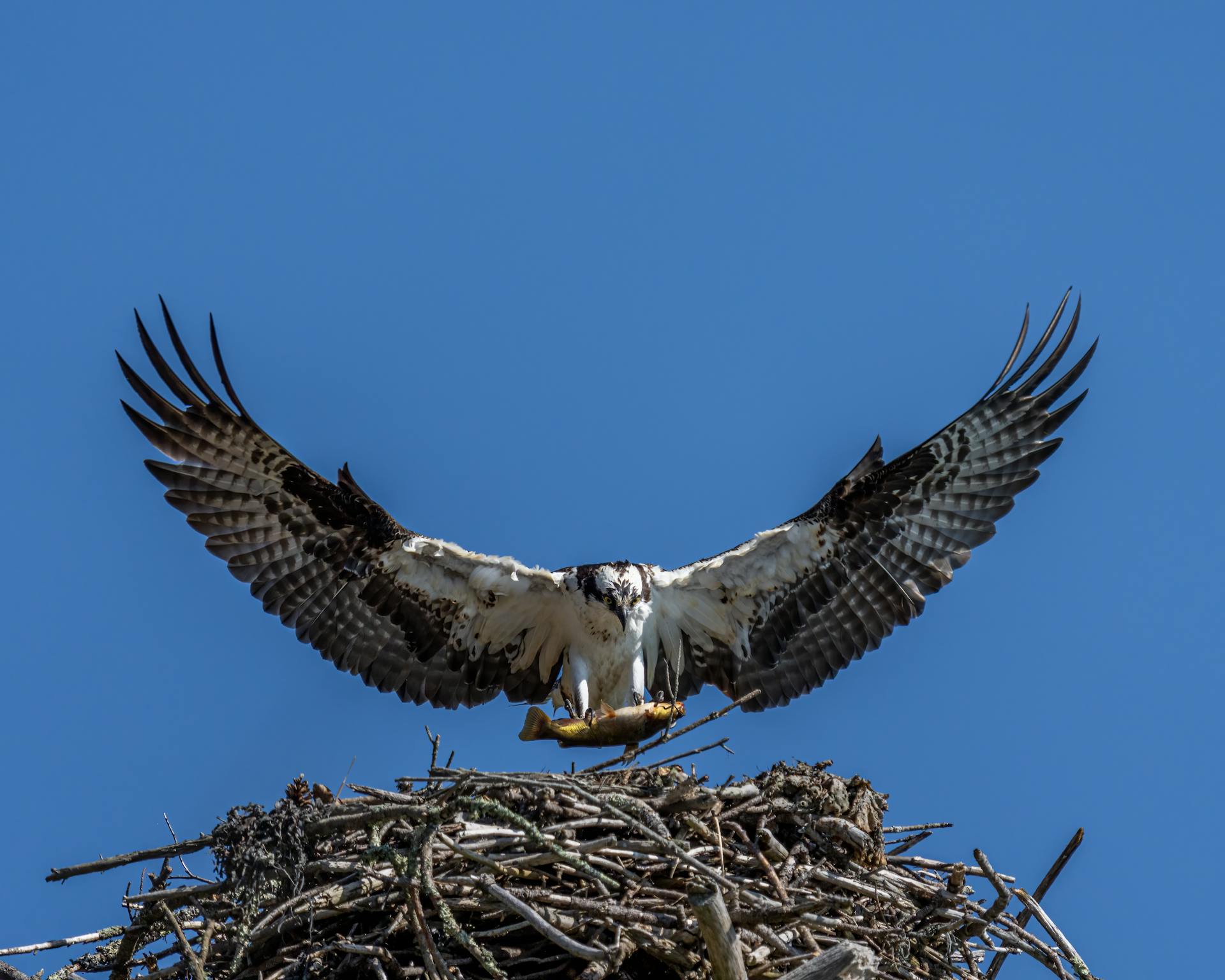
The bald eagle is a powerful flier, soaring on thermal convection currents.
Bald eagles reach speeds of 56-70 km/h when gliding and flapping, and about 48 km/h while carrying fish. They can also dive at speeds of 120-160 km/h.
Despite being less well adapted to faster flight, bald eagles are surprisingly maneuverable in flight.
They've even been recorded catching up to and then swooping under geese in flight, turning over and thrusting their talons into the other bird's breast.
For more insights, see: American Bald Eagle Nest
Diet and Feeding
Diet and Feeding is a crucial aspect of a pet's overall health and well-being.
A balanced diet should include a mix of protein, fat, and carbohydrates to meet their energy needs.
In the wild, these animals primarily eat a diet rich in protein from small mammals, birds, and insects.
Feeding them a diet high in protein can help maintain their muscle mass and overall health.
A good quality commercial pet food can provide the necessary nutrients, but it's also essential to provide a variety of fresh fruits and vegetables.
In fact, offering a treat of fresh vegetables like carrots or apples can be a great way to add some variety to their diet.
Predation
Bald eagles have few natural predators, but their eggs and young are vulnerable to attacks from magpies, gulls, ravens, crows, black bears, raccoons, bobcats, wolverines, and arctic foxes.
In some areas, bald eagles nest on the ground, but this is not always the case. Their fully grown adult birds are rarely preyed upon by other animals.
Bald eagles are not directly a threat to humans, but their nesting sites require buffer zones to protect them from human development. This can limit where people can build homes or businesses in certain areas.
Their ability to soar and glide makes them surprisingly maneuverable in flight, and they have even been known to catch up to and swoop under geese in mid-air.
The bald eagle's migration patterns take advantage of thermals, updrafts, and food resources, allowing them to conserve energy and stay safe during their journeys.
Conservation and Management
Conservation efforts have helped bald eagles recover from their endangered status. Their population has increased significantly since the ban of DDT in 1972.
In 1963, there were an estimated 417 pairs of bald eagles remaining in the continental US, but by 1998, that number had grown to 5,748 pairs. This is a remarkable increase of over 1,300%.
The Bald Eagle Protection Act was put into effect in 1940, but it wasn't until the ban of DDT that their population began to recover. Today, bald eagles are listed as a species of least concern according to the IUCN Red List of Threatened Species.
Conservation Status
The conservation status of bald eagles has come a long way in recent years. As of June 28, 2007, they were removed from the protection of the Endangered Species Act, where they had been listed since 1978.
Their population was severely impacted in the early and mid-1900s due to hunting, habitat destruction, and the use of insecticides like DDT. DDT's fat-soluble properties allowed it to accumulate in the fats of organisms, putting top predators like bald eagles at great risk.
After the ban of DDT in 1972, the bald eagle population began to increase dramatically. In 1963, there were an estimated 417 pairs of bald eagles remaining in the continental US.
By 1998, this number had grown to 5,748 pairs, bringing their productivity back to levels seen prior to DDT usage. In Alaska, the population was estimated to be between 20,000 and 25,000 individuals as of 1993.
The state of Washington saw a remarkable 700% population increase from 1981 to 2005, with an annual growth rate of approximately 9%. These positive trends have led to the species being listed as a species of least concern according to the IUCN Red List of Threatened Species.
Here are the current conservation statuses of bald eagles:
- IUCN Red List: Least Concern
- US Migratory Bird Act: No special status
- US Federal List: No special status
- CITES: No special status
- State of Michigan List: No special status
In Captivity
In captivity, bald eagles require special permits to be kept in the United States. These permits are mainly issued to public educational institutions.
The eagles kept in captivity must be permanently injured individuals that cannot be released to the wild. They are often used for educational shows.
The facilities where eagles are kept must be equipped with adequate caging. This is crucial for the birds' safety and well-being.
Workers experienced in the handling and care of eagles are necessary to ensure the birds receive proper care. This includes a diet, environment, and health checks.
Bald eagles can live a long time in captivity if well cared for. However, they do not breed well even under the best conditions.
In some jurisdictions, a license may be issued to allow use of bald eagles in birds-of-prey flight shows.
Identification
The bald eagle, Haliaeetus leucocephalus, is a majestic bird, and understanding its identification is key to appreciating its beauty.
One way to identify the bald eagle is to look at its plumage differences from other eagles, such as the white-tailed eagle, which was described by Peter J. Grant in 1988.
A key characteristic of the bald eagle is its subfamily, Buteoninae, which includes many other types of eagles and hawks.
The bald eagle's genus, Haliaeetus, is a unique identifier that sets it apart from other birds of prey.
The bald eagle's species, Haliaeetus leucocephalus, is not extinct, and it is actually considered a least concern species by the IUCN Red List.
Here is a list of some of the other birds of prey that are part of the same subfamily as the bald eagle:
- Geranoaetus
- Buteo
- Rupornis
- Parabuteo
- Buteogallus
- Busarellus
- Leucopternis
- Pseudastur
- Kaupifalco
- Butastur
- Harpyhaliaetus
Cultural Significance and Images
The bald eagle is a national symbol of the United States, and as such, it's featured prominently in various official items like seals, logos, coinage, and postage stamps.
Its cultural significance extends to various Native American cultures, where it holds a special place.
The bald eagle is also a prominent symbol in the U.S. federal government's branding and imagery.
Cultural Significance
The bald eagle holds a special place in various Native American cultures. It's also the national symbol of the United States, which is why you'll often see it on seals and logos related to the federal government.
This national significance is reflected in U.S. coinage, postage stamps, and other items associated with the government.
Bald Eagle Images
Bald Eagle Images can be quite striking, especially when it comes to juveniles and second year birds. Their variable amount of white feathering makes them look quite unique.
Second year birds have a distinctive appearance, with a mostly white belly and some brown mottling. A brown chest and broad brown mask on the face add to their striking appearance.
Juveniles and second year birds are often mistaken for adults, but they can be identified by their varying amounts of white feathering.
Bald Eagle Specifics
The bald eagle is an impressive bird, and let's dive into some of its specifics.
On average, a bald eagle can live up to 20-30 years in the wild.
They have a wingspan of up to 7.5 feet, which is quite impressive.
Their wings are also very strong, with some eagles reaching speeds of up to 30-40 mph when gliding.
Bald eagles are known for their distinctive white head and tail feathers, which contrast with their dark brown body.
They can weigh anywhere from 9-14 pounds.
Their sharp talons are perfect for grasping and holding onto prey.
These birds are also incredibly skilled hunters, with a success rate of around 50-60%.
They primarily feed on fish, but will also eat small mammals and birds.
Bald eagles can go without eating for several days, and then gorge on food when they catch something.
Their nests are massive, with some reaching up to 10 feet wide and weighing over 2,000 pounds.
They're built high up in trees, often near water sources.
Bald eagles are monogamous, with many pairs staying together for many years.
Frequently Asked Questions
Why is it illegal to pick up a bald eagle feather?
Bald eagle feathers are protected by law due to their symbolic status as a national symbol and to prevent poaching, which previously threatened the species' survival.
What is so special about the bald eagle?
Bald eagles have exceptional eyesight, with some able to see up to five times farther than humans, allowing them to spot prey from great distances. Their impressive vision is made possible by large eyes that fill most of their skull.
Did Shadow and Jackie lose an eagle?
Yes, Jackie and Shadow's bald eagle family experienced a loss with the passing of one of their three eaglets. Unfortunately, one of their eaglets did not survive.
What is the difference between a northern bald eagle and a southern bald eagle?
There is no difference in the sub-species of bald eagles between the north and south, but there are physical differences between eagles from the farthest southern and northern regions. However, these differences disappear as you move closer to the middle.
Featured Images: pexels.com