House training a Great Pyrenees requires patience and consistency. This gentle giant can take time to learn, but with a clear understanding of their needs and habits, you can set them up for success.
Great Pyrenees are naturally inclined to be independent and strong-willed, which can make house training a challenge. However, with positive reinforcement and clear boundaries, they can learn to respect your home and habits.
Establishing a routine is key to house training a Great Pyrenees. Feed them at the same times each day, and take them outside to the same spot immediately after meals and playtime.
Related reading: Indoor Dog House Training
Preparation and Planning
To start house training your Great Pyrenees, you'll need to establish a designated area for your puppy to use the bathroom. This spot should be easily accessible and preferably located outside.
Consistency is key when it comes to potty training, so make sure to take your puppy outside regularly, such as after meals and naps. This will help them learn to associate going outside with going to the bathroom.
Don't scold your puppy if they have an accident in the house. Instead, clean up the mess and take them outside right away to show them the correct behavior.
Readers also liked: Dog House Training Pads
Training Techniques
Training a Great Pyrenees requires patience, consistency, and positive reinforcement. You'll need to make training fun for your dog, using high-value rewards like food, treats, or praise.
To start, establish a designated area for your puppy to use the bathroom, such as a specific spot outside. Take your puppy outside every hour, or every half hour if they're active, to prevent accidents. Praise your puppy when they go to the bathroom, using a gentle tone and a word like "potty" to associate with the action.
Consistency is key when crate training your Great Pyrenees. Crate training can help control your puppy's environment, provide a secure place to rest, and give you freedom. To crate train successfully, make the crate a happy place for your dog, and don't leave them in the crate for more than 4 hours at a time.
Here are the essential commands your Great Pyrenees must learn for their safety and yours:
- Sit/Stay – a calming command and vital for situations where your dog needs to stay back.
- Leave it – an important command to teach your dog to back off and leave people or things alone.
- Come – a crucial command for recall and keeping your dog safe.
- Off – a command to tell your dog not to jump on someone or something.
Reward and Praise
Reward and praise are crucial components of positive training methods. Rewarding your dog promptly with high-value treats and praise helps them associate desired behaviors with positive experiences.
To effectively reward your dog, use a cheerful tone, but avoid being too excited, as this can scare them. A gentle praise is more effective, especially when teaching your puppy to go outside. You can use a word like "potty" to associate with the action, but be sure to introduce it gradually.
Consistency is key when rewarding your dog. Be sure to give them a tiny treat immediately after they finish going to the bathroom, and use a consistent phrase like "Good potty!" to help them learn.
Here are some tips for effective reward and praise:
- Praise your dog gently and enthusiastically.
- Use high-value treats to reinforce desired behaviors.
- Introduce new words like "potty" gradually to avoid confusion.
- Be consistent with your reward and praise to avoid confusing your dog.
Remember, positive reinforcement is the best way to teach your dog to go outside, and it's essential to associate going outside with positive experiences.
Curious to learn more? Check out: Can Great Pyrenees Sleep outside
Leash Training a Puppy
Start by choosing a quiet area with minimal distractions where your puppy can focus on you.
A puppy's attention span is short, so keep training sessions brief, ideally 5-10 minutes.
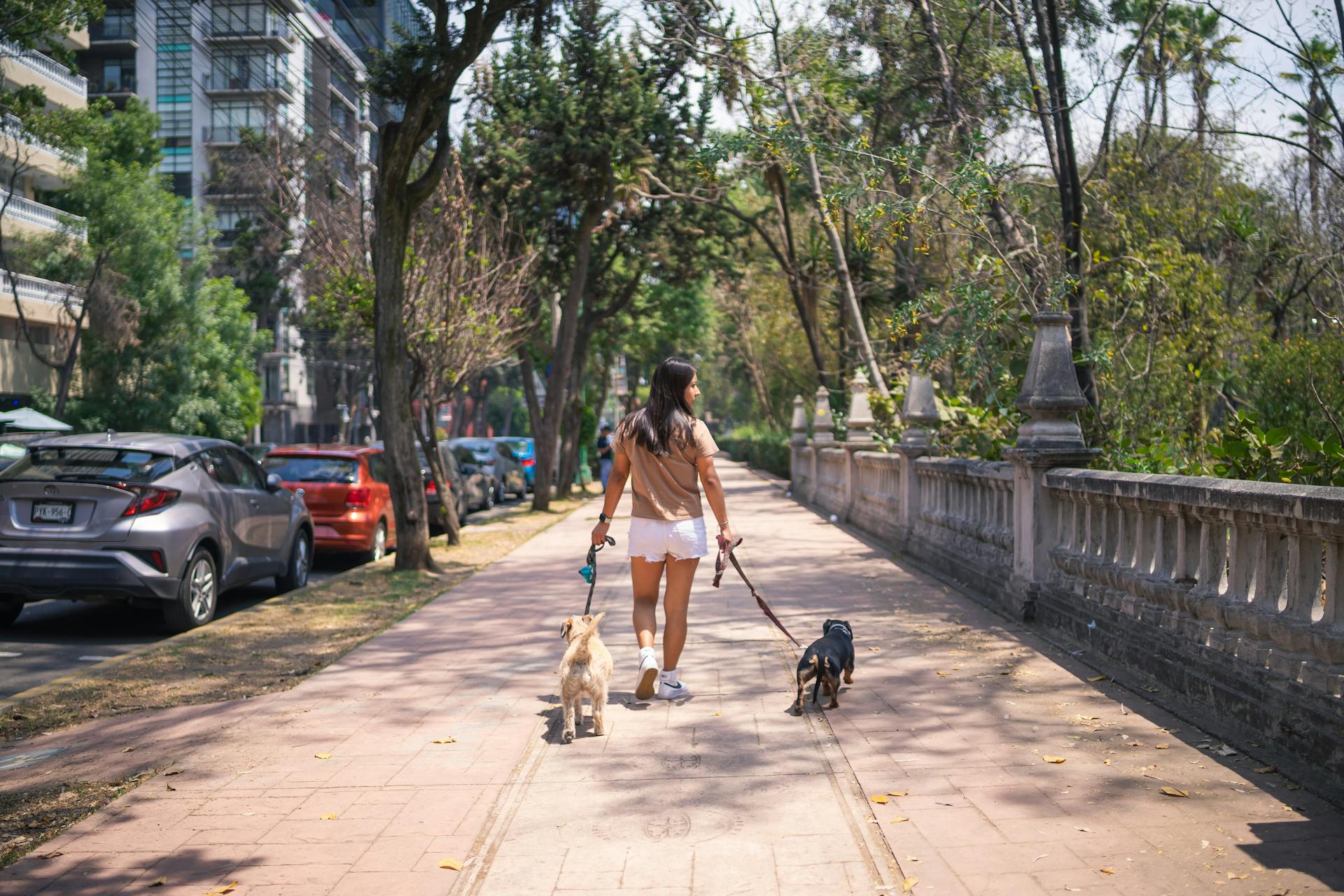
Begin by letting your puppy get used to wearing a harness and leash in a controlled environment.
You can even practice walking around the house with your puppy while still indoors.
It's essential to reward good behavior with treats and praise to encourage your puppy to walk by your side.
For example, if your puppy starts to pull on the leash, stop moving forward and wait for them to come back to your side before continuing.
Understanding Your Puppy
Great Pyrenees puppies are naturally wary of strangers and may take time to warm up to new people.
Puppies under six months old have limited bladder control and can only hold their urine for a short period.
They need frequent potty breaks and a consistent routine to learn good house training habits.
Expand your knowledge: Pics of Great Pyrenees Puppies
Understanding Your Puppy's Cues
Your puppy will likely develop a "tell" to indicate they need to go potty, such as scratching on a blanket or whining.
Some puppies are easier to recognize than others - my first puppy, for example, would rearrange her blanket before going potty, while another would whine loudly.
Learning to recognize your puppy's "tell" is crucial for successful potty training, as it allows you to take them outside before accidents happen.
A dramatic "tell" might be a more extreme reaction, like my older dog Doogie's seizures-like behavior when he needed to go - but even these can be outgrown with time.
Catching your puppy's "tell" and taking them outside every time is essential, and don't worry if it takes some time for them to develop a consistent signal.
With patience and dedication, you can learn to recognize your puppy's cues and make potty training a breeze.
Expand your knowledge: Great Pyrenees Potty Training
Socialisation and Obedience
Socialisation is key to helping your puppy learn how to interact with other dogs and people in a positive way. This will help them become well-behaved and less anxious around other animals and people.
Start by introducing your puppy to other dogs and people in a controlled environment. Praise your puppy when they interact with other animals and people in a positive way.
Consistency and patience are the keys to successful obedience training. Start with simple commands and gradually increase the difficulty as your puppy learns.
Training Commands
Training your Great Pyrenees to go potty outside can be a challenge, but with the right approach, you can achieve success.
Establish a consistent routine and designate a specific area for your dog to go potty, such as a grassy spot or a puppy pad.
This will help your dog learn to associate that area with going potty.
Repeat a word while your Great Pyrenees poops so that eventually you can use it as a command when you go out.
The most common word is 'potty', and saying it in an encouraging tone can help your dog learn to associate it with the action.
Consistency is key, so make sure everyone in the household is using the same command and routine.
Expand your knowledge: Why Do Great Pyrenees Bark so Much
House Training Tips
Establish a routine for your Great Pyrenees by feeding them at the same time each day and giving water on a schedule. This helps you predict when your dog will need to go outside.
Take your puppy outside every hour, or every half hour if they're active, to prevent accidents. Stand outside with them and give them time to sniff around.
Clean up accidents quickly using an enzymatic cleaner to remove the scent, and consider blocking off areas that your dog regularly goes to, as they may confuse them with outdoor spaces.
A Great Pyrenees may take 2-3 years to mature, so be patient and remember that potty training can take time, especially if you start later in your dog's life. Avoid scolding or punishing your dog for accidents, as this may cause fear and anxiety around elimination.
Consistency is key when it comes to potty training, so stick to your routine and reward your dog with praise and treats when they successfully go outside.
Check this out: How Long Do Great Pyrenees Grow
Things You'll Need
To get started with house training your Great Pyrenees puppy, you'll need a few essential items.
A dog crate is a must-have for effective potty training.
You'll also need a collar and leash to secure your puppy during training sessions.
Puppy treats are a great way to reward your puppy for successful pottying outdoors.
Here's a list of the things you'll need:
- Dog crate
- Collar
- Leash
- Puppy treats
9 Tips on Training
Training a Great Pyrenees requires patience, consistency, and positive reinforcement. You need to make training fun for your dog by using high-value rewards, such as food, treats, or praise.
Exercise is crucial for successful training sessions. Take your dog for regular walks or engage in physical play to ensure they're not too wound up to focus. A tired dog is a more receptive dog.
Great Pyrenees may take 2-3 years to mature, so training will take time and patience. Be prepared to repeat training sessions multiple times before your dog fully grasps the concept.
To crate train a Great Pyrenees puppy, make the crate a happy and safe space. Don't leave them in the crate for more than 4 hours at a time, and establish a consistent routine for feeding and exercise.
Potty training a Great Pyrenees puppy requires establishing a routine and teaching them where to go potty. Take them outside every hour, and praise them when they go potty in the right spot.
Here are some key tips to keep in mind:
- Use high-value rewards to motivate your dog.
- Exercise your dog regularly to ensure they're focused during training.
- Be patient and consistent, as training a Great Pyrenees takes time.
- Make the crate a happy and safe space for your puppy.
- Establish a routine for feeding, exercise, and potty breaks.
- Supervise your puppy closely to prevent accidents.
- Use command words, such as "potty", to help your dog learn to go to the bathroom outside.
- Be patient and don't scold your dog for accidents – it can create fear and anxiety.
Final Thoughts
Potty training a Great Pyrenees can be a relatively smooth process, but it's essential to be patient and follow the steps carefully. They typically potty train quickly, but it can still take a few weeks.
Great Pyrenees are bigger dogs, which can make potty training a bit easier. However, they still need consistent training and reminders.
Even if your Great Pyrenees was potty trained as a puppy, they may need a quick reminder in their adult life. This can happen due to unforeseen circumstances, such as a traumatic event or surgery.
A unique perspective: Great Pyrenees Exercise Needs
Frequently Asked Questions
Can Great Pyrenees be good house dogs?
Yes, Great Pyrenees can make wonderful house dogs for those who live in quiet areas and value a predictable routine. However, proper socialization is crucial to bring out their best qualities.
Are Great Pyrenees difficult to train?
Great Pyrenees can be challenging to train due to their strong-willed and independent nature. Establishing yourself as the pack leader early on is crucial for successful training.
Featured Images: pexels.com