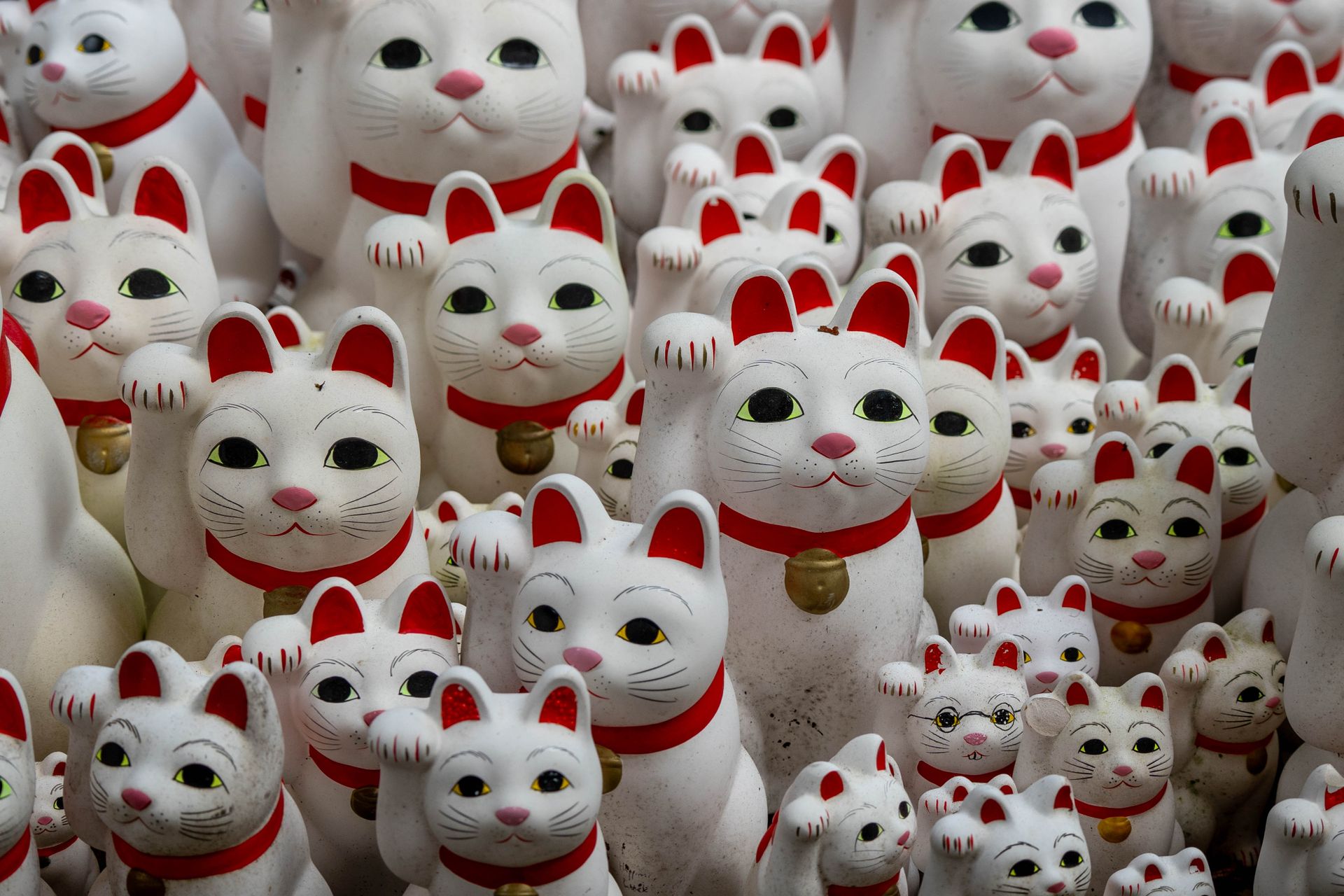
In Japan, the Maneki Neko, orbeckoning cat, is a beloved symbol of good luck, often found in shops and restaurants. This iconic cat is said to have originated in the Edo period.
The Maneki Neko's raised paw is believed to attract customers, while its other paw is often depicted as holding a coin, signifying good fortune.
The Japanese believe that the Maneki Neko's presence can bring prosperity and success to businesses, which is why you'll often see it displayed in stores and restaurants.
In Japan, it's customary to give a Maneki Neko as a gift to someone starting a new business or venture, as it's thought to bring them good luck.
For another approach, see: Akitas in Japan
History and Beliefs
The history of good luck cats in Japan is a fascinating story. The maneki-neko style Japanese cat dolls originated in the Edo period (1603-1868), or shortly beforehand.
These dolls have roots in the new eastern capital, Edo, which is today's Tokyo, rather than the traditional Japanese center of Kyoto. They probably first appeared in Buddhist temples such as Gotokuji, Saihoji, or Jishoin, all located in Edo.
At the Gotokuji temple, the legend is based on the story of Ii Naotaka, a lord samurai who was saved from a thunderstorm by a cat at the temple gate. As a result, the cat became the temple's symbol and brought them continuous good fortune.
These cats were said to bring good luck to the owner, and were often worn with a bell around their neck. Later, in the Meiji era, bells were replaced with coins, perhaps linked to Japan's increasing economic prosperity.
History
Maneki-neko figurines originated from Imado ware sold in Asakusa during the Edo period (1603–1868).
The earliest known record of maneki-neko as figurines is the marushime-neko, a variation of maneki-neko made of Imado ware in the late Edo period.
One of the earliest records of maneki-neko appear in the Bukō nenpyō's (a chronology of Edo) entry dated 1852, and Utagawa Hiroshige's ukiyo-e "Joruri-machi Hanka no zu", painted also in 1852, depicts the marushime-neko being sold at Sensō-ji Temple, Tokyo.

A 1902 advertisement for maneki-neko indicates that by the turn of the century they were popular.
There are several tales in the folklore of Japan concerning the origin of maneki-neko, including one about Ii Naotaka during the Kan'ei era (1622–1624) of the Edo period.
According to this folklore, a cat at Gōtoku-ji Temple beckoned Naotaka's party, and a violent thunderstorm soon followed, but they marvelled at the cat's good fortune and thanked the temple priest for his hospitality.
This event led to Gōtoku-ji becoming the family temple of the Ii clan, and the temple prospered under their patronage.
Another folklore concerns Ōta Dōkan, a warlord of the Muromachi period (1336–1573), who credited a cat with helping him win a war and donated a sculpture of the cat to the Jishōin Temple.
Beliefs
It's said to have the power to "beckon customers into shops", which is why you'll often find maneki-neko figurines displayed outside Japanese businesses.
The cat's ability to bring good fortune is rooted in Japanese folklore, where it's believed to have been a symbol of prosperity and good luck for centuries.
In the Edo period, maneki-neko were often associated with material rather than emotional happiness, reflecting Japan's increasing economic prosperity.
In many Japanese temples and shrines, maneki-neko are still considered sacred symbols, and are often displayed as a way to attract good fortune and prosperity.
These cats are often depicted wearing bells or coins around their necks, which is said to bring good luck to the owner.
By the Meiji era, mass production of maneki-neko had made them a popular figure nationwide, and they were often depicted in ukiyo-e paintings and advertisements.
You might enjoy: Cat Whiskers Good Luck
Maneki Neko - The Famous Beckoning
The Maneki Neko, also known as the Lucky Cat, is a beloved symbol of good fortune in Japan.
In Japanese culture, the Maneki Neko is known for beckoning good fortune, happiness, and prosperity. Its popularity has spread across the world, making it a favorite among fans of Japanese culture and those interested in good luck charms.
The Maneki Neko's ubiquity can be seen in various forms of pop culture, including literature, anime, and video games. It's a common sight in Asian specialty shops and at Japanese Festivals around the world.
The colors of the Maneki Neko hold different meanings. Here's a breakdown of the colors and their significance:
- White Lucky Cat: invites happiness.
- Golden Lucky Cat: brings intense wealth.
- Black Lucky Cat: gets rid of bad lucks.
- Cat raising its left hand: invites customers to business.
- Cat raising right hand: invites prosperity.
- Calico Cat: Traditionally considered to be the luckiest cat
- Bandana cat collar and bell: Symbol of abundance
The Maneki Neko is often seen with its left hand raised, which is believed to invite customers to businesses. This is a popular variation among shopkeepers and business owners in Japan.
Maneki Neko Variations
The Maneki Neko, or lucky cat, comes in a variety of colors, each with its own symbolic meaning.
White Maneki Neko invites happiness, while the Golden Maneki Neko brings intense wealth. Black Maneki Neko gets rid of bad luck.
Each color has its own unique significance, from positivity and purity to wealth and prosperity.
Here's a breakdown of the colors and their meanings:
In addition to color, the Maneki Neko's hand position also holds significance, with a raised left hand inviting customers to a business and a raised right hand inviting prosperity.
Maneki Neko Accessories
Maneki neko accessories are a fun way to bring a touch of Japanese culture into your life. These adorable cats are often adorned with various items to enhance their good luck charm.
Collars, decorative bibs, and bells are common neck ornaments for maneki neko, just like the real pet cats of the Edo Period wore collars with bells to track their whereabouts.
You'll often see maneki neko holding a koban, a gold coin worth one ryo (approximately $1,000 USD by today's standards), or a coin marked 千万両 which is ten million ryo, an incredible amount of money for that time period.
A carp (koi) or other fish is a symbol of fortune and abundance, making it a popular accessory for maneki neko.
Maneki Neko in Different Forms
Maneki Neko are available in a wide range of colors, each associated with a different form of luck.
The most common colors include white, black, gold, red, green, blue, pink, and yellow, each with its own symbolic meaning.
White Maneki Neko are said to invite happiness, while Golden ones bring intense wealth.
Black Maneki Neko get rid of bad lucks, making them a popular choice for businesses.
The color of the Maneki Neko can also be influenced by the direction of its raised hand.
A Maneki Neko raising its left hand invites customers to a business, while one raising its right hand invites prosperity.
You can also find Maneki Neko with a Calico pattern, which is traditionally considered the luckiest.
Some Maneki Neko have a bandana collar and bell, symbolizing abundance.
Here's a quick reference guide to the colors and their meanings:
These colors and meanings can help you choose the perfect Maneki Neko for your business or home.
Understanding Maneki Neko
Maneki Neko, also known as the Japanese Lucky Cat, is a symbol of good fortune and prosperity. It's a popular decoration in Japanese homes and businesses.
The Maneki Neko is known for its various colors, each associated with a different form of luck. The colors include white, symbolizing positivity and purity; black, representing protection against evil; gold, associated with wealth and prosperity; red, linked to marriage, love, and personal matters; green, representing education and health; blue, symbolizing intelligence, wisdom, and success; pink, associated with love and romance; and yellow, representing stability, health, and relationships.
You can choose a lucky cat that suits your needs based on the color you prefer. For example, if you're looking for a symbol of wealth and prosperity, a gold Maneki Neko might be the perfect choice.
The pose of the lucky cat is also significant, with different meanings depending on the position of its paw. A Maneki Neko with its left paw raised is said to invite customers to a business, while one with its right paw raised brings prosperity or good fortune to its owner.
Here's a summary of the different poses and their meanings:
A Maneki Neko with its left paw raised is perfect for display in a store or office, while one with its right paw raised is often seen in homes.
Featured Images: pexels.com