Geophagus fish are relatively easy to care for, but they do require a specific environment to thrive.
Their natural habitat is in South American rivers and streams, where the water is soft and slightly acidic.
A pH level between 6.0 and 7.5 is ideal for Geophagus fish, and they prefer water temperatures between 72°F and 82°F.
To replicate their natural environment, you'll want to set up a tank with a sandy or gravel substrate and plenty of plants.
Geophagus fish are also nocturnal, so they're most active at night, but they still need a tank with plenty of hiding places and visual barriers to reduce stress.
What Are They?
Geophagus fish are a type of freshwater fish found in South America.
They belong to the Cichlidae family and are commonly known as 'eartheaters'.
These fish are medium to large in size and can be found in a wide range of habitats, from still tropical waters to cool, fast-flowing rivers and tributaries.
Geophagus fish are restricted to South America, where they occur in many countries, including Brazil, Colombia, Venezuela, and Paraguay.
They can be found in a variety of freshwater environments, which is quite impressive considering their adaptability.
Species and Types
There are 9 beautiful Geophagus species that you can keep in an aquarium. The most popular species are often found in the aquarium trade.
Geophagus species can be classified under the order Perciformes and family Cichlidae. The 'orange head Araguaia' form is actually a highly endemic and confined species found in the lower Tapajós river.
Species
Geophagus species can be divided into three main groups: Geophagus sensu stricto, G. brasiliensis complex, and G. steindachneri complex. These groups are based on their geographical distribution and physical characteristics.
The Geophagus sensu stricto group is mostly peaceful, has long fin extensions, and is native to the Amazon, Orinoco, and Parnaíba basins. They can be further divided into two subgroups: the G. surinamensis complex and the subgroup containing G. argyrostictus, G. gottwaldi, G. grammepareius, G. harreri, and G. taeniopareius.
The G. brasiliensis complex includes more robust and aggressive species found in river basins of eastern and southeastern Brazil, Uruguay, and northeastern Argentina. Some species within this complex are G. diamantinensis, G. iporangensis, G. itapicuruensis, G. multiocellus, G. obscurus, G. rufomarginatus, and G. santosi.
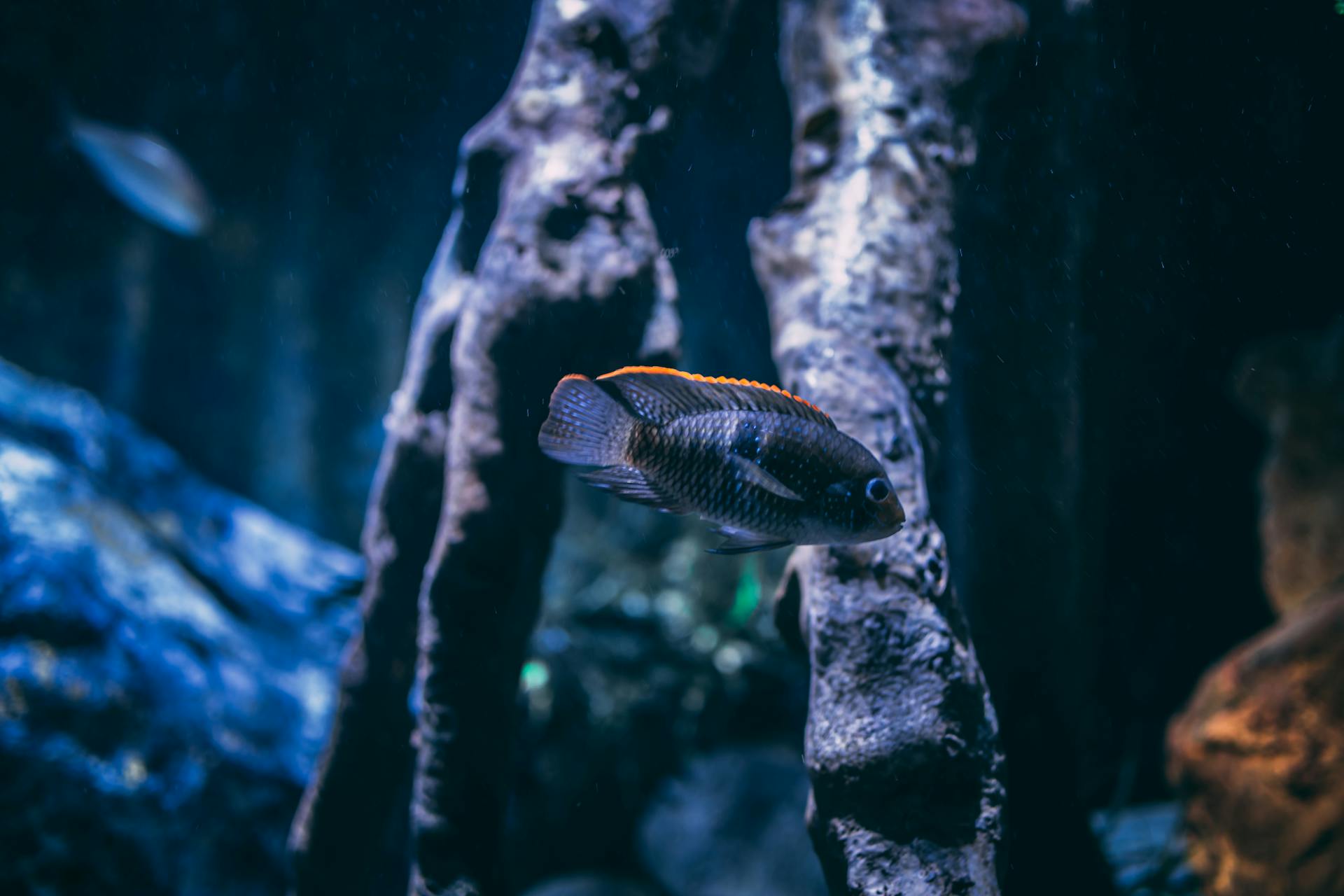
The G. steindachneri complex is found west of the Andes in northern and western Colombia, northwestern Venezuela, and Panama, where adult males develop a distinct, bulbous red forehead.
Here are some popular Geophagus species that you can keep:
- G. surinamensis
- G. argyrostictus
- G. gottwaldi
- G. grammepareius
- G. harreri
- G. taeniopareius
- G. brasiliensis
- G. diamantinensis
- G. steindachneri
Note: Temperature for keeping Geophagus species ranges from 26 to 30°C.
Brasiliensis
The Brasiliensis species is a popular choice among aquarium enthusiasts. They are known for their beautiful appearance, with oval body shapes and striking vertical stripes through their eyes.
Their maximum size varies, with males reaching up to 11 inches and females up to 6 inches. This species requires a suitable environment, with a recommended temperature range of 65-82°F and a pH level between 6-8.
Geophagus brasiliensis, also known as the pearl cichlid, is a freshwater fish found in southeastern Brazil, Paraguay, and Uruguay. They have reddish fins and bright blue spots, making them a stunning addition to any aquarium.
To keep them happy and healthy, make sure to provide a suitable substrate type, as they will feed from the bottom. They don't filter the substrate as often as other earth-eating cichlids, so a sandy substrate in the home aquarium would be a good choice.
Here are some key facts about the Brasiliensis species:
- Origin: Southeastern Brazil, Paraguay, and Uruguay
- Maximum size: Males up to 11 inches, females up to 6 inches
- Recommended temperature range: 65-82°F
- pH: 6-8
Surinamensis
The Surinamensis, also known as the Red Striped Eartheater, is a large eartheater with a very restricted distribution range in the northeast of South America.
Its maximum size can reach up to 12 inches, making it a notable addition to any aquarium. The recommended temperature range for this species is between 72-77°F.
To replicate its natural environment, a pH range of 6-8 is ideal. Many mislabeled eartheaters are sold as Geophagus surinamensis, although this species is actually pretty rare in the hobby and rarely imported.
It's essential to research and verify the origin and species of your fish to avoid misidentification.
Care and Environment
The temperature in a Geophagus aquarium should be kept between 26 – 32 °C, with a pH range of 4.8 – 6.6 for optimal health.
To maintain a suitable environment, the hardness of the water should be kept between 0 – 90 ppm.
A flat rock or section of driftwood can be used as a spawning site, and it's essential to clean and defend this area against intruders.
The female Geophagus lays one or more rows of eggs, which the male then fertilizes, and this process can be repeated several times over a few hours.
Maximum brood size is around 200 eggs, which the female typically takes care of, but on rare occasions, both adults may be involved from the start.
Some males may become aggressive after spawning and drive the female away to care for the eggs alone.
Once the fry are swimming freely, brood care is shared between the parents, although this can vary depending on the male's involvement.
The parents may participate in mouthbrooding duties simultaneously or exchange the entire brood on a daily basis, usually in a sheltered location.
At 25 – 28°C, the fry become free-swimming at 8-11 days of age, and the parents start to release them to feed, initially with caution.
As the fry grow, they may only return to their parents' mouths at night, and the size of the territory becomes correspondingly larger.
Geophagus fry are easily-fed, accepting good quality powdered dry foods, Artemianauplii, and microworm as soon as they reach the free-swimming stage.
If you're maintaining adults in a community situation, it's recommended to remove brooding females as the fry become easy prey for other fish.
Identification and Tank Mates
Geophagus cichlids can be tricky to identify, especially if you don't know their origin. They can be identified by examining the spots on their gill plates, markings on their flanks, and spots/stripes on their fins.
Most Geophagus cichlids are social fish that do best in groups, so it's recommended to keep them with their own kind. You can keep a group of 5 or more, but some species like G. brasiliensis are more aggressive and should be kept alone.
Some species, like Geophagus steindachneri group, Geophagus brasiliensis group, and Geophagus sensu stricto group, are separated into distinct groups based on their distribution in the wild.
Identifying Geos
Identifying Geos can be a challenge, especially if you don't know the river system they were collected from.
These fish are pretty difficult to identify to a species level if you don’t know exactly which river system they were collected from.
You can identify them by careful examination of the spots on their gill plates, markings on their flanks, and spots/stripes on their fins.
It's a good idea to buy these fish from knowledgeable sellers if you want to be sure.
Tank Mates
Geophagus temperaments vary depending on species and individual personalities, so it's best to pick up a group instead of a single fish.
Generally speaking, Geos are social fish that do best when kept with their own kind, so you can keep them with other Geophagus cichlids.
Some popular tank mates for Geos include other South American cichlids like electric blue acaras and smaller community fish like corydoras catfish and larger tetras.
Avoid keeping very small, slow-moving tank mates that your eartheaters may be able to catch and swallow whole.
Most Geophagus cichlids are relatively peaceful fish, but they can be aggressive when breeding, so it's essential to choose tank mates wisely.
To ensure harmony in your tank, choose tank mates that enjoy the same conditions and water parameters as your Geos.
By following these guidelines, you can create a thriving and harmonious community in your aquarium.
Key Information
Geophagus are large to medium-sized South American cichlid fishes. These fish are relatively peaceful and can be kept with a variety of tank mates, but they may become aggressive when spawning.
To keep Geophagus happy and healthy, you'll need a spacious aquarium - a minimum of 75 gallons is recommended. A sandy substrate is also a must, as these fish are known to "earth eat" and need a substrate that won't cause them harm.
Identifying Geophagus can be a challenge, so it's essential to buy from reputable breeders and sellers who can provide accurate information about the fish. This will help ensure you're getting the right species and can provide the best care for your new pet.
Featured Images: pexels.com