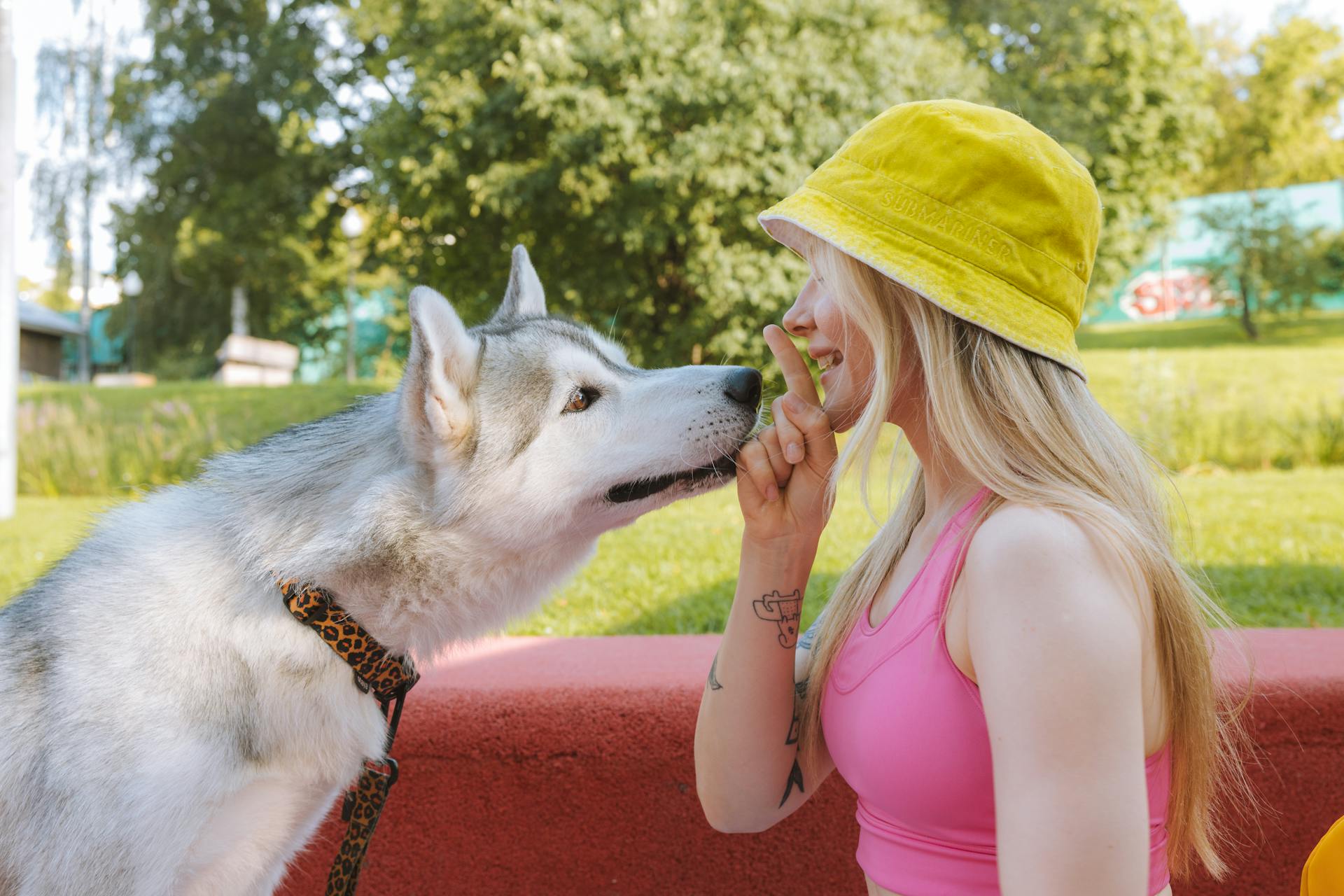
Game-based dog training is a fun and engaging way to teach your furry friend new skills. By incorporating games into training sessions, you can make learning a positive and enjoyable experience for your dog.
Games like "Find the Treat" and "Hide and Seek" can help improve your dog's problem-solving skills and encourage them to think critically. These games also provide mental stimulation and can help prevent boredom and destructive behavior.
One of the key benefits of game-based dog training is that it allows you to tailor training to your dog's individual needs and learning style. By using games that are tailored to your dog's strengths and weaknesses, you can help them build confidence and develop a stronger bond with you.
By incorporating game-based training into your routine, you can see real results in a short amount of time, with some dog owners reporting improvements in just a few weeks.
On a similar theme: Do Dog Diapers Help with Potty Training
Interactive Games
Interactive games are a fantastic way to engage your dog's mind and body, and they're easy to set up at home. You can start with simple games like Hide and Seek, where you hide treats or toys and encourage your dog to find them.
Curious to learn more? Check out: Crate Training Games
To play Hide and Seek, start by hiding in plain sight, then gradually increase the difficulty by hiding in different rooms or even outdoors. Reward your dog with treats and praise when they find you.
One of the best ways to challenge your dog's problem-solving skills is with puzzle toys or DIY games like the Muffin Tin Game or the Toilet Tube Treat Dispensers. These games require your dog to use their nose and paws to figure out how to get the treats out.
You can also create a DIY dog agility course using household objects like chairs and brooms. Set up an obstacle course and encourage your dog to weave through the chairs or jump over the broom.
If you're looking for a game that's perfect for rainy days, try playing Hide-and-Seek or Nosework. Nosework is a great way to exhaust your dog and calm them down, and it's easy to set up at home.
Here are some other interactive games you can try:
- Play Tug-of-War to strengthen the bond between you and your dog
- Set up a DIY Bottle Treat Dispenser or a PVC Pipe Puzzle to challenge your dog's problem-solving skills
- Create a Snuffle Mat using a towel and treats to encourage your dog to sniff and search
- Play Fetch or Chase to provide mental stimulation and exercise for your dog
Problem Solving and Training
Problem-solving is a crucial aspect of dog training, and it's a skill that can be developed through fun and engaging activities. One way to teach your dog to solve a problem is by letting them figure out how to pull a string to get a treat.
Encouraging problem-solving can be as simple as hiding a treat under a small platform or piece of furniture, far enough back so your dog can't reach it with their mouth or paw. This activity can help develop their reasoning skills and boost their confidence.
Mental exercise is just as important as physical exercise for a well-rounded dog, and games like "Under the Bridge" can help strengthen their mind and your bond with them. This game involves tempting your dog to move under the "bridge" made by your legs, using a high-value treat or their favorite toy.
Additional reading: Dog Problem Training
Hot and Cold
The Hot and Cold game is a fun and effective way to improve your dog's listening skills. It's simple: hide a treat when your dog is not looking.
If your dog moves away from the hidden reward, use a calm tone to indicate they are getting “colder.” This helps your dog understand that they're moving away from the treat.
As your dog gets closer to the hidden treat, use a more excited tone for “hotter.” This special language helps build a strong bond between you and your dog.
Here's an interesting read: Send Away Dog Training Cost
Teach Problem Solving
Reasoning skills are essential for developing puppies and older dogs alike. Successful problem-solving is also a big confidence booster.
You can teach your dog to solve a problem by letting them figure out how to pull a string to get a treat. Tie a ribbon or small rope to a treat, then hide it under a small platform or piece of furniture, far enough back so they cannot reach the treat with their mouth or paw.
Encourage your dog to investigate and see how long it takes for them to tug on the string to retrieve the treat. This game is a great way to challenge your dog's problem-solving skills and build their confidence.
Related reading: Training a Small Dog
Games-based training can also enhance your dog's problem-solving skills. By using fun games to build real-life and translatable skills, you can help your dog learn to think critically and solve problems on their own.
Playing short, fun games and focusing on building missing links to the dog's learning is a successful method of training.
DIY Training Equipment
You can create your own dog training equipment at home using everyday items, making it a fun and cost-effective way to engage your furry friend.
For example, you can use toilet paper tubes or paper towel rolls to make treat dispensers by stuffing them with soft treats like peanut butter or cream cheese. Your dog will have to lick out the treats to get them.
Some other creative ideas include using muffin tins to hide treats, or creating a snuffle mat with a towel and treats inside. You can also make a DIY bottle treat dispenser by cutting holes in a plastic bottle and threading a string through it.
Readers also liked: Dog Treat Training
Here are some DIY dog training equipment ideas:
DIY Agility Course
You can easily create a DIY agility course for your dog using common household objects that are safe for them. Set up your dining room chairs for your dog to weave through, or use a broom or mop for them to jump over.
This activity is mentally and physically stimulating for your dog, and they'll be having so much fun they won't even realize they're being trained. Your dog will be following your cues to get through the course.
You can also use a dog agility set if you prefer, but creating your own course is a fun and creative way to engage your dog. If you find your dog excelling at this activity, you may consider getting them involved in dog sports.
Broaden your view: Dog Agility Training at Home
Indoor Shelter
Creating your own DIY training equipment at home can be a fun and cost-effective way to keep your furry friend mentally stimulated and engaged. You can try hiding treats in a muffin tin covered with various objects, encouraging exploration.

Using empty toilet paper tubes or paper towel rolls as treat dispensers is another great idea. Simply stuff them with soft treats, such as peanut butter or cream cheese, for your dog to lick out. This activity provides mental stimulation and satisfies your dog's natural instinct to forage.
A snuffle mat is a perfect item for curious dogs, providing hours of mental stimulation and fun for your pet. You can make your own snuffle mat using a rubber doormat and fleece material, or try the tea towel snuffle mat by laying a towel flat on the floor, placing treats in the center, and folding it in a loose knot.
If you're looking for indoor shelter, consider using a durable product like Canine Climbing for indoor use. Sending your dog from one climb to another can provide good cardio exercise. Alternatively, you can try hiding treats around the house for your dog to find using their keen sense of smell.
Here are some fun DIY shelter ideas:
- Recycled Containers: Use egg cartons, plastic containers with paper and elastic bands, or bottles with holes to create a fun and challenging shelter.
- PVC Pipe Puzzle: Use a 2-inch PVC pipe, cap, and adapter fitment with a threaded cap to create a puzzle shelter.
- Bottle Spinning Toy: Build a structure with soda bottles and a dowel, ensuring the bottles spin and dispense treats.
Remember, the key to keeping your dog engaged and mentally stimulated is to play with them every day, be silly, consensual, and use your imagination. Games can be adapted to suit different weather conditions and your dog's preferences.
Training Methods and Benefits
Game-based dog training is a fun and effective way to teach your furry friend new skills. It encourages problem-solving and good behavioral choices, ultimately strengthening the bond between you and your dog.
By using fun activities and games, you can increase engagement and focus in training activities, making it a reinforcing consequence for desired behaviors. This approach also provides mental stimulation, preventing destructive behavior caused by boredom.
Here are some key benefits of game-based dog training:
- Target training builds confidence in dogs and provides a starting point for other training and tricks.
- Training provides mental stimulation, preventing destructive behavior caused by boredom, and teaches dogs how to socialize.
- Training keeps your home and family safe by teaching a dog to change unwanted behaviors.
- Professional dog training provides consistency, helping dogs learn faster.
The Benefits of
Dog training games are a great way to teach your dog new skills and behaviors, and they're fun for both you and your dog! Play can increase engagement and focus in training activities, acting as a reinforcing consequence for desired behaviors.
Using games and toys as rewards can yield positive correlations with desired dog behaviors. Dogs learn from experiences and respond to cause-effect, with immediate rewards reinforcing desired behaviors.
Target training is a type of game that builds confidence in dogs and provides a starting point for other training and tricks. It also improves recall.

Training provides mental stimulation, preventing destructive behavior caused by boredom, and teaches dogs how to socialize.
Consistency is key when training your dog. Training should occur at transition points and become the dog's idea, with consistency being key.
Here are some benefits of dog training games:
- Builds confidence in dogs
- Provides a starting point for other training and tricks
- Improves recall
- Prevents destructive behavior caused by boredom
- Teaches dogs how to socialize
By incorporating games and rewards into your training routine, you can strengthen the bond between you and your dog, and help your dog become an upstanding member of society.
Best for Nervous Animals
For nervous animals, it's essential to teach them to calmly notice exciting, scary, or distracting things. This can be achieved through the "Look at That!" game, which is great for leash reactive and aggressive dogs when done right.
Take treats on a walk with you, and when you see the object of focus, click or say "yes!" and feed your dog a treat when he looks back at you. This is a crucial step in teaching your dog to associate looking at you with rewards.
Suggestion: When to Start Training a Dog
If your dog doesn't turn towards you because he's too fixated on the object of focus, you're too close or your treats aren't good enough. Try again next time, and remember that patience is key.
The goal is to create an "autowatch" behavior, where your dog automatically looks from you to the object and back again, looking for a treat. This is achieved by playing the game on walks and consistently rewarding your dog for looking at you.
Canine Intelligence and Behavior
Brain training games are a great way to challenge your dog's memory, attention, and problem-solving skills. These games encourage independent thinking and help your dog learn new tricks, keeping them mentally stimulated and engaged.
Some popular brain training games include Treasure Hunt, where you hide treats around the house or garden for your dog to find using their sense of smell. Three Cups is another game where you place a treat under one of three upturned cups and shuffle them around, allowing your dog to choose the correct cup.
The Name Game is a particularly useful brain training game that helps dogs generalize learned behaviors and focuses on getting their attention. This is especially beneficial in new environments with unfamiliar smells or sounds.
Broaden your view: Brain Dog Training
Comparing Canine Intelligence by Breed
Dogs have evolved to possess three distinct types of intelligence: instinctive, adaptive, and learning-based. This means that different breeds have developed unique cognitive abilities.
Some breeds, like herding dogs, have a strong instinctive intelligence that helps them navigate complex social hierarchies and communicate effectively with their human handlers. Their ability to read body language and respond accordingly is unmatched.
Herding breeds, such as Border Collies and Australian Shepherds, are renowned for their problem-solving skills and adaptability. They can adjust to new situations and learn from their experiences.
Other breeds, like Poodles, excel in learning-based intelligence. They have a strong ability to learn and understand complex commands and tasks, often with ease.
Their intelligence is not limited to obedience; Poodles also demonstrate a high level of creativity and problem-solving skills, making them a popular choice for dog sports and competitions.
In contrast, some breeds, such as Bulldogs and Pugs, have a more instinctive intelligence that focuses on survival and self-preservation. Their cognitive abilities are geared towards navigating their environment and responding to immediate threats.
While they may not be as adept at learning complex tasks, breeds like Bulldogs and Pugs have a unique charm and loyalty that makes them beloved companions.
Intriguing read: Herding Dog Training
Brain for Stimulation
Brain training games are a great way to challenge your dog's memory, attention, and problem-solving skills. They encourage independent thinking and help your dog learn new tricks, keeping them mentally stimulated and engaged.
One popular brain training game is the Treasure Hunt, where you hide treats around the house or garden for your dog to find using their sense of smell. This game is a great way to get your dog moving and engaged.
The Name Game is another useful brain training game that helps dogs generalize learned behaviors and focuses on getting their attention. This is especially beneficial in new environments with unfamiliar smells or sounds.
You can also try the Muffin Tin Game, where you hide treats in a muffin tin with objects covering them. This game provides a fun and challenging way to test your dog's problem-solving skills.
Here are some popular brain training games you can try with your dog:
- Treasure Hunt: Hide treats around the house or garden for your dog to find using their sense of smell.
- Three Cups: Place a treat under one of three upturned cups and shuffle them around, allowing your dog to choose the correct cup.
- Find the Toy: Encourage your dog to search for a specific toy, rewarding them with praise, treats, or a quick tug-of-war game.
- Name that Object: Teach your dog to recognize objects by name, associating the object with a unique word.
- Hide and Seek: Hide and let your dog seek you, providing treats, praise, and excitement when they find you.
Remember to increase the difficulty level of these games as your dog masters them, adding more complex tricks or obstacles to keep their brain challenged and engaged.
Featured Images: pexels.com