Gadus chalcogrammus, also known as Alaskan pollock, is a crucial species in the Gulf of Alaska ecosystem. It plays a vital role in maintaining the delicate balance of the marine food chain.
Gadus chalcogrammus is a cold-water fish that thrives in the subarctic waters of the Gulf of Alaska, typically found between 200 and 400 meters below sea level. Its distribution is limited to this specific region.
The species is an important food source for various marine animals, including sea birds, marine mammals, and other fish. Its abundance supports the livelihoods of commercial and recreational fisheries in the region.
Ecology and Biology
The Alaska pollock, also known as Gadus chalcogrammus, has a unique ecology that helps it thrive in the harsh Bering Sea environment. Its speckled coloring makes it harder for predators to spot it near sandy ocean floors.
The pollock's growth rate is remarkable, with some individuals starting to reproduce by the age of 3 or 4. This rapid growth and short life span of about 12 years make them more productive than slower-growing species.
In the Bering Sea, pollock feed mainly in shallow waters, where tidal mixing occurs in the spring. They follow a diel vertical movement, rising to feed on zooplankton near the surface at night.
Pollock have a varied diet that changes as they grow. Small pollock eat mainly copepod nauplii and eggs, while larger pollock feed on shrimp and fish. This adaptability is crucial for their survival in the dynamic Bering Sea ecosystem.
Here's a brief breakdown of the pollock's life stages and their corresponding diets:
The pollock's life cycle is closely tied to the ocean's productivity, with catches increasing three years after stormy summers. This remarkable resilience allows them to thrive in the Bering Sea's unpredictable environment.
Feeding Ecology
In the Bering Sea, euphausiids are the most important food for pollock under 400 mm.
Pollock larvae (4.8 to 17.7 mm standard length) from the Bering Sea consume mainly copepod nauplii and eggs and adult copepods, especially Oithona similis.
Copepods are, however, consumed only by small (less than 200 mm) pollock.
In the Southeastern Gulf of Alaska, small (less than 250 mm) walleye pollock ate mostly planktonic crustaceans, particularly euphausiids, mysids, and copepods.
Large pollock (larger than 349 mm) generally ate larger prey, such as shrimp and fish.
Pollock feed mainly in the shallow (90 to 140 m) waters of the outer continental shelf, where tidal mixing occurs in the spring.
Pollock feeding activity is concentrated in the summer months (June - August).
Biology
Alaska pollock have a relatively short life span of about 12 years. This means they don't have a lot of time to grow and reproduce.
As a result, they are generally more productive compared to slower growing, longer living species. This is because they can start reproducing at a young age and have multiple generations in a short period.
Some pollock begin to reproduce by the age of 3 or 4 and are extremely fertile. This allows them to quickly replace aging or harvested fish.
Pollock migrate inshore to shallow water to breed and feed in the spring. They move back to warmer, deeper waters in the winter months.
The survival of young pollock depends on several factors, such as the availability of food, environmental conditions, and predation.
Gulf of Alaska Ecosystem Status 2024
The Gulf of Alaska is a unique and fascinating ecosystem, and understanding its status is crucial for conservation efforts. The Alaska pollock plays a major role in this ecosystem.
The Alaska pollock's main habitats are in the coastal areas of the Northern Pacific, particularly in the waters off Alaska, Russia, Japan, and Korea. This species is a major biological component of the Bering Sea ecosystem.
Catches of Alaska pollock tend to increase three years after stormy summers. This is because the storms stir up nutrients, allowing more phytoplankton to grow and providing a food source for pollock hatchlings.
The Alaska pollock's well-developed drumming muscles enable it to produce sounds during courtship, a trait shared with other gadids.
The largest concentrations of Alaska pollock are found in the eastern Bering Sea. This is where you'll find the highest numbers of this species.
Here are some key statistics on the Gulf of Alaska ecosystem status, based on the 2024 report:
- Alaska Fish Research Surveys
- Age and Growth Procedures for Otolith Examination
- Age Reading Interactive Demonstration
- Fish Species Maximum Age Data
- Groundfish Catch Percentage and Value
- Resource Ecology and Ecosystem Modeling, Number of Stomachs Database
- Alaska Ichthyoplankton Information System Database
Habitat and Distribution
Gadus chalcogrammus, also known as Alaska pollock, can be found in the North Pacific Ocean.
They typically live in the mid-water region of the ocean when they're younger, but as they age, they tend to dwell near the ocean floor.
Pollock swim in large schools in waters between 330 and 985 feet deep, but have been known to venture as deep as 3,300 feet.
Their main habitats are the coastal areas of the Northern Pacific, particularly in the waters off Alaska, Russia, Japan, and Korea.
Here are some specific locations where Alaska pollock can be found:
- Eastern Bering Sea
- Gulf of Alaska
- Aleutian Islands
- Western Bering Sea
- Sea of Okhotsk
Scientific Classification and Facts
The gadus chalcogrammus, also known as the Atlantic cod, belongs to the kingdom Animalia. This classification tells us that the Atlantic cod is an animal.
Its phylum is Chordata, which means it has a notochord, a dorsal nerve cord, and a post-anal tail at some stage in its development.
The Atlantic cod's class is Actinopterygii, a group of fish that have fins supported by bones. This class is made up of ray-finned fish, which include many species of fish that are commonly found in the ocean.
Here is a breakdown of the Atlantic cod's scientific classification:
Scientific Classification
Scientific classification is a way of grouping living things based on their characteristics and evolutionary relationships. It's like organizing books on a shelf by author, title, and genre.
The kingdom Animalia is the broadest category in the classification system, and it includes all animals, from tiny insects to massive blue whales. This is where our fish falls under.
The phylum Chordata is a more specific group within Animalia, and it includes animals with a notochord, a dorsal nerve cord, and a post-anal tail. Our fish has these characteristics, so it fits into this category.
Here's a breakdown of the classification levels for our fish:
The class Actinopterygii is a group of fish with fins supported by bones, and our fish has these characteristics. It's a pretty specific category, but it helps us understand the evolutionary relationships between different species.
Walleye Pollock
Walleye Pollock is a species of fish that can be found in the Bering Sea. It's also known as Gadus chalcogrammus.
Walleye Pollock is an important part of the marine ecosystem, serving as a key food source for many other animals. They feed on zooplankton, which is a crucial component of their daily diet.
The biomass dynamics of Walleye Pollock are influenced by their consumption patterns, which can vary depending on the availability of food sources. This in turn affects the overall nutrition of the species.
Here's a breakdown of the key terms associated with Walleye Pollock:
- walleye pollock Gadus chalcogrammus
- biomass dynamics
- zooplankton
- nutrition
- consumption
- daily diet
- Bering Sea
Conservation and Management
The Alaska pollock fishery is a shining example of conservation and management in action. Alaska pollock landings are the largest of any single fish species in the U.S, with an average annual catch of 1.26 million metric tons from the Eastern Bering Sea between 1979 and 2022.
Each year's quota is adjusted based on stock assessments to prevent overfishing. For example, quotas were reduced from 2008 to 2010 in the Bering Sea due to stock declines.
Independent certification groups have hailed the fishery as an example of good management. The Marine Stewardship Council (MSC) certified the Gulf of Alaska and Bering Sea/Aleutian Islands fisheries as "sustainable" in 2005, and again in 2010 and 2016.
The MSC recognized Alaska pollock from U.S. fisheries as one of the "healthiest" and "most sustainable sources" of protein. This is a testament to the effective management of the fishery.
Here are some key facts about the conservation and management of Alaska pollock:
- Quotas are adjusted annually based on stock assessments.
- The average annual catch of Alaska pollock from the Eastern Bering Sea is 1.26 million metric tons.
- The Gulf of Alaska and Bering Sea/Aleutian Islands fisheries have been certified as "sustainable" by the MSC.
- Alaska pollock from U.S. fisheries is considered one of the "healthiest" and "most sustainable sources" of protein.
Geographic and Population Information
Gadus chalcogrammus, also known as the Alaska pollock, can be found in the Arctic Ocean, specifically in the Barents Sea waters of northern Norway and Russia.
Small populations of this fish have been discovered in these waters, and genetic analyses have shown that they are genetically identical to the Alaska pollock.
These fish are large, measuring between 465-687 mm in total length, and were caught in the coastal waters between Vesterålen in the west and Varangerfjord in the east.
The history of the species in the Barents Sea is unknown, but it was initially described as its own species, Theragra finnmarchica, by Norwegian zoologist Einar Koefoed in 1956.
The population of Gadus chalcogrammus in the Barents Sea is considered very small, and it was listed as Near Threatened in the 2010 Norwegian Red List for Species.
Small Arctic Populations (Barents Sea)
Small Arctic Populations in the Barents Sea are very rare, with only a handful of fish caught between 1957 and 2002.
These fish, initially thought to be a separate species called Theragra finnmarchica, were found in the coastal waters of northern Norway and Russia.
In 1932, two specimens were landed in Berlevåg, northern Norway, which led to the initial classification as a new species.
Between 1957 and 2002, just seven specimens were caught, and it wasn't until 2003 and 2004 that 31 more were caught.
All of these specimens were large, measuring between 18+1⁄4–27 inches in total length.
By 2006, a total of 54 individuals had been recorded.
Genetic analysis revealed that these fish are genetically identical to the Alaska pollock, and are therefore considered to be the same species, Gadus chalcogrammus.
Source
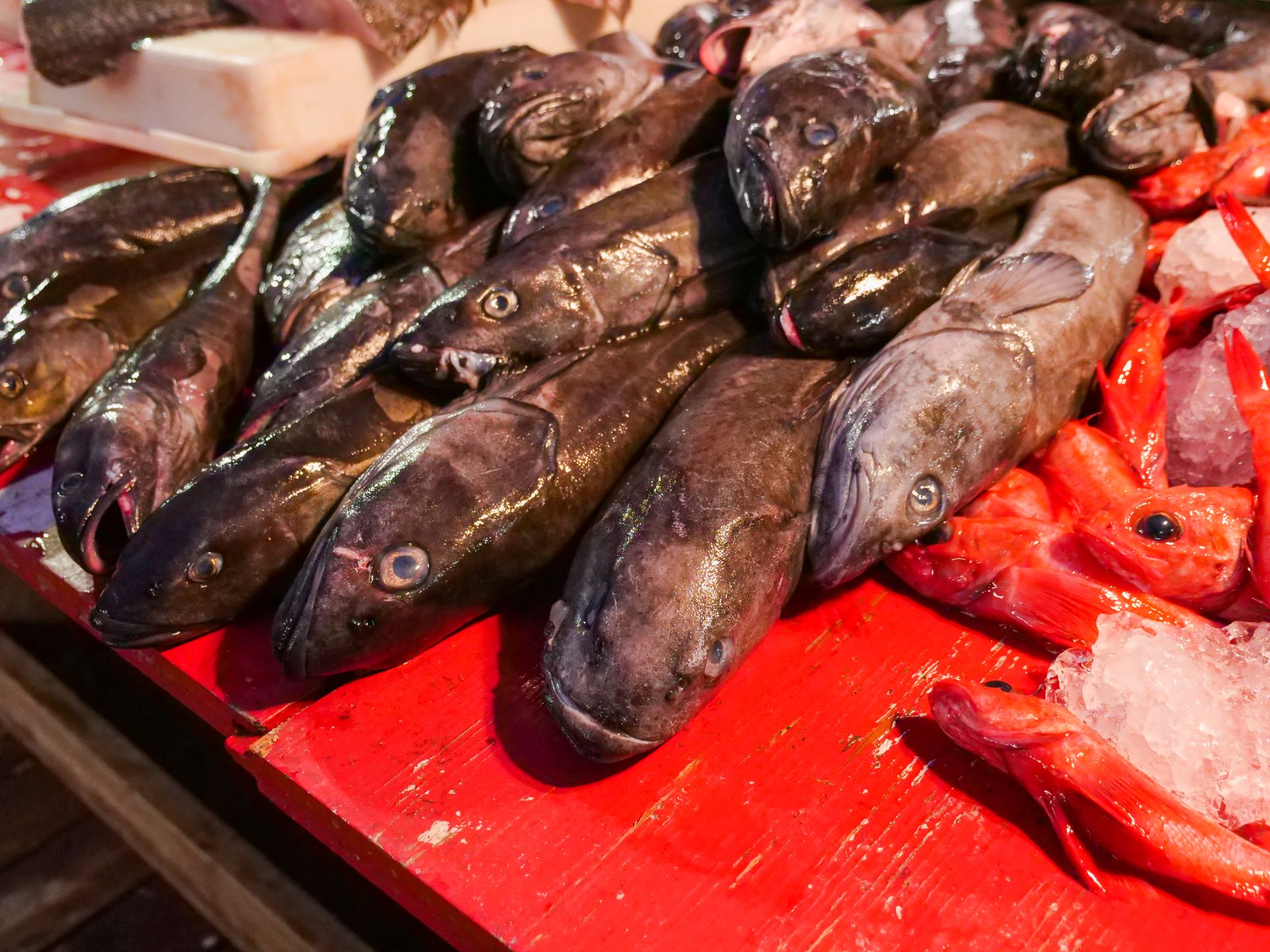
Alaska pollock is primarily caught in the Bering Sea and Gulf of Alaska.
U.S. wild-caught pollock is a common source of this fish.
Pollock is mainly sourced from these two locations due to their rich marine life.
The Bering Sea and Gulf of Alaska provide ideal conditions for pollock to thrive.
Featured Images: pexels.com