Finch Bird Identification is a fascinating topic, and understanding the different species and habitats is key to accurate identification. There are over 140 species of finches, ranging in size, shape, and color.
One of the most recognizable features of finches is their beak shape and size, which varies depending on the species. For example, the beak of a Goldfinch is short and conical, while the beak of a Crossbill is long and crossed.
Finches can be found in a variety of habitats, including forests, grasslands, and backyards. In fact, many species of finches are common visitors to backyard bird feeders.
Here's an interesting read: Bird Species Identification
Field Marks
Field marks are a crucial aspect of finch bird identification. They are distinctive characteristics that can help you tell one species from another.
One of the most useful field marks is the presence of red or purple coloration on the face. Female Purple Finches have a bold face pattern with a bright white eyebrow, a dark cheek patch, and a white stripe at the bottom of the cheek, giving the face a striped appearance. In contrast, House Finches have a plain head with a red coloration that covers most of it.
The shape and color of the bill can also be a useful field mark. House Finches have a stubby, roundish bill, while Purple Finches have a longer, more pointed bill.
Here's a quick reference guide to some key field marks:
By paying attention to these field marks, you can improve your chances of correctly identifying the finch species you're observing.
Female Field Marks
When it comes to identifying female finches, facial patterns are a great place to start. The female Purple Finch has a bold face pattern with a bright white eyebrow, a dark cheek patch, and a white stripe at the bottom of the cheek, giving the face a striped appearance.
The female House Finch, on the other hand, lacks a strong facial pattern. Its face pattern is faint and less obvious than the Purple Finch's.
The underparts of the female Purple Finch are a bright white that contrasts with sharply defined streaks, while the female House Finch has dull white with long, thin, smudgy streaks.
Consider reading: Australian Zebra Finch
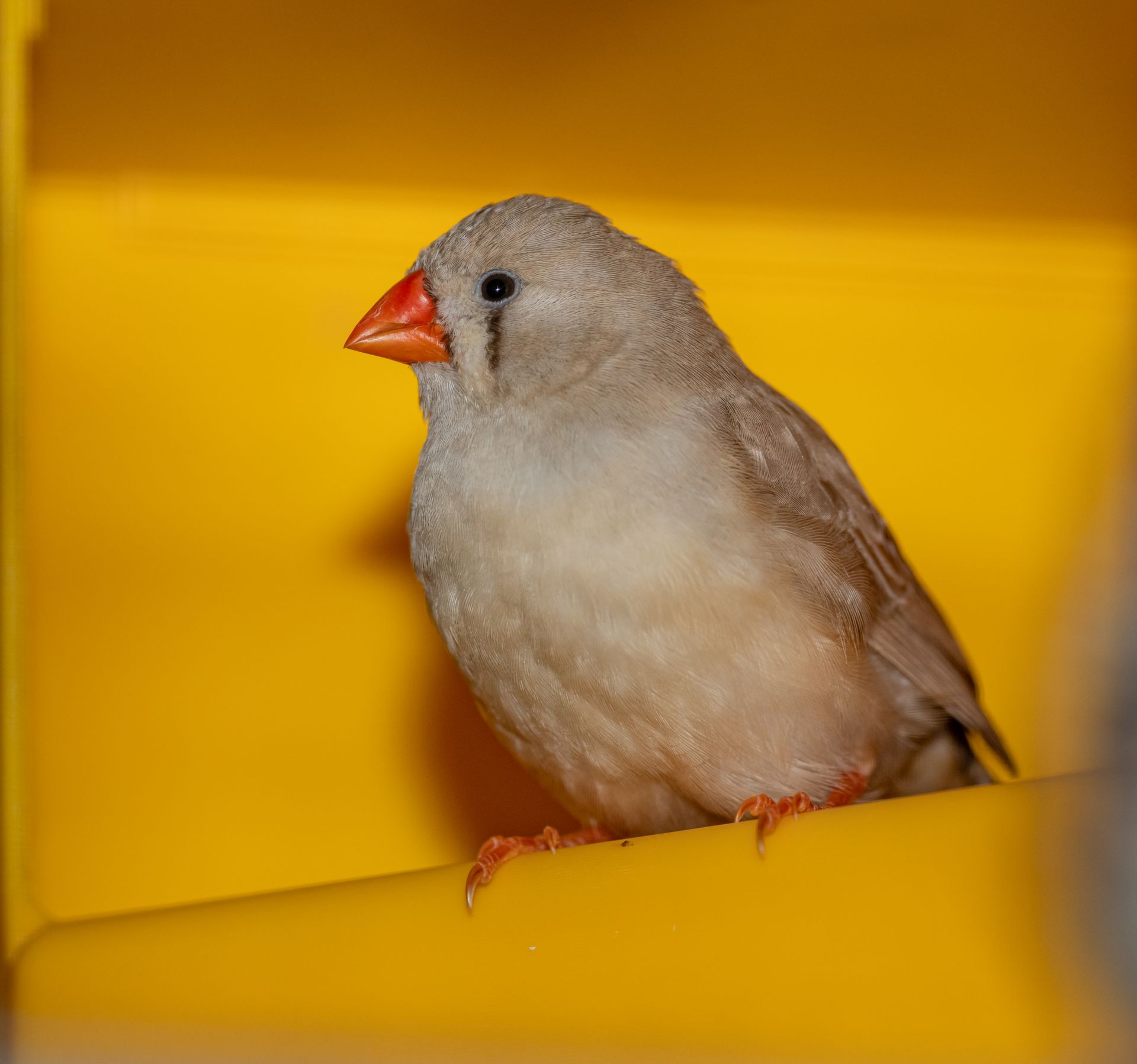
Here's a comparison of the underparts of the two finches:
The female Purple Finch also has a well-defined dark streaks against a white background under its tail, while the female House Finch has broad, dark streaks.
In profile, the female Purple Finch's bill is larger and less curved than the female House Finch's bill. The facial pattern of the female Purple Finch is also more obvious than the female House Finch's.
House Field Marks
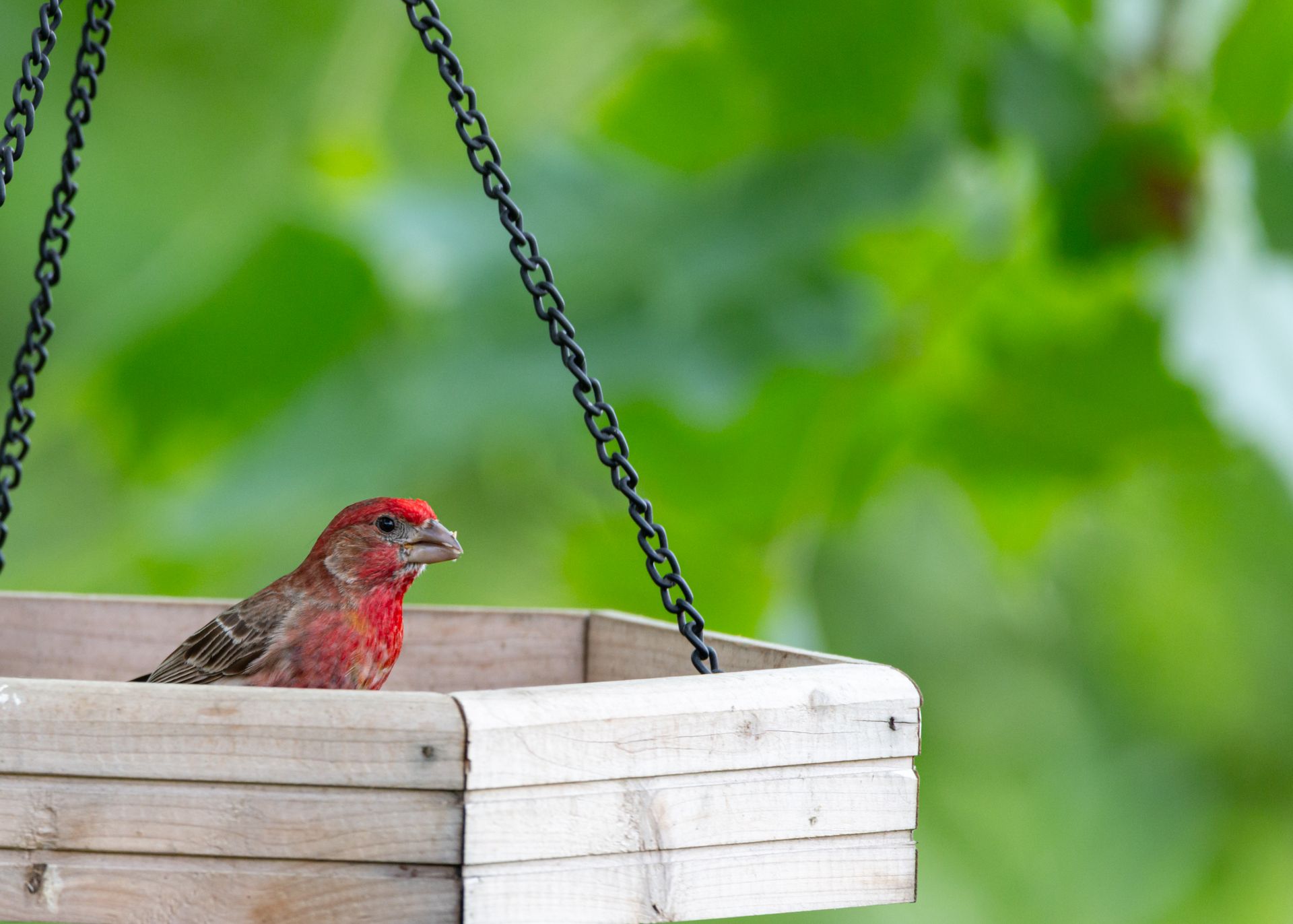
The House Finch has a fairly plain head, outside of the red coloration that covers most of it.
The area behind the eye, or auriculars, is grayish, far grayer than in a Purple Finch. This is a subtle but important field mark to note.
The bill of the House Finch is stubby and far more roundish in appearance than the Purple Finch.
The flank of the House Finch has dark streaking that extends from the breast onto the flanks and extends to the undertail coverts. This is a key characteristic to look for when trying to identify a House Finch.
The wing of the House Finch has distinct white wingbars, a feature that's quite different from the male Purple Finch. This is a useful field mark to remember.
The breast of the House Finch does not have the extensive color of the Purple Finch, instead featuring brown streaks that encroach into the breast coloration. This is a subtle but important detail to note.
The back of the House Finch lacks the extensive color on the back when compared to the Purple Finch, with patterning that can be dark but not always distinct. This is another field mark to consider when trying to identify a House Finch.
Overall, the House Finch appears smaller, less covered in color, smaller-billed, grayer, and more streaked than the Purple Finch.
Intriguing read: Mn Bird Identification by Color
bird identification
Bird identification can be a challenge, but with a few key tips, you can quickly separate similar species like the House Finch and Purple Finch.
The head is a great place to start, as the Purple Finch has a more rounded head shape compared to the House Finch's more pointed head.
Facial pattern is another important area to examine, as the Purple Finch has a distinctive white stripe above its beak, while the House Finch has a more streaked or spotted pattern.
The flank area is also worth noting, as the Purple Finch has a more reddish-brown color on its flanks, whereas the House Finch has a more brownish-gray color.
The breast area can be tricky, but look for the Purple Finch's more reddish-pink color, while the House Finch has a more brownish-pink color.
Wing and back markings can also help distinguish between the two species, but it's essential to examine all these areas together to get a clear picture.
By paying attention to these distinct areas, you can quickly separate these two similar species and become a more confident birder.
Finch Species
Goldfinches are common across the UK and can be found in gardens and bird feeders. They have a distinctive face with a red, white, and black pattern, and their wings have bright yellow bars.
Juvenile goldfinches are less colourful than their parents, but can still be identified by their black wings with yellow bars. They initially have a brown and streaky black head, back, and breast.
House Finches have brown wings and brown backs, which can be used to distinguish them from Purple Finches. The backs and wings of Purple Finches have a fair amount of red coloring blending in with the brown feathering.
Only the male finches of both House and Purple Finches have red coloring, while the females are streaky brown and look similar to sparrows. The female Purple Finch, however, has a distinct white stripe above each eye.
A unique perspective: Black Birds
Gold
The goldfinch is a stunning bird with a vibrant appearance. Both males and females have a red, white, and black face, along with a brown and black breast, and black wings with bright yellow bars.
One of the most distinctive features of the goldfinch is its bright yellow bars on its black wings. These bars are a clear indication that you're looking at a goldfinch.
Goldfinches are common visitors to gardens and bird feeders in the UK, making them a joy to spot. They're also relatively easy to identify, especially with their bold and colorful plumage.
Juvenile goldfinches are initially less colorful than their parents, with a brown and streaky black head, back, and breast. However, they can still be spotted with their black wings and yellow bars.
If you're lucky enough to spot a goldfinch in the wild, take a closer look at its face – it's a real treat!
Green
Green is a color often associated with nature, and finches are no exception. The Greenfinch, also known as Pyrrhula pyrrhula, is a common sight in the UK's woodlands and gardens.
This bird's bright pink breast is a standout feature, and its thick neck is a characteristic that sets it apart from other finches. Males also have a bright white rump that's more noticeable during flight.
The Greenfinch's habitat preferences include woodland and gardens, where it can be seen in pairs or small groups. They're also known to visit gardens, especially if seed is provided.
In terms of plumage, the Greenfinch's female has a buff brown breast and dull brown back, which is distinct from the male's bright pink breast.
Common Crossbill
The Common Crossbill is a bird species that's quite easy to identify. It's got a distinctive appearance, with males sporting a rosy red head, breast, and belly.
The male crossbill's dark grey wings are a dead giveaway, and its namesake crossed bill is unmistakable. Females, on the other hand, have a grey-green head, breast, and belly.
Juvenile crossbills are a different story altogether, covered in streaky, grey-brown feathers. They're not easily identifiable as crossbills, but they'll grow into their distinctive adult plumage over time.
You can find common crossbills in coniferous woodland across most of the UK, often feeding in the canopy.
Intriguing read: Bird Head
Twite
The twite is a finch species that's quite easy to identify.
Its Latin name is Carduelis flavirostris.
Male twites are less colourful than many other finches, with a streaky brown appearance all over and a stubby bill.
They have a forked tail, which is a distinctive feature.
During summer, the male's rump turns a bright shade of pink, which is a lovely sight to see.
Female twites are similar in appearance to the male, but they don't get the pink rump during summer.
Juvenile twites are similar to the female, which makes them a bit tricky to tell apart.
Twites breed in the Scottish uplands, the Pennines, and North Wales, as well as on Scottish islands and coastal parts of Northern Ireland.
During winter, they can be found further afield, but they tend to stick to coastal areas.
Purple John
Purple John is a lucky guy to have Purple Finches in Mashpee.
These finches are easily distinguishable from House Finches when they're side-by-side, but not when they're alone.
For another approach, see: What Does It Mean When You Hit a Bird?
The wings and backs are key to telling them apart.
Both birds have red on their heads, chests, and at the base of their tails, but House Finches have brown wings and brown backs.
Purple Finches, on the other hand, have a fair amount of red coloring blending in with the brown feathering on their backs and wings.
Only the male finches have red coloring, and the females are streaky brown, looking sparrowish.
The female Purple Finch has a distinct white stripe above each eye, which helps with identification.
Male finches can sometimes be subject to a condition called "xanthochromism", where they're tinged with yellow instead of red.
Purple Finches tend to avoid urban feeders due to the aggressiveness of House Finches.
They're more likely to be seen in rural areas, like the boonies.
Habitat and Comparison
Finches can be found in a variety of habitats, including forests, grasslands, and even backyards with bird feeders. They're incredibly adaptable birds.
The size of finches varies greatly, with some species reaching lengths of up to 20 centimeters. In contrast, the smallest finch species can be as small as 10 centimeters.
Finches can be identified by their distinctive beaks, which are often shaped like a cone or a sparrow's beak.
House Habitat
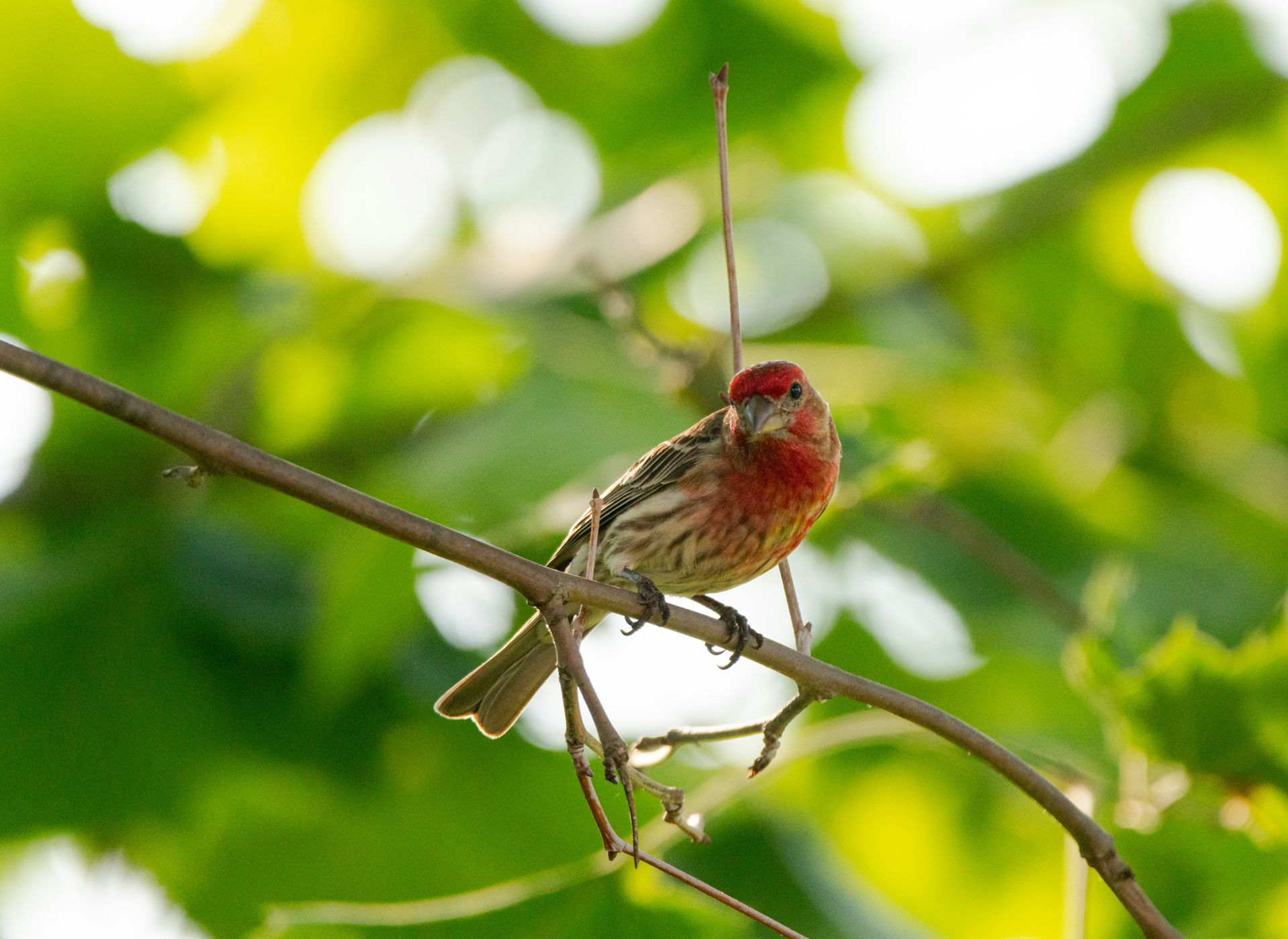
House Finches have a unique relationship with human development, with eastern populations relying almost exclusively on bird feeders in developed areas.
In contrast, western populations, which are native, can be found in a variety of natural habitats, including desert and juniper forest.
The presence of bird feeders in developed areas is a key factor in the eastern populations' survival, as it provides them with a reliable food source.
House Finches in western habitats, on the other hand, must adapt to the challenges of their native environments, such as the harsh conditions of the desert.
Their ability to thrive in these areas is a testament to their resilience and adaptability as a species.
Female Finch Comparison
The female House Finch and Purple Finch can be tricky to tell apart, but with some key identification clues, you'll be a pro in no time. The shape and markations of their heads are a great place to start. The House Finch has a smaller and more curved bill than the Purple Finch.
The facial pattern of the Purple Finch is significantly more obvious than the House Finch's. The facial patterns of these two finches are quite different.
Comparing the females of these two finch species in profile can offer further identification clues. The female House Finch bill is smaller, more curved, less pointy, and stubbier than the Purple Finch's.
The back pattern of the Purple Finch is often more distinct and contrasted than the House Finch's, giving it a more streaked back. A bird with worn feathers may make this pattern difficult to notice.
The undertail coverts are another important field mark to look for. The House Finch undertail coverts have distinct streakings that are lacking on the Purple Finch. The clean, white undertail of the Purple Finch is a loud identifier.
Featured Images: pexels.com