Farriery is an ancient profession that dates back to around 3000 BC in the Indus Valley Civilization, where horse shoes were first used to protect hooves from wear and tear.
The earliest known evidence of farriery comes from a 2000-year-old Chinese tomb, where a well-preserved set of horse shoes was discovered.
The art of farriery evolved over time, with the ancient Greeks and Romans using metal shoes to protect the hooves of their war horses.
In the Middle Ages, farriery became a crucial part of a blacksmith's work, with farriers working alongside blacksmiths to shoe horses.
History of Farriery
This early gathering marked the beginning of the Guild's efforts to maintain standards in the trade. The Guild protected customers and practitioners alike by overseeing quality and punishing those who violated its rules.
The existence of the Farriers' Company as a structured body was formally recognised in the 17th century. Today, the Worshipful Company of Farriers brings together craft farriers, veterinary surgeons, and others committed to the welfare of the horse.
The Company upholds the traditions of the City of London while promoting excellence in the craft of farriery and advancing the highest standards of equine welfare.
Farriery Profession
The farriery profession is governed by various laws and regulations around the world. In the UK, the Farriers (Registration) Act 1975 prevents unskilled individuals from calling themselves farriers or performing farriery work.
In countries like the US, farriery is not regulated, and certifications are voluntary. The American Farrier's Association (AFA) has a large certification program with about 2800 certified farriers.
Farrier examinations in the US are conducted by peer panels, and certifications are obtained through a combination of technical knowledge, practical skills, and field experience.
Qualifications
In the UK, people need to be registered farriers to call themselves a farrier or do farriery work, thanks to the Farriers (Registration) Act 1975.
The primary aim of the act is to prevent suffering and cruelty to horses from unskilled farriery.
In the US, farriery is not regulated, and there's no legal certification, which means qualifications can vary greatly.
Four organizations in the US offer voluntary certification programs for farriers: the American Farrier's Association (AFA), the Guild of Professional Farriers (GPF), the Brotherhood of Working Farriers, and the Equine Lameness Prevention Organization (ELPO).
The AFA's certification program is the largest, with about 2800 certified farriers, and has a reciprocity agreement with the Farrier Registration Council and the Worshipful Company of Farriers in the UK.
Farrier examinations for these organizations are conducted by peer panels and test technical knowledge and practical skills.
To maintain a particular license or certification, farriers often need to complete continuing professional development activities, such as the 16 hours of continuing education required by the American Association of Professional Farriers every year.
Core Principles of Manners
Good manners are essential in the farriery profession, where building trust with clients and horses is crucial.
Respect for the horse's space and personal boundaries is a fundamental principle of farriery.
Always approach a horse calmly and quietly to avoid startling it, as this can lead to misbehavior.
A farrier should never touch a horse without permission, even if it's just to check its hooves.
The farrier's attitude and body language can greatly impact how the horse responds to the trimming or shoeing process.
Being gentle and patient is key when working with nervous or skittish horses.
Regular communication with the horse's owner is vital to ensure the farrier understands the horse's specific needs and any concerns the owner may have.
The farrier's ability to listen and respond to the owner's questions demonstrates respect and a commitment to providing quality service.
In the farriery profession, it's essential to be mindful of personal hygiene and cleanliness, especially when working with horses that may be more prone to certain diseases.
A clean and well-maintained workspace is also crucial for the farrier's own health and safety, as well as that of the horses.
In the farriery profession, honesty and transparency are essential in building trust with clients and horses.
Farriery Tools and Practices
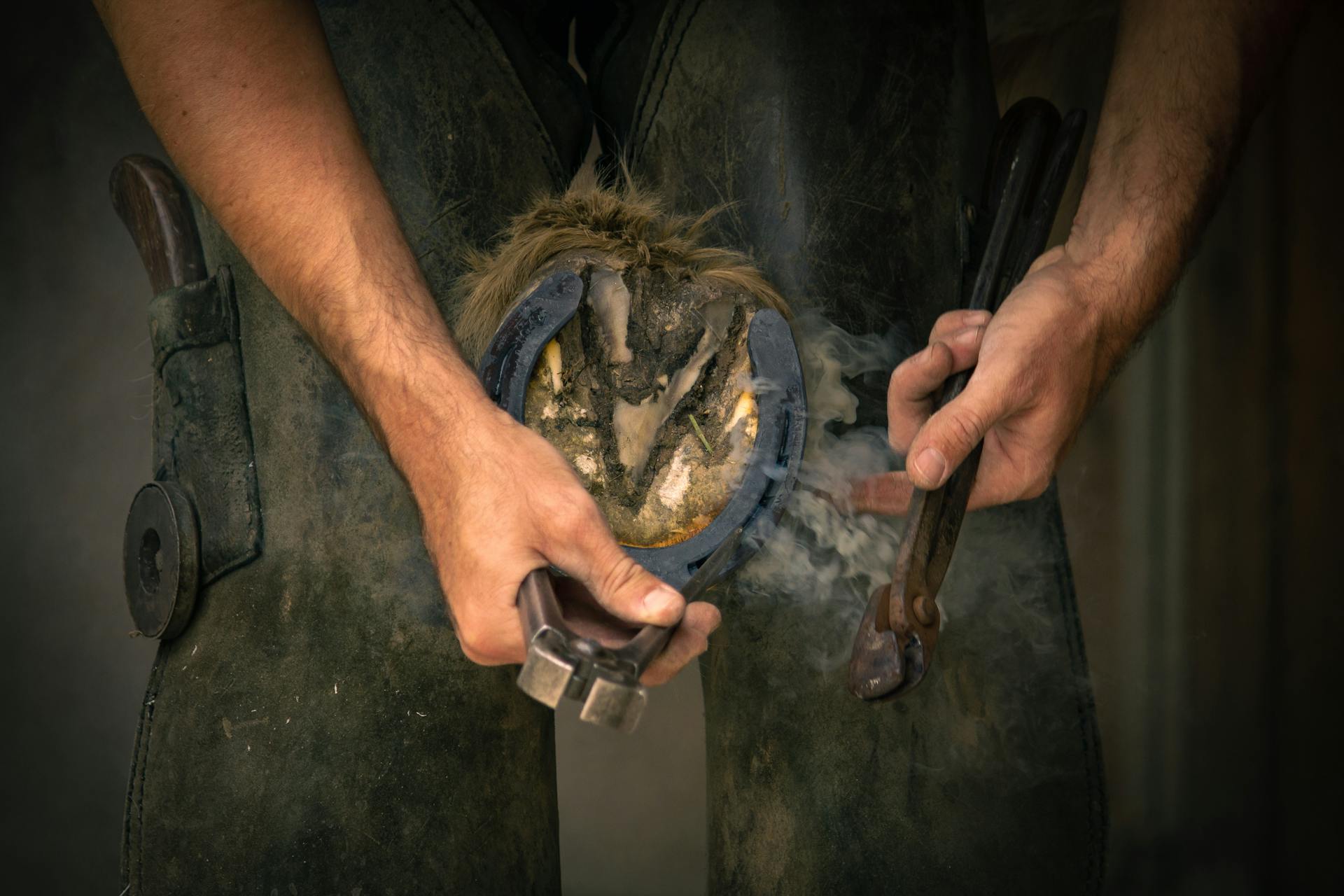
An anvil and hammer are used to shape horseshoes to fit a horse's feet. This is the first step in the farriery process.
A forge and tongs are also essential tools in farriery, as they allow custom shaping and specialized design of horseshoes. Tongs hold a hot shoe in both the furnace and on the anvil.
The following tools are commonly used in farriery:
Tools Used
As a farrier, you'll need a range of specialized tools to shape, trim, and fit horseshoes to a horse's feet. This requires a combination of precision, patience, and practice.
An anvil and hammer are used to shape horseshoes to fit a horse's feet. A forge and tongs are also necessary to heat horseshoes and allow for custom shaping and specialized design.
Clinkers are used to bend over the ends of nails to hold the shoe in place. There are two types of hammers used in farriery, one for shaping shoes on the anvil and the other for driving nails into the hoof wall.
A hoof knife is used to trim the frog and sole of the hoof, while hoof nippers are used to trim the hoof wall. Hoof testers are used to detect cracks, weakness, or abscesses in the hoof.
A rasp is used to finish trim and smooth out the edges of the hoof. A stand is used to rest a horse's hoof off the ground when rasping the toe area.
Here's a list of the tools used in farriery:
Equine Lameness Prevention
Equine lameness prevention is a crucial aspect of farriery, and several organizations offer certification programs to ensure farriers are equipped to prevent lameness in horses.
The Equine Lameness Prevention Organization (ELPO) offers a certification program that starts with Live Sole Hoof Mapping Certification (LSHMC).
ELPO's certification program progresses to Certified Barefoot Trimmer (CBT) and Certified Farrier Practitioner (CFP), who have passed the first two levels and the tests required for applying shoes.
A Certified Farrier GLUE Practitioner (CFGP) has completed the CFP level and has accreditation for using composite or other "shoe" materials attached with adhesives.
The horseshoe modifications required in ELPO tests are not as extensive as those required in the AFA tests.
In addition to these certifications, ELPO also offers Certified Lameness Specialist (CLS) accreditation for individuals who have completed further testing on pathologies and treatment of the hoof and leg.
Farriery Community and Standards
The farriery community has made significant strides in promoting standards and professionalism.
The Brooke organization has been instrumental in raising standards in farriery, as evident in their documentary showcasing the transformation of a street farrier in Pakistan into a skilled farrier.
The Farriers (Registration) Act of 1975 aimed to prevent cruelty to horses caused by unskilled shoeing and promote proper training and regulation.
Brotherhood of Working Farriers Association (BWFA) offers professional certification for farriers at all stages of learning, from beginners to experienced professionals.
The BWFA has six certification levels, including Master Farrier after 15 or more years of experience, and Master Educator for Horseshoeing School Owners/Instructors.
The Farriers' National Research Center Inc. offers an Associate's Degree in Farrier Science after 25 years or more of experience, exclusively to BWFA certified members.
The BWFA website provides valuable resources for farriers and the lay public, including educational materials and membership information.
Farriery Challenges and Opportunities
Lameness is a major welfare problem in working livestock in low and middle income countries, causing pain and severely compromising welfare.
In low and middle income countries, farriery is an unrecognised and unregulated industry, with no training institutions or professional standards for practitioners.
Practising farriers are poorly trained, have limited access to equipment, and suffer a low status in the community.
As a result, few young people in rural areas where need is the greatest choose to become farriers.
100% of animals in research studies conducted with communities in India and Pakistan suffered from lameness and foot defects.
If an animal is in poor welfare and poor health, it cannot work to earn income which families' livelihoods depend on.
Farriery and Women
Farriery has traditionally been seen as a male-dominated profession, but women are increasingly entering the field. In the early twentieth century, images showed women shoeing horses at a horse hospital.
Women in farriery are now becoming 'master' farriers and Fellows of the Worshipful Company of Farriers in the UK. This is a significant achievement, considering the profession's historical association with men.
Changes in materials and ways of working have made it easier for women to combine farriery with motherhood. This shift has led to an increase in women entering the profession in various countries.
Today, women can be found working as farriers in countries like Australia, Canada, Ireland, New Zealand, Senegal, the UK, and the USA.
Frequently Asked Questions
How do you get into farriery?
To become a farrier, you'll need to complete a four-year apprenticeship under an Approved Training Farrier while studying at a recognized college. This hands-on training and education will equip you with the skills and knowledge to succeed in this rewarding profession.
Featured Images: pexels.com