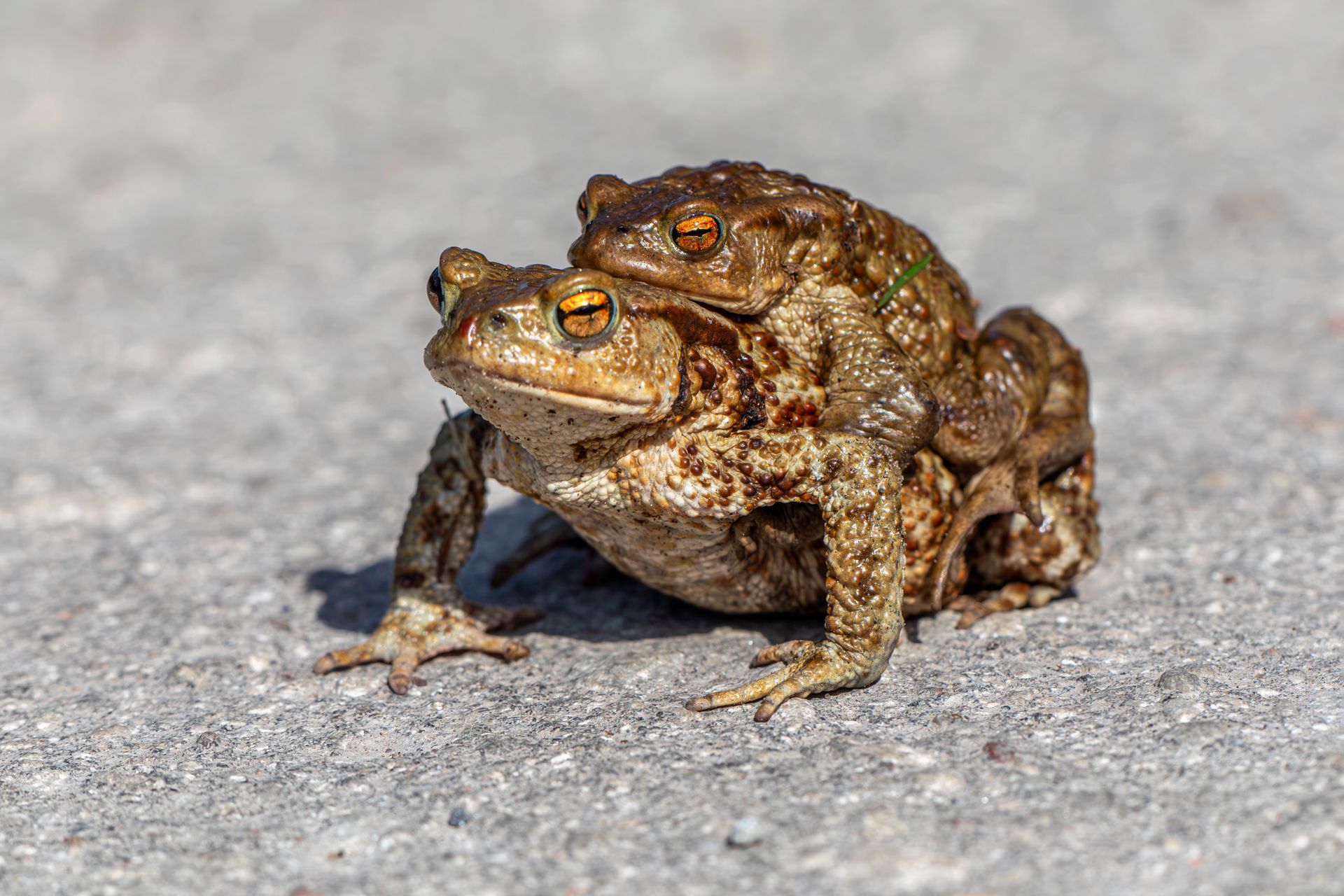
Amphibians have been around for over 360 million years, with the first known amphibians emerging during the Devonian period. They were quite different from modern amphibians, with some species having four legs and others having a more fish-like appearance.
One of the key characteristics of early amphibians was their ability to live in both water and on land. This was made possible by their development of lungs and skin that could breathe and absorb moisture.
The evolution of amphibians can be seen in the different reproductive modes they have developed over time. Some amphibians lay eggs, while others give birth to live young.
Evolution of Amphibians
The earliest amphibians evolved during the Devonian era, around 375 million years ago. Their ancestor was the lobed finned fish, similar to the present-day lungfish.
Some of these fish developed the most primitive pair of lungs that helped them breathe the air when the standing and temporary pools were devoid of oxygen. Gradually, their fins evolved into pairs of limbs, and these fish species became ancestors to all the tetrapods, including the amphibians, birds, reptiles, mammals, etc.
The first recorded amphibians were labyrinthodonts, meaning that their teeth had layers of dentin and enamel forming a structure similar to a maze. These early amphibians were quite different from modern amphibians and had some characteristics that are now lost in their descendants.
Here's a brief timeline of the evolution of amphibians:
- Devonian era (375 million years ago): Earliest amphibians evolved from lobed finned fish.
- Carboniferous period (310-300 million years ago): First true amphibians appeared, with characteristics like scaly skin and strong legs.
- Early Cretaceous period (120 million years ago): Temnospondyls, a diverse group of primitive amphibians, went extinct.
The first amphibians were quite impressive, with some species like Mastodonsaurus reaching lengths of 20 feet and having almost comically oversized heads.
The First
The first true amphibians emerged during the late Carboniferous period, around 310 to 300 million years ago. They were quite massive, with some genera reaching lengths of 15 feet from head to tail.
Eogyrinus, a slender, crocodile-like creature, is a great example of one of these early amphibians. Its skin was scaly rather than moist, a sign that the earliest amphibians needed to protect themselves from dehydration.
The first recorded amphibians were labyrinthodonts, characterized by teeth with layers of dentin and enamel forming a structure similar to a maze.
These early amphibians were the ancestors of modern amphibians, and their evolution paved the way for the diversity of species we see today.
Here are some key characteristics of the first amphibians:
- Developed primitive lungs to breathe air
- Evolved from lobed-finned fish, similar to the present-day lungfish
- Gradually developed limbs from fins
- Developed skin that could retain body fluids and resist desiccation
Species Headed for Extinction
Amphibians are among the most threatened creatures on the Earth today, having evolved over 300 million years ago and survived into modern times.
Over the last few decades, a startling number of frog, toad, and salamander species have spiraled toward extinction.
The exact reasons for this decline are unknown, but possible culprits include pollution, global warming, deforestation, disease, or a combination of these factors.
If current trends persist, amphibians may be the first major classification of vertebrates to disappear off the face of the Earth.
Reproductive Modes and Diversification
Amphibians have evolved a wide range of reproductive modes, with some laying eggs on land and others in water.
The majority of sampled amphibians lay eggs on land, not water, with 51.5% of anurans, 61.1% of caudates, and 67.5% of gymnophionans doing so.
Direct development, where eggs hatch into young without a larval stage, is the most common mode in caudates, present in 56.1% of species.
In contrast, biphasic fully aquatic reproduction, where eggs and larvae develop in water, is the most common mode in anurans, present in 43.8% of sampled species.
Semi-terrestrial biphasic reproduction, where eggs are laid on land but larvae develop in water, is widespread in anurans, but not caudates.
Obligate paedomorphism, where individuals never undergo metamorphosis and remain in a juvenile stage, is present only in caudata, and is relatively rare, occurring in 5.7% of species.
Live-bearing, where young are born alive, is rare in anurans and caudates, but more common in gymnophionans, occurring in 14.6% of species.
The rates and frequencies of reproductive-mode transitions vary across different groups of amphibians, with the highest transition rates away from the semi-terrestrial mode in anurans and caudates.
In caudates, paedomorphism evolves most frequently, always from the aquatic mode, while in anurans, semi-terrestriality evolves most frequently, often from an aquatic ancestor.
In gymnophionans, the most frequent transitions are from direct development to live-bearing, with reversals from direct development to semi-terrestrial being twice as common as origins of direct development.
Prehistoric Amphibians
The earliest amphibians were quite different from their modern counterparts. The Carboniferous and Permian periods saw the emergence of two distinct groups: lepospondyls and temnospondyls.
Lepospondyls were small and weird-looking, often aquatic or semiaquatic, and more likely to have slimy skin. Some lepospondyls resembled small snakes, while others were reminiscent of salamanders.
One notable example of a lepospondyl is Diplocaulus, a three-foot-long creature with a huge, boomerang-shaped skull that might have functioned as an undersea rudder.
Adaptations and Orders
Lepospondyls, a group of primitive animals, exhibited a wide range of body shapes and adaptations. They appeared at the early Carboniferous and disappeared at the late Permian period.
The first lepospondyls looked superficially like small lizards. However, many groups underwent processes of limb reduction or loss, resulting in a diverse array of body forms.
The relationship of lepospondyls to the rest of tetrapods is unclear, with different hypotheses suggesting they are a separate group, the ancestors of modern amphibians and reptiles, or only a portion of modern amphibians.
Reproductive Mode Distribution
The majority of amphibians lay eggs on land, not water. In fact, a study found that 51.5% of anuran species, 61.1% of caudate species, and 67.5% of gymnophionan species lay eggs on land.
Direct development is a common reproductive mode in some amphibians, with 56.1% of caudate species exhibiting this trait. In contrast, only 27.2% of anuran species develop directly.
Live-bearing is a rare reproductive mode in anurans, found in only 0.2% of species. However, it is more common in gymnophionans, where 14.6% of species exhibit this trait.
Here's a breakdown of the reproductive modes found in different amphibian groups:
Order Lepospondyli
The Order Lepospondyli was a small group of primitive animals that appeared at the early Carboniferous period.
They were not as numerous as the temnospondyls and were generally smaller in size.
The first lepospondyls looked superficially like small lizards, but subsequent groups suffered processes of limb reduction or loss.
Their relationship with the rest of tetrapods isn't very clear, with different hypotheses suggesting they are a group separated from the labyrinthodonts, or the ancestors of current amphibians and reptiles.
Some researchers even propose that they are the ancestors of only a portion of modern amphibians.
Evolutionary History
The earliest amphibians evolved during the Devonian era, around 375 million years ago, from lobed finned fish similar to the present-day lungfish.
These early amphibians developed primitive lungs that helped them breathe air when water sources were scarce, and their fins gradually evolved into limbs.
Some of these fish species became ancestors to all tetrapods, including amphibians, birds, reptiles, and mammals.
Amphibians evolved from adaptations that permitted them to stay out of water for longer periods, upgrading their lungs and skeletons to better support their bodies on land.
Here's a brief timeline of major milestones in amphibian evolution:
- Devonian era (375 million years ago): Early amphibians evolved from lobed finned fish.
- Carboniferous period: Carnivorous amphibians adapted to terrestrial environments and dominated the land.
- Permian period: Modern amphibians, or lissamphibians, radiated from a common ancestor.
Rates and Frequencies of Reproductive-Mode Transitions
The evolution of reproductive modes in amphibians is a complex and intriguing process. The study of transition rates and frequencies reveals some fascinating patterns.
For Gymnophiona, the best-performing model had identical transition rates fixed between states. This means that the rates of transition between different reproductive modes were the same in this group.
In Anura and Caudata, the best-performing models had variable rates, with the highest transition rates away from the semi-terrestrial mode. This suggests that semi-terrestrial mode is not a stable state in these groups.
Rates to and from live-bearing were very low in Anura and Caudata, indicating that this reproductive mode is not common in these groups. In fact, live-bearing evolved least frequently in Anura, with only 2 times estimated.
Paedomorphism evolved most frequently in Caudata, with 10 times estimated by both methods. This suggests that paedomorphism is a common reproductive mode in this group.
The most frequent transitions in Gymnophiona were from direct development to live-bearing, with 3 times estimated by joint estimation and 3.64 times estimated by SCM. This suggests that live-bearing is a common outcome of direct development in this group.
Despite the differences in transition rates and frequencies between groups, there are some common patterns. Semi-terrestriality evolved most frequently in Anura, followed by direct development. In Caudata, paedomorphism evolved most frequently, always from the aquatic mode.
A different take: Which of the following Is Not an Amphibian?
Origin of the
The origin of modern amphibians is a bit of a mystery. It's believed that lissamphibians, which include frogs, toads, salamanders, newts, and caecilians, radiated from a common ancestor that lived in the middle Permian or early Triassic periods.
These early amphibians evolved from lobe-finned fish, specifically sarcopterygians, around 395 million years ago during the Devonian period. This group of fish is characterized by its fins with a bony base, which allowed the subsequent evolution of limbs in the first amphibians.
The first tetrapods, or four-limbed vertebrates, emerged from these fish, and they were the ancestors of all modern amphibians, reptiles, birds, and mammals. The nearest relatives of the tetrapods are the osteolepiformes, a group of tetrapodomorph fish that went extinct around 299 million years ago.
Here's a brief timeline of the early amphibians:
Methods and Conclusion
To summarize our findings, the evolution of amphibians has been a long and complex process.
Their ancestors date back to the Devonian period, around 360 million years ago.
Through natural selection and genetic drift, these early amphibians adapted to their environments and eventually gave rise to the diverse range of species we see today.
By studying the fossil record and comparative anatomy, scientists have been able to piece together the evolutionary history of amphibians.
Methods
In the methods used for this study, data was collected from a sample of 500 participants.
A combination of online and offline surveys were used to gather information from a diverse group of people.
The surveys were designed to be easy to understand and complete, with a total of 20 questions that covered various aspects of the topic.
Participants were randomly selected from a pool of volunteers who had shown interest in the study.
The data was collected over a period of 6 weeks, with a response rate of 75%.
The surveys were distributed through social media, email, and in-person invitations.
A total of 375 participants completed the surveys, providing a rich dataset for analysis.
Discussion
We compared species richness of different reproductive modes in amphibians, and found that the three major groups have distinct patterns of evolution.
The study focused on comparing species richness of different reproductive modes, which is a key aspect of understanding how amphibians have evolved over time.
Species richness refers to the number of different species within a particular group, and in this case, we're looking at the number of species with different reproductive modes.
The three major groups of amphibians are frogs, salamanders, and caecilians, and each group has its own unique characteristics and reproductive strategies.
We tested alternative evolutionary scenarios of transitions among modes, which means we explored different possible paths that these groups may have taken as they evolved.
Our research suggests that each group has its own distinct evolutionary history, and that these histories have shaped the diversity of reproductive modes we see today.
Diversification rates, or the rate at which new species emerge, also varied among the different reproductive modes, with some modes producing more new species than others.
By studying these patterns, we can gain a better understanding of how life-cycle and reproductive-mode evolution have shaped the diversity of amphibians over time.
Featured Images: pexels.com