Equine hoof health is a complex and multifaceted topic. A horse's hooves are made up of a hard outer layer called the hoof wall, a soft inner layer called the laminae, and a sensitive area called the frog.
A healthy equine hoof should be strong, yet flexible. Hooves that are too hard can crack, while hooves that are too soft can become deformed.
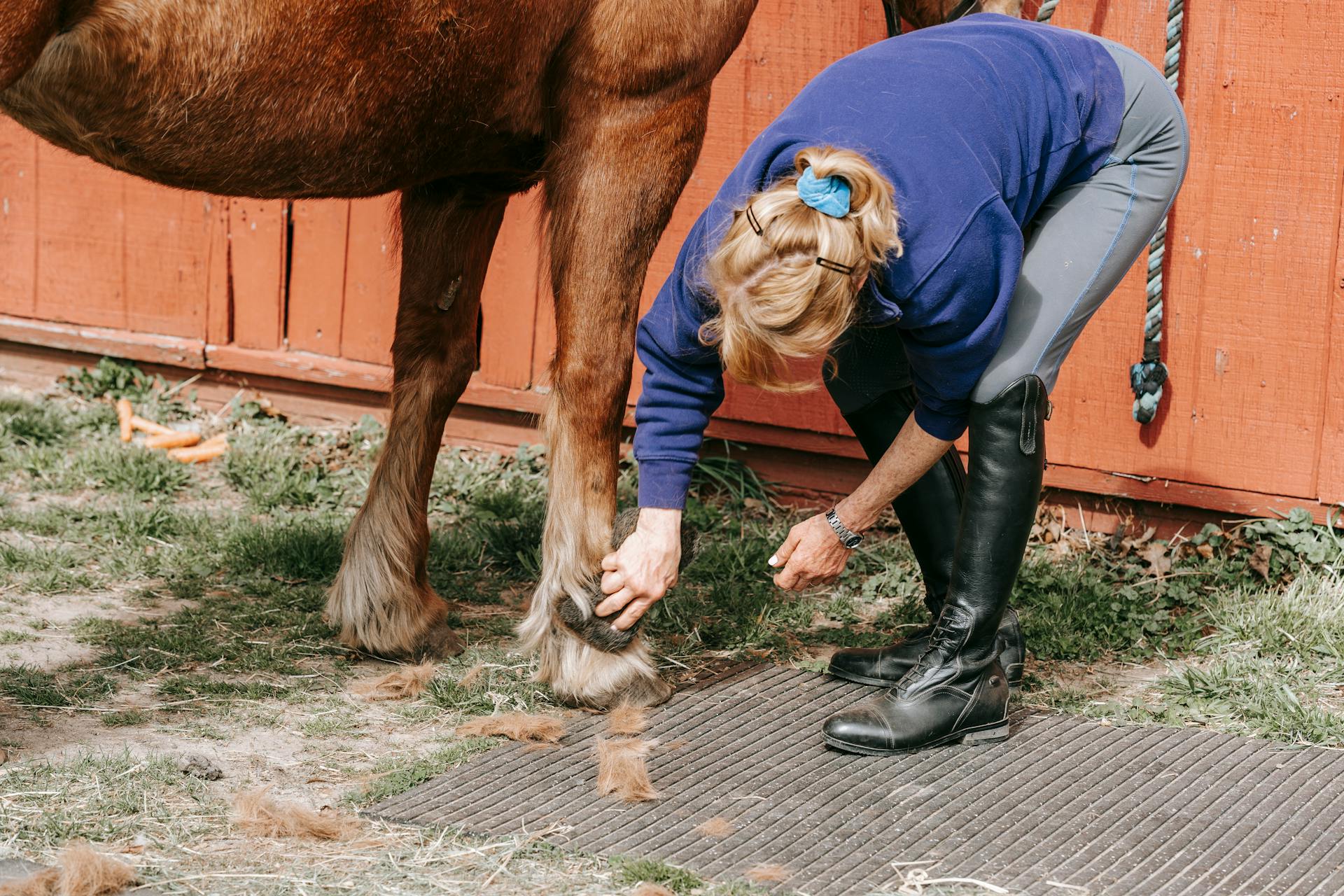
Regular trimming is essential to maintain healthy hooves. Trimming every 4-6 weeks can help prevent cracks and splits from forming.
For another approach, see: Horse Hoof Health
Hoof Care Basics
Hoof care is a crucial aspect of equine health. Poor shoeing or trimming can lead to problems like long toes and collapsed heels, short toes and long heels, and imbalanced hooves.
Regular farrier sessions are essential to prevent hoof issues. A good rule of thumb is to schedule trimming or shoeing every 4 to 6 weeks.
Shorter intervals between farrier sessions are better than longer ones. This allows for early detection and treatment of hoof problems.
Worth a look: Horse Hoof Care Products
Regular trimming can help prevent the growth of long hoof walls and hoof imbalances. These issues can promote stress and strain on the hoof capsule, soft tissues, and ligaments.
Here are some common hoof problems that can arise from poor shoeing or trimming:
- Long toes and collapsed heels
- Short toes and long heels
- Imbalanced hooves
By following a regular farrier schedule, you can help prevent these problems and keep your horse's hooves healthy.
Hoof Anatomy and Problems
The equine hoof is a complex structure that's essential for a horse's mobility and overall health. The outermost layer of the hoof is a hard wall that protects the inner tissues, including the sensitive and insensitive laminar layers of the foot.
The white line, located between the hoof wall and the sole of the foot, is the visible part of the laminar layers within the equine foot. This area is prone to problems like cracks and infections.
Horses are susceptible to a range of common hoof problems, including abscesses, thrush, and navicular syndrome. Navicular syndrome affects the navicular bone, bursa, ligamentous, and/or soft tissue structures in the heel of the hoof.
Here are some common hoof problems that can affect horses:
- Abscesses
- Thrush and other infections
- Septic arthritis (joint infection)
- Hoof bruises, punctures, and corns
- Hoof wall cracks
- White Line Disease (Seedy toe) or white line widening
- Laminitis
- Founder
- Navicular Syndrome (Palmar Hoof Syndrome)
- Bone cysts
- Fractures
- Pedal osteitis
- Cankers or overgrowths
- Contracted heels
- Keratoma
- Frog cancer
Navicular
Navicular is a common hoof problem that affects the navicular bone, bursa, ligamentous, and/or soft tissue structures in horses.
Horses with navicular disease often step toe-first due to heel pain. This condition is more prevalent in Quarter Horses and Thoroughbreds, and can be caused by inheritance, poor conformation, hoof imbalance, and exercise on hard surfaces.
Proper shoeing can help alleviate navicular symptoms. Techniques such as keeping a short toe, elevating the heels, and having a good break over can be beneficial. Additionally, using pads may also be helpful in some cases.
Horses with navicular syndrome may exhibit lameness, changes in their gait, and a reduction in performance. They may also display signs such as increased tripping, toe-first landing, contracted heels, or a shortened stride.
The following factors can increase a horse's likelihood of developing navicular syndrome:
- Genetic factors that contribute to poor nutrient channels in the navicular bone
- Age over ten years
- Weight-to-height ratio of 3.45 or higher
- Divided navicular bone at birth
- Injury resulting in poor blood supply to the rear of the foot
- Small feet for their height and weight
- Long toe and underrun heel hoof conformation
Horse Anatomy
The horse's hoof is made up of several layers, with the outermost being a hard wall that protects the inner tissues. This wall is a crucial barrier against the elements and everyday wear and tear.
The white line is a distinctive feature of the hoof, located between the hoof wall and the sole of the foot. It's a visible part of the laminar layers within the equine foot.
The insensitive laminar layers of the hoof are a key component, connecting to the inside face of the hoof wall. These layers are made up of dense tissue that provides support and structure to the hoof.
The coffin bone is the foundation of the hoof, connected to the sensitive laminar layers that are filled with blood vessels. This bone is a vital part of the horse's anatomy, providing the base for the hoof to grow and develop.
Common Hoof Issues
Poor shoeing or trimming can lead to long toes and collapsed heels, short toes and long heels, or imbalanced hooves.
Horses are prone to a multitude of hoof problems, ranging from minor to life-threatening. Some common issues include abscesses, thrush, and septic arthritis.
Hoof cracks can be caused by dry weather, frequent changes from wet to dry, or poor hoof quality. They can be treated by applying hoof moisturizers, providing good nutrition, and regularly trimming the hooves.
Types of hoof cracks include horizontal cracks, blowouts, grass cracks, and sand cracks. Horizontal cracks and blowouts generally don't cause lameness, while sand cracks can result in lameness.
White Line Disease is a bacterial and fungal invasion into the hoof, often caused by wet or dry conditions and hoof capsule distortions. It can lead to laminitis and coffin bone sinking or rotation, and may require hoof-wall resection by a skilled farrier.
To prevent hoof issues, it's essential to ensure your horse's turnout space is dry. Consider laying down a gravel base and filling it with round, pea-sized gravel to create an area that can drain away excess moisture.
Here are some common hoof problems and their causes:
- Abscesses: caused by infection in the hoof
- Thrush and other infections: often caused by poor hygiene and moisture
- Septic arthritis: caused by joint infection
- Hoof bruises, punctures, and corns: often caused by injury or poor trimming
- Hoof wall cracks: caused by dry weather, poor hoof quality, or frequent changes from wet to dry
- White Line Disease: caused by bacterial and fungal invasion into the hoof
- Laminitis: often caused by White Line Disease or poor hoof care
- Founder: caused by laminitis or poor hoof care
- Navicular Syndrome: caused by hoof capsule distortions and poor trimming
Nutrition and Hoof Health
Nutrition plays a crucial role in maintaining healthy hooves. A well-balanced diet is essential for promoting strong hoof growth and overall wellness.
To promote quality hoof wall growth and soul depth, horses need the right vitamins and minerals. Some of the most important nutrients include biotin, copper, selenium, and zinc.
Horses can get most of these nutrients by grazing on good pasture, but not all forage is created equal. Depending on geography, pasture may be deficient in certain nutrients, making supplements necessary.
A good equine hoof health supplement can go a long way in promoting overall health and wellness. Consider it affordable insurance against potentially debilitating hoof conditions.
The right supplement can provide essential vitamins and minerals, such as biotin, zinc, and copper. For a 500kg horse at maintenance, optimal amounts of each of these nutrients are as follows:
It's essential to feed a high-quality mineral and vitamin supplement that provides organic trace minerals. These are better absorbed and utilized by the body compared to inorganic trace minerals.
To grow and maintain healthy hooves, horses require a balanced diet that provides adequate amounts of key vitamins and minerals. This includes biotin, copper, selenium, and zinc, which can be found in a good quality mineral and vitamin supplement.
A well-balanced diet is essential for promoting strong hoof growth and overall wellness. With the right nutrients, horses can enjoy healthy hooves and a happy, healthy life.
Hoof Trimming and Shoeing
Hoof trimming and shoeing are crucial for maintaining your horse's equine hoof health. A balanced hoof is essential for your horse's overall well-being.
The primary concerns when trimming and shoeing a horse are balance and maintaining equal medial/lateral size and shape, along with anterior/posterior balance. A general rule for frequency of trimming non-use or light use, unshod horses is every 10-12 weeks.
Younger horses tend to grow hoof faster than older horses, while horses in cold climates grow hoof slower. Nutrition and environment also play a significant role in hoof growth, with well-fed and exercised horses having healthier hooves.
A properly trimmed hoof should have a hairline or coronary band level with the ground, with any flaring of the hoof wall trimmed to show equal and straight slopes on both sides. The heel angle and toe/pastern/shoulder angle should also be very close to the same angle.
Proper shoeing is basically proper trimming with the addition of a shoe for added hoof protection. A general guideline for frequency of shoeing is every 6-8 weeks, with the age of the horse causing the major differences in schedule.
For maximum hoof health and heel expansion, nails should not be placed posterior to the widest part of the hoof. Adequate heel expansion or widening of the shoe beyond the hoof width from the widest part of the hoof around to the heel is also essential.
Here are some key points to consider when maintaining a regular farrier schedule:
- Keep your horse's hooves well maintained on a regular trimming/shoeing schedule of 4 to 6 weeks.
- Shorter intervals between farrier sessions are better than longer ones and will make it more likely that hoof issues are caught early.
- Regular trimming can help prevent the growth of long hoof walls and hoof imbalances.
Prevention and Maintenance
Poor shoeing or trimming can lead to long toes and collapsed heels, short toes and long heels, and imbalanced hooves. These issues can cause stress and strain on the hoof capsule, soft tissues, and ligaments.
Regular trimming can help prevent the growth of long hoof walls and hoof imbalances. This is especially important for maintaining equine hoof health.
A regular farrier schedule of 4 to 6 weeks is recommended to catch hoof issues early. Shorter intervals between farrier sessions are better than longer ones, so don't wait too long between visits.
Maintain a Regular Care Schedule
Maintaining a regular care schedule is crucial to prevent hoof problems in horses. A regular farrier schedule of 4 to 6 weeks is recommended to keep your horse's hooves well maintained.
Regular trimming can help prevent the growth of long hoof walls and hoof imbalances, which promote stress and strain on the hoof capsule, soft tissues, and ligaments. This can lead to a multitude of problems, from minor to life-threatening.
Here are some common hoof problems that can be prevented or caught early with regular care:
- Abscesses
- Thrush and other infections
- Hoof bruises, punctures, and corns
- Hoof wall cracks
- White Line Disease (Seedy toe) or white line widening
Remember, shorter intervals between farrier sessions are better than longer ones, making it more likely that hoof issues are caught early.
Avoid Wet Areas in Horse Turnout
Avoiding wet areas in your horse's turnout space is crucial to prevent health issues. Ensure that the turnout area where your horse spends the most time is dry.
A gravel base can be an effective solution to create a dry area in your pasture. Laying down a gravel base and filling it with round, pea-sized gravel to a depth of approximately 4 inches can help drain away excess moisture.
Daily cleaning and drying of your horse's feet is essential when wet conditions cannot be avoided.
Diagnosis and Treatment
Diagnosing hoof abscesses typically involves visually inspecting the affected hoof and using hoof testers to determine the sites of pain.
A veterinarian and/or farrier may need to be involved in the treatment of abscesses where proper drainage is not present.
Proper drainage is a critical factor in treating all hoof abscesses, and can be promoted with poultices and drawing ointments like ichthammol.
Horses typically experience significant pain relief once drainage occurs from a hoof abscess.
During the healing process, an antiseptic treatment such as betadine or two percent iodine should be applied to the drainage tract of a hoof abscess.
Medicated putty may be used within the drainage tract to prevent microorganisms from re-entering the hoof.
Horses being treated for an abscess should be housed in a clean, dry area, such as a well-bedded stall or small paddock.
Bandages should be removed and changed daily during treatment.
A shoe with a hospital plate can be applied if shoes are absolutely necessary, allowing access to the abscessed area.
Horses with mild infections due to a hoof abscess may be able to return to work in less than a week following treatment.
However, abscesses involving deep infections can take several weeks or even months to resolve.
Some horses are more prone to contracting the infection if they have a long heel conformation that promotes deep, narrow frog sulci and are exposed to the contributing environmental conditions.
Symptoms of thrush include a black and foul-smelling discharge emanating from the affected areas of the frog.
Horses with thrush may also display pain when pressure is applied to these areas, and should be treated promptly to prevent further complications.
Thrush is typically treated by removing necrotic tissue from the hoof, a process completed by a farrier or veterinarian.
The affected hooves should be cleaned daily with a diluted iodine solution or other antifungal or antibacterial product.
Horses treated for thrush typically recover within 7 to 14 days unless there are complications involving the deeper tissues of the hoof being affected.
Understanding Hoof Problems
Horses are prone to various hoof problems that can range from minor to life-threatening. Some common issues include abscesses, thrush, and hoof bruises.
Hoof problems can be caused by a multitude of factors, including regular shoeing or trimming, keeping short toes, and keeping frog and sole support.
Here are some common hoof problems that can affect horses:
- Abscesses
- Thrush and other infections
- Hoof bruises, punctures, and corns
- Hoof wall cracks
It's essential to be aware of these potential issues and take preventative measures to maintain your horse's hoof health. Regular trimming and shoeing can help prevent some of these problems, but it's also crucial to identify any underlying causes and address them promptly.
Laminitis and Founder
Laminitis and founder are two painful conditions that can affect a horse's hooves. Laminitis occurs when the interlocking laminae become elongated and weakened, causing the coffin bone to rotate or sink downward.
This condition can range from mild to severe and potentially lead to founder, which involves laminar damage and coffin bone rotation or sinking.
Horses most at risk for laminitis include those with endocrine disorders, such as Equine Metabolic Syndrome and PPID (Equine Cushing’s disease).
These horses can have a laminitic episode even if they're not on any grain or pasture, as long as their diet contains more than 10% hydrolyzable carbohydrate.
Causes of laminitis include:
- Abnormally high insulin due to grain overload or sudden access to lush pasture
- Exposure to black walnut hull shavings
- Hoary alyssum ingestion in hay or at pasture
- Grain overload
- Pregnancy-induced insulin resistance
Symptoms of laminitis include softening of the coronet band, heat in the hooves, and increased digital pulse.
If you suspect your horse has laminitis, it's essential to have them evaluated by a veterinarian as soon as possible to prevent lasting damage to the hoof structure.
Treatment involves removing the underlying cause of the condition and using strategies like realigning trim with boots and pads, pain medication, soft and deep bedding, and cold therapy to support the horse's healing.
Navicular Syndrome
Navicular Syndrome is a common hoof problem that affects horses, particularly in the forelimbs. It's a complex condition that involves multiple structures in the heel of the hoof, including the navicular bone, coffin joint, and ligaments and tendons.
Horses with navicular syndrome may exhibit mild to severe lameness, changes in their gait, and a reduction in performance. They may also have increased tripping, toe-first landing, contracted heels, or a shortened stride.
One of the key factors that contribute to the development of navicular syndrome is genetic factors that affect the nutrient channels in the navicular bone. This can lead to abnormal bone remodeling processes.
Horses over ten years of age are also more likely to develop navicular syndrome. A weight-to-height ratio of 3.45 or higher can also increase the risk.
A divided navicular bone at birth, poor blood supply to the rear of the foot due to an injury, small feet for their height and weight, and a long toe and underrun heel hoof conformation are all risk factors for navicular syndrome.
Diagnosing navicular syndrome requires a veterinary clinical evaluation, including diagnostic analgesia and radiographic imaging. Magnetic Resonance Imaging (MRI) may be necessary to visualize the soft tissues of the foot.
Here are the common risk factors for navicular syndrome:
- Genetic factors that contribute to poor nutrient channels in the navicular bone
- Age over ten years
- Weight-to-height ratio of 3.45 or higher
- Divided navicular bone at birth
- Poor blood supply to the rear of the foot due to an injury
- Small feet for their height and weight
- Long toe and underrun heel hoof conformation
Featured Images: pexels.com