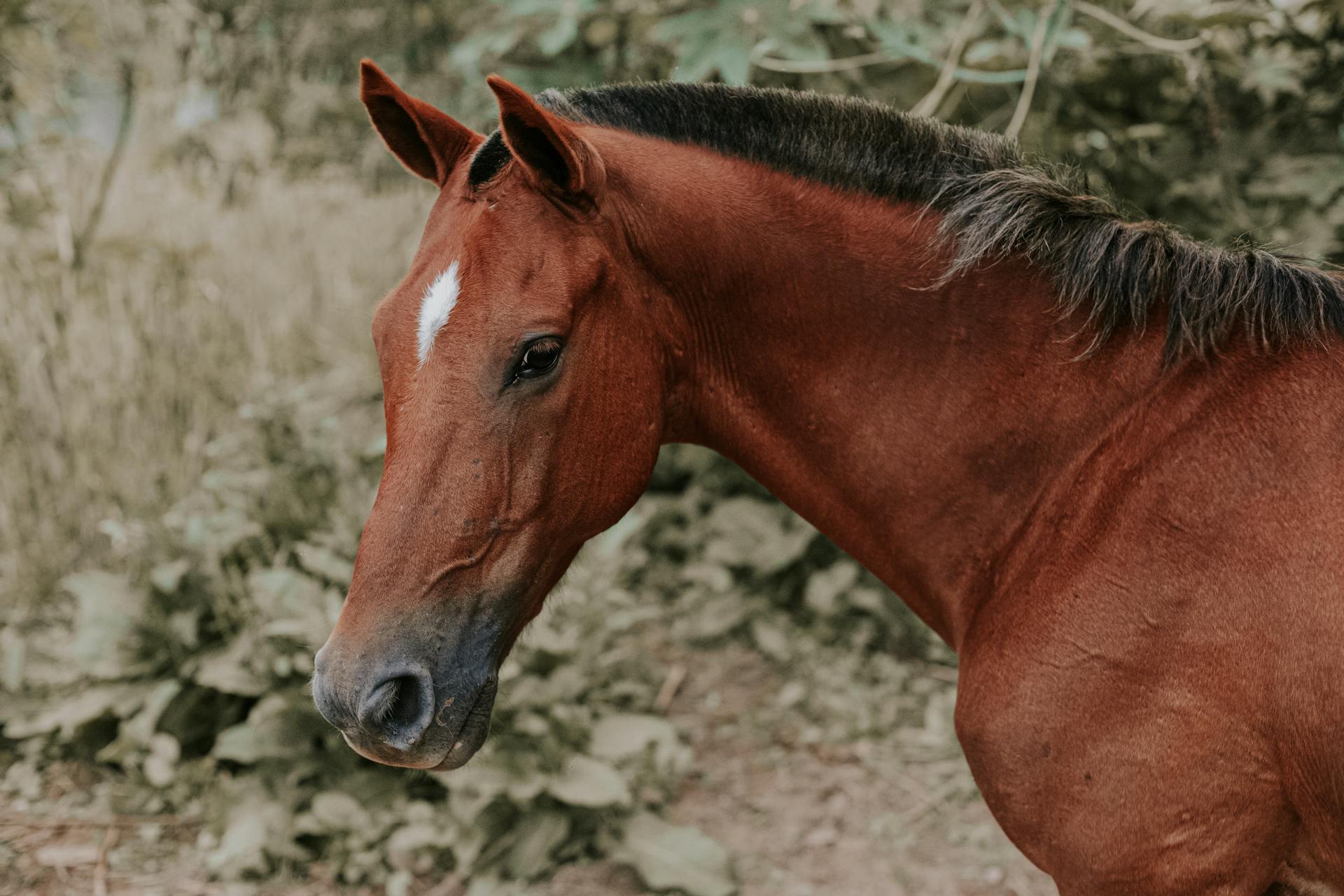
Identifying conformation faults in horses is crucial for their overall health and well-being. According to research, horses with poor conformation are more prone to lameness and musculoskeletal issues.
A horse's conformation is determined by its genetic makeup, breeding, and environmental factors. This means that even a well-bred horse can develop conformation faults due to environmental factors.
Some common conformation faults include joint issues, hoof problems, and skeletal abnormalities. These issues can be caused by a variety of factors, including genetics, nutrition, and training methods.
It's essential to identify conformation faults early on to prevent long-term damage and pain for the horse. Regular veterinary check-ups and proper care can help prevent or manage these issues.
Discover more: Horse Equine Artists
Evaluating Horse Balance
Evaluating horse balance is crucial for identifying potential conformation faults. A horse's legs should be positioned evenly, with the front legs not too far forward and the rear legs not too far backward.
Horses with front legs placed too far forward can experience stress on the front of the knee and strain on ligaments and tendons. This can lead to discomfort and potentially even injury.
Rear legs placed too far backward can result in horses that are not very athletic, as they cannot work off their hindquarters.
Discover more: Horse Anatomy Chestnut
Structural Correctness
Structural correctness is a critical aspect of a horse's overall health and performance. A horse's legs carry 65 percent of its weight, making them prone to injuries from trauma or concussion.
Conformational defects can cause deviations in a horse's way of moving, affecting the way impact travels up the leg. This can lead to chronic or acute injuries, especially in the front legs.
Horses with structural deviations in their legs may not move their legs straight forward when traveling. Instead, they may "wing out" or "wing in" as they move, potentially interfering with each other.
Evaluating Structural Correctness
Evaluating structural correctness is crucial in determining a horse's overall health and athletic ability. A horse's structural correctness is mainly determined by the structure and position of the bones in the legs.
A horse's legs take incredible impact in most riding disciplines, and any conformational flaw can cause deviations in where the horse absorbs concussion. This can lead to chronic or acute injuries.
Conformational defects affect the horse's way of moving and can also lead to future lameness due to excessive stress placed on certain areas of the body during athletic movements. A horse carries approximately 65 percent of its weight on its front legs.
The front legs are the most likely area for injuries resulting from trauma or concussion. A horse with structurally correct legs will have a more even distribution of impact, reducing the likelihood of chronic or acute injuries.
Here are some common conformational defects and their effects on a horse's movement:
- Pigeon toes: Horses with pigeon toes typically "wing out" when they move, causing the horse to swing its lower leg to the outside of a straight line to place it back in front of itself.
- Mature horses with pigeon toes may not persist into adulthood, but mature horses that toe out can "wing in" as they move forward, potentially interfering and hitting their other leg.
- Base narrow horses tend to "rope walk", or cross one front leg over the other when moving, and also have a tendency to interfere.
By evaluating a horse's structural correctness, you can identify potential issues before they become major problems. This will help you make informed decisions about your horse's training, riding, and overall care.
Tail
The tail is a distinctive feature of a horse's anatomy, and its position can reveal a lot about the horse's overall structure. A tail that comes out of the body on a level with the top of the back is commonly seen in breeds like Arabians, Saddlebreds, Morgans, and Gaited horses.
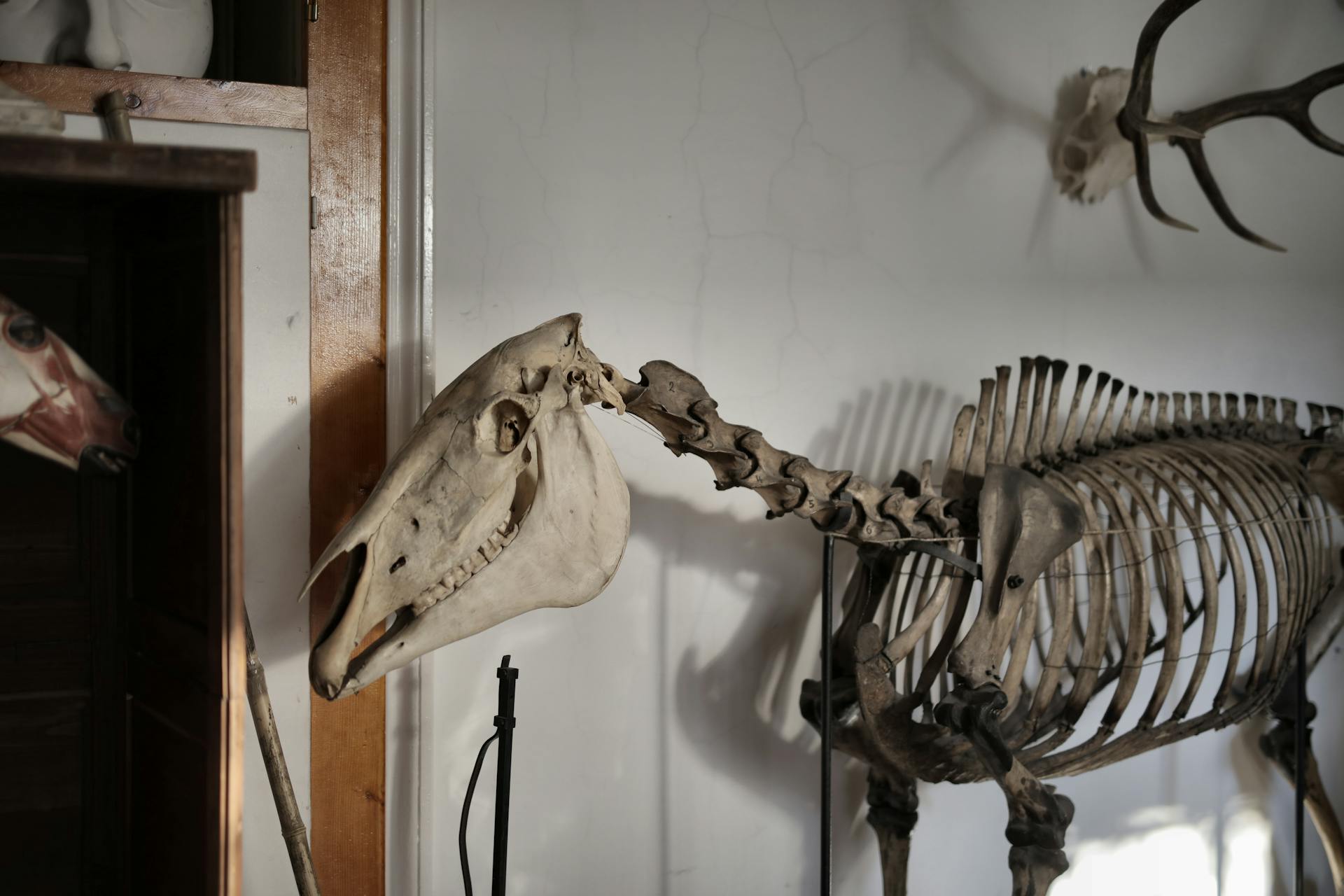
There is no direct performance consequence to a tail set like this, but it can contribute to a flat croup, which some people may find aesthetically unappealing. This can give a horse a more animated appearance, which is beneficial for parade, showing, or driving.
A high-set tail can also contribute to the appearance of a horizontal croup, which may be a concern for some horse owners.
Front and Hind Limbs
A horse's front and hind limbs play a crucial role in its overall conformation and athletic ability. Proper alignment of the legs is essential for a horse to move efficiently and avoid injuries.
From a side view, the front and rear legs should come under the horse's body so that they stand square and strong. This allows the horse to distribute its weight evenly and move with power.
A horse with its hind legs placed too far forward under the body may be prone to sickle-hocked or post-legged conformation, which can put excessive stress on the hock joint and surrounding tendons and ligaments. This can lead to conditions such as curbed hocks, bog spavin, and bone spavin.
The knee joint is a critical area of concern in equine conformation. Calf knees, where the knee is behind a line that bisects the foreleg, can cause excess stress on the front of the knee and strain on the tendons. This can make the horse susceptible to chip fractures of the knee and bowed tendons.
A horse's hind legs should be examined for structural deviations by viewing them from the side and from behind. The hooves on the back leg will naturally point slightly outward, but problems such as cow hocks or base narrow can lead to additional stress on the leg and joints.
Head and Neck
A horse's head and neck conformation can greatly affect its overall performance and comfort. A Roman nose, which is a bulging nasal bone, can make the head heavier and reduce balance and agility.
Horses with a parrot mouth, where the upper jaw extends beyond the lower jaw, may experience difficulty grazing and require frequent dental care to prevent discomfort and chewing issues. This is because the teeth don't align properly, leading to uneven wear on the incisors.
A sow mouth, where the lower jaw extends beyond the upper jaw, can also cause chewing difficulties and may require regular dental maintenance. Horses with these head conformation faults may benefit from working with a skilled equine dentist to ensure their teeth are properly aligned and healthy.
Here are some common head and neck faults to look out for:
- Roman nose: A bulging nasal bone that can make the head heavier and reduce balance and agility.
- Parrot mouth: The upper jaw extends beyond the lower jaw, leading to difficulty grazing and uneven wear on the incisors.
- Sow mouth: The lower jaw extends beyond the upper jaw, causing chewing difficulties and requiring regular dental maintenance.
- Ewe neck: A neck that bends upward instead of down, making it difficult for a horse to engage its hindquarters and collect its back.
- Knife neck: A long, skinny neck with poor muscular development, often associated with poor development of back, neck, abdominal, and haunch muscles.
Head
A horse's head is a crucial part of its overall structure, and there are several conformation faults to look out for. A Roman nose, for example, is a bulging nasal bone that can make the head heavier and reduce balance and agility.
A parrot mouth, where the upper jaw extends beyond the lower jaw, can lead to difficulty grazing and require frequent dental care. Sow mouth, where the lower jaw extends beyond the upper jaw, also causes chewing difficulties and may need regular dental maintenance.
A horse's jaw size is also important, with an ideal width of 7.2 cm, about the width of a fist. If the jaw is narrow, it can be a sign of a horse that may have difficulty flexing at the poll to bring its head and neck into proper position for collection and balance.
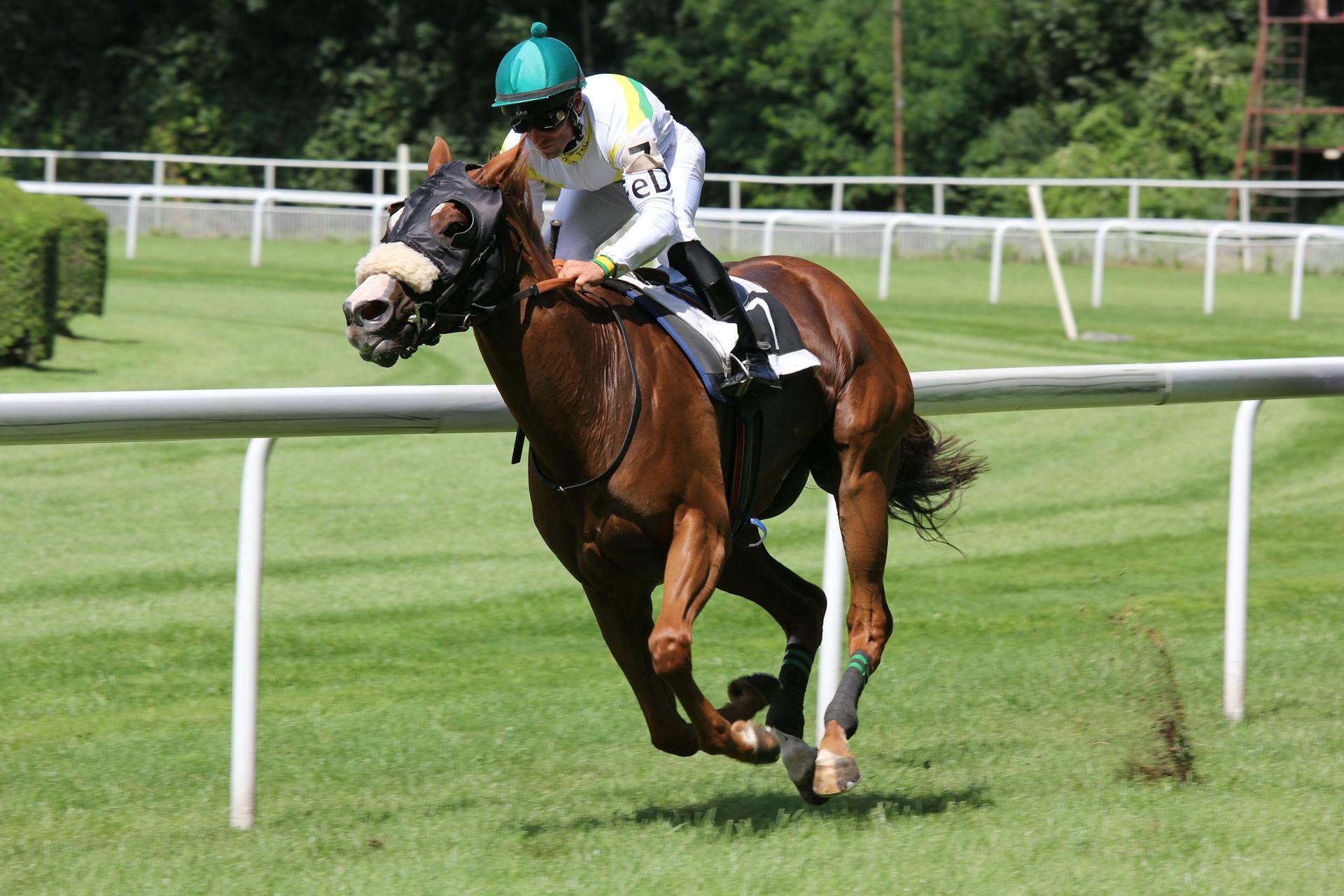
Here are some common head conformation faults to watch out for:
A horse's head and neck are closely connected, and a well-proportioned head is essential for a horse's overall balance and agility.
Hunter's Bump
A hunter's bump is an injury affecting the joint between the horse's sacrum and pelvis.
It occurs when the sacroiliac joint subluxates, or moves slightly out of position, due to tearing of the ligaments holding the joint in place.
From the side, hunter's bumps appear as a very sharp angle over the point of the croup.
Some horses may have an additional "bump" in front of the point of the croup, giving the condition its name.
Hunter's bumps often occur due to a long back and weak-loin conformation.
These faults prevent the horse from tucking their hindquarters underneath themselves, reducing their ability to collect.
Body and Back
A horse's back is a vital part of its anatomy, and any issues here can have a significant impact on its overall health and performance.
A long, weak back is a common conformation fault that reduces a horse's power and increases the risk of strain.
Sway back, on the other hand, is characterized by an excessive dip in the back, particularly common in older horses, which weakens the topline.
A roach back is an arched back with the spine curving upwards, especially towards the loin area, which can cause stiffness and reduce performance.
A short, overly compact back can limit flexibility and fluidity in movement, making it harder for the horse to move freely.
Here's a quick rundown of the common back conformation faults:
Hindquarters and Hips
A well-built hindquarter is essential for efficient movement, strong engagement, and long-term soundness. It allows a horse to move with power and balance.
A horse with ideal hindquarter conformation will have a well-muscled, proportionate, and correctly angled pelvis that is in line with the withers. This ensures that the horse can step under itself and transfer power to its hindlimb.
Weak or sloping hindquarters, on the other hand, can lead to reduced power and propulsion. It can also make collection and engagement difficult, especially in dressage.
Goose-rumped, flat croup, and cow-hocked conformation faults can all impact a horse's movement and soundness. These faults can be managed through conditioning, healthcare, and correct training techniques.
Here are some common conformation faults of the hindquarters:
- Weak or sloping hindquarters
- Goose-rumped (steep croup)
- Flat croup
- Cow-hocked (hocks angle inward)
Each of these faults can have a significant impact on a horse's performance and soundness. By understanding these faults, you can take steps to manage them and ensure your horse remains healthy and thriving.
Defects and Abnormalities
Pastern conformation defects in horses are a common issue, and one of the most notable is the pastern angle being too steep or too shallow.
A horse with a pastern angle that's too steep may be prone to injuries and chronic pain in the hoof and pastern area.
Pastern conformation defects can also lead to issues with the horse's movement and overall performance, making it difficult for them to excel in their chosen discipline.
In some cases, pastern defects can be a sign of a more underlying issue with the horse's bone structure or development.
Managing Conformation Faults
Managing conformation faults requires a thorough understanding of how a horse's structure affects their performance and soundness. Experts in your discipline and your veterinarian can provide valuable insights to help you make informed management decisions.
A horse's conformation can't be changed, but careful care can reduce the problems it might cause. This includes building muscle to support weak joints through training programs, balancing stress on the hooves and legs through farrier work, and catching issues before they become severe with regular veterinary attention.
You can't erase a horse's conformation faults, but good management can help reduce the risks they create and support long-term performance.
Standing Out
In horses with a conformation fault, the way they stand can reveal a lot about their potential athletic ability.
Horses with their front legs too far forward can put excess stress on the front of their knee and strain on ligaments and tendons.
Placing the entire hind leg too far backward can make a horse less athletic because they can't work off their hindquarters.
Horses with this conformation fault may struggle with agility and quick movements.
Their inability to use their hind legs efficiently can also affect their jumping ability and overall performance.
Additional reading: Fault (breeding)
Managing
Managing conformation faults requires a thoughtful approach. Assessing a horse's conformation is an important step in purchasing a new horse or evaluating your current horse's suitability for your desired sport.
Experts in your discipline and your veterinarian can provide valuable insights to ensure the horse's conformation matches your desired performance outcomes. They can also help you identify which faults can be overlooked or managed within the context of your discipline.
A hock with a normal angle is essential for absorbing shock and spreading forces evenly across the joint. This reduces the risk of joint problems and long-term soundness issues.
Careful care can reduce the problems caused by conformation faults. Training programs can build muscle to support weak joints, farrier work can balance stress on the hooves and legs, and regular veterinary attention can catch issues before they become severe.
Horses that develop unsoundness due to their conformation may require veterinary intervention to return them to full performance. This can include joint injections, pain control medications, stall rest, and regenerative therapies to heal damaged tissues.
Worth a look: Equine Veterinary Practice
Frequently Asked Questions
What is the rule of thirds in horse conformation?
The rule of thirds in horse conformation assesses a horse's balance by dividing its body into three equal sections: front, middle, and hind thirds, measured from the shoulder, back, and hip respectively. A well-balanced horse will have equal length in all three sections.
Featured Images: pexels.com