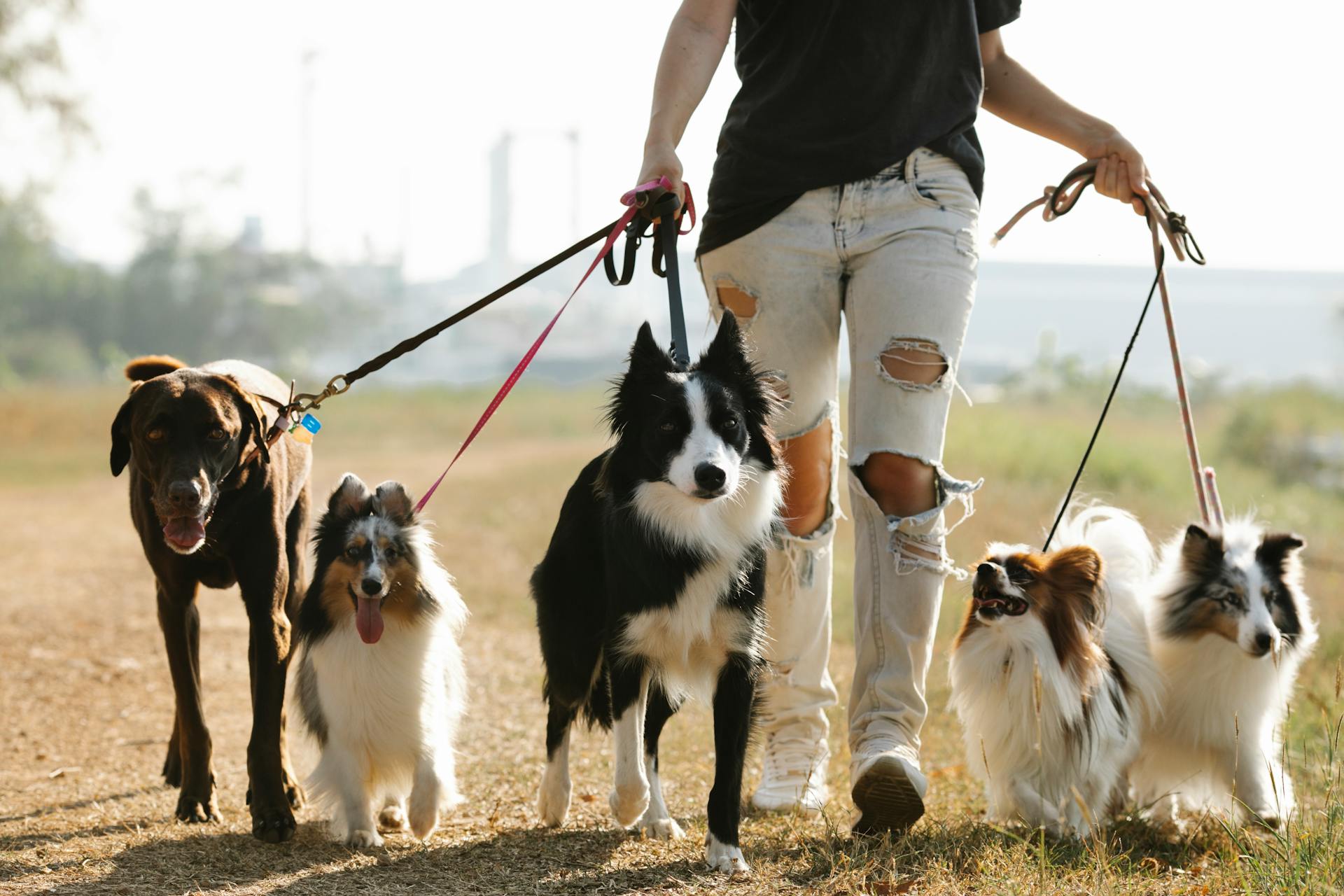
Dogs are social animals that thrive in the company of others, and their natural behavior is influenced by their pack dynamics. A dog's pack is their family unit, consisting of a dominant male and female, their offspring, and other subordinate members.
In the wild, a pack's size typically ranges from 2 to 12 dogs, and they live together in a hierarchical structure. The alpha pair leads the pack, while the beta pair and other members follow their lead.
Dogs are able to learn from each other through a process called social learning, where they observe and imitate the behavior of others in their pack. This is evident in how puppies learn to hunt and play from their mother and other pack members.
Observing dogs interact with each other can be a fascinating experience, and it's clear that they have a strong instinct to live and learn together.
Wolf Behavior and Social Structure
Wolf packs are primarily family units composed of a breeding pair and their offspring. They are not as rigidly hierarchical as once thought, with leadership roles often shared and dominance dynamics fluid.
In wolf packs, age and experience are powerful influences on determining the rightful order, with older and more experienced wolves often holding higher ranks. This is similar to what we see in domestic dogs, where older dogs often take on leadership roles.
Wolves use eye contact and posture to indicate dominance or submission, but these postures are often rare except when it comes to food. In contrast, younger wolves may leave the pack to find a mate and produce offspring of their own, especially in smaller packs.
Here are some key characteristics of wolf packs:
In wolf packs, males assist in raising the pups and stay with the pack for life, while females leave their birth pack at around 2.5 years old to join another pack. This unique social structure is different from that of domestic dogs, which have been selectively bred for various traits over thousands of years.
The Pups
The pups are the heart of the wolf pack, with their survival and development being a collaborative effort among all members. In fact, the breeding pair will often prioritize feeding the youngest wolves first in times of scarcity.
Pup mortality is alarmingly high, with only about 30% surviving their first year of life. This means that the pack's social structure is constantly being rebuilt.
Those pups that do survive grow up surrounded by numerous caretakers and teachers, learning valuable social skills from each member of the pack.
Wolves vs
Wolves live in family units composed of a breeding pair and their offspring, with leadership roles often shared and dominance dynamics fluid.
In contrast, dogs have been selectively bred for various traits over thousands of years, which has likely altered their social dynamics compared to their wild counterparts.
Wolf packs are primarily family units, and age and experience play a significant role in determining leadership roles.
Dogs, on the other hand, can form complex social hierarchies, but their dynamics are often more fluid and influenced by human intervention.
In wolf packs, the dominant individual is typically characterized by exhibiting strong leadership qualities and taking on the role of the central decision-maker.
In contrast, the concept of an "Alpha Dog" in domestic dogs is often misunderstood and can be counterproductive in training.
Domestic dogs, like wolves, have unique personalities, and it's essential to assess each dog as an individual rather than making assumptions based on breed or appearance.
Broaden your view: Are Boxer Dogs Good Family Dogs
Dogs that are more willful may require stronger leaders, while a "senior support program" can be effective in maintaining a stable hierarchy.
By understanding the differences in wolf and dog social structures, we can create a more harmonious and respectful bond with our canine companions.
Here are some key differences between wolf and dog social structures:
Social Structure
Wolf packs are primarily family units composed of a breeding pair and their offspring. In the wild, wolf packs are not strictly hierarchical, and dominance dynamics are fluid.
African wild dogs, on the other hand, live in packs with a single female breeding with all males, and males assist in raising the pups. The females leave their birth pack at approximately 2.5 years old to join another pack without females.
Wolf packs, like those of African wild dogs, hunt cooperatively, with wolves running down large game and tearing it apart with their pack. In wolf packs, the adult parents are usually unrelated, and other unrelated wolves may sometimes join the pack.
You might enjoy: African Wild Dog Pack
Gray wolves tend to live in packs that consist of adult parents and their offspring of the last two or three years. They usually hunt in packs, but they hunt alone in the spring and summer months when plenty of prey is available.
Black-backed jackals and coyotes have a single long-term mate, and they usually hunt alone or in pairs. A pack consists of the breeding pair and their current young, and they occasionally cooperate in larger packs to hunt big game.
In wolf packs, the alpha pair is the genetic parents of most cubs in the pack, and they have access to mating females. Wolves show deference to the alpha pair by allowing them to allocate the distribution of food.
Wolf biologist L. David Mech suggests that the term "alpha" is not required to describe dominance, as any parent is dominant to its young offspring. He recommends reserving the term "alpha" for large wolf packs comprised of multiple litters, where the older breeders are probably dominant to the younger breeders.
Our domestication of dogs has taken them from their natural positioning as members of a pack to isolating them from other dogs and pack members completely. This can lead to dogs experiencing strong feelings of attachment to their human family members, but it's unfair to base our treatment of them on the assumption they are blissfully happy in an inherently unnatural setting for them.
The basic unit of canine social structure is the pack, which is not easy to study in a domestic situation. However, we can project what we do know about dogs, wild dogs, and wolves to understand how stable hierarchies are maintained.
In wolf packs, infighting arises when an alpha wolf loses control or dies, and the normally peaceful hierarchy is disturbed until a new order is formed. Domestic dogs are similar in this respect, and really bad things happen when human family members intervene to support a failing order that is contrary to what natural forces dictate.
Here's a summary of the types of social structures found in different wild canid species:
Dominance and Hierarchy
In canine social structures, dominance is often associated with the term alpha. Wolves, for example, show deference to the alpha pair in their pack by allowing them to allocate food distribution.
Alpha wolves are typically the genetic parents of most cubs in the pack, and their access to mating females creates strong selective pressure for intra-sex competition. This means they have a big advantage when it comes to reproducing.
However, the term alpha is often misused, and wolf biologist L. David Mech suggests reserving it for cases where the older breeders are dominant to the younger breeders, as in large wolf packs with multiple litters.
In a pack, dominant animals eat first, get the best resting areas, and get the first choice of mates. This comes with responsibilities, such as initiating and terminating all pack activities, physically leading the others, and warning and defending the pack against dangers.
Dominant dogs suffer the least stress because they're in charge of their own destinies and all resources. In contrast, omega animals experience the most stress and frustration and may eventually leave the pack or be chased off.
Here's a breakdown of the roles within a pack:
Training and Understanding
Training an alpha dog requires a balanced approach that includes positive reinforcement, consistency, and clear communication. This helps establish the human as the pack leader, while ensuring the dog feels secure and confident in its place within the pack.
Establishing eye contact is a fundamental aspect of training an alpha dog, as it shows the dog that the handler is in control and helps build trust between them. Eye contact can be achieved by holding a treat close to your face and rewarding the dog when it looks in your eyes.
Positive reinforcement is a key element of training, especially for alpha dogs. By offering rewards such as treats, praise, or playtime, after the dog demonstrates the correct behavior, they are encouraged to repeat that behavior. This creates a positive association with following commands, which can be especially beneficial for assertive dogs.
A well-mannered alpha dog requires regular obedience practice to maintain consistent behavior. Teaching basic commands such as sit, stay, and lay down reinforces the handler's leadership position and helps create a well-balanced and confident dog.
Here are some essential training techniques for an alpha dog:
- Establish eye contact
- Use positive reinforcement
- Practice obedience training
- Teach resource management
- Train for problem-solving skills
By adopting this comprehensive approach, handlers can ensure a healthy and balanced relationship with their alpha dog, while nurturing a strong, confident, and well-behaved canine companion.
Use in Training
Training an alpha dog requires a balanced approach that includes positive reinforcement, consistency, and clear communication. This is a far cry from the outdated "pack" methods that were once popular.
Establishing eye contact is a fundamental aspect of training an alpha dog, helping to show the dog that the handler is in control and building trust between them. This can be achieved by holding a treat close to your face and rewarding the dog when it looks in your eyes.
Positive reinforcement is a key element of training, especially for alpha dogs. By offering rewards such as treats, praise, or playtime, after the dog demonstrates the correct behavior, they are encouraged to repeat that behavior.
Resource management is essential when working with an alpha dog, controlling access to valuable resources such as toys, treats, and doorways. Reinforcing the pack hierarchy by having the dog wait for permission to access these resources is crucial.
On a similar theme: Veteran Dog Treats
Obedience training is a key ingredient in building a well-mannered alpha dog. Teaching basic commands such as sit, stay, and lay down, reinforces the handler's leadership position and helps to create a well-balanced and confident dog.
Leash training is another vital component of working with an alpha dog. It is essential to teach the dog to walk calmly beside the handler, without pulling or trying to lead the way.
Problem-solving skills can enhance the overall training experience for an alpha dog. By providing interactive toys and activities, the dog's cognitive abilities are stimulated, and their confidence is boosted.
Behaviorists' Perspective
Behaviorists have a unique perspective on the alpha dog concept, and it's fascinating to learn from their research. They've found that the idea of an alpha dog is not solely dependent on size, breed, or strength, but rather on socialization, desensitization, and counter-conditioning.
Desensitization involves gradually exposing a dog to stimuli that may provoke an undesirable response, reducing the intensity of their reactions over time. Counter-conditioning, on the other hand, is the process of changing a dog's emotional response to a stimulus by associating it with something positive.
The most effective pack leaders are not necessarily the most aggressive or forceful dogs, but rather those who exhibit calm assertiveness, consistency, and clear communication. This approach is essential in canine relationships.
Dogs are essentially scavengers rather than predators, and their social structures have evolved to focus more on teamwork and collaboration than individual dominance. By employing a combination of desensitization, counter-conditioning, and other behavior modification techniques, animal behaviorists can help transform dogs into well-adjusted, confident companions.
A clear and neutral understanding of the alpha dog theory is crucial in understanding human social interactions as well. By having a deeper understanding of canine behavior, we can better navigate our relationships with our dogs and other animals.
Energetic Cues and Expressions
Decoding canine energetic cues is crucial for building a strong bond with your dog. By paying attention to these cues, you can better understand your dog's needs and emotions.
Dogs communicate primarily through body language, including energetic cues like tail wagging, ear position, and posture. These cues can indicate excitement, anxiety, or even aggression.
Becoming a confident and peaceful leader is essential for meeting your dog's needs. This means being calm, assertive, and consistent in your interactions with your dog.
Fostering trust, respect, and empathy with your dog requires you to be aware of their energetic cues. By doing so, you can create a safe and valued environment for your dog.
Here are some common canine energetic cues to look out for:
- Tail wagging: excitement or friendliness
- Ear position: alertness or relaxation
- Posture: confidence or submission
By recognizing and responding to these cues, you can cultivate a deep sense of purpose in your own life and strengthen your relationship with your dog.
The Concept in Human Perspective
The concept of the alpha dog is often applied metaphorically to describe a person who controls, directs, or has authority within a given environment.
In human society, establishing a similar relationship with our dogs is a common goal, as it fosters a strong bond between the owner and their pet. This stems from a desire for a well-behaved and obedient dog.
Developing a trusting relationship is essential for the success of this dynamic, as it ensures that the dog will feel secure and confident in following the instructions given by their human caretaker. This requires the owner to exhibit characteristics that promote trust and confidence in their leadership.
A pack leader should be calm and assertive when giving commands or addressing misbehavior, as well as offer praise and rewards when appropriate. Consistency is also key, establishing clear boundaries and expectations for their dog.
The role of alpha dog is not an indication of aggression or harshness, but rather one of balance and control. By observing effective pack leaders and applying those principles in a balanced and controlled manner, humans can foster a sense of understanding and cooperation with their dogs.
In many cases, humans look to establish themselves as the pack leader, seeking to create a harmonious relationship with their pets. This can be achieved by adopting certain attributes and behaviors that reflect a strong and respected leader.
Ideally, a pack leader should remain consistent and establish clear boundaries and expectations for their dog. This helps to maintain order and ensures the survival of the group as a whole.
The concept of the alpha dog serves as a useful guide for humans trying to build a strong, trusting relationship with their pets. By understanding this concept, we can better navigate our relationships with our dogs and create a happy, healthy partnership.
Curious to learn more? Check out: How to Be a Dog Pack Leader
Featured Images: pexels.com