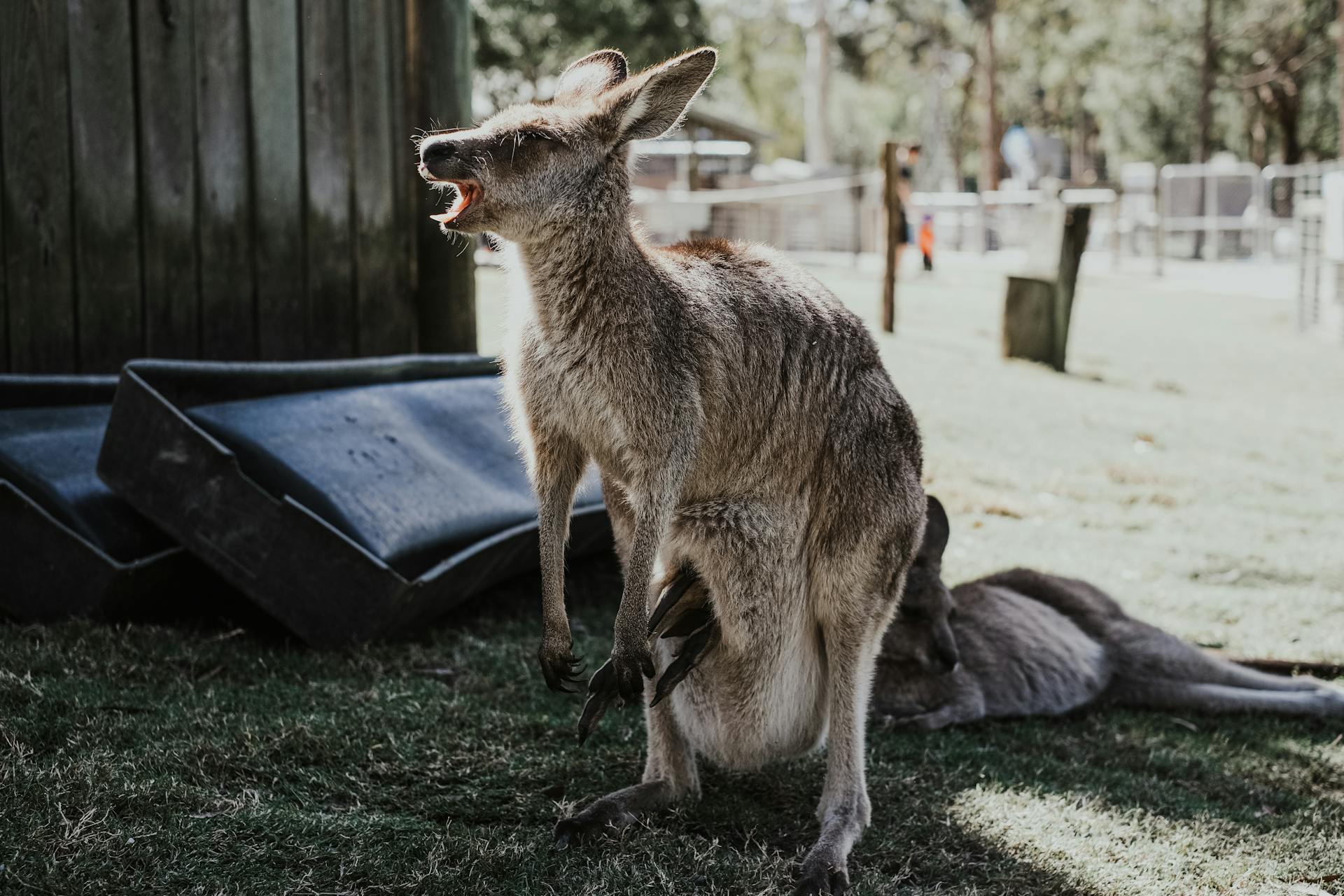
Diprotodonts are a group of fascinating marsupials that have been around for millions of years. They are found in Australia and New Guinea.
Wombats, koalas, and possums are all types of diprotodonts. These animals have a unique characteristic - a pair of teeth in the lower jaw that are larger than the others.
Diprotodonts are herbivores, which means they primarily eat plants. This diet helps them play a crucial role in their ecosystems, dispersing seeds and maintaining vegetation.
Some diprotodonts, like wombats, are known for their burrowing skills, while others, like koalas, are famous for their love of eucalyptus leaves.
Classification
The order Diprotodontia consists of 140 extant species belonging to 39 genera. This does not include hybrid species or extinct prehistoric species.
These 39 genera can be grouped into 11 families, which are further divided into suborders. The suborders are Macropodiformes, Phalangeriformes, and Vombatiformes.
The suborder Macropodiformes includes the families Macropodidae, Potoroidae, and Hypsiprymnodontidae. Macropodidae includes the musky rat-kangaroo, which has one genus and one species. Potoroidae includes four genera, with one extinct, and nine species, with two extinct.
The suborder Phalangeriformes includes the superfamily Petauroidea and Phalangeroidea. The superfamily Petauroidea includes the families Acrobatidae, Tarsipedidae, Petauridae, and Pseudocheiridae.
The suborder Vombatiformes includes the families Phascolarctidae and Vombatidae. Phascolarctidae includes the koala, with one genus and one species. Vombatidae includes two genera and three species.
Here's a breakdown of the families and their characteristics:
These classifications provide a framework for understanding the diversity of diprotodonts and their relationships to one another.
Physical Characteristics
Diprotodonts are marsupials that can be quite large, with some species weighing up to 100 kg.
Their bodies are well-suited for their herbivorous diet, with broad, flat heads and powerful jaws that allow them to grind tough plant material.
Diprotodonts have a distinctive characteristic - their teeth are specialized for grinding and crushing plant material, with a pair of incisors in the lower jaw that are larger than those in the upper jaw.
Their forelimbs are adapted for digging and breaking branches, with strong claws and a robust shoulder structure.
Some species of diprotodonts have a long, pointed snout, while others have a shorter, more rounded snout.
Their ears are relatively small and rounded, and their eyes are positioned on the sides of their head, giving them a wide range of vision.
Habitat and Diet
Diprotodonts lived in a variety of habitats, including forests, woodlands, and plains.
Their diet consisted of a significant amount of vegetation, with estimates suggesting they consumed 100 to 150 kilograms daily.
Their chisel-like incisors were likely used to root out vegetation, showing their adaptability to different environments.
Habitat
Diprotodon preferred semi-arid plains, savannahs and open woodlands.
These habitats were generally absent from hilly, forested coastal regions.
Dry, windy conditions alternated with more equable conditions throughout the Pleistocene period, causing Australian habitats to change over time.
Sea levels were generally much lower than today as ice was locked in polar regions, and extended droughts would have made much of inland Australia uninhabitable.
Hundreds of Diprotodon individuals have been found at the centre of Lake Callabonna in northern South Australia, trapped in the mud as the lakebed dried out.
Areas once covered in woodlands, vine thickets and scrublands on the Darling Downs in Queensland gave way to grasslands as the climate became drier.
Feeding Ecology and Diet
Diprotodon likely had a massive appetite, eating as much as 100 to 150 kilograms of vegetation daily.
Its diet consisted of a variety of plants, with fossil evidence showing it ate saltbush, a type of vegetation found in the area.
Diprotodon's chisel-like incisors were perfectly suited for rooting out vegetation, allowing it to feed efficiently in its environment.
The animal's ability to eat such large quantities of vegetation suggests it was an herbivore, feeding on plants for sustenance.
Behaviours and Adaptations
Diprotodonts likely didn't travel in large herds, unlike some depictions. This is because marsupials are not known to form large groups.
One of the key differences between male and female diprotodonts was their size, with males being significantly larger. This means there was a high degree of morphological difference between the sexes.
The large gatherings of diprotodonts at a drying waterhole were probably smaller family groups drawn together.
Fossils and Evolution
The oldest fossils of diprotodonts come from late Pliocene deposits in South Australia and New South Wales. These ancient remains date back to around 25 million years ago.
Diprotodon optatum, a species of diprotodon, is known from the Pleistocene era and went extinct around 25,000 years ago. Its fossils have been found with complete skulls, skeletons, hair, and foot impressions.
The most complete specimen of a diprotodon is a skeleton found at Tambar Springs in NSW and is now on display at the Coonabarabran Visitor Centre. This specimen is significant because it provides evidence that humans may have hunted diprotodons, as indicated by a small hole in one of its ribs.
Fossils Description
The oldest fossils of Diprotodon were found in late Pliocene deposits at Lake Kanunka, South Australia and Fisherman's Cliff, New South Wales.
Complete skulls and skeletons, as well as hair and foot impressions, have been discovered, providing valuable insights into the life of this ancient creature.
A trackway preserved at Lake Callabonna offers further evidence of Diprotodon's existence.
The most complete specimen is the skeleton of a very large individual found at Tambar Springs in NSW, which is now part of the Australian Museum fossil collection and is on display at the Coonabarabran Visitor Centre in central New South Wales.
A small, square hole was found on one of the rib bones, which is believed to have been made by a spear while the bone was still fresh, suggesting that humans may have hunted Diprotodon.
Evolution and Systematics
The earliest known diprotodont fossils date back to the Oligocene epoch 24–35 million years ago.
These early fossils were a diverse assemblage of forms, suggesting that the origins of the group almost certainly go back further, to the Cretaceous period.
Australia's marsupials were isolated when Gondwana broke apart about 40 million years ago, and they began a major radiation, expanding to fill a huge range of ecological niches.
No group diversified more than the diprotodonts, with 131 species in 40 genera, representing 10 families of koalas, wombats, possums, and more.
The suborder Vombatiformes, containing the living families Phascoloarctidae and Vombatidae, probably represents an early offshoot of the diprotodont lineage.
This group is characterized by a reduced tail and backward-opening pouch, and it's likely that it split off from the main diprotodont lineage early on.
The diprotodonts closest relatives in other orders are probably the bandicoots and bilbies, and the marsupial moles.
These relationships are largely speculative, but they give us a glimpse into the complex history of these fascinating creatures.
The discovery of previously undescribed mammal species is an increasingly rare event, but the diprotodonts continue to surprise us with new finds, such as the long-footed potoroo and the Proserpine rock wallaby.
Types of Diprotodonts
Diprotodonts are divided into smaller groups called suborders, which help us understand how different diprotodonts are related to each other.
The Potoroidae family is one of these suborders, and it includes four genera: Aepyprymnus, Bettongia, Caloprymnus, and Potorous. Each of these genera has unique characteristics, such as size and diet.
The Aepyprymnus genus, for example, includes the rufous rat-kangaroo, which is found in northeastern Australia and has a diet that includes grass, herbs, roots, and fungi.
Here's a list of the four genera in the Potoroidae family, along with some of their key characteristics:
The Vombatiformes suborder includes some of Australia's most famous animals, such as the koala and the wombat.
Conservation and Significance
Diprotodonts are an important part of Australia's ecosystem, playing a vital role in seed dispersal and forest regeneration.
Many diprotodont species have been extinct for thousands of years, but their conservation significance remains. They are an indicator species, providing valuable insights into the health of their ecosystems.
Diprotodonts are herbivores, and their diet consists mainly of grasses, leaves, and fruits. This unique diet has allowed them to thrive in a variety of environments.
Their large size and specialized teeth make them well-suited to their role as seed dispersers.
Conservation
Conservation is a vital aspect of preserving our planet's biodiversity. It involves protecting and conserving ecosystems, species, and natural resources for future generations.
The loss of biodiversity is a significant threat to ecosystems, with around 27,000 plant and 9,000 animal species facing extinction globally.
Conservation efforts can be effective in protecting endangered species, such as the California condor, which was down to just 22 individuals in the 1980s but has since been reintroduced to the wild.
Protecting natural habitats like forests, coral reefs, and wetlands is crucial for preserving biodiversity. These ecosystems provide essential services like clean water, air, and food.
Significance to Humans

Humans play a crucial role in conservation efforts, as they are the primary cause of environmental degradation.
Many species rely on humans for their survival, such as the mountain gorillas who depend on conservation efforts to protect their habitats.
Deforestation and land degradation are significant threats to biodiversity, with over 13 million hectares of forest lost annually.
Humans can make a positive impact by reducing their carbon footprint and adopting sustainable practices.
The loss of pollinators, such as bees and butterflies, can have devastating effects on food production, with a single crop like almonds relying on over 1 million honeybees for pollination.
Fast Facts and Introduction
Diprotodonts are a fascinating group of mammals, and here are some fast facts to get you started.
The Diprotodon optatum was the largest marsupial known, reaching lengths of up to 3.8 m long and 1.7 m at the shoulder.
Diprotodon was the first fossil mammal named from Australia, and it's one of the most well-known of the megafauna.
The order Diprotodontia is relatively new to science, first recognized as an order just 150 years ago in 1866.
Australasia is home to 131 described living species of diprotodonts, making it a surprisingly diverse group.
Here's a breakdown of the Diprotodon optatum's classification:
- Genus: Diprotodon
- Species: optatum
- Subfamily: Diprotodontinae
- Family: Diprotodonidae
- Order: Diprotodontia
- Magnorder: Australidelphia
- Cohort: Marsupialia
- Infralegion: Theria
- Sublegion: Boreosphenida
- Division: Theriiformes
- Superdivision: Theriimorpha
- Infraclass: Holotheria
- Subclass: Mammaliaformes
- Class: Mammalia
- Super Class: Tetrapoda
- Subphylum: Vertebrata
- Phylum: Chordata
- Kingdom: Animalia
Diprotodon was widespread across Australia when the first indigenous people arrived, co-existing with them for thousands of years before becoming extinct about 25,000 years ago.
Featured Images: pexels.com