Devario is a fascinating genus of fish, comprising over 100 species. They are found in freshwater habitats across Asia.
Devarios are known for their striking colors and patterns, which serve as a form of communication and camouflage. Their vibrant scales can be a deep blue, green, or yellow, often with intricate markings.
In the wild, Devarios inhabit rivers, streams, and lakes, preferring areas with rocky substrates and plenty of vegetation. They thrive in environments with moderate water flows and temperatures between 15°C to 25°C.
Devarios are social fish, often schooling in large groups, and can be quite active, darting quickly through the water to catch prey or evade predators.
Taxonomy of the Genus
The Devario genus is a fascinating group of fish, and understanding its taxonomy is key to appreciating its diversity. The genus Devario belongs to the family Danionidae.
The classification of Devario is as follows: Eucaryota, Animalia, Chordata, Vertebrata, Osteichthyes, Actinopterygii, Neopterygii, Teleostei, Ostariophysi, Cypriniformes, Cyprinoidei, Danioninae, Danionidae, and Devario.
The genus Devario was first described by Heckel in 1843, and the type species is Devario devario. This information is crucial for researchers and scientists studying the genus.
Species
Devario contains a diverse range of species, each with unique characteristics. There are currently 45 recognized species within the genus.
Some of the most notable species include the Giant Danio (Devario aequipinnatus), the Nilgiri Danio (Devario neilgherriensis), and the Blue Moon Danio (Devario xyrops).
The Devario genus includes species that live in various types of water, including flowing and stagnant water, as well as flooded rice paddies. They are found in the Indian subcontinent, Sri Lanka, and Southeast Asia.
Devario species are known for their elongated bodies, which are strongly compressed laterally. They can grow to varying lengths, ranging from 3 cm to 15 cm.
Here is a list of some of the Devario species mentioned in the article:
- Devario acrostomus
- Devario acuticephala
- Devario aequipinnatus (Giant Danio)
- Devario affinis
- Devario ahlanderi
- Devario annandalei
- Devario anomalus
- Devario apogon
- Devario apopyris
- Devario browni
- Devario chrysotaeniatus
- Devario coxi
- Devario deruptotalea
- Devario devario (Bengal danio)
- Devario fangae
- Devario fangfangae
- Devario fraseri
- Devario gibber
- Devario interruptus
- Devario kakhienensis
- Devario kysonensis
- Devario laoensis
- Devario leptos
- Devario malabaricus
- Devario manipurensis
- Devario memorialis
- Devario micronema
- Devario monticola
- Devario myitkyinae
- Devario naganensis
- Devario neilgherriensis
- Devario pathirana
- Devario pullatus
- Devario quangbinhensis
- Devario regina
- Devario salmonatus
- Devario shanensis
- Devario sondhii
- Devario spinosus
- Devario strigillifer
- Devario subviridis
- Devario xyrops (Blue Moon danio)
- Devario yuensis
Distribution and Habitat
Devario species can be found throughout much of the Ganges and Brahmaputra river systems in northern India, Nepal, and Bangladesh.
Their range extends to the Godavari drainage in central and southern India, although records from this area require confirmation.
In northern India, specifically in Uttar Pradesh and West Bengal states, Devario devario was recorded in four separate localities with varying water conditions.
The pH level in these streams was recorded to be between 7.9-8.2, and water temperature ranged from 27-35°C/80.6-95°F.
Water depth varied between 21-100 cm, and substrates were composed of clay, silt, sand, cobbles, and boulders.
Devario species can thrive in both moderately-flowing streams and still-water habitats, such as the one found above a small dam.
In the wild, they coexist with a wide range of other fish species, including the congener D. aequipinnatus and Opsarius barna.
Devario species are also found in other parts of their range, including Southeast Asia, Thailand, Sri Lanka, and the Indian Subcontinent.
Their habitat includes flowing and standing waters, as well as overflown areas like rice fields.
Physical Characteristics
Devario species have a distinctive body shape, being long and relatively compressed on the sides. Their body length ranges from about 3 to 15 cm.
The mouth of Devario is either upper or endständig, and is often accompanied by 1-2 pairs of barbels that can be short or completely absent. The sides of their body are fully lined.
Males are more vibrantly colored than females, but females are generally rounder-bellied and a bit larger than males.
Merkmale
Devario fish have a distinctive elongated body shape, which is relatively compressed from the sides. Their body length can range from about 3 to 15 cm.
The mouth of a Devario fish is either upper or end-positioned. You'll often find one to two pairs of barbels at their mouth, but these can be very short or completely absent.
The lateral line of Devario fish is fully developed, unlike some other fish species. Their dorsal fin has 8 to 17 divided fin rays, while their anal fin has 11 to 17.
Male Devario fish are more vibrantly colored than females. Females, on the other hand, tend to be fuller and slightly larger than males.
Maximum Standard Length
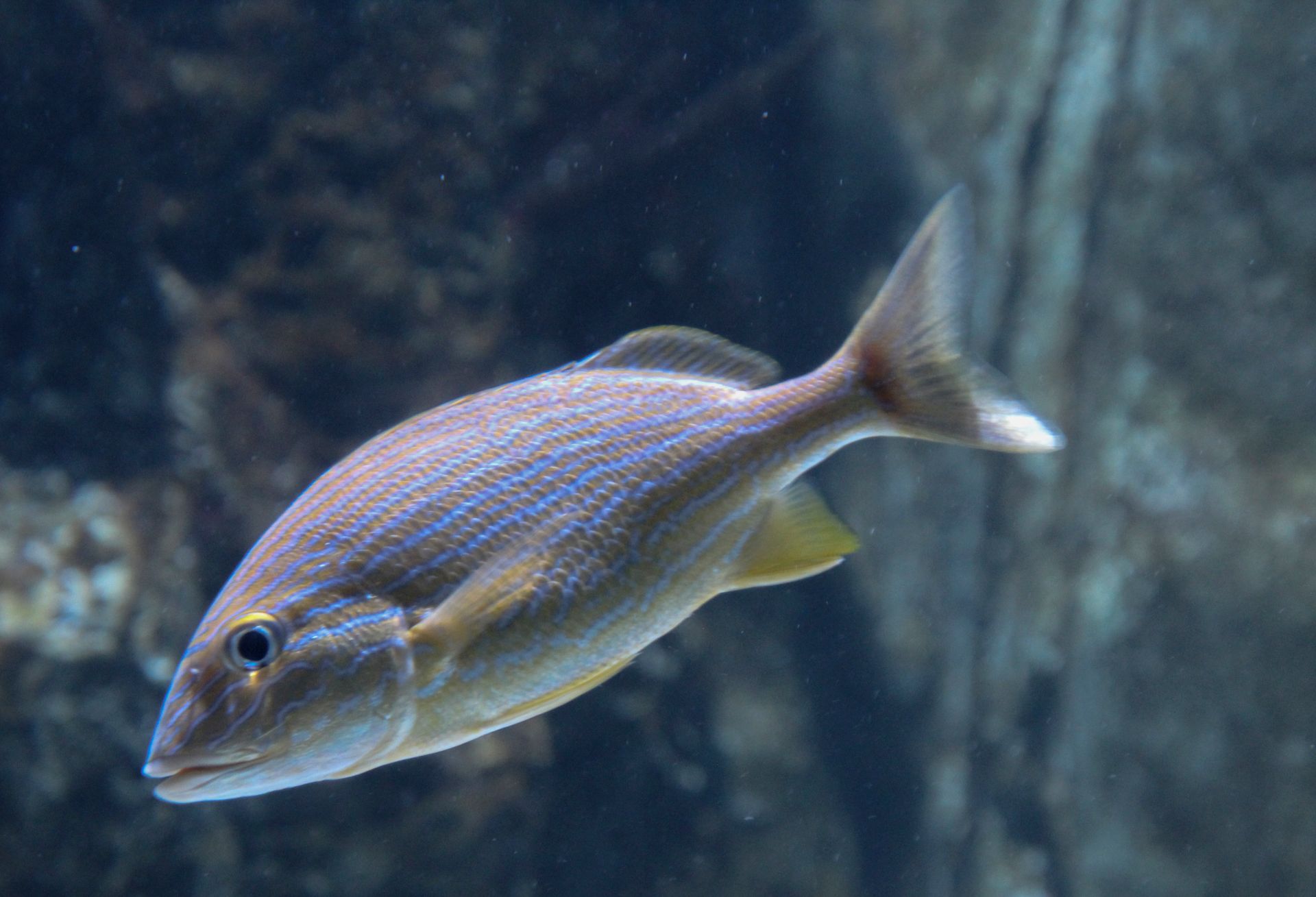
The maximum standard length of the species is a crucial aspect of its physical characteristics.
On average, the species reaches a maximum length of about 6 feet.
Its body is slender and elongated, allowing it to move efficiently through its aquatic environment.
In ideal conditions, the species can grow up to 7 feet in length.
Sexual Dimorphism
Sexual Dimorphism is a fascinating topic, and it's especially interesting in certain species.
Sexually mature females are often rounder-bellied compared to males.
In some cases, females can be less colourful than males, which can be a useful characteristic for identification.
A notable example is that females can be a little larger than males, which can be a key distinguishing feature.
Aquatic Requirements
To keep your Devario happy and thriving, you'll want to get the water conditions just right. The ideal pH range is between 6.0 and 8.0.
Hardness is another crucial factor, and for Devarios, it should be between 36 and 268 ppm.
Behaviour and Compatibility
The Devario is not an aggressive fish, but it can be a handful for slower-moving or timid tankmates due to its constant activity and feeding behaviour. This means it's best suited for larger aquaria with robust, similarly-sized fish.
You'll find plenty of compatible options among cyprinids, loaches, cichlids, catfishes, and characins. Just remember to do your research and choose tankmates wisely.
As a schooling species, Devarios thrive in groups of at least 8-10 specimens. This not only makes them less nervous but also creates a stunning display.
In a group, aggression is contained as the fish focus on maintaining their hierarchical position. Plus, males display their vibrant colours even more prominently in the presence of rivals.
Haltung im Aquarium
The temperature for Devario should be between 21 °C and 26 °C. This is a crucial aspect of their care, as they thrive in this temperature range.
Devario are egg-scattering free spawners, which means they don't take care of their eggs. To maximize yield, a more controlled approach is required, such as setting up a separate tank for breeding.
For breeding, a tank with a base measuring at least 60 cm x 30 cm should be set up, filled with mature water, and equipped with an air-powered sponge filter or air stone(s) to provide oxygenation and water movement. This setup will help create an ideal environment for the eggs to develop.
The water pH for Devario should be slightly acidic to neutral, ranging from 6.0 to 8.0. This pH range is essential for their well-being and will help them thrive in the aquarium.
In the wild, Devario are excellent swimmers and need plenty of space to move around. In the aquarium, they should be kept in a group of at least 8-10 individuals, with an abundance of free-swimming space and hiding places.
Frequently Asked Questions
What is the local name of Devario Devario?
The local name for Devario Devario is "debari", which is also a term meaning "brother-in-law" in Bengali.
Featured Images: pexels.com