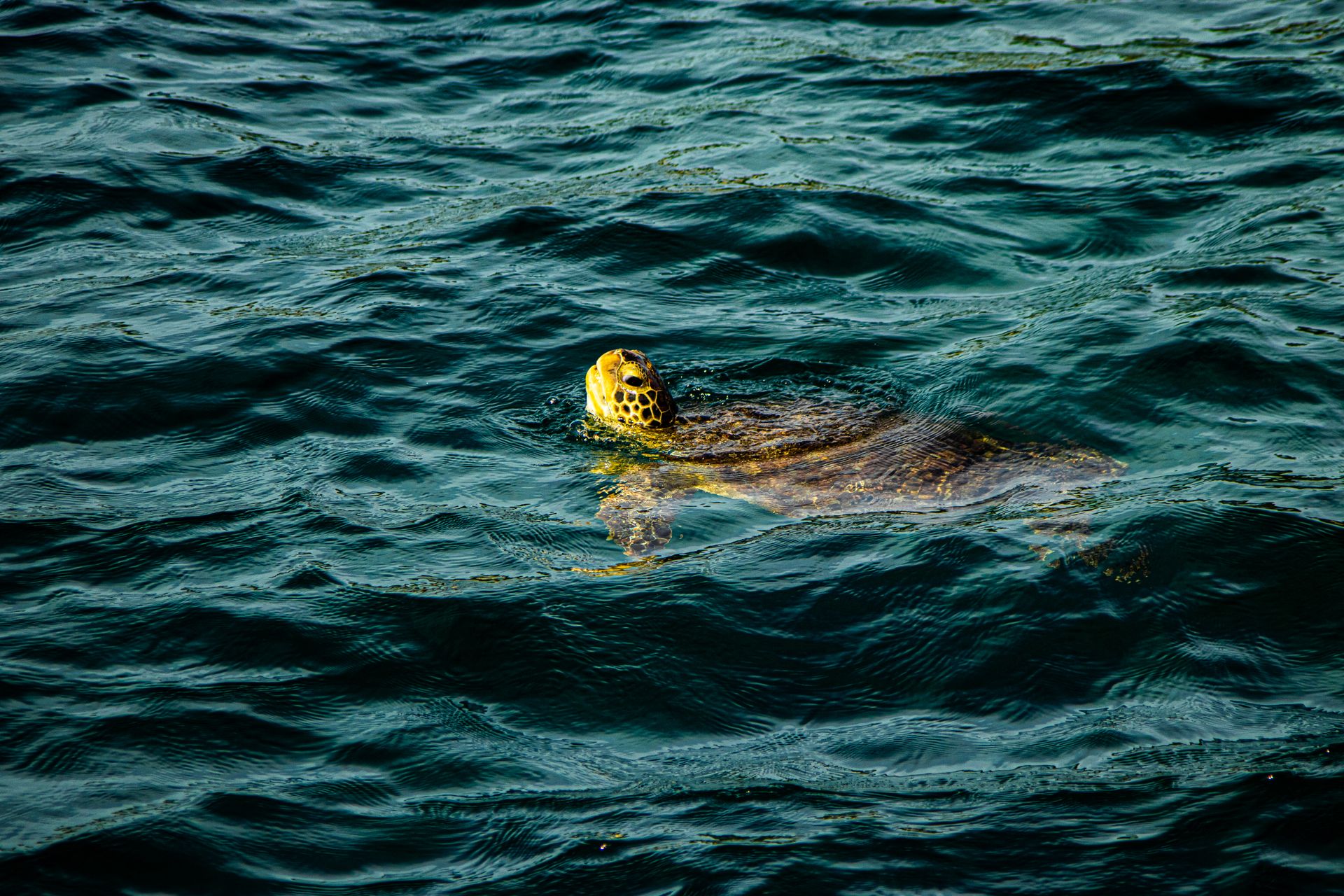
Dermochelyidae Sea Turtles are the largest turtles on the planet, with some species reaching lengths of up to 6 feet and weighing over 2,000 pounds.
These massive creatures are characterized by their streamlined shells, which are perfect for gliding through the ocean with incredible speed and agility.
Their flippers are also highly efficient, allowing them to cover vast distances in search of food, such as jellyfish and other soft-bodied organisms.
Dermochelyidae Sea Turtles are incredibly long-lived, with some individuals estimated to live up to 80 years in the wild.
Check this out: Geoemydidae
Physical Characteristics
The Dermochelyidae family, specifically the Leatherback seaturtles, are quite unique in their physical characteristics.
Their carapace is teardrop-shaped, reaching up to 96 in (244 cm) in length, and bears seven longitudinal ridges. The leathery skin covering the carapace is generally black with scattered white or yellow blotches or spots.
A distinctive feature of the Leatherback seaturtles is the absence of epidermal scutes on their carapace. Most of the bones of the carapace have been lost, but a mosaic of hundreds of small dermal bones lies just under the leathery skin.
Their forelimbs are paddle-like and lack claws. This adaptation allows them to swim efficiently through the oceans.
Here's a summary of the key physical characteristics of the Leatherback seaturtles:
Their head also lacks scales and has a prominent toothlike cusp on each side of the upper jaw. The plastron is predominately white with scattered dark blotches or spots.
Habitat and Ecology
The leatherback turtle's habitat is quite unique. This species is pelagic, which means it spends most of its time in open ocean waters.
They're not typically found in shallow bodies of water, which is good news for beachgoers and coastal ecosystems.
Their diet consists mainly of oceanic jellyfish, and they also consume a variety of other sea creatures, including hydrozoans, snails, and small fish.
Habitat
This species is found in open ocean waters, where it can roam freely without being confined to shallow bodies of water.
It's a pelagic species, which means it spends most of its time in the open sea.
Feeding Ecology
Leatherbacks are almost completely carnivorous, preferring oceanic jellyfish.
They also consume a wide variety of other ocean creatures, including hydrozoans, snails, bivalves, octopi, squid, amphipod crustaceans, crabs, sea urchins, and small fish.
Unfortunately, plastic waste can be mistaken for jellyfish and cause serious harm, even death, if consumed.
Leatherbacks also eat algae, kelp, and sea grasses, showing that they're not picky eaters.
Classification and Systematics
The Dermochelyidae family of turtles is a fascinating group, and understanding their classification and systematics is key to appreciating their unique characteristics.
The leatherback sea turtle (Dermochelys coriacea) is most closely related to other marine turtles of the family Cheloniidae.
This species is also known as caldon, canal, caouana, cardon, laúd, luth, and trunk turtle. The taxonomy of this species is Testudo coriacea Vandelli, 1761, Mediterranean and Adriatic seas.
The family Dermochelyidae is known from the Eocene to the Pliocene in various regions, including Africa, Europe, Japan, Antarctica, Peru, and North America.
Here's a breakdown of the subfamilies and genera within the Dermochelyidae family:
- Subfamily Desmatochelyinae
- Subfamily Allopleuroninae
- Subfamily Dermochelyinae
The genus Dermochelys is the only genus within the Dermochelyidae family, and it includes the leatherback sea turtle.
The Dermochelyidae family is part of the larger order Testudines, which includes all turtles.
Conservation
The Dermochelyidae is in a precarious position, listed as Critically Endangered on the IUCN Red List.
This classification reflects the species' vulnerability to extinction, and it's essential to acknowledge the severity of its situation.
The U.S. Fish and Wildlife Service has also assessed the species as Endangered, highlighting the need for immediate conservation efforts.
Unfortunately, the species is also listed in Appendix I of the CITES, indicating that international trade is a significant threat to its survival.
Featured Images: pexels.com