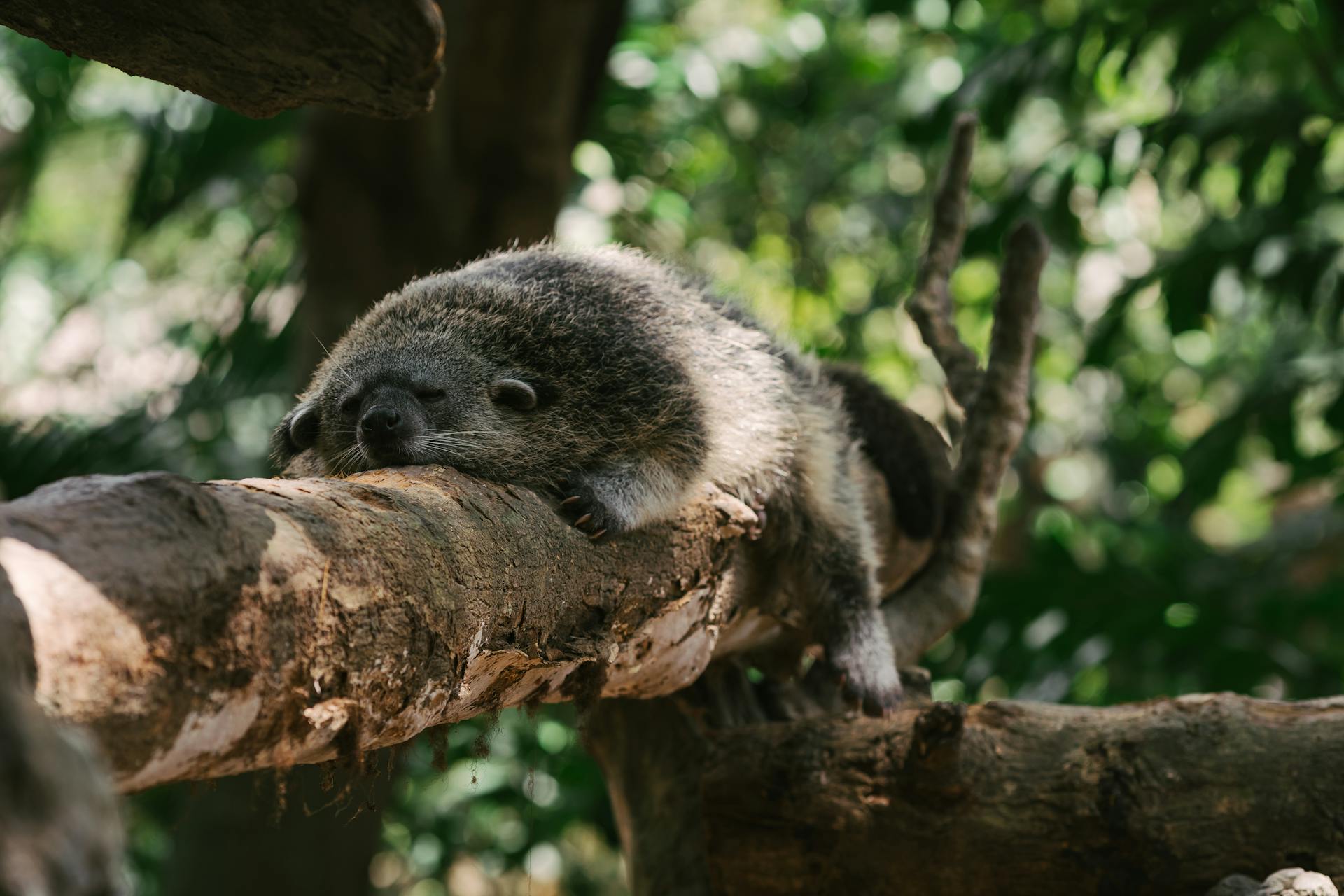
The civettictis civetta, also known as the African civet, is a medium-sized mammal native to sub-Saharan Africa.
They have a distinctive appearance, with a stout body, short legs, and a long, bushy tail.
Their fur is typically brown or reddish-brown in color, with a white or yellowish belly.
Civettictis civetta are primarily nocturnal animals, meaning they're most active at night.
Taxonomy and Evolution
The African civet, Civettictis civetta, has a rich history of scientific study. Its scientific name was introduced in 1776 by Johann Christian Daniel von Schreber.
Von Schreber is considered the binomial authority for this species. He based his description on previous accounts and descriptions of the African civet.
In 1915, Reginald Innes Pocock described the structural differences between the feet of African and large Indian civet specimens. This led him to propose Civettictis as a new genus, with C. civetta as the only species.
The following subspecies were proposed in the 20th century:
- C. c. congica was described by Ángel Cabrera in 1929 from a zoological specimen from the upper Congo River.
- C. c. schwarzi was also proposed by Cabrera in 1929 for African civet specimens from East Africa.
- C. c. australis was described by Bengt G. Lundholm in 1955 based on a male type specimen and three paratype specimens collected near the Olifants River in northeastern Transvaal province.
- C. c. volkmanni was a specimen from the vicinity of Otavi in Namibia, also described by Lundholm in 1955.
- C. c. pauli was described in 2000 by Dieter Kock, Künzel and Rayaleh, and was a specimen collected close to the coast near Djibouti.
A 1969 study noted that the African civet showed enough differences from the rest of the viverrines in terms of dentition to be classified under its own genus.
Etymology
The name "Civettictis" is a combination of the French word "civette" and the Greek word "ictis", meaning "weasel".
This unique name gives us a hint about the animal's origins and characteristics. The word "civette" itself is the source of the specific name "civetta" and the common name "civet".
The name "civet" also has roots in Arabic, where it's known as "zabād" or "sinnawr al-zabād", which translates to "civet cat".
Physical Characteristics
The civettictis civetta, also known as the African civet, is a large and impressive animal.
Its coat is a mix of brown and grey, with a distinctive white or yellowish patch on the throat.
The African civet has a long, bushy tail that it uses for balance and communication.
It can grow up to 60 cm in length and weigh between 10-20 kg.
This animal has a stocky body and short legs, well-suited for its nocturnal and solitary lifestyle.
Distribution and Habitat
African civets are typically found in areas with tall grasses and thickets, which provide them with necessary cover during the day. They often inhabit savannahs, forests, and areas near rivers.
In central and southern Africa, you can spot African civets sleeping in the tall grasses near water sources during the day. This is because they require a covering of tall grasses or thicket to feel safe.
African civets have been recorded in various national parks and protected areas, including the National Park of Upper Niger in Guinea, Moukalaba-Doudou National Park in Gabon, and Odzala-Kokoua National Park in the Republic of Congo.
They can also be found in the transboundary Dinder–Alatash protected area complex, which spans across Sudan and Ethiopia. In fact, they are frequently spotted in Ethiopia's northern Degua Tembien massif.
African civets live in a variety of terrestrial biomes, including savannas, grasslands, forests, rainforests, and scrub forests. You can find them in areas with permanent water systems, as they rarely inhabit arid regions.
Here are some specific habitats where African civets have been recorded:
- savanna or grassland
- forest
- rainforest
- scrub forest
They can be found along river systems that project into arid areas, such as those in Niger, Mali, and Chad.
Behavior and Ecology
African civets are nocturnal creatures, but they can sometimes be seen in the morning or afternoon on cloudy days.
They have a unique way of marking their territories, using their perineal gland secretion to spray urine backwards, similar to felids.
African civets are typically solitary creatures, only coming together for breeding.
Their latrines, or "civetries", are large piles of feces that serve as a mechanism of seed dispersal and forest regeneration.
These latrines are characterized by fruits, seeds, exoskeletons of insects and millipedes, and occasionally clumps of grass.
The role of civet latrines in seed dispersal and forest regeneration is still being researched.
Male African civets use scent marking to establish their dominance and attract a mate.
They use their perineal gland secretion to mark their territories around their civetries, which are typically located within 100 meters of the latrines 96.72% of the time.
If an African civet feels threatened, it raises its dorsal crest to make itself look larger and more formidable.
This behavior is a predatory defense mechanism that helps protect the civet from potential threats.
Feeding and Diet
African civets are opportunistic feeders, taking advantage of whatever food sources are available to them. They have been known to eat a wide variety of prey, including rodents, amphibians, and small reptiles.
Their diet consists of rodents like giant pouched rats and striped grass mice, as well as amphibians like Hallowell's toad. They also eat small reptiles, such as the herald snake and common agama.
In addition to meat, African civets also eat birds, millipedes, and insects like Orthoptera and Coleoptera. Fruits, berries, and seeds are also a part of their diet, including Strychnos fruits.
African civets have even been known to eat carrion and eggs. They can take down prey as large as hares, but can be somewhat clumsy killers with sizable prey.
Threats
The African civet is facing threats to its population due to hunting. In 2006, it was estimated that around 9,400 African civets are hunted yearly in the Nigerian part and more than 5,800 in the Cameroon part of the Cross-Sanaga-Bioko coastal forests.
Hunters consider the African civet a rare species, indicating a decline in population due to hunting for trade as bushmeat. Skins and skulls of African civets were found in 2007 at the Dantokpa Market in southern Benin, where it was among the most expensive small carnivores.
The African civet has historically been hunted for the secretion of perineal glands, which is used as a basic ingredient for many perfumes. This has been going on for hundreds of years, with the writer Daniel Defoe once investing in a scheme to raise civets in captivity for their secretions.
Extraction of the civetone is cruel and has been criticised by animal rights activists. Most African civets are hunted alive and kept in small cages, where they die within three weeks after capture, likely due to stress.
The population of African civet in Botswana is listed under Appendix III of the Convention on International Trade in Endangered Species of Wild Fauna and Flora (CITES).
Reproduction and Life Cycle
The African civet's reproductive habits are quite fascinating. They can live for 15 to 20 years in the wild.
In West Africa, there's no specific breeding season, but in Kenya and Tanzania, it occurs from March to October. Southern Africa's breeding season takes place during the warm, wet summer months from August to January.
Female African civets can have two or three litters a year, with 1 to 4 young in each litter. They're polyestrous, meaning they can breed frequently.
Young civets are born in advanced stages, with fur that's darker, shorter, and softer than adult fur. They're fully furred and able to crawl at birth.
Here are some key reproductive features of the African civet:
- Average number of offspring: 2.5
- Average gestation period: 65 days
- Average age at sexual or reproductive maturity (female): 365 days
- Average age at sexual or reproductive maturity (male): 213 days
By the time they're 42 days old, their mothers start providing them with solid food. After about two months, they're catching food for themselves.
African Civet
The African civet is a medium-sized carnivorous mammal known for its spotted coat and distinctive black band across its eyes.
It primarily inhabits savannas, forests, and woodlands in sub-Saharan Africa.
The African civet is mainly nocturnal, feeding on a variety of foods, including fruits, insects, and small animals.
It's also known for producing a musky secretion used in the perfume industry.
In the wild, African civets are generally solitary, but can sometimes be seen in small groups.
They're highly adaptable to various habitats and diverse diets, making them a resilient species.
However, habitat loss and hunting can pose significant threats to their survival.
If you're lucky enough to spot an African civet, be sure to keep a safe distance - they're suspicious and may hide if they feel threatened.
A minimum approach distance of 10 meters is recommended to avoid startling them.
For photographers, night outings are the best time to capture images of the African civet, and a 400mm lens or longer can help you get detailed shots from a distance.
A tripod can also be helpful in low-light conditions.
Frequently Asked Questions
Are civets related to raccoons?
No, civets are not related to raccoons, despite sharing some physical features. They belong to a unique group of animals.
What is a civet cat used for?
Civets are valued for their unique musk secretion, which is used as a fragrance and stabilizing agent in perfumes. This highly prized secretion is produced by both male and female civets.
Featured Images: pexels.com