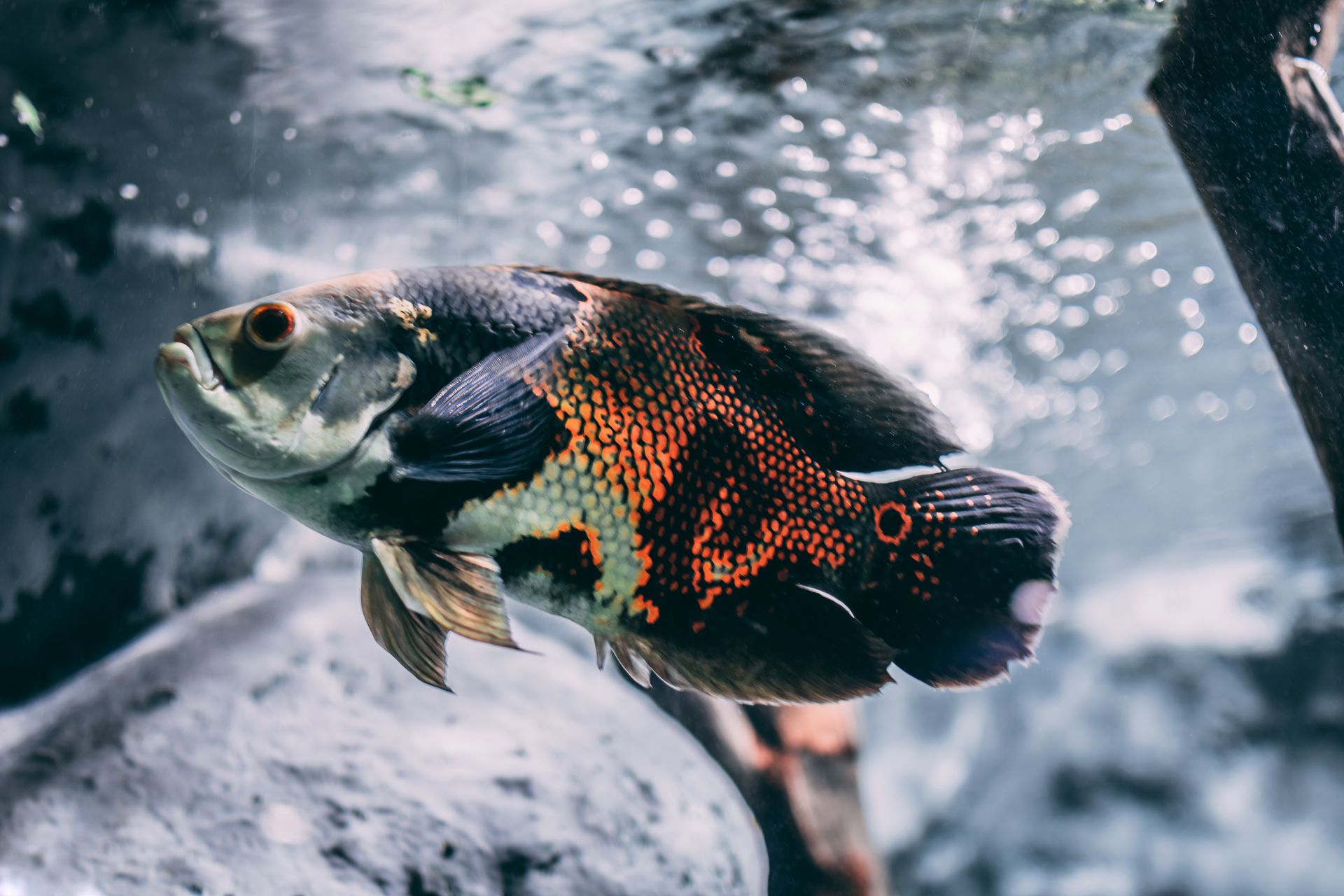
The Cichlidae family is a diverse and fascinating group of fish. With over 1,600 species, they can be found in a wide range of habitats, from shallow lakes to deep-sea environments.
One of the most distinctive features of cichlids is their complex social behavior. They are known to form long-term monogamous relationships, with some species even displaying parental care.
Cichlids have evolved a range of unique physical adaptations to suit their environment. Some species have developed elaborate finnage, while others have evolved to have armor-plated bodies.
These remarkable fish are also incredibly intelligent, with some species even displaying problem-solving abilities.
Discover more: Fish Lake Malawi
Anatomy and Appearance
Cichlids come in a wide range of body sizes, from as small as 2.5 cm (1 in) in length to much larger species approaching 1 m (3 ft) in length.
The smallest cichlid species, such as the Neolamprologus multifasciatus, are barely larger than a grain of rice. In contrast, larger species like Boulengerochromis and Cichla can grow to be quite massive.
Generally, however, cichlids tend to be of medium size, ovate in shape, and slightly laterally compressed.
Internal Anatomy

Cichlids have a unique internal anatomy that allows them to process food efficiently. This is due to the fusion of the lower pharyngeal bones into a single tooth-bearing structure.
This fusion enables cichlids to use their upper and lower pharyngeal bones as a second set of jaws, dividing labor between their true jaws (mandibles) and pharyngeal jaws.
The complex set of muscles in cichlids allows for this division of labor, making them highly specialized feeders that can capture and process a wide variety of food items.
Highlights
Cichlid visual sensitivities vary greatly depending on several factors, including their cornea and lens transmission, photoreceptor densities, and photoreceptor sensitivities.
These variations are closely linked to the different ecological environments that cichlids inhabit, including their foraging and light environments.
Cichlids are a great example of how studying their visual system can help us understand the underlying causes of their unique characteristics.
Here are some key factors that contribute to the differences in cichlid visual sensitivities:
- Chromophore changes
- Opsin gene sequence changes
- Opsin gene expression changes
- Opsin gene loss
Taxonomy and Classification
The taxonomy of cichlids has varied depending on the author, with some recognizing eight subfamilies and others recognizing more.
Cichlid taxonomy is still debated, and classification of genera cannot yet be definitively given. A comprehensive system of assigning species to monophyletic genera is still lacking, and there is not complete agreement on what genera should be recognized in this family.
The Catalog of Fishes (2025) recognizes the Family Cichlidae as a single unit, but the subfamilies within it are still a matter of debate.
Phylogeny derived from morphological characters shows differences at the genus level with phylogeny based on genetic loci. A consensus remains that the Cichlidae as a family are monophyletic.
Here's a simplified breakdown of the classification hierarchy for cichlids:
- Kingdom: Animalia
- Phylum: Chordata
- Subphylum: Vertebrata
- Class: Actinopterygii
- Order: Perciformes
- Family: Cichlidae
Note that the classification of cichlids is still evolving, and new research may lead to changes in the hierarchy.
Evolution and History
Cichlids have a fascinating evolutionary history that spans millions of years. The modern cichlids have a disjunct distribution, meaning they can be found in Africa, the Neotropics, the Levant, southern Iran, and the southern Indian subcontinent.
The debate about the origin of cichlids is ongoing, with some scientists proposing that they originated from the breakup of Gondwana, while others suggest that they dispersed across oceans. Molecular clock estimates have placed the family's origin in the Late Cretaceous period, making it unlikely that they were present during the breakup of Gondwana.
Cichlids have undergone rapid diversification in various lakes, resulting in species flocks with hundreds of species each. The African Great Lakes, such as Lake Malawi and Lake Victoria, are home to the most diverse radiation of cichlids.
The isolation of these lakes, combined with the plasticity of the cichlid body plan, has led to the evolution of unique species. The pharyngeal jaw, a second set of teeth in the throat, has allowed for impressive specialization of teeth in the outer jaws.
Here are the five major lineages of cichlids, as identified by recent molecular phylogenetic studies:
- Heroines
- Cichlasomines
- Crenicichlines
- Geophagines
- Chaetobranchines
The fossil record of cichlids begins in the Eocene, with fossil cichlids found in both South America and Africa. This suggests that the divergence between Old and New World cichlids occurred prior to the Eocene.
Rapid diversification within enclosed ecosystems is a longstanding trait of cichlids, with fossil sites representing former maars or rift lakes showing species flocks similar to those in modern African rift lakes.
Distribution and Habitat
Cichlids are one of the largest vertebrate families in the world, with an estimated 1,600 species found in Africa alone.
Africa is home to the highest diversity of cichlids, with species found in various habitats, including lakes, rivers, and swamps. Madagascar has its own unique species, which are only distantly related to those found on the African mainland.
Cichlids can be found in a variety of habitats, including shallow and deep waters. The deepest known occurrence of cichlids is in Lake Tanganyika, where Trematocara has been found at depths of over 300 meters.
Some species of cichlids, such as Mayaheros urophthalmus, can tolerate brackish water and are found in mangrove swamps and saltwater environments. However, only a few species of cichlids are primarily found in brackish or saltwater habitats.
Here are some of the habitats where cichlids can be found:
- Lakes and ponds
- Rivers and streams
- Coastal areas
- Brackish water
Cichlids have a remarkable degree of specialization, with each species exploiting its environment in its own way. They can be found in almost every possible body of freshwater within their geographic range, including rivers, lakes, swamps, and even ditches and puddles.
Cichlids are typically found in freshwater habitats, but some species can tolerate brackish water and are found in coastal areas. In fact, some species of cichlids are found in areas with high salinity levels, such as the Salton Sea in California.
Behavior and Reproduction
Cichlids are known for their complex behaviors, which play a crucial role in their reproduction and social interactions. They exhibit a range of behaviors, including territoriality, aggression, and parental care.
Territorial behavior is a common trait among cichlids, with males defending their territories against other males and females. In some species, males will even maintain feeding territories, which are often better defined than breeding territories.
Cichlids also display aggressive behavior, particularly during mating season. Males will use ritualized displays, such as color changes and lateral lines, to evaluate competitors and establish dominance.
In terms of reproduction, cichlids can mate either monogamously or polygamously. Some species, like the Haplochromini tribe, exhibit unique patterns of oval-shaped color dots on their anal fins, known as egg spots, which aid in the fertilization process.
Here are some key behaviors associated with cichlids:
- Natatorial
- Diurnal
- Nocturnal
- Parasite
- Motile
- Nomadic
- Territorial
- Social
- Colonial
- Dominance hierarchies
Pit spawning, a behavior in which a fish builds a pit in the sand or ground, is another reproductive behavior exhibited by cichlids. This behavior is associated with parental care, food provisioning, and brood guarding.
Behavior
Cichlids display numerous complex behaviors in feeding, reproduction, and parental care. These behaviors are crucial for their survival and success in various aquatic environments.
One fascinating aspect of cichlid behavior is their territoriality. Many species establish feeding territories, which are often better defined than breeding territories. In some cases, feeding territories overlap between different species, while in others, they are fiercely defended by a single dominant individual.
Cichlids also exhibit a range of feeding behaviors, from carnivory to herbivory. Some species are specialized to eat specific food sources, such as algae or mollusks, while others are generalists that catch a variety of small animals.
Some cichlids are known to be aggressive, using displays of ritualized aggression to seek confrontation and evaluate competitors. This aggression is often linked to mating and territoriality, with dominant males displaying bright coloration and engaging in physical displays to drive out subordinate males.
In addition to their complex social behaviors, cichlids also exhibit a range of parental care strategies. Some species, such as the daffodil cichlid (Neolamprologus pulcher), have cooperative breeding systems where multiple helpers assist the breeding pair in raising their young.
Recommended read: Full Grown Green Terror Cichlid
Here are some key behaviors exhibited by cichlids:
- Natatorial: swimming in a specific pattern or direction
- Diurnal: active during the day
- Nocturnal: active at night
- Parasite: feeding on the body of another animal
- Motile: able to move or swim
- Nomadic: moving from place to place in search of food or shelter
- Territorial: defending a specific area from other individuals
- Social: interacting with other members of their species
- Colonial: living in a group or colony
- Dominance hierarchies: establishing a social ranking system
These complex behaviors are a testament to the adaptability and diversity of cichlids, allowing them to thrive in a wide range of aquatic environments.
Mating
Cichlids exhibit a range of mating behaviors, from monogamy to polygamy. The mating system of a given cichlid species is not consistently associated with its brooding system.
Some cichlids, such as Chromidotilapia, Gymnogeophagus, Spathodus, and Tanganicodus, are monogamous mouthbrooders. Others, like Apistogramma, Lamprologus, Nannacara, and Pelvicachromis species, are polygamous and engage in open- or cave-spawning.
Male cichlids in the tribe Haplochromini often display unique oval-shaped color dots on their anal fins, known as egg spots. These egg spots aid in the mouthbrooding mechanisms of cichlids and help initiate the fertilization process.
The genuine color of egg spots is typically a yellow, red, or orange inner circle with a colorless ring surrounding the shape. This coloration is thought to have evolved in the common ancestor of the Astatoreochromis lineage and the modern Haplochrominis species.
Two pigmentation genes, fhl2-a and fhl2-b, are associated with egg-spot patterning and color arrangement. These genes are paralogs and aid in pattern formation and cell-fate determination in early embryonic development.
Here's a breakdown of the different types of mating behaviors in cichlids:
These different mating behaviors play a crucial role in the reproductive success of cichlids and have evolved over time to suit their specific environments and ecological niches.
Aquarium and Breeding
Aquarium fish have become increasingly popular since 1945, with the Pterophyllum scalare, also known as the "angelfish", being the most common species in hobbyist aquaria.
The popularity of aquarium fish is evident in the variety of species available, including the oscar, convict cichlid, and discus fish.
Many cichlids have been selectively bred to develop ornamental aquarium strains, with angelfish and discus being the most intensive programs.
Some notable hybrids include the blood parrot cichlid, which is a cross of several species, and the flowerhorn cichlid, which was popular in some parts of Asia until its popularity declined in 2004.
The selective breeding of cichlids has led to numerous mutations, including albino, leucistic, and xanthistic pigment mutations in oscars, convict cichlids, and Pelvicachromis pulcher.
This selective breeding has also led to unintended consequences, such as health and fertility problems in hybrid strains of Mikrogeophagus ramirezi and physical abnormalities in angelfish due to intentional inbreeding.
Aquarium Hybrids
The most common aquarium hybrid is the blood parrot cichlid, a cross of several species, especially from the genus Amphilophus. It's a bit of a controversy among aquarists due to its unusual appearance.
This hybrid has a triangular-shaped mouth, an abnormal spine, and an occasionally missing caudal fin, earning it the nickname "love heart" parrot cichlid. Some people have compared it to the "Frankenstein monster of the fish world".
The blood parrot cichlid is a cross between Amphilophus labiatus and Vieja synspillus. The flowerhorn cichlid is another notable hybrid that was very popular in some parts of Asia from 2001 until late 2003, and is believed to bring good luck to its owner.
For more insights, see: Amphilophus Citrinellus
However, the popularity of the flowerhorn cichlid declined in 2004, and owners released many specimens into the rivers and canals of Malaysia and Singapore, where they threaten endemic communities.
Some cichlids have been selectively bred to develop ornamental aquarium strains, with the most intensive programs involving angelfish and discus. Many mutations that affect both coloration and fins are known.
In convict cichlids, for example, a leucistic coloration is recessively inherited, while in Oreochromis niloticus niloticus, red coloration is caused by a dominant inherited mutation.
Methods
To set up a thriving aquarium and breeding program, you'll need to consider several methods.
One key method is to create a suitable environment for the fish, which involves maintaining stable water parameters such as pH, temperature, and water hardness.
A well-designed aquarium with adequate filtration and aeration is essential for the health and well-being of the fish.
Regular water changes are crucial to prevent the buildup of toxins and maintain optimal water quality.
Monitoring water parameters and making adjustments as necessary will help prevent water quality issues.
Conservation Status
The conservation status of cichlids is a pressing concern. Many cichlid species are endemic to small geographic areas, making them vulnerable to threats.
The introduction of Nile perch in Lake Victoria has led to the largest mass extinction of endemic species in recent times, with 43 cichlids extinct, five extinct in the wild, 37 species critically endangered, 11 species endangered, 34 species vulnerable, and one species at low risk.
Overfishing by local fishers in Lake Malawi and water pollution from agricultural runoff are also significant threats to cichlids. In 2010, the International Union for Conservation of Nature classified 184 cichlids as vulnerable, 52 as endangered, and 106 as critically endangered.
About two-thirds of endemic cichlids have become endangered or extinct, with many species not seen since the 1980s, such as Haplochromis aelocephalus, H. apogonoides, H. dentex, and H. dichrourus.
Genetics and Research
Cichlids are being used as a genetic model to understand the mechanisms controlling opsin expression. This involves identifying key regulatory elements and transcription factors that regulate the opsins, similar to studies in zebrafish and medaka.
Genetic crosses and quantitative trait loci (QTL) studies have been used to identify several QTL and underlying transcription factors that regulate opsin expression in cichlids. This research aims to define the key genes and how they form a switchable opsin gene regulatory network.
The origin of the East African Rift (EAR) has been estimated to be around 28.71 Ma, during the Late Eocene/Early Oligocene.
Phylogenetic Analysis and Divergence Time Estimate
The family Cichlidae is comprised of ~2000 species distributed across the world in a Gondwanan distribution.
Cichlids are a diverse group of fish, with estimates suggesting that the divergence between New and Old World cichlids occurred around ~95mya.
This divergence is significant, as it means that cichlids are approximately 230 MY divergent from zebrafish but are closer to medaka, being only 120 MY divergent.
Cichlids and medaka display a lot of chromosomal synteny, including having similar homologs for all opsin genes except for a duplicate LWS opsin in medaka that is missing in cichlids.
Our research estimates the origin of the EAR to Late Eocene/Early Oligocene (28.71 Ma; 95% HPD: 24.43–33.15 Ma).
The divergence ages of the most recent common ancestor (MRCA) of several Tanganyika cichlid tribes were estimated to be substantially older than the oldest estimated maximum age of the Lake Tanganyika.
The Trematocarini tribe, for example, has a divergence age of 16.13 Ma (95% HPD: 11.89–20.46 Ma), while the Lamprologini tribe has a divergence age of 15.27 Ma (95% HPD: 12.23–18.49 Ma).
We also recovered a novel lineage within the Lamprologini tribe, which encompasses only Lamprologus of the lower and central Congo drainage with its divergence estimated to the Late Miocene or early Pliocene.
Cichlids as a Genetic Model
Cichlids have emerged as a valuable genetic model for studying the genetic mechanisms that control opsin expression.
Using genetic crosses and quantitative trait loci (QTL) studies, researchers have identified several QTL and underlying transcription factors that regulate opsin expression in cichlids.
This complements work in zebrafish and medaka, which have identified key regulatory elements controlling opsin expression.
The ultimate goal is to define the key genes and how they form a switchable opsin gene regulatory network.
This would provide insights into how opsin expression changes through development within a species.
By studying cichlids, researchers can gain a better understanding of the genetic mechanisms that underlie the evolution of visual sensitivities in this group of fish.
Changes in opsin amino acid (AA) sequence can shift visual pigment absorbance, resulting in visual pigments that are better matched to the local light environment.
Species moving from rivers into clearer lakes have acquired changes that blue shift their RH1 opsins.
Deep living species in clear Malawi and Tanganyika have evolved RH1 and RH2 genes that match the blue shifted waters at depth.
Opsin sequence changes have been found for cichlids differing in depth or water turbidity.
In murky Lake Victoria, opsins sequence changes shift visual pigments to longer wavelength with depth.
Featured Images: pexels.com