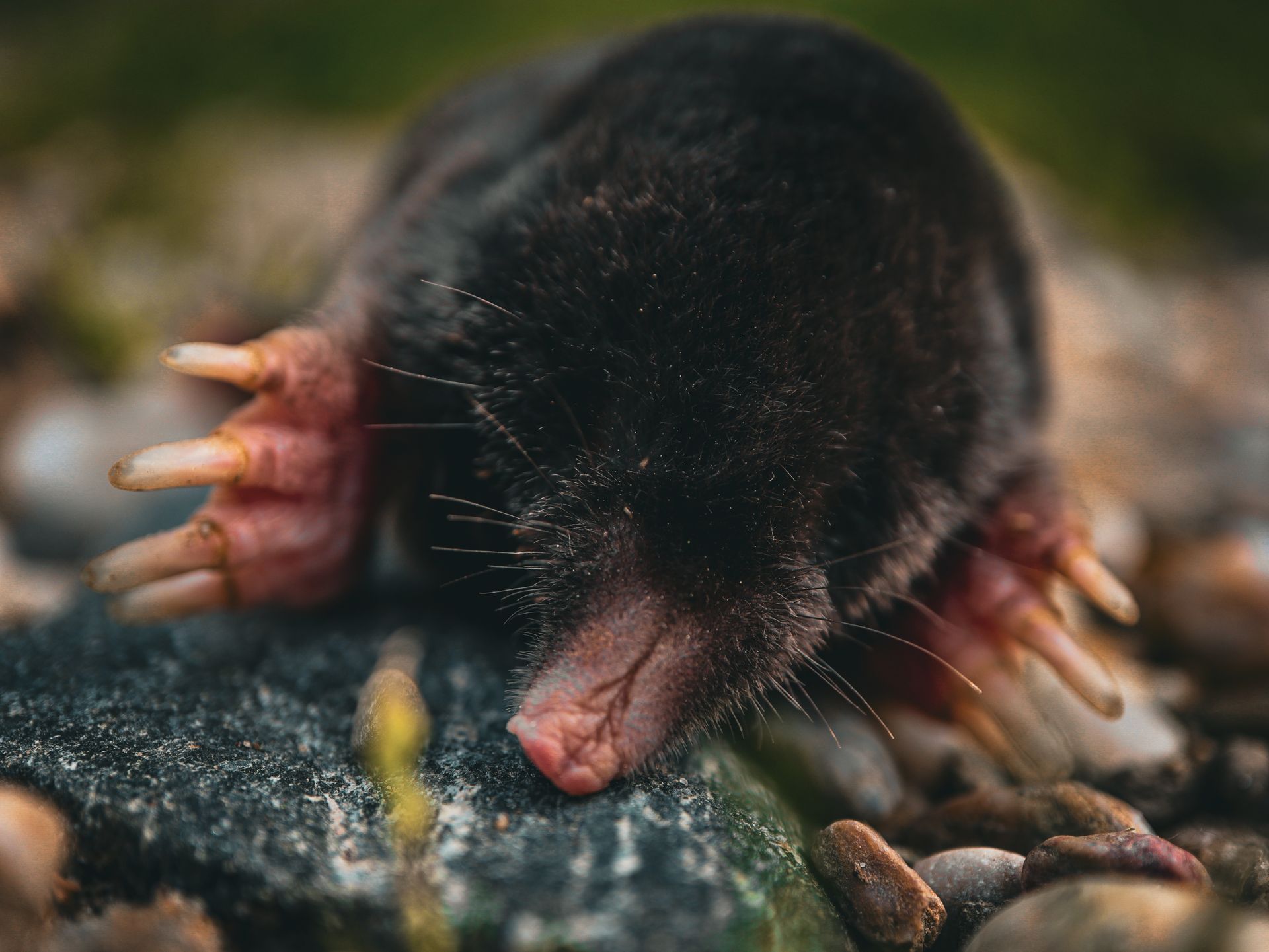
The Chrysospalax trevelyani is a fascinating species.
It is a burrowing mammal, specifically a golden mole, native to South Africa.
Found in a variety of habitats, including grasslands and rocky outcrops, this species is well adapted to its underground lifestyle.
Their unique, spade-like hands and powerful claws allow them to dig complex burrow systems with ease.
Physical Description
The giant golden mole, Chrysospalax trevelyani, is a remarkable creature with some fascinating physical characteristics. Its subterranean lifestyle is made possible by its powerful forelimbs, large claws, and wedge-shaped head.
Its skin is dark and brown on the upper parts, with a darker line down the mid-thorax, and faded on the underparts. The head is slightly darker, with two dull yellow patches where the eyes would be, and a yellow patch around the ear openings.
The giant golden mole has a unique coat of hair that is longer and coarser than any other species of golden mole. This hair is about 20 millimeters long, thick, and has a dense, woolly underfur.

Here are some key physical features of the giant golden mole:
- Length: 208-235 millimeters (8.2-9.3 in)
- Weight: 410-500 grams (14-18 oz)
- Claw length: 17 millimeters (0.67 in)
- Claw width: 7 millimeters (0.28 in)
Its fur is reddish-brown, but can range from black to pale yellow, with an iridescent sheen of coppery gold, purple, green, or bronze. This unique coat helps the mole to move through the soil with ease, and also gives it a striking appearance.
Biology and Behavior
The giant golden mole is a fascinating creature, and understanding its biology and behavior can give us a glimpse into its unique lifestyle. It spends most of its time underground, which is likely due to the fact that it is blind and deaf.
This nocturnal creature is solitary, meaning it doesn't form groups, but it does exhibit some social behavior, such as hibernating in others' burrows among the roots of trees in winter. Female giant golden moles give birth to one or two offspring at a time, and they have a stockpile of food to sustain themselves.

The mating system of giant golden moles is polygynous, meaning males mate with multiple females. Males engage in a courtship ritual, making chirruping sounds, bobbing their heads, and stomping their feet to attract females, who respond with rasping and squealing noises.
- Key Reproductive Features:
- iteroparous
- year-round breeding
- gonochoric/gonochoristic/dioecious (sexes separate)
- sexual
- viviparous
Females nurse and care for their young until they are weaned, but little is known about the kinds of parental care provided before independence in giant golden moles.
Biology
The giant golden mole is a fascinating creature that spends most of its time underground. It's nocturnal, meaning it's active at night, but it also hunts during cool and cloudy daytime conditions.
These moles are blind and deaf, which makes you wonder how they navigate their underground world. But despite their limitations, they're skilled hunters.
Female giant golden moles give birth to one or two offspring at a time, and they have a stockpile of food to sustain themselves while they care for their young. This is likely a result of their solitary lifestyle, where they don't form groups like some other animals.

Here are some key facts about the biology of giant golden moles:
The giant golden mole's solitary lifestyle means they don't form groups like some other animals. However, they do exhibit some social behavior, such as hibernating in others' burrows among the roots of trees in winter.
Communication and Perception
Golden moles are unique creatures, and their communication and perception abilities are no exception. They likely rely heavily on their senses of smell, touch, and hearing to understand their environment.
Their eyes are covered with a layer of skin, which suggests they don't rely on vision to navigate. It's likely they use their other senses to detect vibrations, chemical cues, and sounds around them.
Golden moles can communicate through various channels, including tactile, acoustic, and chemical means. This is likely essential for them to convey information and coordinate with each other.
Here are the different channels through which golden moles perceive and communicate:
- Perception Channels: tactile, acoustic, vibrations, chemical
- Communication Channels: tactile, acoustic, chemical
Fortunately, there are no known adverse effects of giant golden moles on humans.
Habitat and Distribution
The giant golden mole, Chrysospalax trevelyani, has a very specific habitat. It's found in forests with soft soil, deep leaf litter layers, and well-developed undergrowth.
These forests are typically located in the Eastern Cape of South Africa, where the soil is suitable for the mole's subterranean lifestyle. The mole's habitat is also characterized by a lack of rocky terrain and steep slopes.
In fact, giant golden moles are absent from commercial forest plantations in the region, which suggests that these areas may not provide the right conditions for the mole's survival. The mole's preference for soft soils and deep litter layers is likely due to its burrowing behavior.
Here are some key facts about the habitat and distribution of the giant golden mole:
- Habitat Regions: temperate, terrestrial
- Terrestrial Biomes: forest
- Biogeographic Regions: Ethiopian
The mole is active during the night, which is likely an adaptation to its subterranean lifestyle. Its geographic range is restricted to the forests of the eastern Cape of South Africa, where it can be found in large patches of coastal or Afromontane forests.
Conservation Status
The giant golden mole, also known as Chrysospalax trevelyani, is a species that's in trouble. It's classified as Endangered (EN) on the IUCN Red List of Threatened Species.
Habitat loss is a major concern, mainly due to human activities like firewood collection, bark stripping, and overgrazing of livestock. This has led to a decrease in the population.
Chrysospalax trevelyani is also preyed upon by domestic dogs. This is a significant threat to the species' survival.
The conservation status of Chrysospalax trevelyani is a pressing issue. Research is needed to protect this species and assess the status and viability of the remaining populations.
Here are some key threats to Chrysospalax trevelyani's conservation status:
- Habitat loss due to human activities
- Preyed upon by domestic dogs
Conservation efforts are necessary to protect this species and its habitat. By understanding the threats and taking action, we can work towards preserving the giant golden mole for future generations.
Classification
Classification is a crucial aspect of understanding the biology of the Chrysospalax trevelyani, also known as the giant golden mole.
The Chrysospalax trevelyani belongs to the kingdom Animalia, which is home to a vast array of animals, with over 22861 pictures available online.
In the phylum Chordata, we find the Chrysospalax trevelyani, a group that includes chordates with 15213 pictures available online.
Vertebrates, a subphylum of Chordata, are characterized by the presence of a backbone, and the Chrysospalax trevelyani is no exception, with 15168 pictures available online.
The Chrysospalax trevelyani is classified under the class Mammalia, which includes mammals with 4389 pictures available online.
The order Afrosoricida, which includes the Chrysospalax trevelyani, is a group of mammals that includes tenrecs and golden moles, with 20 pictures available online.
The family Chrysochloridae, to which the Chrysospalax trevelyani belongs, is a group of golden moles with 5 pictures available online.
Here's a breakdown of the classification of the Chrysospalax trevelyani:
- Kingdom: Animalia
- Phylum: Chordata
- Subphylum: Vertebrata
- Class: Mammalia
- Order: Afrosoricida
- Family: Chrysochloridae
- Genus: Chrysospalax
- Species: Chrysospalax trevelyani
Frequently Asked Questions
What is the biggest mole ever recorded?
The largest mole ever recorded is the giant golden mole, found in South Africa, which measures 20-24 cm in length. This massive mole is a forest dweller that digs burrows but also ventures out to forage and travel on the surface.
Do golden moles eat termites?
Yes, golden moles eat termites as part of their insect-based diet. Termites are one of the many insects that golden moles feed on underground.
Featured Images: pexels.com